The Ultimate Guide to Scoring the Best Local Backlinks

The Ultimate Guide to Scoring the Best Local Backlinks
Why Local Backlinks Are the Missing Piece in Your Local SEO Strategy
How to build local backlinks is one of the most important skills any small business owner can develop — and one of the most misunderstood.
Here's a quick answer if you need it fast:
How to Build Local Backlinks (Quick Overview)
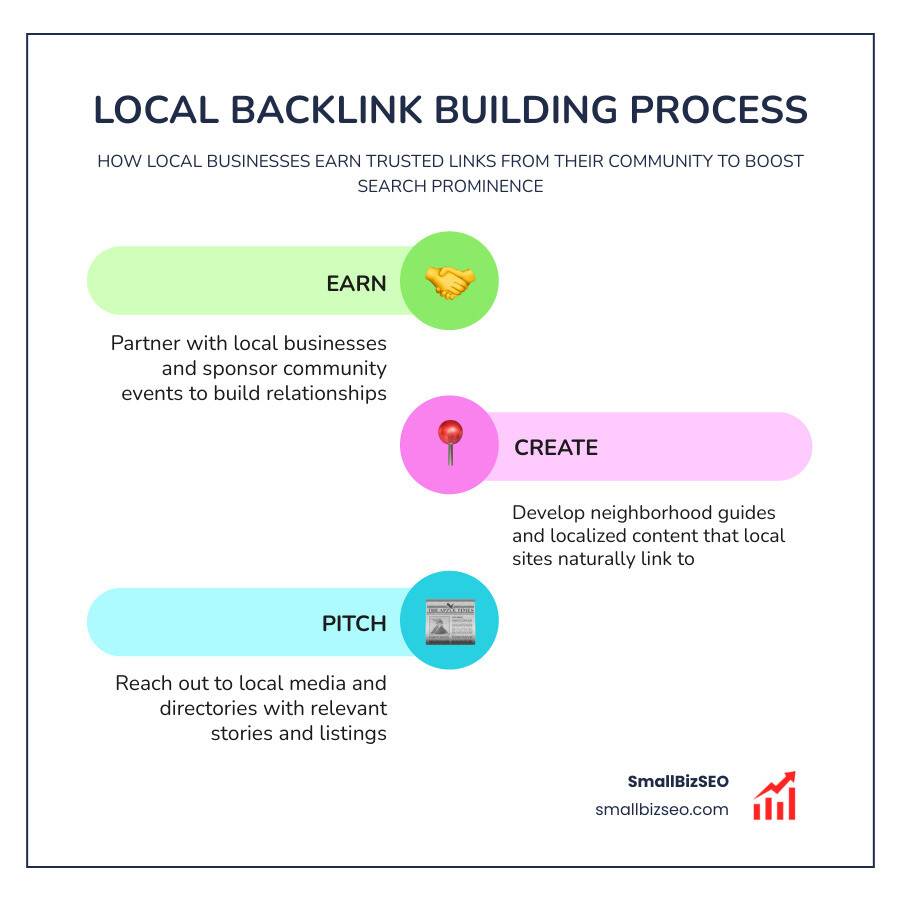
- Partner with local businesses — cross-promote and link to each other's sites
- Sponsor local events, charities, or sports teams — earn links from their sponsor pages
- Get listed in local directories — Chamber of Commerce, BBB, city directories
- Create localized content — neighborhood guides, local data, free tools
- Pitch local media — get featured in local news, blogs, and roundups
- Analyze competitors' backlinks — find who links to them and reach out too
- Build relationships with local influencers — earn mentions and links organically
Now, why does this matter so much?
Google ranks local businesses based on three things: relevance, distance, and prominence. The first two are relatively easy to influence. Prominence — how well-known and trusted your business appears — is the hard one. And backlinks are one of the biggest ways to move it.
Link signals are among the top ranking factors for local organic results. Yet most small businesses either ignore link building entirely or do it wrong — chasing random directory submissions instead of earning links that actually signal local trust.
The gap between businesses that rank and businesses that don't often comes down to backlinks. Not hundreds of them. Just the right ones.
I'm Clayton Johnson, a digital PR and SEO specialist who has spent years building local backlink strategies that drive real search visibility — and I'll walk you through exactly how to build local backlinks that move the needle for your business. Let's get into it.
What Are Local SEO Backlinks and Why Do They Matter?
A local SEO backlink is any link pointing to your website from another site that has geographic relevance to your operational area. Unlike standard link building, where the sole focus is often on massive Domain Authority (DA) metrics, local link building prioritizes geographic proximity and community relevance.
These links play a vital role in how search engines calculate prominence. When local news sites, neighborhood blogs, and regional directories link to you, they serve as digital votes of confidence. They tell search engines that your business is a real, trusted participant in the local economy.
For a deeper dive into growing your regional presence, check out our comprehensive guide to local marketing.
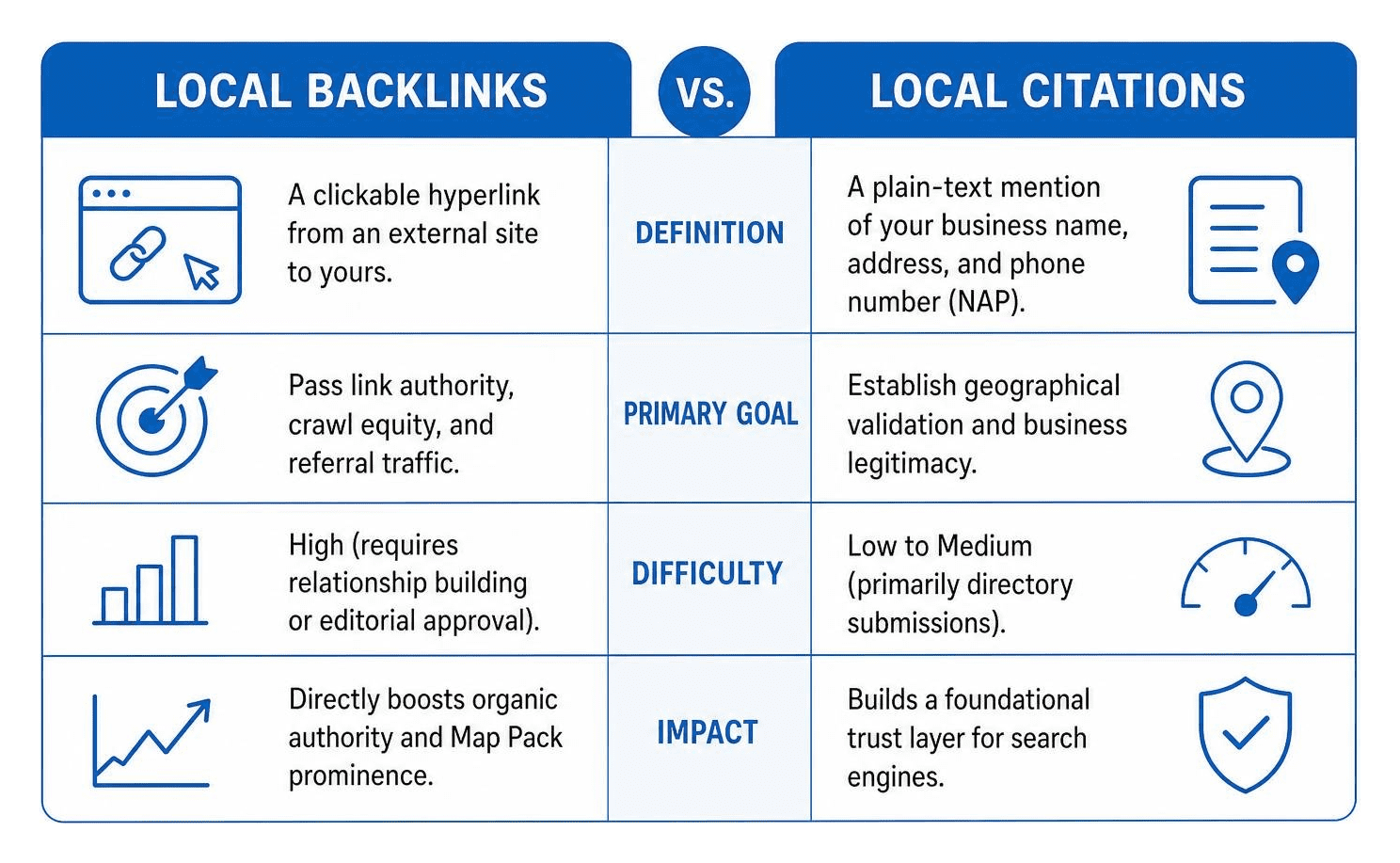
Understanding the difference between backlinks and citations is crucial for a balanced strategy:
| Feature | Local Backlinks | Local Citations |
|---|---|---|
| Definition | A clickable hyperlink from an external site to yours. | A plain-text mention of your business name, address, and phone number (NAP). |
| Primary Goal | Pass link authority, crawl equity, and referral traffic. | Establish geographical validation and business legitimacy. |
| Difficulty | High (requires relationship building or editorial approval). | Low to Medium (primarily directory submissions). |
| Impact | Directly boosts organic authority and Map Pack prominence. | Builds a foundational trust layer for search engines. |
Local Backlinks vs. Traditional Backlinks
Traditional link building focuses heavily on getting links from high-DA sites, regardless of where those businesses are based. In contrast, local link building values geographic relevance over raw domain metrics.
A link from a neighborhood association or a regional business group might only have a DA of 15, but to search engines, that link is incredibly valuable because it establishes your physical connection to the community. Additionally, these hyper-local links drive highly targeted referral traffic — actual residents who are far more likely to convert into paying customers.
The Impact of Local Backlinks on Map Pack Rankings
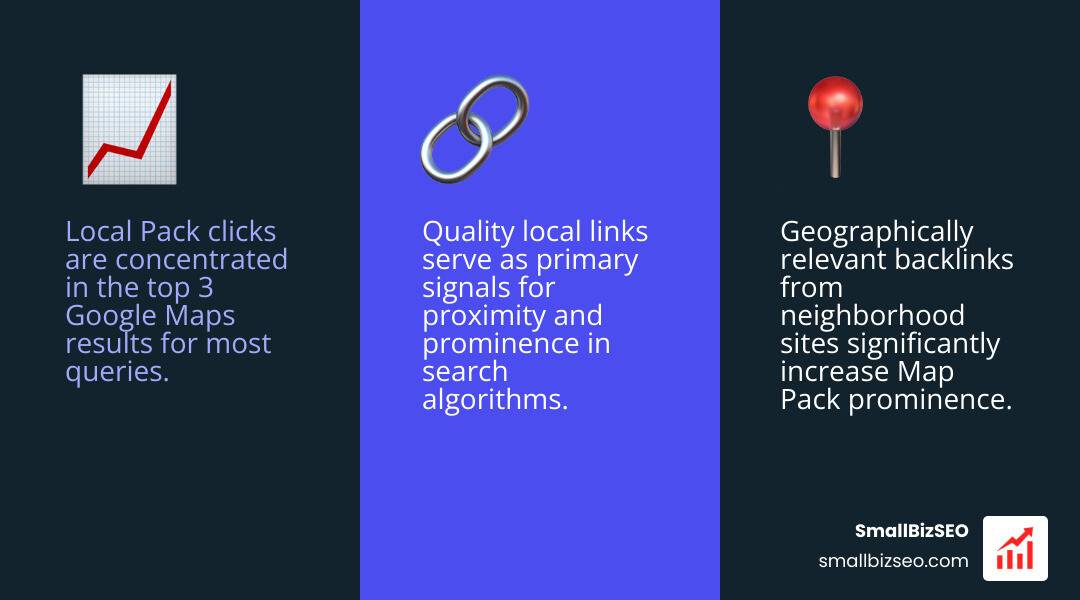
Earning a spot in the coveted Google Maps Local Pack (the top three Google Maps results displayed for local searches) is the ultimate goal for nearby businesses. Research shows that a significant portion of all local search clicks go directly to these top three Map Pack spots.
Because prominence is a core pillar of local search algorithms, quality local links act as a primary driver for Map Pack visibility. By building a steady stream of geographically relevant links, you show search engines that your business is highly prominent in your service area.
How to Build Local Backlinks: The Core Strategies
Building a strong local link profile does not require thousands of links. In most mid-sized markets, acquiring a handful of high-quality, geographically relevant links is enough to outrank your competitors. The key is focusing on authentic community relationships rather than transactional shortcuts.
For a visual breakdown of how these strategies work in real-time, watch this video on How to Build Local Backlinks That Actually Increase Local Rankings.

1. Partner with Local Businesses and Organizations
One of the easiest ways to earn high-quality links is by looking at the business relationships you already have. Think about your suppliers, vendors, and non-competing businesses that serve the same target audience.
- Vendor Testimonials: Reach out to the local companies you buy supplies or services from. Offer to write a detailed, positive testimonial for their website in exchange for a link back to your business. Most business owners will gladly publish a glowing review that links to a partner.
- Cross-Promotions: Partner with complementary businesses for joint promotions. For example, a local wedding photographer and a local florist can easily feature each other on their respective websites as trusted partners, creating natural, contextual links.
- Local Business Alliances: Join regional business groups or networking circles. These organizations often maintain member directories that provide clean, authoritative backlinks to all participants.
2. Sponsor Local Events, Charities, and Sports Teams
Sponsorships are a win-win strategy. They allow you to support your community while earning powerful, authoritative links from trusted local organizations.
- Youth Sports Leagues: Sponsoring a local Little League, soccer club, or youth basketball team is highly cost-effective. These leagues almost always feature a "Sponsors" page on their websites where they link to their contributors.
- Charities and Nonprofits: Partner with nearby charities by donating your services or financial support. Local nonprofits often have established domains with high authority, making their partner links incredibly valuable.
- Community Events: Look for neighborhood festivals, charity runs, or business expos. These events rely on local sponsors and will list your business name, logo, and website link on their event calendars and registration pages.
3. Leverage Local Directories and Citations
Before diving into advanced outreach, you must establish a strong foundation of local citations. A citation is any online mention of your Name, Address, and Phone number (known as your NAP data).
Consistency is critical here. If your business name is spelled differently or has outdated phone numbers across various directories, search engines may struggle to verify your physical location. Start by claiming your profiles on major platforms like Google Business Profile, Bing Places, Apple Maps, and Yelp.
Once your core profiles are optimized, target regional and industry-specific directories. Joining your local Chamber of Commerce or Better Business Bureau (BBB) provides highly trusted links that signal immediate authority to search engines.
For a complete walkthrough on setting up your foundational listings, check out our Local SEO Guide.
Advanced Tactics and Content Strategies for Hyperlocal Links
Once your foundational links are in place, you can scale your efforts by creating link-worthy assets and leveraging digital PR.
To avoid the common errors that hold most businesses back, take a look at this guide on why 99% of SEOs Build Backlinks WRONG (Do THIS Instead).

Creating Localized Content: How to Build Local Backlinks Naturally
The most sustainable way to build links is by creating content that local websites naturally want to link to. Instead of writing generic blog posts, focus on hyper-local resources:
- Local Data and Surveys: Conduct a simple survey about regional trends or preferences in your industry. Local journalists and bloggers love citing original, regional data.
- Neighborhood Guides: Write comprehensive guides to your community. Whether it is a list of the best parks, historical landmarks, or a seasonal event calendar, these resources naturally attract links from travel blogs, neighborhood associations, and relocation websites.
- Free Tools and Calculators: Develop a simple interactive tool tailored to nearby needs, such as a localized cost estimator or climate-specific maintenance calculator. These practical assets earn passive links over time as residents share them.
Competitor Analysis: How to Build Local Backlinks Your Rivals Already Have
You do not have to reinvent the wheel. Your top-ranking competitors have already laid out a roadmap of the links search engines value in your market.
By conducting a competitor backlink analysis, you can identify their referring domains and find the exact sources of their authority. Use tools like Semrush or Ahrefs to run a link intersect analysis. This highlights websites that link to multiple competitors but not to you. Reach out to these sources — whether they are local resource pages, directories, or blogs — and pitch your business for inclusion.
To see how professional analysis can accelerate this process, read our SEO Services Guide.
Common Pitfalls to Avoid in Local Link Building
While building links is essential, engaging in manipulative tactics can quickly destroy your search rankings. Avoid these common mistakes to keep your website safe:
- Buying Links: Purchasing links from spammy websites violates search engine guidelines and can lead to severe ranking penalties.
- Private Blog Networks (PBNs): Using networks of fake websites created solely to pass link authority is a risky strategy that search engines easily detect.
- Over-Optimized Anchor Text: Avoid using exact-match keywords (like "best plumber near me") as your link text too frequently. Keep your anchor text natural, utilizing your brand name or descriptive phrases.
- Ignoring Link Quality: Chasing a high quantity of low-quality, irrelevant links will yield far worse results than securing a few highly relevant local links.
To make sure your strategy remains on track, review these 5 Local SEO Mistakes Killing Your Visibility.

Frequently Asked Questions about Local Backlinks
How many local backlinks does my business need to rank?
There is no single number that guarantees a top ranking. It depends entirely on your market competition and industry. In many mid-sized areas, securing 15 to 25 high-quality local links is enough to significantly improve your Map Pack rankings. Focus on steady, natural link growth rather than trying to build dozens of links in a single week.
Are nofollow links from local sites valuable?
Yes. While follow links pass direct search authority, nofollow links still hold significant value. They act as crawl signals for search engines, help diversify your link profile, and drive highly targeted referral traffic to your website. If a local neighborhood association links to you with a nofollow tag, it is still an incredibly valuable link for your business.
How long does it take to see results from local link building?
Most businesses begin to see noticeable ranking shifts within 4 to 8 weeks after their new local links are indexed. However, local SEO is a compounding process. The true benefits of your link-building efforts will continue to grow over several months as search engines crawl and recognize your sustained community authority.
Conclusion
Building a strong profile of local backlinks is one of the most effective ways to establish your business as a prominent, trusted leader in your community. By focusing on authentic relationships, local sponsorships, and high-quality localized content, you can build a sustainable off-page strategy that outranks the competition.
At SmallBizSEO, we help small businesses accelerate this process through our data-driven "Velocity" framework. We combine technical SEO, content strategy, and transparent, E-E-A-T-compliant link-building services to deliver fast, sustainable organic growth.
Ready to take your search visibility to the next level? Explore our professional link-building services or read our comprehensive Local SEO Guide to start dominating your local market today.