SEO for Advertising Agencies: Turn Your Portfolio Into Qualified Inquiries

How Can SEO Help Advertising Agencies Attract Clients?
SEO for advertising agencies captures prospective client demand by turning creative deliverables and campaign results into indexable, intent-driven search landing pages. Rather than relying solely on word of mouth or unindexed portfolio carousels, agencies structure dedicated service pages, vertical sector hubs, and crawlable case studies that align with commercial search queries.
I’m Clayton Johnson, founder of SmallBizSEO. In this guide, I share how advertising agencies can structure their digital portfolios to earn organic search visibility, filter out unqualified inquiries, and connect with brand marketers actively looking to hire specialized agency partners.
What SEO Strategies Help Advertising Agencies Attract Clients?
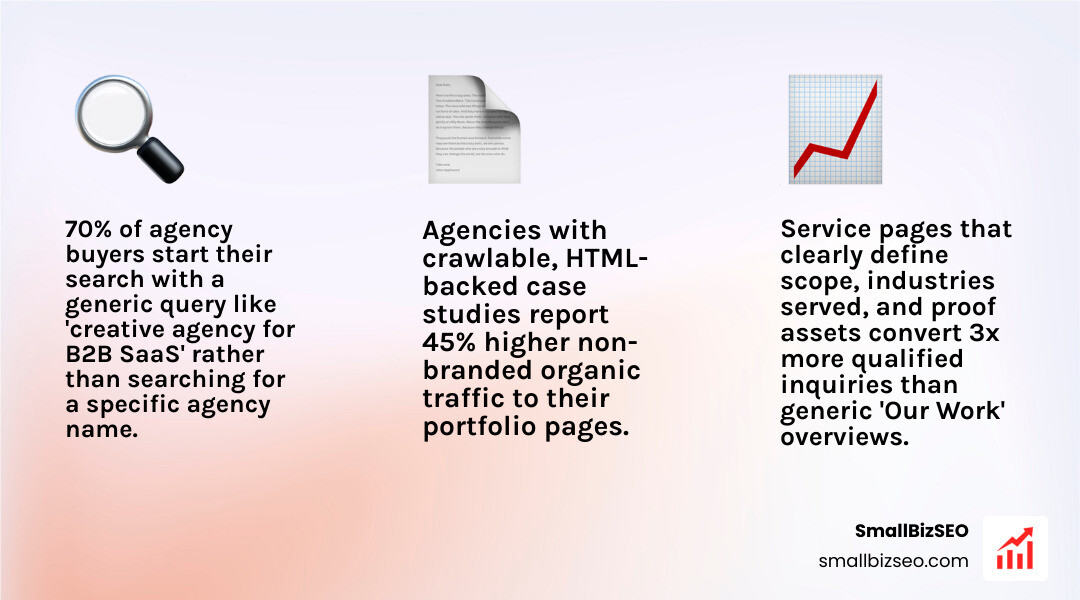
Agencies attract high-intent corporate clients by mapping dedicated URLs to specific commercial search terms, establishing clear topical silos between services and industries, and backing every capability with crawlable HTML proof.
Corporate decision-makers and marketing procurement leads may arrive through agency homepages or specialized searches for defined operational challenges. To capture this commercial intent, agencies should never create landing pages for services they do not provide, nor should they spin duplicate location landing pages containing thin or repetitive copy. Focus organic search development entirely on verified core capabilities.
| Query Type | Actual Service Scope | Suitable Client | Core Proof Requirement | Primary Call to Action |
|---|---|---|---|---|
| B2B Brand Campaign Agency | Multi-channel rebranding, creative concepting, and positioning strategy. | Mid-market and enterprise marketing directors. | Full campaign narratives, sample creative assets, and cross-channel distribution maps. | Request a Brand Discovery Session |
| Retail Media Buying | Programmatic advertising, marketplace ad management, and media planning. | Consumer goods brands and retail marketing teams. | Verified ad spend management scopes, channel distribution records, and attribution models. | Schedule a Media Audit |
| Creative Video Production | Commercial scriptwriting, live-action shooting, motion design, and post-production. | In-house creative leads and brand managers needing commercial assets. | Embeddable video deliverables, behind-the-scenes production scopes, and script-to-screen workflows. | Submit a Production Brief |
| Agency Retainer & Pricing Guides | Transparent engagement models, deliverable cadences, and staffing allocations. | Procurement officers and business leaders budgeting campaign initiatives. | Structured tier comparisons, scope-of-work documentation, and staffing breakdowns. | Download Scope of Work Template |
| Sector-Specific Advertising | Industry-specific campaigns built around the sector's relevant rules, approval processes, terminology, and buyer context. | Organizations seeking an agency with directly relevant sector experience. | Case studies that accurately document sector work, scope limitations, and any applicable approvals or credentials. | Book a Sector Strategy Call |
How Can SEO for Advertising Agencies Turn Showreels Into Search Proof?
Agencies turn visual showreels into search-accessible proof by pairing embedded visual media with descriptive HTML body copy, structured metadata, and proper technical crawl settings.
While search engines can process visual assets and render JavaScript, relying solely on embedded video players or raw image carousels creates indexing ambiguity. Following Google Search Central image SEO best practices, agencies should supply descriptive context in nearby text, compress portfolio media files before publishing to maintain fast page speed, utilize natural, non-stuffed alt attributes, and serve responsive, modern image formats like WebP. Ensure every portfolio entry lives on its own indexable URL. When similar or duplicate versions exist, use a canonical tag to identify the preferred original URL rather than relying on an infinite-scroll lightbox.
How Should Agencies Map Service Pages, Sector Pages, and Case Studies?
Agencies avoid keyword cannibalization by assigning distinct search intents to service pages, vertical sector pages, and individual case studies, connecting them through structured internal links.
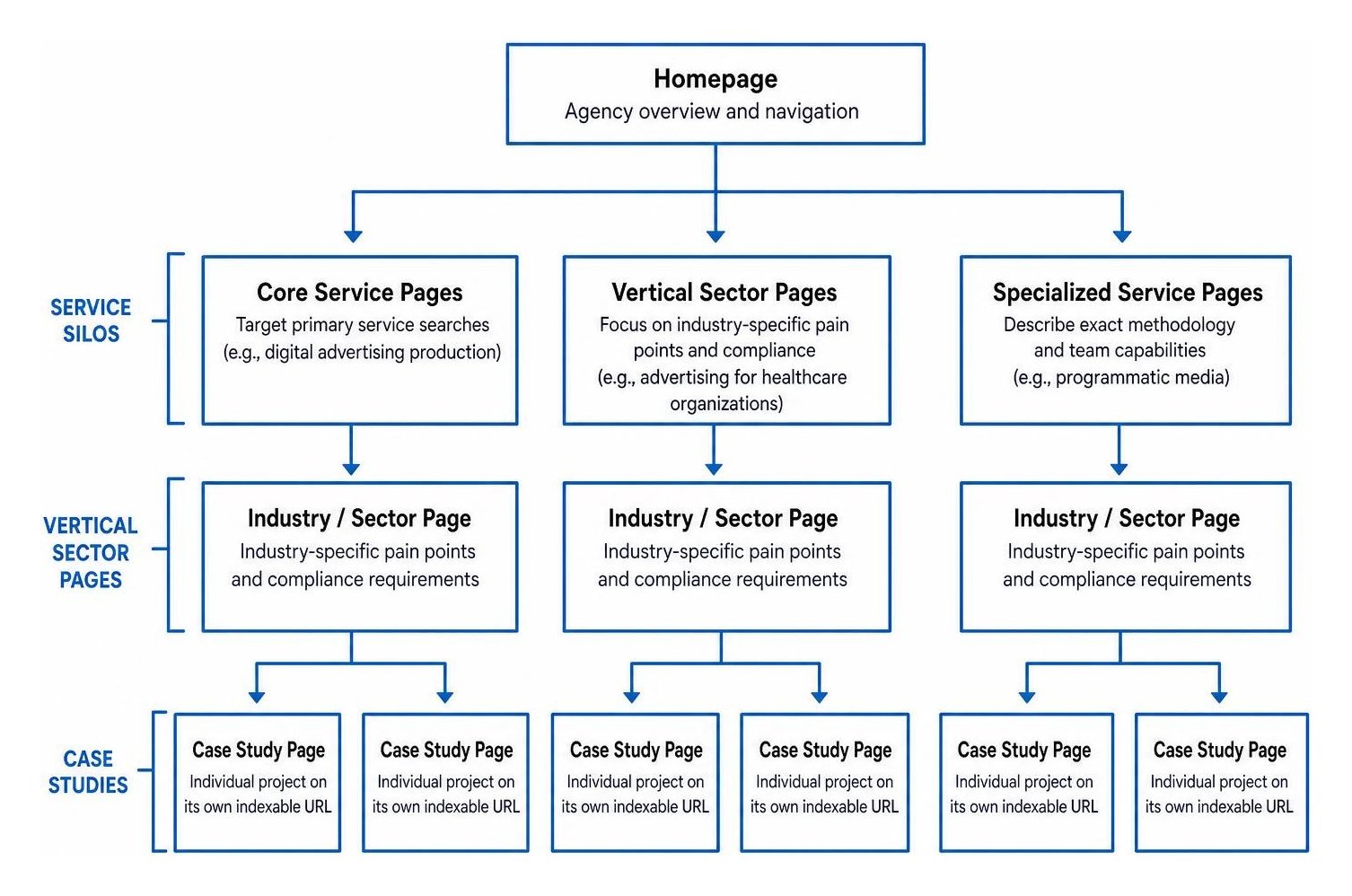
- Service Pages: Target functional capability searches (such as programmatic media buying or creative direction) by detailing operational methodology, deliverable standards, and team execution.
- Sector Pages: Target vertical industry searches (such as healthcare advertising or SaaS marketing) by addressing regulatory environments, industry buyer behaviors, and vertical-specific challenges.
- Case Studies: Provide individual proof points substantiating the claims made on service and sector pages, linking back to foundational service lines.
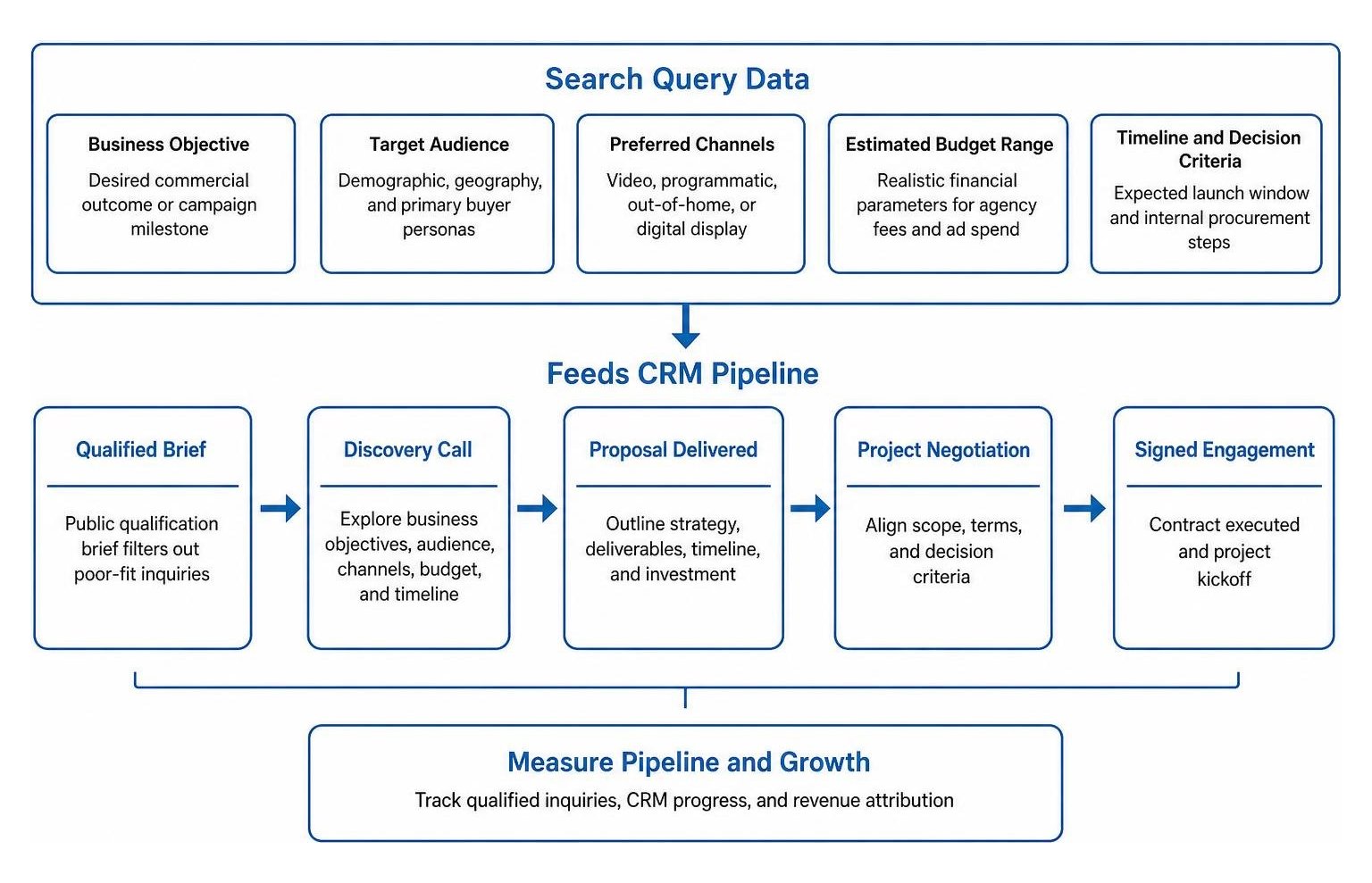
A clear public qualification brief sets expectations without requiring prospective clients to disclose confidential campaign strategies:
- Business Objective: Primary commercial goal or repositioning target.
- Target Audience: Core demographic, geographic scope, and buyer persona.
- Preferred Channels: Media channels under evaluation (digital video, programmatic, print, social).
- Project Scope: Estimated volume of deliverables and required agency capabilities.
- Budget Range (if known): Expected financial parameters for media spend and agency retainer.
- Timing and Decision Process: Target kickoff milestones, launch windows, and internal stakeholder review steps.
What Is the Standard Case Study Structure for Search and Conversions?
Structure agency case studies to fulfill Google Search helpful content guidelines by detailing authentic project scopes, methodologies, and clear attribution boundaries. Confidential client work may be anonymized with the client's permission when nondisclosure agreements prevent public naming.

Reusable Agency Case Study Template
Use this standardized modular layout to structure every portfolio entry as an indexable proof asset:
- Client Context and Permission: Verified client name or anonymized industry descriptor (confidential client work may be anonymized with the client's permission).
- Challenge, Objective, Project Timing, and Baseline Period: Explicit commercial objective, an evergreen description of when the work occurred, and pre-campaign baseline benchmarks with clear measurement periods.
- Agency Scope vs. Partner Scope: Precise operational boundaries detailing agency deliverables versus internal client contributions or third-party vendor tasks.
- Deliverables and Strategic Artifacts: Crawlable text descriptions of creative concepts, storyboards, media plans, and production assets.
- Documented Results and Attribution Boundaries: Verified outcome metrics, including exact metric definitions, reporting periods or measurement windows, data sources (such as ad platform logs or CRM reports), and disclosures of external market variables.
- Prospect Takeaway: Strategic insight applicable to marketing leaders facing comparable operational hurdles.
- Related-Service Call to Action: Direct link connecting the project proof back to the relevant service or sector capability page.
Hypothetical Example: Converting a Visual Showcase Into Search Proof
- Visual-Only Starting Point: A portfolio entry containing an embedded showreel video titled with an unsearchable internal project name and zero descriptive HTML context.
- Accessible HTML Narrative (Hypothetical Transformation):
- Heading & Functional Context: A descriptive heading structured around the capability and industry vertical rather than an ambiguous creative title.
- Core Objective and Scope Boundaries: Crawlable HTML text outlining the operational brief, itemizing agency responsibilities (such as scriptwriting or asset production) versus client-managed tasks.
- Measurement Framework: Documentation of the analytical criteria used to evaluate performance, including the metric definitions, reporting windows, and underlying attribution limits.
- Strategic Internal Link: A concluding CTA guiding prospective buyers directly to the corresponding primary service landing page.
How Should Agencies Measure Inbound Pipeline and Growth?
Agencies measure SEO success by tracking non-branded query impressions and clicks in Google Search Console, paired with CRM pipeline metrics such as qualified project briefs, scheduled discovery calls, formal proposals delivered, and signed retainer profit margins.
Traffic volume alone does not indicate commercial growth. Search visits from students, job seekers, and technology vendors inflate analytics without driving revenue. Agencies must isolate commercial search intent and connect organic traffic to actual sales pipeline stages.
How Can Agencies Track Qualified Inquiries and Attribute Revenue?
Agencies track true organic ROI by integrating web conversion goals with CRM records, separating branded navigation from high-intent non-branded discovery.
- Filter Non-Commercial Actions: Segment career inquiries, vendor solicitations, and customer service requests out of marketing attribution reports.
- Track Mid-Funnel Milestones: Monitor high-intent micro-conversions, including discovery session bookings, scope-of-work template downloads, and completed project brief submissions.
- Review Search Console Query and Page Dimensions: Follow Google Search Console Performance report documentation to inspect existing URLs and query filters. By reviewing exact page impressions, query clicks, and average positions for published service pages, teams identify which non-branded capability terms already attract impressions without inventing performance projections.
- Account for Attribution Limits: Recognize that enterprise B2B sales cycles involve multiple touchpoints across extended review periods.
- Evaluate Net Profit Margin: Assess inbound campaigns based on the realized profit margin of retained accounts rather than top-line contract value.
What Is the Prioritized Agency SEO Maintenance Cadence?
A disciplined review cadence keeps technical health intact and ensures new client work is regularly transformed into crawlable search assets.
| Cadence | Responsible Role | Key Maintenance Actions |
|---|---|---|
| Weekly | Marketing Operations | Inspect Google Search Console for crawl anomalies, indexation status, and emerging unbranded queries. |
| Monthly | Content Lead | Publish comprehensive HTML case studies for newly completed agency deliverables with structured proof. |
| Quarterly | Technical SEO Lead | Audit image compression formats, canonical tags, mobile responsiveness, and internal link silos between service and sector pages. |
| Biannually | Agency Leadership | Review overall organic pipeline contribution and public qualification briefs; assess page relevance, demand, links, and conversions before improving or merging pages, and redirect only to a relevant replacement when justified. |
Building a Search-Driven Lead Generation Engine for Your Agency
Sustainable agency growth requires moving past exclusive dependence on personal referral networks. By creating dedicated service pages, structuring search-accessible portfolio narratives, and establishing transparent qualification criteria, advertising agencies build an inbound channel that can attract high-value corporate partners over time.
Audit your existing portfolio to identify high-performing client campaigns ready for accessible HTML case studies. To discuss customized organic search strategies tailored to your firm's capabilities, review our transparent SEO packages or schedule time directly through our consultation portal.
Prioritized Agency SEO Action Checklist
Execute these prioritized tasks to establish and maintain an indexable, proof-driven agency pipeline:
- Priority 1: Audit Indexability and Canonical URLs
- Owner: Technical SEO Lead
- Cadence: Biweekly
- Actions: Ensure portfolio entries live on standalone URLs, resolve canonical conflicts, and confirm showreel pages render crawlable HTML copy alongside embedded media.
- Priority 2: Compress Portfolio Media and Optimize Image Assets
- Owner: Web Developer / Content Ops
- Cadence: Monthly
- Actions: Compress all visual campaign assets before publishing, serve responsive WebP formats, and verify descriptive, natural alt text across all showcase deliverables.
- Priority 3: Publish Structured Case Studies from Completed Work
- Owner: Content Lead
- Cadence: Monthly
- Actions: Transform newly finished client engagements into structured HTML narratives using the standard proof template with clear scope and attribution boundaries.
- Priority 4: Review Non-Branded Search Performance and CRM Pipeline
- Owner: Marketing Operations
- Cadence: Monthly
- Actions: Filter non-commercial queries out of Google Search Console reports and match non-branded landing page traffic to scheduled discovery calls and delivered proposals.
- Priority 5: Align Service Silos, Qualification Briefs, and Page Improvements
- Owner: Agency Leadership
- Cadence: Quarterly
- Actions: Refine public qualification requirements; assess relevance, demand, links, and conversions before improving or merging pages; redirect only to a relevant replacement when justified; and verify internal link silos connecting case studies to core service pages.