SEO for Airports: Help Passengers Find Accurate Travel Information
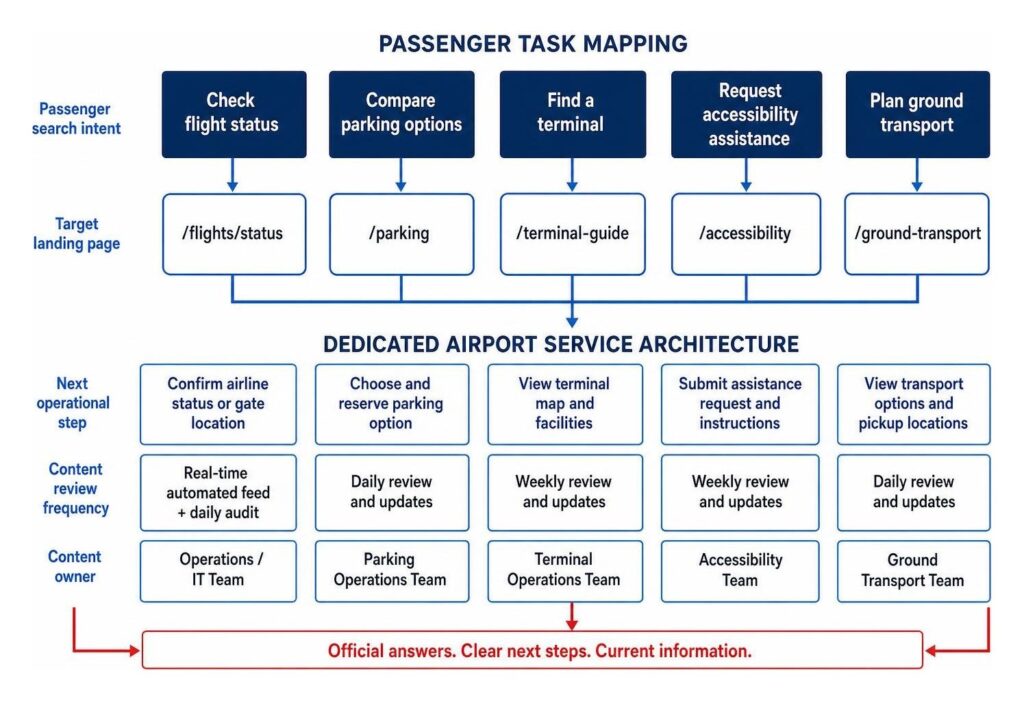
How does SEO for airports help passengers find the right information?
SEO for airports helps passengers find official answers and take their next step. Start with a clear, searchable page for each common task: checking flight status, comparing parking options, finding a terminal, requesting accessibility assistance, or planning ground transport. Make each page easy to use on a phone, and give an answer or clear next action near the top.
An airport should explain the services it operates and link passengers to the airline when an airline owns the answer. For changing information, such as flight status, show the update time and time zone so travelers know how current it is.
Hypothetical passenger journey (illustrative, not a real airport): A traveler searches for a route listing, reaches an airport’s official route page, confirms the airline and destination details, then follows the page’s link to the airline for booking or flight-specific information. The airport team assigns a route-content owner to validate the page whenever service information changes.
How to Build an Effective Framework for SEO for Airports
Airports need an operational search framework built around distinct traveler needs rather than broad promotional marketing. When travelers search for airport information, they need fast, definitive answers to complete immediate tasks such as dropping off passengers, locating long-term parking, or finding special assistance desks.
Implementing structured search engine optimization strategies allows airport operators to organize their digital assets so that both traditional search engines and AI discovery tools deliver authoritative answers. Digital visibility in aviation works best when it eliminates operational confusion and directly guides travelers to the appropriate next step.
Illustrative passenger-task page plan: The example paths, owners, and review cadences below are recommendations, not facts about a real airport. Update any dynamic information immediately when operating conditions change.
| Passenger Search Intent | Illustrative Authoritative Page | Next Operational Step | Suggested Review Cadence | Suggested Content Owner |
|---|---|---|---|---|
| Check daily departures or gate assignments | /flights/departures |
Confirm airline status or gate location | Real-time feed monitoring plus a daily audit | Operations / IT Team |
| Reserve terminal or economy parking | /parking/terminal-rates |
Complete an online space reservation | Review when rates, availability, or terms change | Parking Operations |
| Book ADA or special mobility support | /accessibility/services |
Submit an airline or airport request form | Review when service procedures or standards change | Passenger Services |
| Locate pickup zones or public transit | /ground-transport/shuttles |
View zone maps or purchase transit passes | Update immediately when routes, zones, or schedules change | Ground Transportation |
| Check carry-on security wait times | /security/checkpoint-info |
Prepare documents for screening | Real-time feed monitoring with operational review | Terminal Security Liaison |
| Review routes and destinations | /flights/routes |
Confirm airline details, then continue to the airline for booking or flight-specific information | Update immediately when route information changes | Air Service / Communications Team |
Copyable content-maintenance worksheet:
- Page URL: Add the official page address.
- Owner: Name the person or team responsible.
- Source of truth: Record the operational system or approved source.
- Last verified: Note when the details were checked.
- Next review: Set the next planned review.
- Urgent-update trigger: List the change that requires an immediate update.
- Fallback contact: Add an alternate contact if the primary owner is unavailable.
Use one row for each airport service page so the team can document who verifies operational details and who responds when the primary owner is unavailable.
Why is SEO for airports essential for passenger task completion?
SEO for airports is essential because travelers searching for logistical airport details are operating under fixed travel schedules and need immediate clarity. Direct answers on official service pages can help passengers locate the information needed for their next step while reducing reliance on outdated third-party travel blogs or unofficial directories.
An effective airport web portal clearly distinguishes the airport operator’s responsibilities from those of individual airlines or off-airport commercial operators:
- Airport Operator Scope: Runway status, public parking facilities, security checkpoint wait times, terminal maps, lost and found, and general accessibility accommodations.
- Airline Scope: Rebooking, baggage fees, boarding passes, seat assignments, and onboard service inquiries.
- Independent Vendor Scope: Off-site rental car lots, off-airport private parking lots, and third-party hotel shuttles.
Aligning content with the Google Search Central helpful content guidance requires publishing accurate, direct answers that solve traveler needs without burying practical details beneath unnecessary marketing fluff.
How should airport website architecture organize flight status, parking, and terminal services?
Airport website architecture should use dedicated, indexable URLs for every distinct operational service. Grouping multiple unrelated facilities onto a single generic page creates indexing confusion and makes it harder for mobile users to find what they need while en route.
For ground transit, providing comprehensive landing pages for public options, taxi ranks, and airport shuttle services ensures incoming visitors can navigate regional connections quickly. Terminal maps should follow established Google Images optimization best practices by including clear descriptive file names, structured context, descriptive alt text, and an accompanying text-based wayfinding directory for screen readers and search bots.
When structuring dedicated airport parking pages, follow this operational checklist:
- Clear geographic entrance addresses with lane-level driving directions.
- Designated ADA accessible stall counts and proximity to terminal elevators.
- Timestamped rate schedules showing hourly, daily, and maximum fee caps.
- Vehicle height clearances and oversized vehicle restrictions for each garage.
- Reservation terms, cancellation rules, and accepted payment methods.
- Terminal shuttle route information, pickup frequencies, and average transfer times.
For accessibility pages, explain available services in plain language, provide a clear request path, and offer text alternatives for maps or visual wayfinding. This practical guidance is not a legal-compliance certification. Airport teams should review the current standards and requirements that apply to their operations before publishing or updating accessibility information.
What technical SEO for airports ensures accurate feed fallbacks and mobile performance?
Airport websites rely on a mix of static informational pages and dynamic data feeds for flight boards and security wait times. Technical SEO ensures that search engine crawlers can index the static architecture while users access dynamic updates reliably across mobile devices.
To maintain trust and accuracy across all platforms, every dynamic flight or status feed must display an explicit last-updated timestamp, the local time zone, and the primary data source. If a live API feed experiences an interruption, the page should display a graceful fallback notice directing passengers directly to their specific airline's official mobile application or customer service portal rather than presenting cached or incorrect flight times.
When implementing structured data, use accurate schema types without expecting automatic rich results or guaranteed display features. The official Google AI search features documentation makes clear that Google AI features do not require special AI files or special schema. Standard, well-structured HTML remains the foundation for crawlable, useful airport service pages. Mobile optimization must prioritize fast Core Web Vitals, legible font sizing, and large touch targets for passengers navigating pages on mobile devices within busy concourses.
When should airports consider separate Google Business Profile listings for on-site services?
Airports should consider separate Google Business Profile listings only for genuinely eligible, independently identifiable businesses or departments. Not every garage, service counter, checkpoint, or amenity qualifies. Before creating or changing a profile, verify the current Google Business Profile guidelines for representing a business and confirm that the listing accurately reflects how the entity is recognized and operated in the real world.
A cautious review should consider whether the entity has a distinct customer-facing identity and can be represented accurately without creating duplicate or misleading profiles. When eligibility is unclear, keep the airport's primary profile accurate and seek guidance from the current Google policies before adding another listing.
For any eligible profile, keep the name, category, hours, and customer-facing details accurate, and make changes promptly when service conditions change. Consistent local citation records can support clear local information across relevant directories. For airport pages that guide drivers and passengers, local SEO map visibility guidance can support clearer mapping information.
Measuring Performance and Sustaining Operational Visibility
Tracking airport SEO performance requires focusing on user task completion and operational utility rather than vanity traffic numbers. High organic visibility is meaningful only if it helps travelers find their terminal, reserve parking, or access security screening requirements efficiently.
How can airport teams track organic search queries and conversion metrics?
Airport communications teams can use Google Search Console and web analytics platforms to compare the queries travelers use with the pages that earn impressions and clicks, then identify where an official task page is missing or unclear:
- Search Console query-and-page analysis: Compare the searches that generate impressions and clicks with the landing pages shown for those searches. Use the gaps to prioritize missing flight, route, parking, accessibility, terminal, or ground-transport answers.
- Task-completion and parking-conversion tracking: Where tracking exists, monitor completed parking reservations, assistance-form submissions, route-page referrals, and relevant checkout drop-off points on official portals.
- Assistance document downloads: Track downloads of accessible passenger guides, terminal sensory maps, and mobility assistance request forms where measurement is available.
- Transit referral clicks: Measure outbound clicks to public bus lines, rail links, authorized rideshare portals, and official airline support pages where tracking is available.
- Freshness reviews: Maintain a shared ownership worksheet to confirm that fees, construction detours, route listings, and tenant information remain accurate when operational details change.
Airport authorities seeking structured technical reviews and ongoing digital maintenance can explore specialized SEO packages to sustain clean indexing and search visibility across public operational assets.
Elevating the Passenger Experience Through Operational Search
A well-executed airport SEO strategy turns digital confusion into seamless physical travel. By maintaining dedicated landing pages for parking, accessibility, ground transit, and terminal services, backed by accurate feed fallbacks and verified profile data, airport operators ensure that passengers find reliable, official answers at every stage of their journey.
Prioritizing factual clarity, mobile performance, and regular content audits establishes a dependable digital front door for the airport, making travel days smoother and less stressful for every passenger walking through the terminal doors. For help planning an airport SEO program, book a consultation.