SEO for Auction Houses: Reach Consignors and Qualified Bidders

Why SEO for Auction Houses Must Serve Consignors and Bidders
SEO for auction houses works best when it serves two search journeys. People who want to sell need pages that explain what you accept, where you work, how valuations and consignment work, and what happens next. People who want to bid need searchable auction and lot pages with accurate item details, clear photos, sale dates, costs, and a way to register. Build useful pages for each journey, then make them easy to find through search and easy to use on a phone.
I’m Clayton Johnson, founder of SmallBizSEO. My work in SEO, content strategy, and digital PR shapes this practical approach to SEO for auction houses: help the right people find clear answers and take the next step.
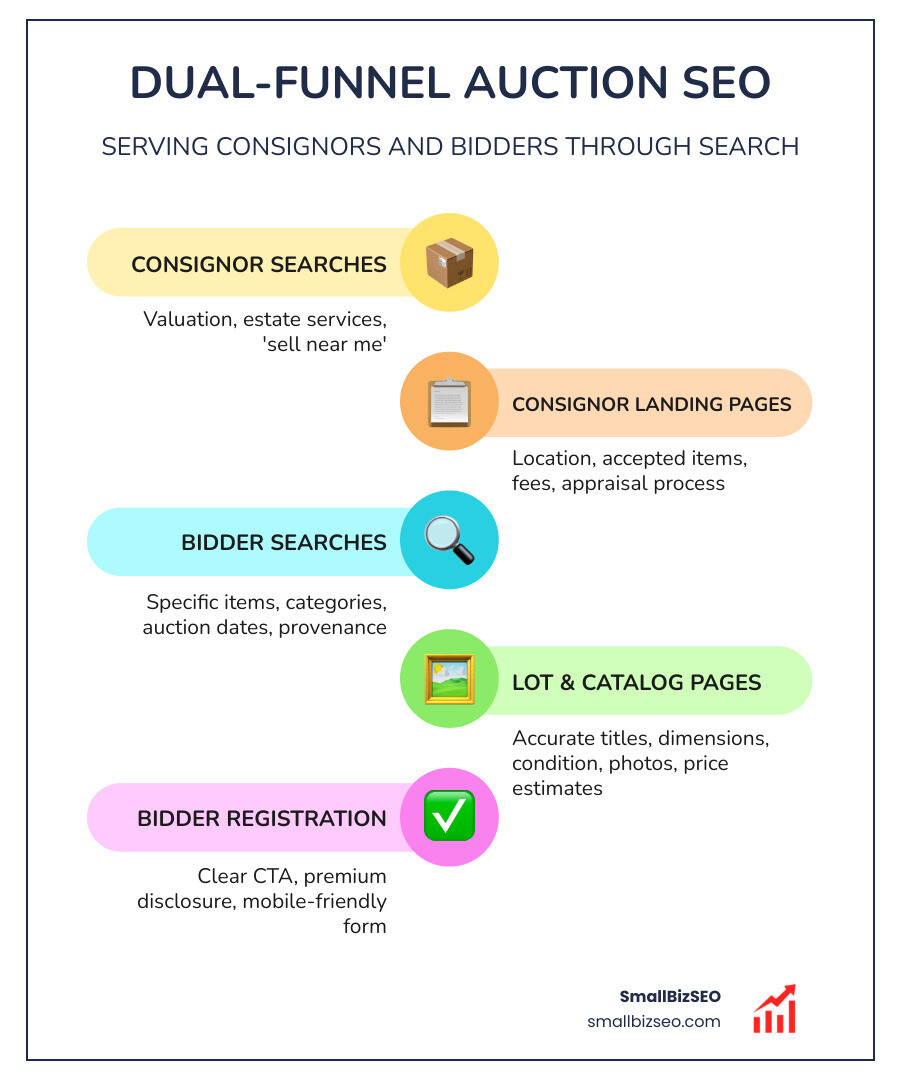
Auction salerooms cannot treat organic search like a single retail storefront. Sourcing quality inventory requires ranking for regionally focused or broader seller terms, while attracting registered buyers requires indexing item-level catalog lots and evergreen department categories. Meeting both intents with clear technical structure can make the site more useful to prospective consignors and bidders.
The Consignor and Bidder Funnels: Content and Keyword Strategy
An effective search strategy splits keyword targeting into distinct commercial valuation pathways and collector discovery funnels. Consignors search with high local intent to understand fair market value, estate settlement options, and saleroom commission fees. In contrast, collectors, dealers, and private buyers search by specific creator, design movement, material, or category classification.
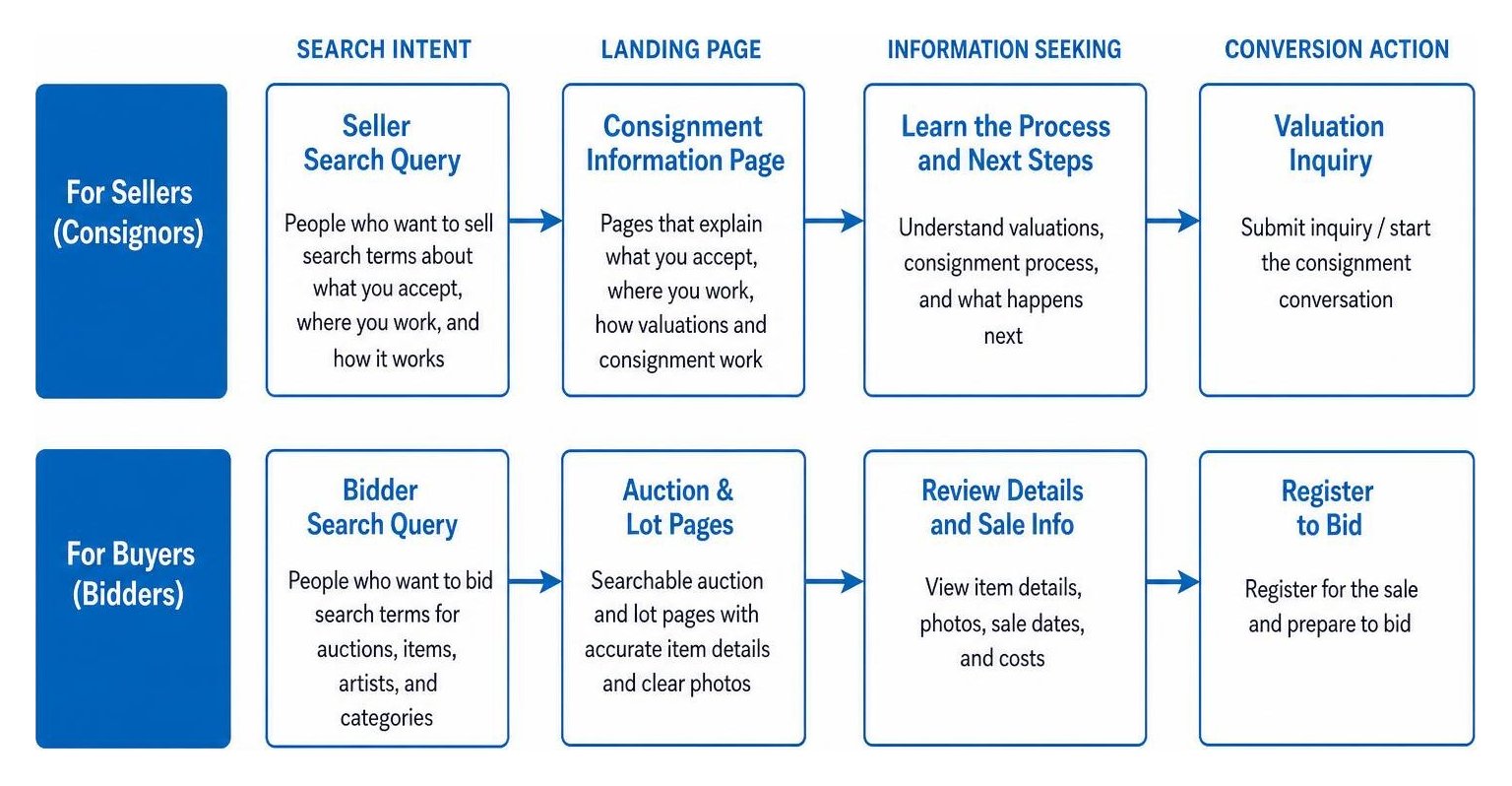
The following table maps user search intent to target page formats, required trust elements, and immediate on-page conversion actions:
| User Intent & Search Query | Target Page Type | Core Proof Elements Required | Primary Next Action |
|---|---|---|---|
| "How to sell fine jewelry at auction" | Category Consignment Landing Page | Specialist appraisal bios, transparent commission ranges, intake process | Online valuation submission |
| "Probate estate valuation services" | Estate & Probate Services Page | Written appraisal credentials, clear property assessment steps | Consultation booking |
| "Signed mid-century walnut credenza" | Individual Lot Detail Page | High-res photos, condition report, maker stamps, dimensions | Bidder registration / catalog watch |
| "Upcoming modern art auctions" | Department / Sale Calendar Page | Auction date, viewing hours, buyer premium schedule | Catalog browsing / sale alert signup |
How to Optimize Consignor Landing Pages Using Local SEO for Auction Houses
Consignor landing pages should clearly outline accepted property types, valuation steps, and the factors that affect commission fees. Some auction houses source consignments primarily within a region, while others accept property from a broader area. State the actual coverage instead of assuming every seller is local. Clear, upfront guidance helps prospective sellers understand whether an inquiry is a suitable next step.
A practical valuation or consignment form can ask for:
- Item category: The type of property and any known maker, model, or era.
- General location: Enough information to confirm service coverage and collection options, without requesting a full address at the first step.
- Photos and known provenance: Clear images plus any available ownership, purchase, or maker information.
- Permission to contact: A clear way for the auction house to follow up about the inquiry.
Avoid asking people to upload confidential estate documents through a generic lead form. Provide a secure, appropriate process if documents are needed later.
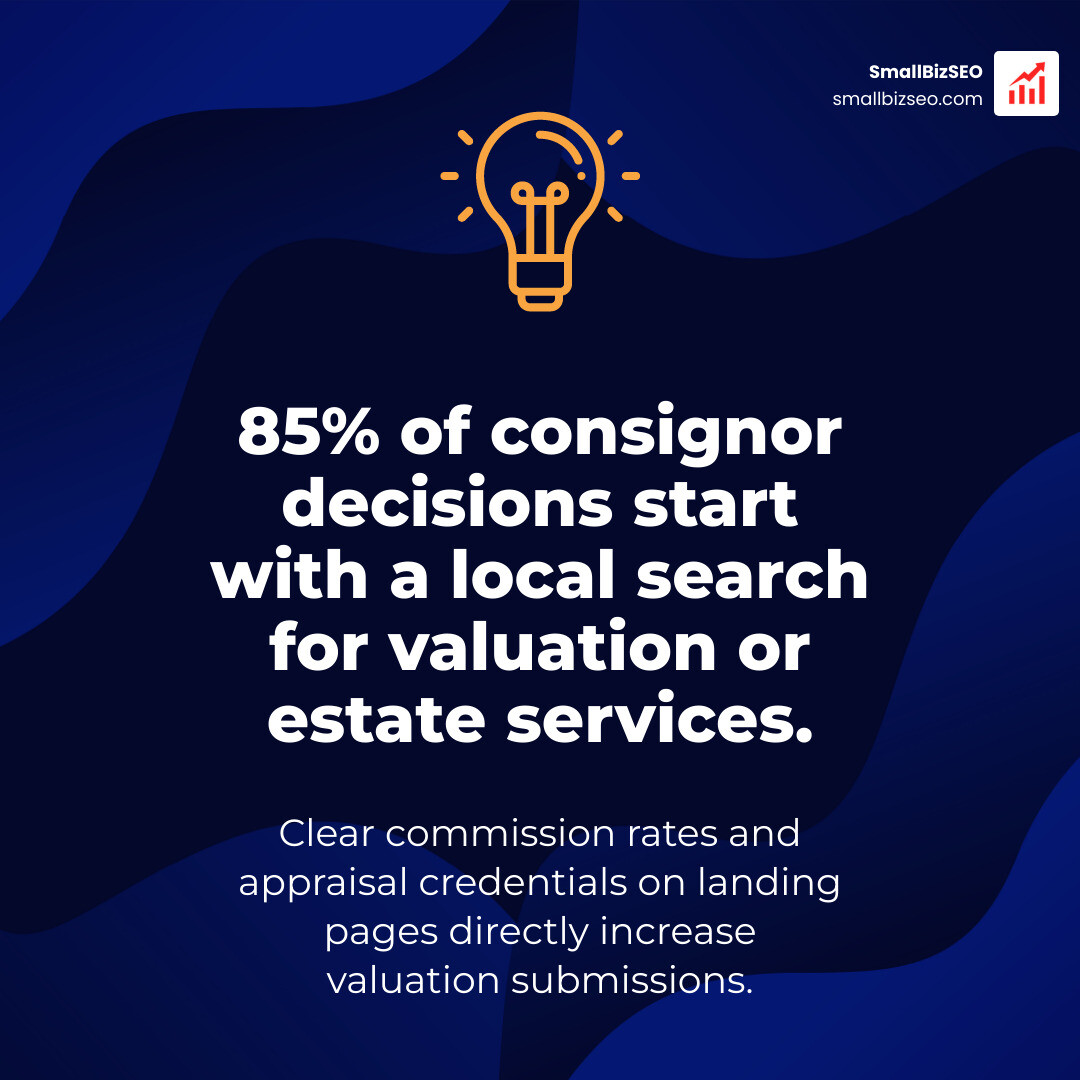
Consider a hypothetical furniture consignment scenario: A homeowner inherits a nineteenth-century dining suite and searches for local valuation options. If your department page clearly presents accepted furniture styles, past auction estimates, staff appraiser credentials, transparent seller commission rates, and transport logistics, the seller can immediately upload photos through a secure valuation form rather than bouncing to a generic listing directory.
What Content and Details Do Bidders Need on Department and Lot Pages?
Bidder-focused pages should provide complete specifications, documented provenance, objective condition reports, and clear buying terms. Bidders need enough information to assess an item and understand the next step before registering. The buyer and seller journeys described by Sotheby’s offer an illustrative example of how distinct workflows can be presented; each auction house should publish its own terms and procedures.
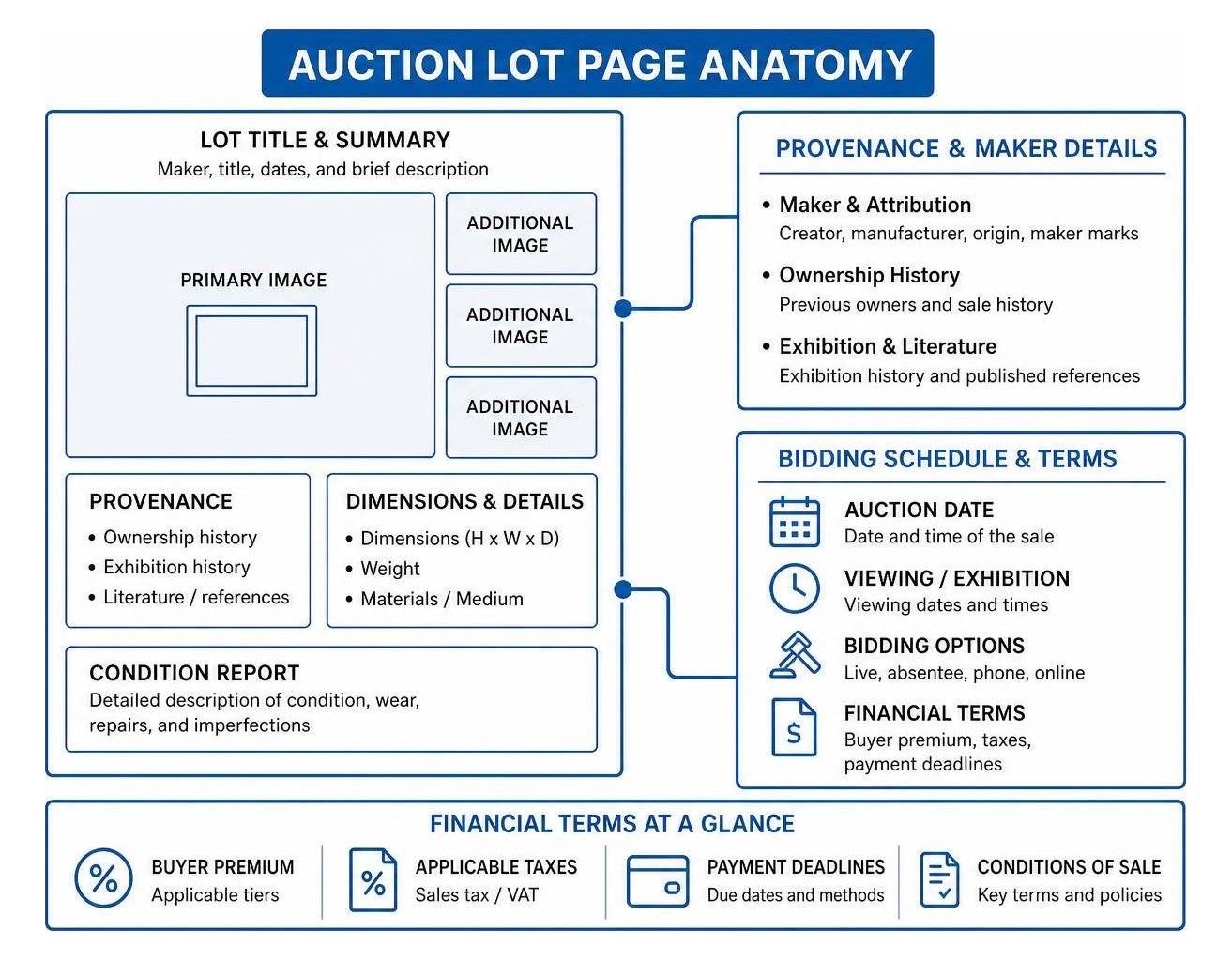
Every individual lot page should feature:
- Maker & Attribution: Clear listing of creator, manufacturer, origin, and relevant maker marks.
- Physical Specifications: Precise dimensions, weight, materials, and medium.
- Condition Transparency: Detailed condition descriptions documenting any repairs, wear, or imperfections.
- Financial Terms: Transparent buyer premium tiers, applicable taxes, and payment deadlines.
- Logistics and Status: Closing date, closing time and time zone, inspection dates, viewing hours, and post-sale collection or shipping guidance. When accurate, clearly label whether a lot is sold, unsold, withdrawn, closed, or still available.
In a hypothetical collector search for a specific mid-century armchair, the buyer searches by designer name and model. A properly structured lot page displays indexed text describing the wood species, original upholstery condition, catalog estimate, and registration deadlines, allowing the collector to register to bid directly.
Technical Infrastructure, Catalog Lifecycle, and Analytics
Auction websites need technical infrastructure that makes public catalog content crawlable while managing expired inventory without breaking user journeys. Keep public lot descriptions and internal links available to crawlers where appropriate, while reserving login requirements for bidding or account functions. For JavaScript-driven catalogs, test whether essential catalog text and links render reliably, following Google’s JavaScript SEO guidance. Measure how any third-party auction platform handles rendering, crawlability, and status changes rather than assuming its catalog output is search-ready.
How Should Technical SEO for Auction Houses Manage Expiring Catalogs and Schema Markup?
Managing the catalog lifecycle means deciding which closed pages remain useful and updating their status accurately. Closed lot pages can remain valuable as public sale archives when the information is accurate, permitted, and useful to visitors. Removal may be appropriate for privacy, rights, thin-content, or quality reasons. In either case, update internal links and serve an appropriate status or destination rather than applying a blanket keep-all policy or redirecting closed lots to the homepage.
| Lifecycle Stage | URL & Indexing Strategy | Content & Navigation Requirements | Schema & Technical Tasks |
|---|---|---|---|
| Before Auction (Catalog Launch) | Stable, descriptive URL path (/department/sale-name/lot-number) |
Complete item descriptions, high-resolution imagery, estimate range, viewing dates | Ensure catalog text renders without requiring user login; verify JavaScript rendering |
| During Auction (Live/Timed) | Maintain existing canonical URL | Real-time bidding status, registration prompts, closing schedule | Monitor crawl stability and page speed under concurrent traffic |
| After Auction (Post-Sale) | Keep the URL when a public archive is accurate, permitted, and useful; otherwise remove or redirect it to the most relevant destination and serve an appropriate status | Clearly label the item as sold, unsold, withdrawn, or closed; display realized price only when permitted; update internal links to active sales | Review any markup for the current page state; never present auction estimates as fixed retail prices |
When evaluating structured data, confirm eligibility against the current search-engine guidance and the page’s actual content. Auction estimates are variable bidding ranges rather than fixed transactional prices, so standard retail product markup requires careful review to avoid inaccurate signals or validation issues.
How Should Salerooms Track Inquiries, Bids, and True Marketing Return?
Auction marketing performance must measure qualified consignment inquiries and bidder registrations separately from gross hammer prices. Tracking gross hammer price alone obscures actual profitability, because gross sale totals do not equal the auction house's earned commission revenue.
To establish accurate reporting:
- Track Consignor Conversions: Measure submitted valuation forms, probate appraisal calls, and signed consignment contracts.
- Track Bidder Conversions: Measure catalog downloads, account registrations, absentee bid placements, and live paddle requests.
- Optimize Regional Visibility: Manage your Google Business Profile with accurate category tags, viewing hours, and client reviews by applying local search optimization basics.
- Review Page-Level Performance: Compare valuation pages, department pages, auction pages, and lot pages to see which journeys lead to qualified inquiries and registrations.
For help aligning valuation pages, catalog architecture, and measurement with your auction-house workflow, Book an SEO strategy call.
Next Steps for Saleroom Search Visibility
Building an effective search presence requires treating consignors and bidders as two distinct audiences with unique search intents. By publishing clear valuation intake pages for the areas an auction house actually serves, structuring detailed and crawlable lot descriptions for buyers, and managing catalog lifecycles with accurate technical signals, auction houses can improve the clarity and usefulness of their search presence.