SEO for Book Publishers: Turn Catalog Searches Into Reader Discovery
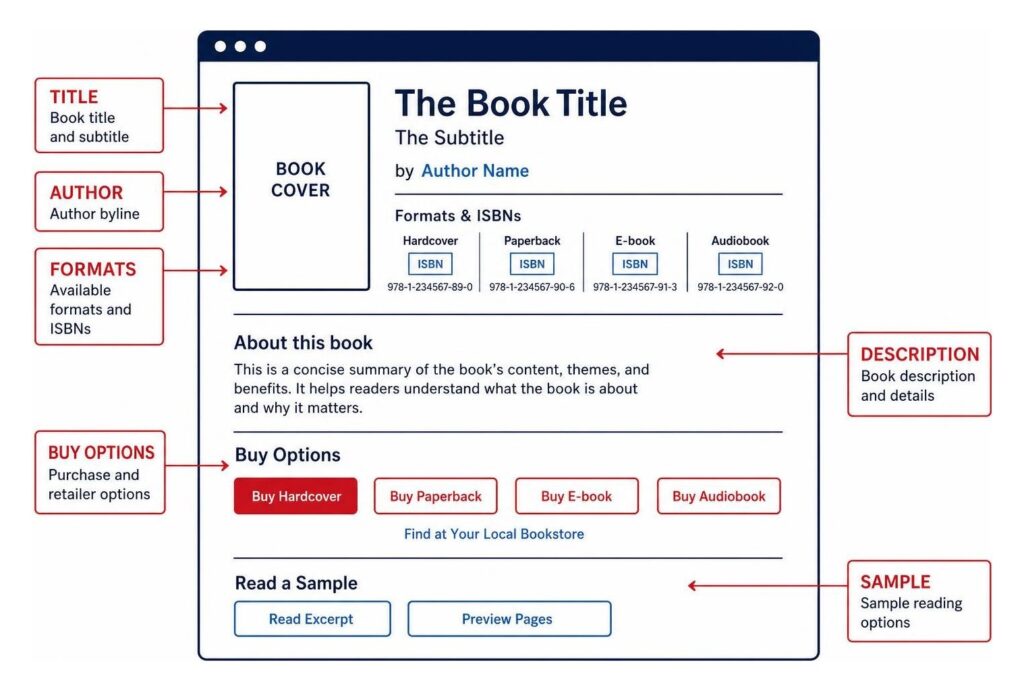
SEO for book publishers starts with matching each search to a useful catalog page. Give every book a dedicated page with its correct title, author, format, ISBN, description, availability, and clear ways to buy or borrow it. Help people browsing by genre or reading need find relevant collections, and make series order easy to follow. Keep ordering information for librarians and booksellers separate from author submission guidelines.
The official title and subtitle should reflect the published title page or authoritative product metadata, rather than serving as a place to add search terms. The Book Industry Study Group’s title and subtitle guidance explains how to use those fields accurately.
For independent publisher marketing teams, this guide focuses on turning catalog searches into useful reader paths with practical content strategy, technical SEO, and digital PR.
Structuring Your Publisher Catalog
Independent publisher marketing teams need sites that route readers, booksellers, librarians, and authors to dedicated, indexable sections. Clean catalog taxonomy organizes imprint catalogs, clarifies navigation for searchers, and aligns with recognized metadata best practices.
Publishing websites often fail searchers when submission guidelines, trade distribution information, and consumer book listings compete for the same search queries. We resolve this by structuring separate directory paths for individual consumer titles, imprint catalogs, trade ordering portals, and editorial submission criteria.
| Reader / Search Query Type | Searcher Intent | Target Landing Page Type | Key On-Page Elements |
|---|---|---|---|
| Known Title / Author | Locate a specific published book | Dedicated Book Product Page | Official title, subtitle, author byline, ISBNs, book description, availability, buy/borrow buttons |
| Genre or Topic Need | Discover relevant reading material | Category or Genre Hub Page | Filtered catalog listings, curated overviews, links to subgenres and reading levels |
| Series Reading Order | Find the chronological sequence of a book series | Series Index Page | Numbered reading order, cover gallery, individual book links, series description |
| Library Ordering | Verify cataloging data, processing, or institutional terms | Library Services Portal | CIP/MARC data availability, wholesale distributors, collection development contacts |
| Bookseller & Wholesale Ordering | Acquire retail inventory or verify distribution terms | Trade & Retailer Ordering Page | Wholesale discount schedules, return policies, distributor warehouse contacts, EDI details |
| Manuscript Submissions | Submit a proposal or manuscript to an imprint | Editorial Guidelines Page | Open submission windows, format specifications, contact forms (no manuscript acceptance implied) |
How Should Publishers Map Reader Intent to Book Landing Pages?
Publishers map reader intent by categorizing catalog pages according to specific reader search stages rather than internal publisher departments. A reader looking for a specific title needs purchase and borrowing options, while visitors browsing specialized or scholarly catalogs often look for chapter summaries, citation details, and specific edition formats.
Structuring distinct landing pages helps publishers present clear, indexable information across non-fiction topics and literary genres. For scholarly or technical lists, providing chapter abstracts, citation records, format specifications, and complete contributor attributions helps searchers find relevant research volumes.
What Are the Essential Elements of On-Page SEO for Book Publishers?
On-page SEO for book publishers requires clearly separating the HTML title tag from the official book title while presenting complete edition, format, and access details. Search engine title tags may include contextual publisher details, while on-page headings and metadata should reflect the published title information without keyword stuffing.
Publishers must audit every individual book landing page against a clear structural checklist:
- Accurate Title and Subtitle: Use the official title and subtitle from the published title page or authoritative product metadata; keep the H1 consistent with that information.
- Differentiated HTML Title Tag: The
</code> tag can include the title, author name, and publisher brand without modifying the official work title.</li>
<li><strong>Author Bylines:</strong> Clean attribution linking to author biographical profiles and their other catalog titles.</li>
<li><strong>Edition Identifiers & ISBNs:</strong> Visible, text-based listings for the formats offered, with identifiers only where they have actually been assigned to that edition or format.</li>
<li><strong>Explicit Book Description:</strong> A comprehensive synopsis, jacket copy, and thematic summary formatted in clear, indexable HTML text.</li>
<li><strong>Authorized Cover Art and Samples:</strong> Fast-loading, authorized cover images and crawlable excerpt text using storytelling principles.</li>
<li><strong>Availability Status:</strong> Unambiguous indicators for in-print, preorder, backorder, or out-of-print status across every format.</li>
<li><strong>Accessible Buy and Borrow Options:</strong> Prominent direct checkout links, primary bookseller referrals, and public or academic library locators.</li>
<li><strong>Audience and Series Links:</strong> Navigation breadcrumbs linking to the parent series index, target age or reading level hubs, and related thematic lists.</li>
</ul>


<h3 class="wp-block-heading" id="how-can-structured-data-clarify-contributor-and-edition-details">How Can Structured Data Clarify Contributor and Edition Details?</h3>


<p class="wp-block-paragraph"><strong>Structured data markup using Schema.org vocabulary helps search engine crawlers interpret book formats, contributors, and identifiers more clearly.</strong> While accurate schema markup does not guarantee specialized Book rich results in search engine results, it provides machine-readable context across complex catalogs.</p>


<p class="wp-block-paragraph">Implement <code>Book</code> and <code>Product</code> schema to declare available format properties (<code>bookFormat</code>), assigned ISBNs where applicable (<code>isbn</code>), and publication dates without applying blanket PDF canonical rules that could confuse crawler indexing. For anthologies, translated texts, and edited collections, publishers should designate authors, illustrators, editors, and translators as distinct entities within the markup.</p>


<h2 class="wp-block-heading" id="measuring-success-and-managing-long-tail-catalog-visibility">Measuring Success and Managing Long-Tail Catalog Visibility</h2>


<p class="wp-block-paragraph"><strong>Long-tail catalog visibility depends on maintaining backlist titles, managing out-of-print inventory gracefully, and auditing discovery metadata over time.</strong> Frontlist titles often enjoy initial launch attention, but ongoing organic discoverability may support continued backlist discovery when publishers utilize comprehensive <a href="https://www.ingramcontent.com/publishers-blog/how-to-make-your-catalog-work-harder-metadata-and-discovery-strategies-for-publishers" target="_blank">catalog discovery strategies</a>.</p>


<p class="wp-block-paragraph">Independent publisher marketing teams can use seasonal reading trends, award announcements, and subject-matter developments to surface relevant archival catalog pages.</p>


<h3 class="wp-block-heading" id="why-is-backlist-optimization-vital-in-seo-for-book-publishers">Why Is Backlist Optimization Vital in SEO for Book Publishers?</h3>


<p class="wp-block-paragraph"><strong>Backlist optimization preserves organic search equity across older catalog pages while helping publishers reduce the risk of broken or outdated links.</strong> Out-of-print books or superseded editions require deliberate status decisions rather than blanket redirects or unannounced page deletions.</p>


<p class="wp-block-paragraph"><img decoding="async" alt="White, navy, and red diagram showing a backlist catalog audit flow for independent publisher marketing teams: review" class="aligncenter" src="https://smallbizseo.com/wp-content/uploads/seo-for-book-publishers-image-1.jpg" style="display: block; margin-left: auto; margin-right: auto; max-width: 100%;" title="White, navy, and red diagram showing a backlist catalog audit flow for independent publisher marketing teams: review"/></p>


<h4 class="wp-block-heading" id="illustrative-backlist-improvement-workflow-hypothetical-example">Illustrative Backlist Improvement Workflow (Hypothetical Example)</h4>


<p class="wp-block-paragraph"><em>Note: The following scenario is an illustrative hypothetical example to demonstrate editorial workflow and does not represent measured client results.</em></p>


<ul class="wp-block-list">
<li><strong>Hypothetical Scenario:</strong> A mid-sized trade publisher audits a 50-title backlist history imprint. Ten older titles have outdated metadata, missing paperback ISBNs, and broken links to out-of-print hardcovers.</li>
<li><strong>Process Implemented:</strong> The marketing team updates product pages with active trade paperback ISBNs, embeds reading group discussion guides in crawlable text, and links individual volumes into a cohesive chronological series hub.</li>
<li><strong>Expected Operational Benefit:</strong> Search engines can index the updated format identifiers, and readers navigating through subject queries reach functional purchase and borrowing destinations.</li>
</ul>


<h4 class="wp-block-heading" id="illustrative-fictional-catalog-examples">Illustrative Fictional Catalog Examples</h4>


<p class="wp-block-paragraph">Every title and scenario below is fictional. Publishers can adapt this sample framework across active, revised, and archival catalog entries:</p>


<figure class="wp-block-table"><table><thead><tr>
<th class="has-text-align-left" data-align="left">Catalog Item</th>
<th class="has-text-align-left" data-align="left">Title / Work</th>
<th class="has-text-align-left" data-align="left">Current Edition Status</th>
<th class="has-text-align-left" data-align="left">Metadata Audit Check</th>
<th class="has-text-align-left" data-align="left">Action & URL Strategy</th>
</tr></thead><tbody><tr>
<td class="has-text-align-left" data-align="left"><strong>Book 01</strong></td>
<td class="has-text-align-left" data-align="left"><em>Modern Ecology Guide</em></td>
<td class="has-text-align-left" data-align="left">Active In-Print (Paperback/Ebook)</td>
<td class="has-text-align-left" data-align="left">Verify ISBN-13 and chapter excerpts</td>
<td class="has-text-align-left" data-align="left">Retain live URL; update retailer and library links</td>
</tr><tr>
<td class="has-text-align-left" data-align="left"><strong>Book 02</strong></td>
<td class="has-text-align-left" data-align="left"><em>Regional Architecture</em></td>
<td class="has-text-align-left" data-align="left">Out of Print (No Replacement)</td>
<td class="has-text-align-left" data-align="left">Historical bibliography value</td>
<td class="has-text-align-left" data-align="left">Keep page live; set status to Out-of-Print; link to related imprint titles</td>
</tr><tr>
<td class="has-text-align-left" data-align="left"><strong>Book 03</strong></td>
<td class="has-text-align-left" data-align="left"><em>Principles of Economics</em> (1st Ed.)</td>
<td class="has-text-align-left" data-align="left">Superseded by 2nd Edition</td>
<td class="has-text-align-left" data-align="left">Revised edition available with new ISBN</td>
<td class="has-text-align-left" data-align="left">Keep the older page when its citations or content remain useful, and link to the newer edition; redirect only if it is a truly equivalent replacement and the older URL no longer needs its own record</td>
</tr><tr>
<td class="has-text-align-left" data-align="left"><strong>Book 04</strong></td>
<td class="has-text-align-left" data-align="left"><em>Urban Gardening Basics</em></td>
<td class="has-text-align-left" data-align="left">Active In-Print (Hardcover/Paperback)</td>
<td class="has-text-align-left" data-align="left">Missing series breadcrumb</td>
<td class="has-text-align-left" data-align="left">Add series navigation and schema markup; keep live URL</td>
</tr><tr>
<td class="has-text-align-left" data-align="left"><strong>Book 05</strong></td>
<td class="has-text-align-left" data-align="left"><em>Anthology of Short Fiction</em></td>
<td class="has-text-align-left" data-align="left">Active In-Print (Multi-Contributor)</td>
<td class="has-text-align-left" data-align="left">Incomplete contributor bylines</td>
<td class="has-text-align-left" data-align="left">Update on-page editor/author credits and multi-author schema</td>
</tr><tr>
<td class="has-text-align-left" data-align="left"><strong>Book 06</strong></td>
<td class="has-text-align-left" data-align="left"><em>Historical Atlas: Vol. 1</em></td>
<td class="has-text-align-left" data-align="left">Active In-Print (Series Entry)</td>
<td class="has-text-align-left" data-align="left">Standalone page lacking sequence order</td>
<td class="has-text-align-left" data-align="left">Link to Series Hub Page and Volume 2 product page</td>
</tr><tr>
<td class="has-text-align-left" data-align="left"><strong>Book 07</strong></td>
<td class="has-text-align-left" data-align="left"><em>Introductory Chemistry</em> (Old Ed.)</td>
<td class="has-text-align-left" data-align="left">Discontinued (New Edition Active)</td>
<td class="has-text-align-left" data-align="left">Outdated syllabus citations pointing to URL</td>
<td class="has-text-align-left" data-align="left">Retain the older page if citations or useful content remain, then link to the current edition; redirect only when the replacement is genuinely equivalent and no separate record is needed</td>
</tr><tr>
<td class="has-text-align-left" data-align="left"><strong>Book 08</strong></td>
<td class="has-text-align-left" data-align="left"><em>Memoir of a Naturalist</em></td>
<td class="has-text-align-left" data-align="left">Out of Print (Rights Reverted)</td>
<td class="has-text-align-left" data-align="left">Out-of-print archival page</td>
<td class="has-text-align-left" data-align="left">Verify permission to retain the cover, excerpts, and other content before maintaining an archival record; do not redirect to the homepage</td>
</tr><tr>
<td class="has-text-align-left" data-align="left"><strong>Book 09</strong></td>
<td class="has-text-align-left" data-align="left"><em>Children's Illustrated Fables</em></td>
<td class="has-text-align-left" data-align="left">Active In-Print (Hardcover/Audiobook)</td>
<td class="has-text-align-left" data-align="left">Missing audio sample and incomplete format details</td>
<td class="has-text-align-left" data-align="left">Add an audio sample where authorized and list only identifiers assigned to the offered formats</td>
</tr><tr>
<td class="has-text-align-left" data-align="left"><strong>Book 10</strong></td>
<td class="has-text-align-left" data-align="left"><em>Poetry Collection 1990</em></td>
<td class="has-text-align-left" data-align="left">Out of Print (Archive Only)</td>
<td class="has-text-align-left" data-align="left">Author backlist discovery</td>
<td class="has-text-align-left" data-align="left">Retain page; link to author's active titles and library locator</td>
</tr></tbody></table></figure>


<h3 class="wp-block-heading" id="how-should-publishing-teams-manage-edition-status-and-redirect-decisions">How Should Publishing Teams Manage Edition Status and Redirect Decisions?</h3>


<p class="wp-block-paragraph"><strong>Publishers must manage format transitions and out-of-print records using clear edition status decisions rather than automated mass redirects.</strong></p>


<ul class="wp-block-list">
<li><strong>Retain Useful Archival Pages:</strong> Keep the page live with an updated "Out of Print" or "Archived Edition" status if the book retains historical citation value or persistent reader interest. Provide links to active editions, author bibliographies, or related in-print titles.</li>
<li><strong>Redirect Only for Direct Replacements:</strong> Apply a permanent 301 redirect only when a replacement is genuinely equivalent and the older URL no longer needs its own record. A new translation is not automatically equivalent. Never redirect discontinued titles to an unrelated homepage or general category hub.</li>
</ul>


<h3 class="wp-block-heading" id="how-should-publishing-teams-track-organic-conversions-and-retailer-referrals">How Should Publishing Teams Track Organic Conversions and Retailer Referrals?</h3>


<p class="wp-block-paragraph"><strong>Independent publisher marketing teams evaluate SEO performance by analyzing Google Search Console evidence (when access is available) and measuring on-site engagement events alongside outbound clicks.</strong> Because search engines and external marketplaces operate independently, publishers must distinguish between on-site reader actions and downstream sales channels.</p>


<p class="wp-block-paragraph">Track each stage separately:</p>


<ol class="wp-block-list">
<li><strong>Search Console queries and pages:</strong> When verified access is available, compare discovery queries with the book pages, series hubs, or trade pages receiving impressions and clicks.</li>
<li><strong>On-site reader actions:</strong> Measure guide views, subgenre browsing, and series-order clicks. <em>Attribution limitation:</em> These actions suggest interest, not completed reading.</li>
<li><strong>Samples and excerpts:</strong> Track downloads, crawlable excerpts, and authorized audio previews. <em>Attribution limitation:</em> Sample use does not show whether an external purchase followed.</li>
<li><strong>Retailer and library referrals:</strong> Track outbound clicks to booksellers and library finders. <em>Attribution limitation:</em> Publishers generally cannot observe carts or checkout after visitors leave the site.</li>
<li><strong>Direct e-commerce transactions:</strong> Record publisher-site sales and preorders separately. <em>Attribution limitation:</em> These figures cover only purchases completed through the publisher's own checkout.</li>
</ol>


<h2 class="wp-block-heading" id="improving-your-publisher-search-strategy">Improving Your Publisher Search Strategy</h2>


<p class="wp-block-paragraph">Independent publisher marketing teams can prioritize the catalog pages and discovery paths that help readers find the right title, format, series, or borrowing option. SmallBizSEO helps teams improve catalog visibility and reader discovery without blurring consumer, library, trade, and submission journeys.</p>


<p class="wp-block-paragraph">Explore how our dedicated <a href="https://smallbizseo.com/seo-packages/">catalog optimization and SEO packages</a> can improve your publishing house's organic visibility, or discover custom solutions at <a href="https://book.smallbizseo.com/">Book SmallBizSEO</a> to build clearer reader paths.</p>

<script type="application/ld+json">{"@context":"https://schema.org","@graph":[{"@type":"FAQPage","mainEntity":[{"@type":"Question","name":"How should book publishers structure SEO-friendly catalog pages?","acceptedAnswer":{"@type":"Answer","text":"Book publishers should give every book a dedicated, indexable page with the correct title, author, format, ISBN, description, availability, and clear buy or borrow options. These pages should match search intent and help users find specific titles, authors, genres, or series information."}},{"@type":"Question","name":"What information should be included on a book product page for SEO?","acceptedAnswer":{"@type":"Answer","text":"A book product page should include the official title and subtitle, author byline, ISBNs, book description, availability, and buy or borrow buttons. The title and subtitle should reflect the published title page or authoritative product metadata, not be used to add extra search terms."}},{"@type":"Question","name":"How can publisher websites help readers browse by genre or topic?","acceptedAnswer":{"@type":"Answer","text":"Publishers can create category or genre hub pages with filtered catalog listings, curated overviews, and links to subgenres or reading levels. These pages help readers discover relevant books based on their interests or reading needs."}},{"@type":"Question","name":"Why should publishers separate catalog pages from ordering and submission information?","acceptedAnswer":{"@type":"Answer","text":"Publishers should keep consumer book listings, library ordering information, bookseller or wholesale ordering details, and author submission guidelines in separate sections so different search intents do not compete on the same pages. This makes navigation clearer for readers, librarians, booksellers, and authors."}},{"@type":"Question","name":"What pages should publishers create for book series and trade ordering?","acceptedAnswer":{"@type":"Answer","text":"For book series, publishers should create a series index page with numbered reading order, a cover gallery, individual book links, and a series description. For trade ordering, they should provide a dedicated page with wholesale discount schedules, return policies, and distributor warehouse information."}}]}]}</script></div></article><sbm-render-slot id="sbm-article-render-slot" class="block" data-sbm-render="article-v1" data-sbm-state="pending"><div class="mx-auto max-w-4xl py-16 px-6"><div class="h-4 w-32 bg-muted rounded animate-pulse mb-6"></div><div class="h-12 w-3/4 bg-muted rounded animate-pulse mb-8"></div><div class="aspect-[16/9] w-full bg-muted rounded-md animate-pulse mb-10"></div><div class="space-y-4"><div class="h-4 w-full bg-muted rounded animate-pulse"></div><div class="h-4 w-5/6 bg-muted rounded animate-pulse"></div><div class="h-4 w-4/6 bg-muted rounded animate-pulse"></div></div></div></sbm-render-slot></div></section></main><footer id="footer" data-nav="light" class="bg-background text-foreground border-t border-border"><div class="max-w-[1152px] mx-auto px-6 py-12 lg:py-16"><div class="grid grid-cols-1 lg:grid-cols-12 gap-10 lg:gap-8"><div class="lg:col-span-4 flex flex-col justify-between space-y-6"><div class="space-y-4"><a href="https://smallbizseo.com" aria-label="SmallBizSEO home" class="inline-block"></a><p class="text-sm text-muted-foreground leading-relaxed max-w-sm">SmallBizSEO is a small business SEO company providing affordable SEO services that help improve rankings, increase visibility, and turn organic search into qualified leads.</p><div><a href="mailto:hello@smallbizseo.com" class="text-sm text-muted-foreground hover:text-primary transition-colors duration-150 inline-block">hello@smallbizseo.com</a></div></div><div class="flex flex-wrap items-center gap-2 pt-2"><a href="https://www.linkedin.com/company/smallbiz-seo-company/" target="_blank" rel="noopener noreferrer" aria-label="SmallBizSEO on LinkedIn (opens in a new tab)" title="LinkedIn" class="inline-flex h-11 w-11 items-center justify-center rounded-md text-muted-foreground hover:text-primary hover:bg-muted focus-visible:outline-none focus-visible:ring-2 focus-visible:ring-primary focus-visible:ring-offset-2 focus-visible:ring-offset-background transition-colors duration-150"><svg xmlns="http://www.w3.org/2000/svg" width="24" height="24" fill="currentColor" aria-hidden="true" focusable="false" viewBox="0 0 16 16"><path d="M0 1.146C0 .513.526 0 1.175 0h13.65C15.474 0 16 .513 16 1.146v13.708c0 .633-.526 1.146-1.175 1.146H1.175C.526 16 0 15.487 0 14.854zm4.943 12.248V6.169H2.542v7.225zm-1.2-8.212c.837 0 1.358-.554 1.358-1.248-.015-.709-.52-1.248-1.342-1.248S2.4 3.226 2.4 3.934c0 .694.521 1.248 1.327 1.248zm4.908 8.212V9.359c0-.216.016-.432.08-.586.173-.431.568-.878 1.232-.878.869 0 1.216.662 1.216 1.634v3.865h2.401V9.25c0-2.22-1.184-3.252-2.764-3.252-1.274 0-1.845.7-2.165 1.193v.025h-.016l.016-.025V6.169h-2.4c.03.678 0 7.225 0 7.225z"></path></svg></a><a href="https://www.facebook.com/smallbizseocompany/" target="_blank" rel="noopener noreferrer" aria-label="SmallBizSEO on Facebook (opens in a new tab)" title="Facebook" class="inline-flex h-11 w-11 items-center justify-center rounded-md text-muted-foreground hover:text-primary hover:bg-muted focus-visible:outline-none focus-visible:ring-2 focus-visible:ring-primary focus-visible:ring-offset-2 focus-visible:ring-offset-background transition-colors duration-150"><svg xmlns="http://www.w3.org/2000/svg" width="24" height="24" fill="currentColor" aria-hidden="true" focusable="false" viewBox="0 0 16 16"><path d="M16 8.049c0-4.446-3.582-8.05-8-8.05C3.58 0-.002 3.603-.002 8.05c0 4.017 2.926 7.347 6.75 7.951v-5.625h-2.03V8.05H6.75V6.275c0-2.017 1.195-3.131 3.022-3.131.876 0 1.791.157 1.791.157v1.98h-1.009c-.993 0-1.303.621-1.303 1.258v1.51h2.218l-.354 2.326H9.25V16c3.824-.604 6.75-3.934 6.75-7.951"></path></svg></a></div></div><div class="lg:col-span-8 grid grid-cols-2 lg:grid-cols-4 gap-8"><div class="space-y-4"><h3 class="text-sm font-semibold tracking-wide text-foreground uppercase">Services</h3><ul class="space-y-2.5"><li><a href="https://smallbizseo.com/seo-services/" class="text-sm text-muted-foreground hover:text-primary transition-colors duration-150 inline-block">SEO Services</a></li><li><a href="https://smallbizseo.com/local-seo-company/" class="text-sm text-muted-foreground hover:text-primary transition-colors duration-150 inline-block">Local SEO</a></li><li><a href="https://smallbizseo.com/on-page-seo/" class="text-sm text-muted-foreground hover:text-primary transition-colors duration-150 inline-block">On-Page SEO</a></li><li><a href="https://smallbizseo.com/seo-content-services/" class="text-sm text-muted-foreground hover:text-primary transition-colors duration-150 inline-block">Content Services</a></li><li><a href="https://smallbizseo.com/link-building-services/" class="text-sm text-muted-foreground hover:text-primary transition-colors duration-150 inline-block">Link Building</a></li><li><a href="https://smallbizseo.com/ai-seo-services/" class="text-sm text-muted-foreground hover:text-primary transition-colors duration-150 inline-block">AI SEO</a></li></ul></div><div class="space-y-4"><h3 class="text-sm font-semibold tracking-wide text-foreground uppercase">Company</h3><ul class="space-y-2.5"><li><a href="https://smallbizseo.com/about-us/" class="text-sm text-muted-foreground hover:text-primary transition-colors duration-150 inline-block">About</a></li><li><a href="https://smallbizseo.com/seo-packages/" class="text-sm text-muted-foreground hover:text-primary transition-colors duration-150 inline-block">SEO Packages</a></li><li><a href="https://smallbizseo.com/case-studies/" class="text-sm text-muted-foreground hover:text-primary transition-colors duration-150 inline-block">Case Studies</a></li><li><a href="https://smallbizseo.com/seo-company/" class="text-sm text-muted-foreground hover:text-primary transition-colors duration-150 inline-block">Industries</a></li><li><a href="https://smallbizseo.com/contact-us/" class="text-sm text-muted-foreground hover:text-primary transition-colors duration-150 inline-block">Contact</a></li></ul></div><div class="space-y-4"><h3 class="text-sm font-semibold tracking-wide text-foreground uppercase">Resources</h3><ul class="space-y-2.5"><li><a href="/seo-roi-calculator/" class="text-sm text-muted-foreground hover:text-primary transition-colors duration-150 inline-block">SEO ROI Calculator</a></li><li><a href="https://smallbizseo.com/seo-glossary/" class="text-sm text-muted-foreground hover:text-primary transition-colors duration-150 inline-block">SEO Glossary</a></li><li><a href="https://smallbizseo.com/resources/" class="text-sm text-muted-foreground hover:text-primary transition-colors duration-150 inline-block">Resources</a></li><li><a href="https://smallbizseo.com/blog/" class="text-sm text-muted-foreground hover:text-primary transition-colors duration-150 inline-block">Blog</a></li><li></li></ul></div><div class="space-y-4"><h3 class="text-sm font-semibold tracking-wide text-foreground uppercase">Locations</h3><ul class="space-y-2.5"><li><a href="https://smallbizseo.com/minneapolis-seo/" class="text-sm text-muted-foreground hover:text-primary transition-colors duration-150 inline-block">Minneapolis SEO</a></li><li><a href="https://smallbizseo.com/new-york-seo/" class="text-sm text-muted-foreground hover:text-primary transition-colors duration-150 inline-block">New York SEO</a></li></ul></div></div></div><div class="pt-8 mt-10 border-t border-border/60"><div class="flex flex-wrap gap-x-4 gap-y-2 text-xs text-muted-foreground"><a href="https://smallbizseo.com/privacy-policy/" class="hover:text-primary transition-colors duration-150">Privacy Policy</a><a href="https://smallbizseo.com/terms-of-service/" class="hover:text-primary transition-colors duration-150">Terms of Service</a><a href="https://smallbizseo.com/disclaimer/" class="hover:text-primary transition-colors duration-150">Disclaimer</a><a href="https://smallbizseo.com/anti-spam-responsible-ai-use-policy/" class="hover:text-primary transition-colors duration-150">Anti-Spam & Responsible AI Use</a><a href="https://smallbizseo.com/accessibility-statement/" class="hover:text-primary transition-colors duration-150">Accessibility Statement</a><a href="https://smallbizseo.com/privacy-policy/#cookie-policy" class="hover:text-primary transition-colors duration-150">Cookie Policy</a></div></div><div data-orientation="horizontal" role="none" data-slot="separator" class="bg-border shrink-0 h-px w-full my-8"></div><div class="text-xs text-muted-foreground"><p>© <!-- -->2026<!-- --> SmallBizSEO. All rights reserved.</p></div></div></footer></div></div>

<script type="text/javascript">
    window.addEventListener("load", function () {
        const root = document.getElementById("single-post-template-root");
        if (!root) return;

        const api = window["SinglePostTemplateVC"];
        if (!api) {
            console.error("SinglePostTemplateVC is not available");
            return;
        }

        let initial = window.__VC_PROPS__?.["SinglePostTemplateVC"] || {};
        const ssrUrl = "/post/post/:post_id";

        // The page starts at its route with the visitor's query and hash, so
        // useSearchParams() and useLocation() see them
        const query = window.location.search;
        initial.router ??= "memory";
        initial.initialEntries ??= [ssrUrl + query + window.location.hash];

        // The SSR HTML was rendered without a query: a page that reads it would
        // not match the HTML, so with a query the page is rendered fresh
        const hasSSR = root.childElementCount > 0;

        if (hasSSR && !query) api.mount(root, initial);
        else api.mount(root, initial);
    });
</script>
<script type="speculationrules">
{"prefetch":[{"source":"document","where":{"and":[{"href_matches":"/*"},{"not":{"href_matches":["/wp-*.php","/wp-admin/*","/wp-content/uploads/*","/wp-content/*","/wp-content/plugins/*","/wp-content/themes/wvc-theme/*","/*\\?(.+)"]}},{"not":{"selector_matches":"a[rel~=\"nofollow\"]"}},{"not":{"selector_matches":".no-prefetch, .no-prefetch a"}}]},"eagerness":"conservative"}]}
</script>
<script id="wvc-content-compiler-js" src="https://smallbizseo.com/wp-content/themes/wvc-theme/assets/js/content.compiler.js?ver=1.0.0"></script>


</body>

</html>