SEO for Oral Surgeons: Proven Strategies to Drive High-Value Consultations
How Can Oral Surgeons Get More Qualified Consultations From Search?
To improve search rankings, SEO for oral surgeons should start with the procedures patients already look for. Build a clear page for each service you offer, such as wisdom teeth removal or dental implants. Then complete your Google Business Profile, make your site fast and easy to use on a phone, and answer common questions about cost, recovery, and sedation.
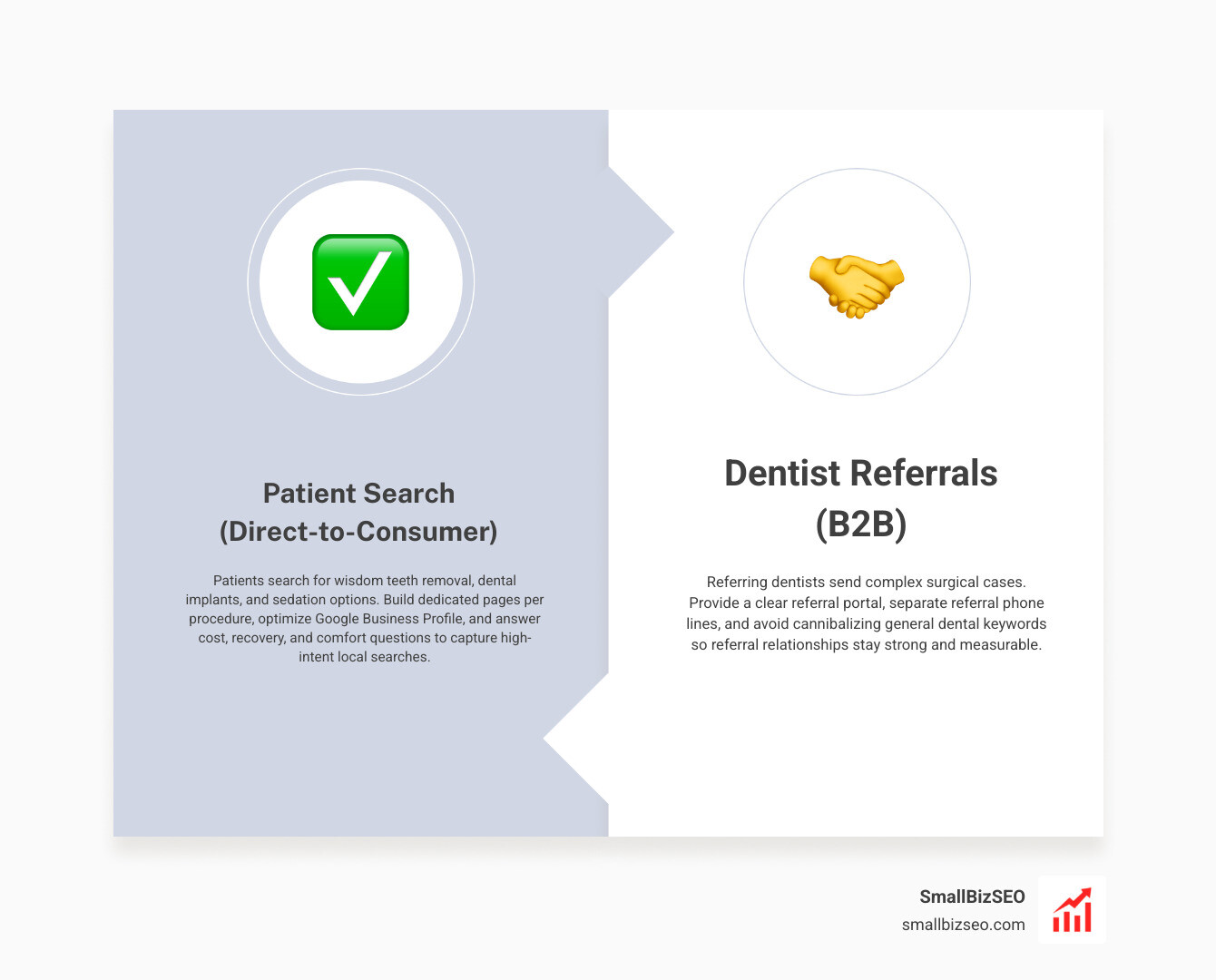
This approach helps patients find and trust your practice without competing for the routine dental work that supports your referral relationships. Give referring dentists a clear path to send cases, too. Measure success by qualified consultations, not just website visits.
I’m Clayton Johnson, founder of SmallBizSEO. My work in technical SEO, content strategy, and search visibility shapes this SEO for oral surgeon guide; I’ll show you how to put those steps together while keeping patient search and dentist referrals distinct.
The Core Technical and Local Framework of SEO for Oral Surgeons
Oral surgery websites require a fast, clean technical structure because prospective patients are often in pain or anxious about surgical interventions. A slow or broken mobile experience instantly causes searchers to bounce back to search results. In fact, 44% of patients who find healthcare options on mobile devices schedule an appointment—provided the mobile browsing experience is frictionless and intuitive.

A solid technical framework begins by ensuring core performance benchmarks are met: page loading speeds under two seconds, HTTPS encryption to protect patient data, and responsive layouts designed specifically for mobile touchscreens.
What Makes SEO for Oral Surgeons Fundamentally Different from General Dentistry?
Specialist SEO differs from general dental SEO in three fundamental ways: case value economics, consumer search intent, and the necessity of protecting doctor referral networks.
When a general dentist optimizes their digital presence, they target high-volume, routine terms like "teeth cleaning," "dental checkup," or "cavity filling." An oral and maxillofacial surgeon targets complex, high-value surgical procedures such as full-arch dental restorations, bone grafting, corrective jaw surgery, and impacted wisdom tooth extractions. While general dentistry keywords boast massive search volumes, surgical search queries carry substantially higher commercial intent and case revenue.
The most critical distinction is maintaining a referral-safe strategy. Oral surgeons rely heavily on general dentists for patient referrals. If an oral surgeon attempts to capture routine preventive dental traffic, referring dentists may view the practice as direct competition. A properly structured campaign focuses purely on specialist surgical terms.
| Strategy Dimension | General Dentistry SEO | Oral Surgery SEO |
|---|---|---|
| Primary Target Audience | Direct consumers seeking preventive care | Anxious patients seeking surgical solutions & referring dentists |
| Primary Search Intent | Routine checkups, hygiene, cleanings, minor fillings | High-intent procedures (e.g., bone grafts, zygomatic implants) |
| Keyword Strategy | Broad dental hygiene & routine terms | Referral-safe procedural terms; zero competition with general dentists |
| Average Case Economics | Lower per-visit value, high visit frequency | High surgical case revenue ($3,000–$50,000+ per case) |
| Trust Factor Needed | Convenience, friendliness, insurance acceptance | Hospital credentials, surgical safety, sedation methods, E-E-A-T |
Our dedicated oral surgeon SEO company framework isolates surgical procedures so your practice increases direct consultations without jeopardizing your referral base.
How to Dominate Google Maps and Local Pack Rankings
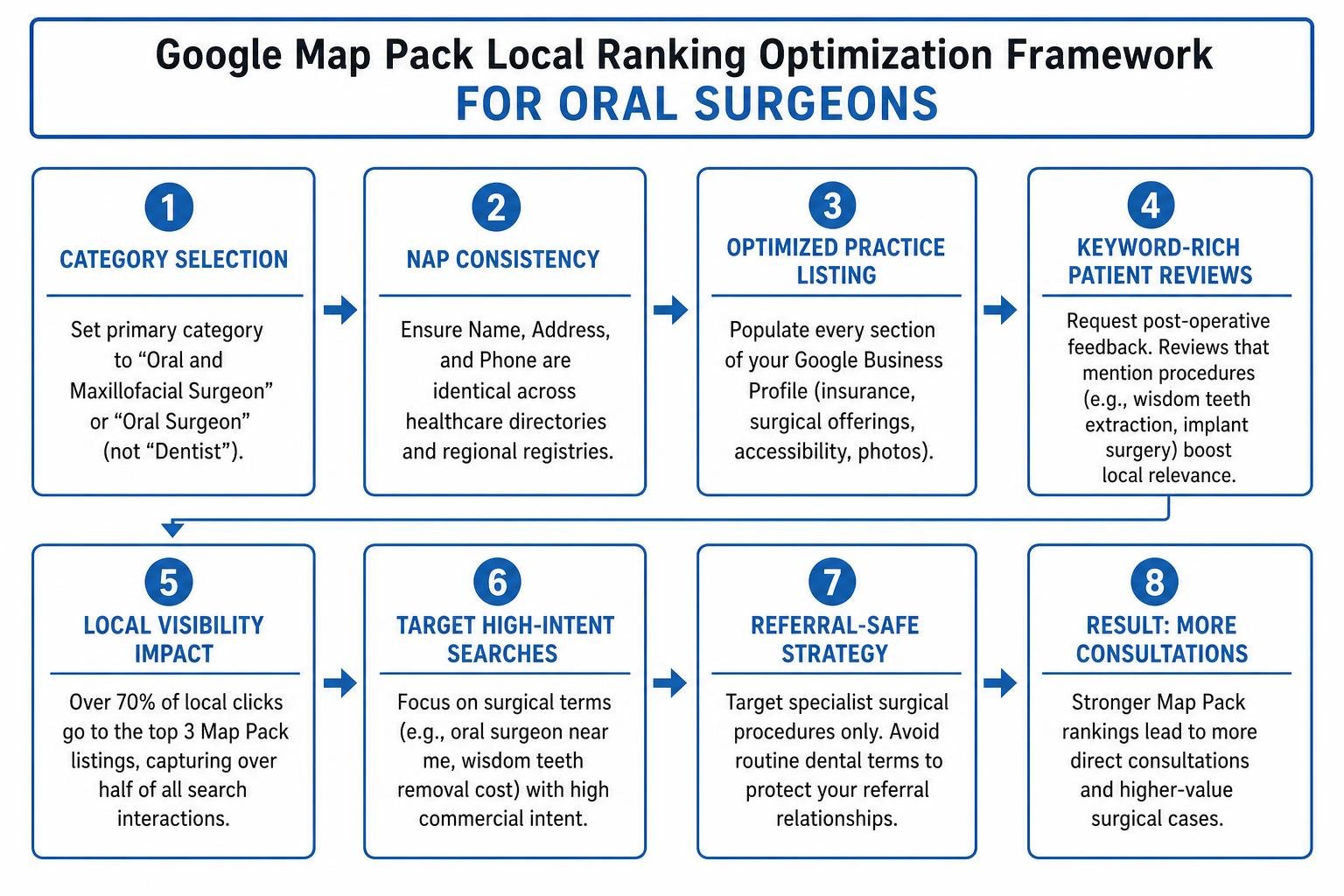
To dominate local search results, an oral surgery practice must secure a prominent spot in the Google Map Pack. Over 70% of all local clicks go directly to the top three Map Pack listings, capturing over half of all available search interactions. With roughly 40,000 monthly searches for "oral surgeon near me" and 12,000 monthly searches for "wisdom teeth removal cost," local visibility directly governs consultation volume.
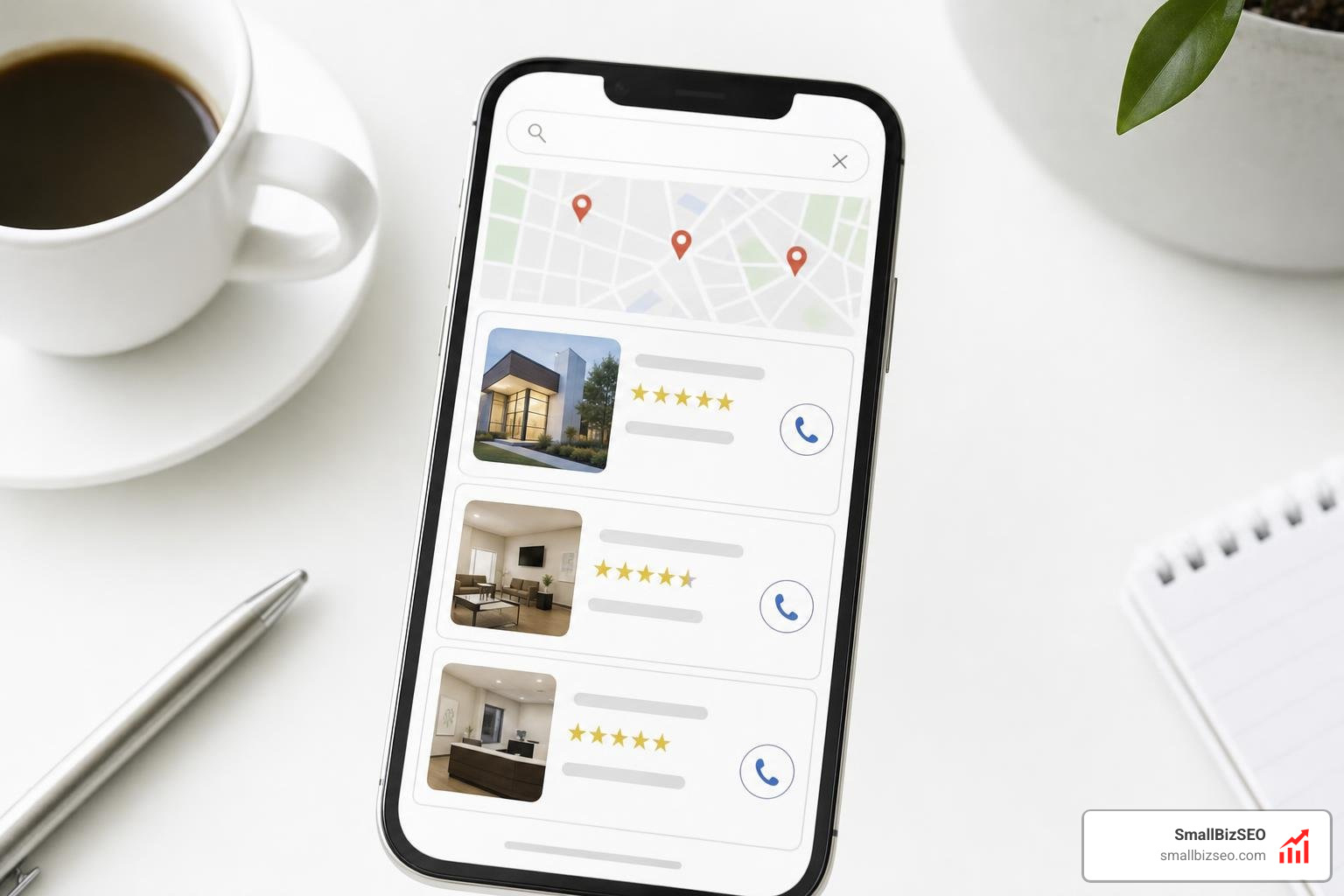
Dominating local search begins with optimizing your practice profile:
- Category Selection: Set your primary category to "Oral and Maxillofacial Surgeon" or "Oral Surgeon," rather than a generic "Dentist" tag.
- NAP Consistency: Ensure your business Name, Address, and Phone number are identical across healthcare directories and regional registries. Master the fundamentals of local search optimization basics to prevent data mismatches.
- Optimized Practice Listings: Populate every section of your Google Business Profile, including accepted insurance, surgical offerings, office accessibility, and clinic photos.
- Keyword-Rich Patient Reviews: Request post-operative feedback from satisfied patients. Reviews that naturally mention procedures like "wisdom teeth extraction" or "implant surgery" boost geographic relevance.
How Does AI Search and Technical Schema Impact Oral Surgery Visibility?
Search engines now leverage artificial intelligence to deliver conversational direct answers through Google AI Overviews, ChatGPT, and Bing Copilot. These engines pull data from authoritative, medically validated web pages that clearly explain complex surgical concepts.
To ensure AI engines cite your practice as an authority, implement comprehensive structured data. Utilizing localbusiness schema helps search engines parse your exact specialty, clinic hours, accepted insurances, and geographical service area.
Integrating specialized schema markups—such as MedicalBusiness, Physician, and FAQPage—creates an unambiguous link between your clinical credentials and procedural offerings. Research on academic search models emphasizes that structured information architecture and authoritative reputation signals are critical for lifting surgical websites to top positions (Hoque et al., 2018).
Content Architecture and ROI: Converting Searches into High-Value Surgical Cases
Attracting visitors to your website is only half the battle; your site architecture must guide an anxious patient toward booking a consultation. High-converting oral surgery websites combine clinical authority with compassionate, transparent educational material.

How to Execute Procedure-Focused Content Marketing in SEO for Oral Surgeons
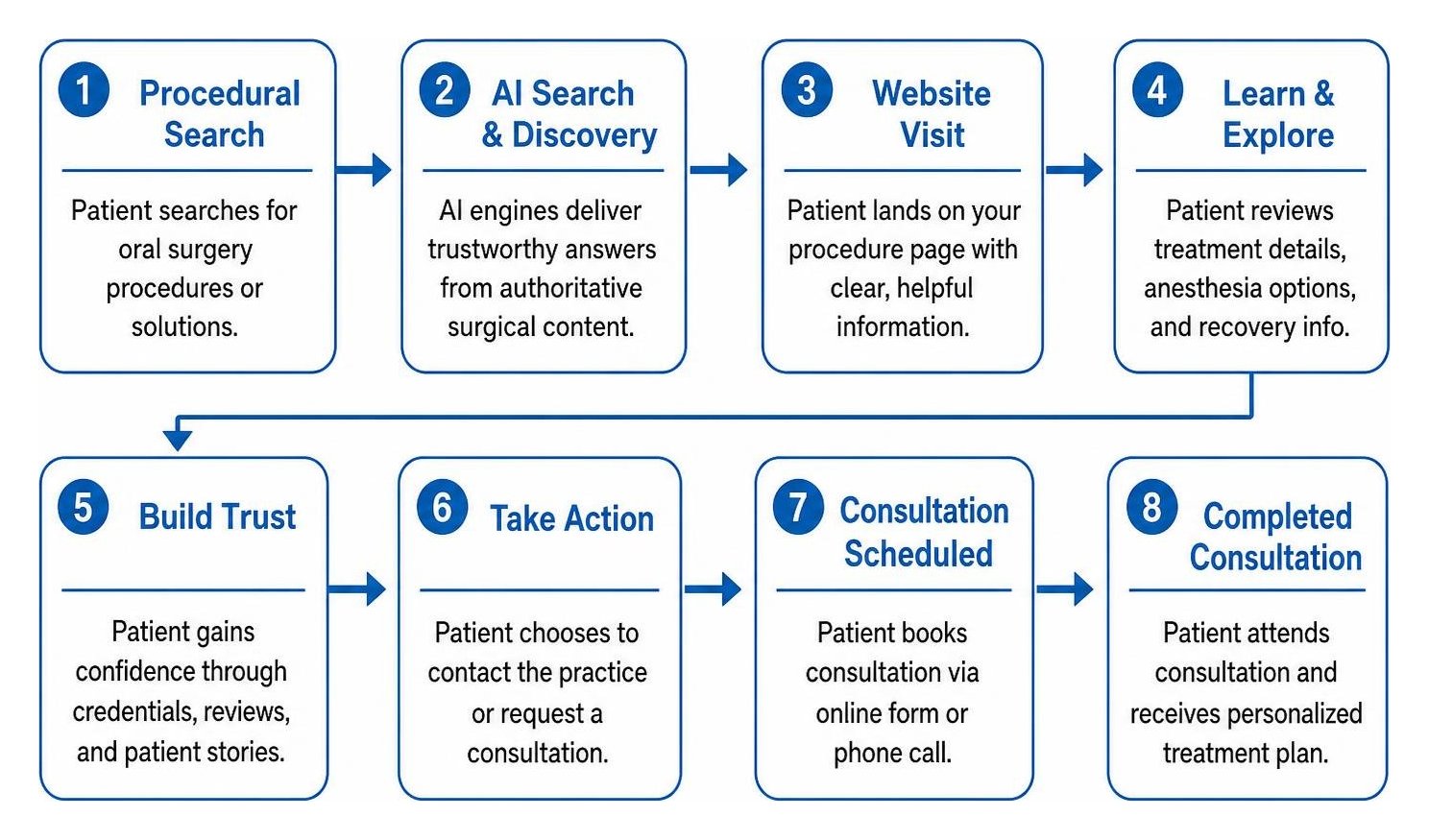
Oral surgery patients rarely make quick, impulsive decisions. They research procedural risks, anesthesia safety, recovery downtime, and financing options. Your content marketing must address these concerns clearly.
Apply structured on-page SEO across dedicated service pages for each distinct procedure your practice performs:
- Wisdom Teeth Extraction: Provide comprehensive information addressing surgical timelines, IV sedation options, dry socket prevention, and age-related extraction benefits.
- Dental Implants & Full-Arch Restorations: Target high-intent queries like single-tooth replacement, all-on-x options, bone grafting, and zygomatic implants. Paid ads for terms like "dental implants near me" often run $20–$80 per click; ranking organically for these queries captures premium cases cost-effectively.
- Surgical Comfort and Anesthesia: Outline your anesthesia protocols, monitoring technology, and staff credentials to ease procedural anxiety.
- Referring Doctor Portals: Build a dedicated, secure page where referring dentists can upload digital X-rays, submit patient histories, and track case progress.
Leveraging specialized SEO content services ensures every article meets strict search quality guidelines while remaining approachable for everyday readers.
How Should Practices Track Marketing ROI and Avoid Costly Pitfalls?
Tracking return on investment in oral surgery requires separating direct patient search consultations from traditional dental referrals.
To track conversions accurately:
- Dynamic Call Tracking: Implement dynamic call tracking to assign unique phone numbers to organic search visitors while keeping your primary line reserved for referring offices.
- Consultation-to-Case Metrics: Track your cost per consultation, case acceptance rates, and booked-to-kept ratios across organic channels.
- Avoid Keyword Cannibalization: Ensure individual blog posts support your main procedure pages rather than competing against them for the same search terms.
A standard organic campaign takes roughly 4 to 8 months to reach page-one rankings for competitive surgical queries, compounding in value as your domain authority grows.
Transform Your Oral Surgery Practice's Search Visibility
Building search visibility for an oral surgery clinic requires a balanced strategy: targeting high-value procedural searches, easing patient anxiety, and providing a streamlined digital portal for referring dentists. By establishing a solid technical foundation, dominating local map rankings, and publishing authoritative content, your practice can secure a predictable pipeline of surgical consultations.
Ready to see where your website stands in search results? Request a tailored SEO visibility audit from SmallBizSEO to uncover hidden technical bottlenecks and start growing your patient consultations today.
References
MdSaidul Hoque, Abeer Alsadoon, Angelika Maag, P.W.C. Prasad, Amr Elchouemi. "Comprehensive Search Engine Optimization Model for Commercial Websites: Surgeon’s Website in Sydney." Journal of Software, 2018. DOI 10.17706/jsw.13.1.43-56.