SEO for Records Storage: Turn Service Searches Into Qualified Quotes

Search optimization for commercial records management connects facilities with organizations searching for offsite physical storage, document scanning, rapid retrieval, and certified shredding. Effective search strategy builds clear, dedicated service pages, highlights verifiable chain-of-custody protocols, and captures structured quote inquiries without exposing confidential records.
This guide focuses on commercial business-to-business records management. Making a public digital archive discoverable for researchers involves open bibliographic indexing, which serves a different purpose than helping corporate buyers evaluate and select a secure records vendor.
How Does SEO Help Archives, Records, & Documents Storage Providers?
Commercial records storage SEO aligns facility capabilities with high-intent enterprise searches, structures technical landing pages for crawlability, and gives decision-makers the operational evidence required to request formal pricing.
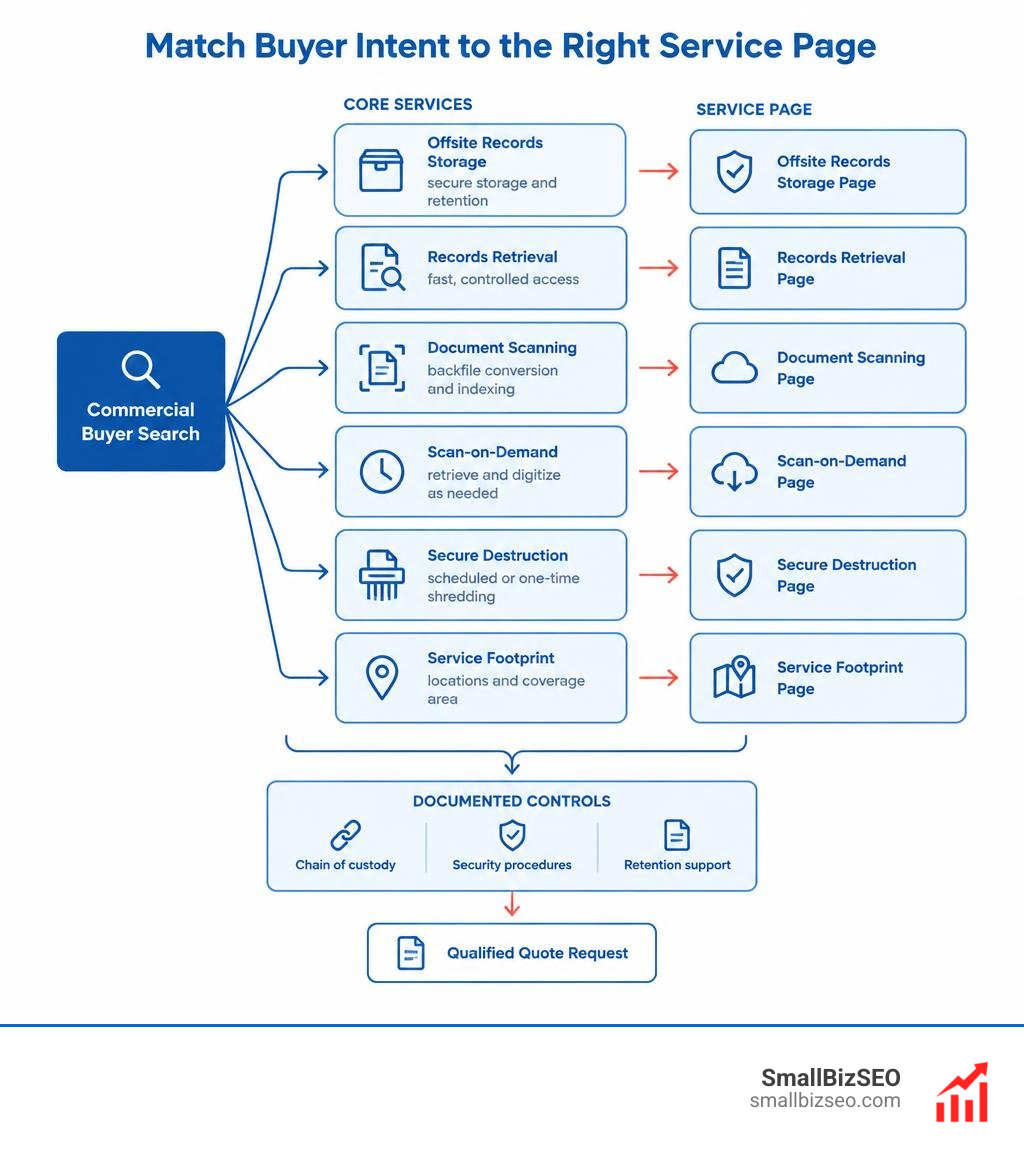
Commercial search results for records management commonly feature separate pages for storage, retrieval, scanning, destruction, service footprint, and documented controls. Reflect those patterns with clear service-focused pages rather than one broad overview page.
When healthcare systems, legal practices, and corporate enterprises need offsite storage or digital conversion, they search for verified vendors with strict chain-of-custody controls. Consolidating all services onto a single generic page can make relevant pages harder for search engines to identify. Dedicated pages for each core capability give search engines and commercial buyers a clearer match to the service they need.
Which Core Service Pages Match Commercial Search Intent?
Targeting commercial search queries captures organizations ready to procure compliant offsite archiving, backfile scanning, or destruction programs.
| Core Commercial Service | Buyer Search Intent | Primary Page Focus | Target Search Queries |
|---|---|---|---|
| Offsite Records Storage | Long-term physical box archiving | Verified storage capabilities and retention support | "secure document storage", "medical records archive warehouse" |
| Document Scanning | Backfile conversion to digital formats | High-volume scanning, OCR text extraction, indexing | "bulk document scanning services", "legal file digitization" |
| Scan-on-Demand | Rapid digital access to physical files | Current, verifiable response options and delivery methods | "scan on demand records", "emergency document retrieval" |
| Secure Shredding | Compliant physical destruction | Current, verifiable certifications where applicable; available shredding options | "certified paper shredding", "scheduled records destruction" |
| Records Retrieval | Scheduled physical file delivery | Courier delivery options, barcode tracking | "physical records delivery", "archive retrieval service" |
What Operational Evidence Belongs on Service Landing Pages?
Commercial buyers require verifiable operational details before submitting an inquiry. Every service page should include:
- Verified Service Capabilities: Describe only capabilities the provider currently offers and can substantiate, such as available storage, scanning, retrieval, or destruction services.
- Documented Handling Controls: Summarize high-level controls and procedures without publishing operational security details.
- Conditional Regulatory Alignment: Describe applicable documented procedures only where they are relevant to the provider's operations and client requirements.
- Current Service Commitments: State response times, certifications, or service terms only when they are current, verifiable, and applicable to the specific service.
How Does Public Archive Indexing Differ from Commercial Storage?
Public digital archives and institutional repositories focus on open research access rather than private commercial storage. Public collections require open metadata structures, permanent URLs, and crawlable XML sitemaps to help academic search engines discover historical files. In contrast, commercial records management keeps client assets private and focuses search optimization on landing pages that generate qualified service inquiries.
What Technical SEO Steps Help Service Pages Get Found?
Keep each core service page available to search engines with a descriptive title, a unique primary heading, a self-referencing canonical URL, and an XML sitemap entry. Do not block customer-facing service pages with noindex, password gates, or robots directives unless the page is intentionally private.
Use contextual internal links between related storage, scanning, retrieval, and destruction pages so visitors can compare services without returning to a generic overview. For local eligibility, create locally focused pages only for areas the provider genuinely serves and support them with specific operational details, not near-duplicate pages that merely swap place names.
How Can Storage Providers Turn Search Visibility into High-Value Contracts?
Providers turn search visibility into commercial contracts by addressing pricing factors clearly, using structured intake forms, and maintaining strict data security boundaries.
What Price-Component Questions Should Landing Pages Address?
Commercial buyers expect clarity around how contracts are priced. Rather than quoting arbitrary rates, service pages should outline the core pricing variables:
- What is the total volume of boxes or linear feet stored per month?
- How frequently will files require physical retrieval or scan-on-demand fulfillment?
- What preparation is required for document scanning, such as staple removal, indexing complexity, or OCR processing?
- Is physical destruction billed per container, per purge project, or by recurring route frequency?
- What administrative fees apply for initial intake, barcode indexing, or permanent file withdrawal?
How Do Active Records and Inactive Archives Compare in Practice?
Consider a hypothetical scenario comparing two distinct business profiles:
- Hypothetical Profile A (Low-Retrieval Archive): A law firm might store approximately 3,000 cartons of closed case files and request retrieval infrequently. The illustrative priority is economical storage and a service model suited to low retrieval demand.
- Hypothetical Profile B (Frequent-Retrieval Records): A clinical group might maintain approximately 600 cartons of active charts and request retrieval or scan-on-demand services often. The illustrative priority is a service model that supports frequent access.
These examples are illustrative, not service promises. Retention, destruction, and legal-hold decisions require authorized review, and any service-level commitment should be confirmed in the provider's current agreement.
Highlighting these distinct workflows on dedicated landing pages helps both buyer types recognize that the facility accommodates their specific operational demands.
How Should Quote Requests Be Structured?
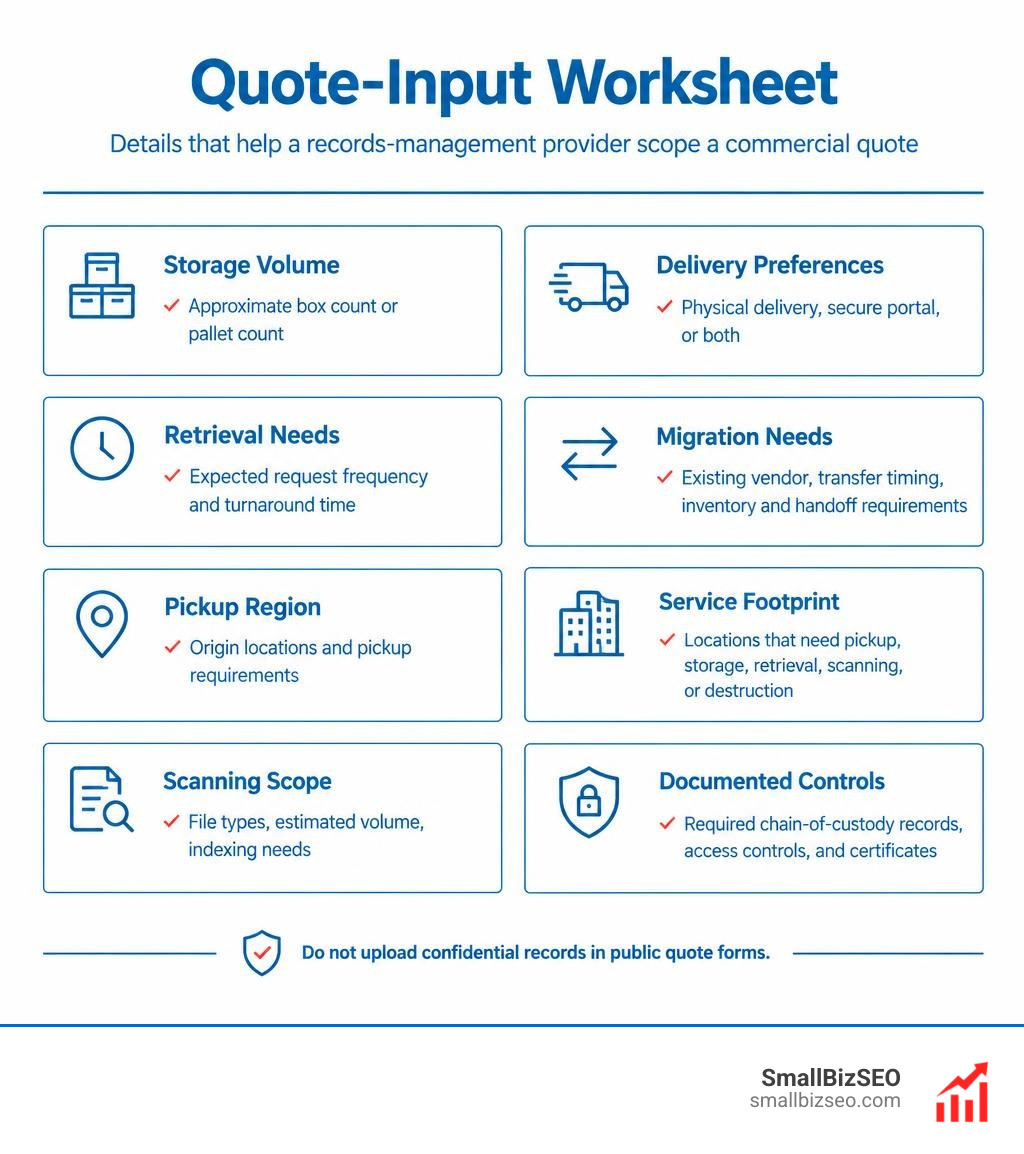
A structured intake form qualifies incoming opportunities without introducing friction. Essential worksheet fields include:
- Total storage volume (approximate box count or linear shelf feet)
- Expected retrieval frequency (daily active access vs. long-term retention)
- Required service region and scheduled pickup frequency
- Scanning scope (full backfile conversion vs. scan-on-demand)
- Digital delivery preferences and records management software compatibility
- Migration needs, including legacy-system export, file mapping, and onboarding support
Important Security Warning: Never permit prospective clients to upload confidential documents or sensitive records through standard public web forms. Direct prospects to schedule a consultative scoping call or use an authenticated client portal for document exchanges.
How Do Authentication and Access Controls Protect Confidential Portals?
A robots.txt disallow rule asks compliant crawlers not to crawl a URL; it does not guarantee that the URL will be removed from search results. A noindex directive controls indexing when crawlers can access the page. Neither mechanism is access control, as explained in Google's control what you share documentation. Confidential files require authentication and authorization.
Public marketing pages should describe high-level access and confidentiality controls without exposing implementation details. When a provider or client qualifies as a HIPAA covered entity or business associate, applicable operations must follow the relevant safeguards described in HHS covered-entity and business associate guidance.
Which Pipeline Metrics Show Whether SEO Supports Business Growth?
Evaluating search performance requires tracking pipeline progression through each stage of the sales cycle:
- Total Organic Visits: Baseline traffic arriving at commercial service pages.
- Qualified Quote Submissions: Inquiries that meet the provider's documented qualification criteria.
- Proposal Conversion Rate: The share of qualified inquiries that advance to formal pricing and scoping.
- Signed Contract Value: Revenue associated with signed storage, digitization, or destruction agreements.
- Attributed Acquisition Cost: SEO, content, sales, and operational costs needed to generate and pursue qualified opportunities.
Attribution is imperfect: buyers may return through direct, referral, paid, or offline channels before contacting a provider. Use consistent source tracking and CRM records to estimate ROI, while treating channel credit as an informed approximation rather than a precise guarantee.
Evaluating tailored SEO packages helps providers align their technical structure and service pages with these commercial pipeline metrics.
Accelerate Your Commercial Records Inquiries
Generating qualified commercial inquiries requires a clear service architecture, documented operational controls, and conversion-focused intake forms. By building dedicated pages for physical storage, backfile scanning, scan-on-demand, and secure shredding, records management facilities attract high-intent business buyers ready to contract.
To build a targeted search strategy that delivers qualified commercial quote requests, schedule a discovery consultation to review your market opportunities.