The Ultimate Guide to SEO Services

The Ultimate Guide to SEO Services
How Can SEO Services Help Your Business Grow?
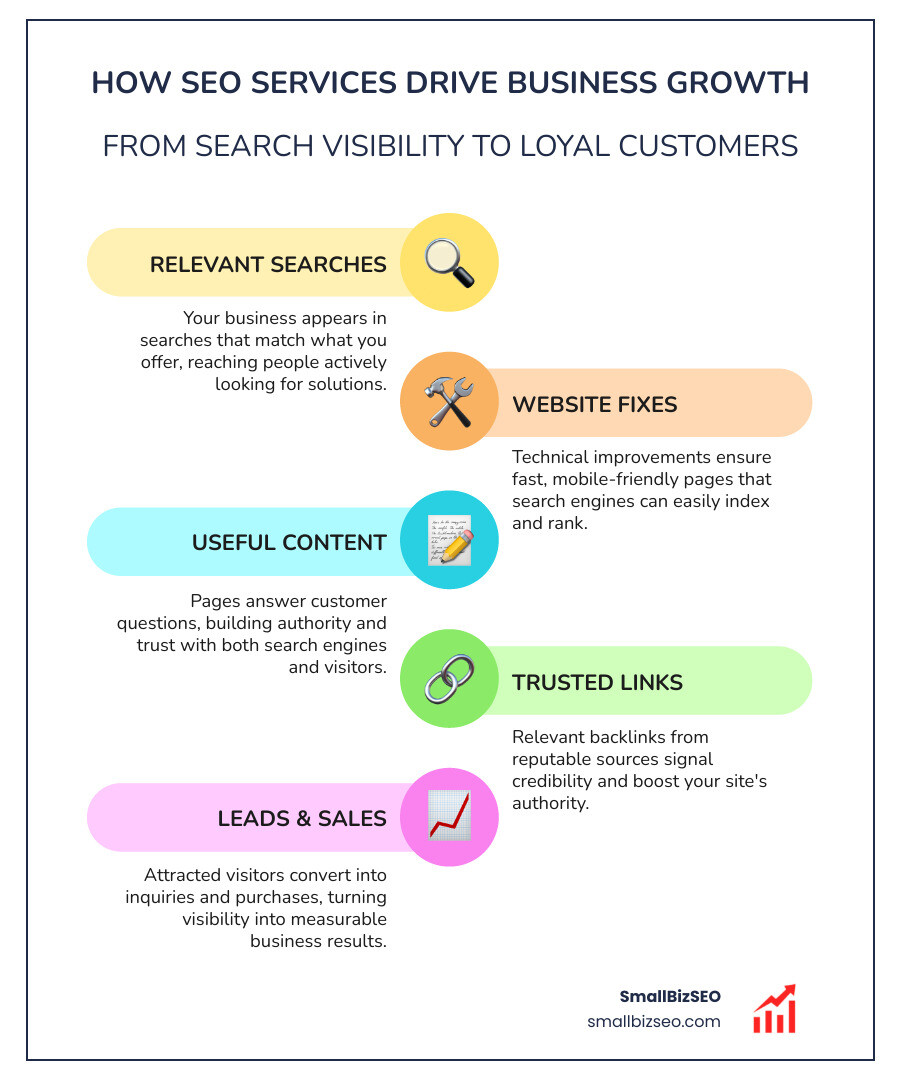
SEO services help your business appear in relevant searches, attract potential customers, and turn more of those visits into leads or sales over time. A useful service should fix website issues, improve pages that answer customer questions, build trust through relevant links, and report on inquiries or sales, not just rankings.
The right plan depends on who you serve and where they search. A local shop may need stronger visibility in Google Maps, while an online store may need better product pages. Neither should pay for work that does not support its business goals.
I'm Clayton Johnson, founder of SmallBizSEO. My work in SEO, content, and digital PR helps owners judge what an SEO service for business should deliver, including visibility in traditional search and AI-generated answers.
SEO service for business helpful reading:
How to Choose and Implement the Right SEO Service for Business Growth
Direct answer: The right SEO service connects technical website health, high-value content creation, and authoritative backlink acquisition to the exact queries your potential buyers type into search engines every day.
Search engines use automated bots to crawl web pages, index their content, and rank them based on relevance, quality, and authority. Winning top search rankings requires satisfying search algorithms while answering real human intent. The top 3 organic search results capture more than two-thirds (68.7%) of all clicks, which means ranking on page two leaves your business virtually invisible.
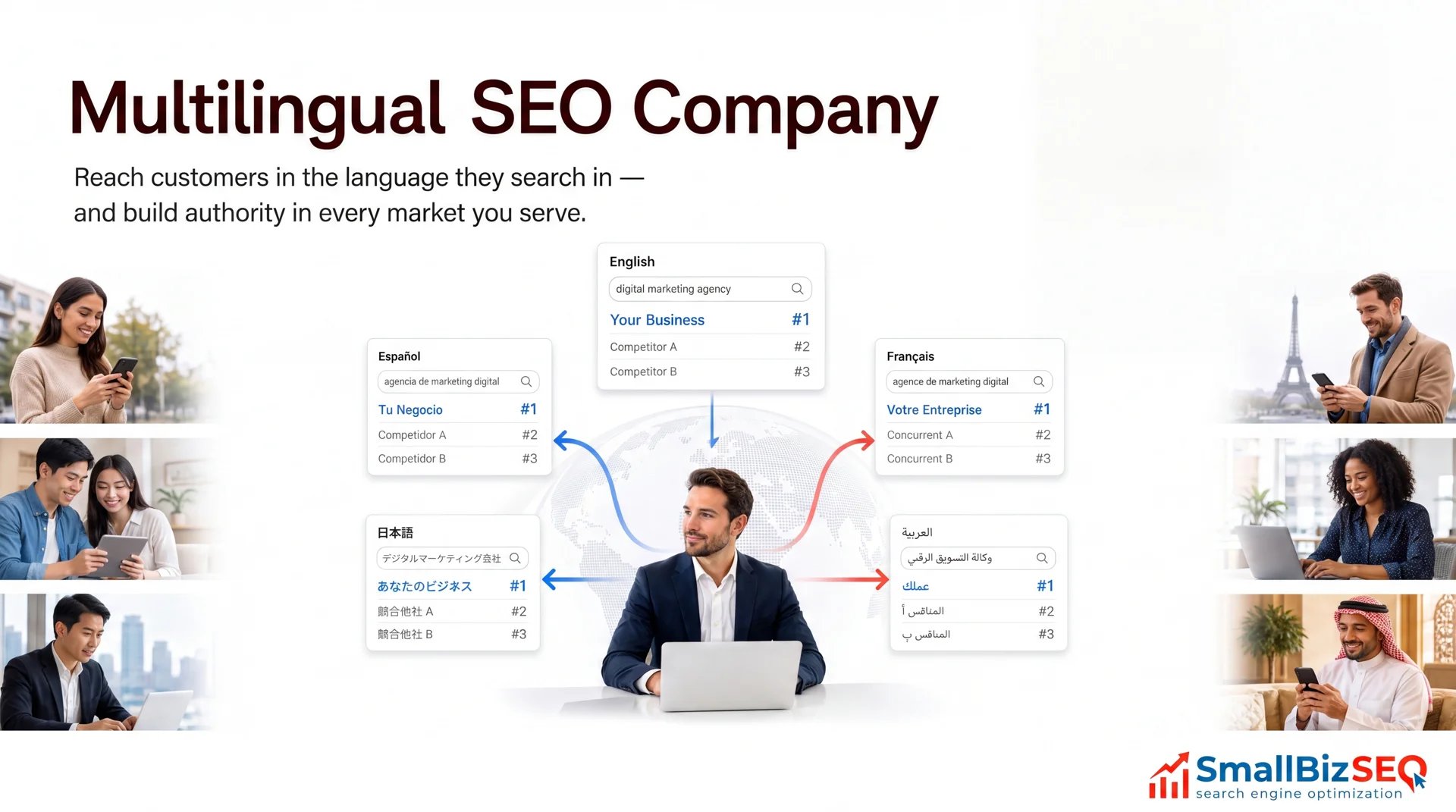
A strategic approach aligns with Google's E-E-A-T guidelines (Experience, Expertise, Authoritativeness, and Trustworthiness). Achieving sustainable growth requires structuring your site architecture, establishing topical authority, and tracking bottom-line conversions. Our team follows a data-driven Velocity framework to deliver fast rankings and transparent growth. You can explore our foundational roadmap in The Complete Guide to SEO Business Growth to see how organic channels support overall commercial expansion.
What Core Deliverables Come With an SEO Service for Business?
Direct answer: A complete SEO service package includes comprehensive technical audits, on-page optimization, content production, ethical link building, and transparent monthly performance reporting.
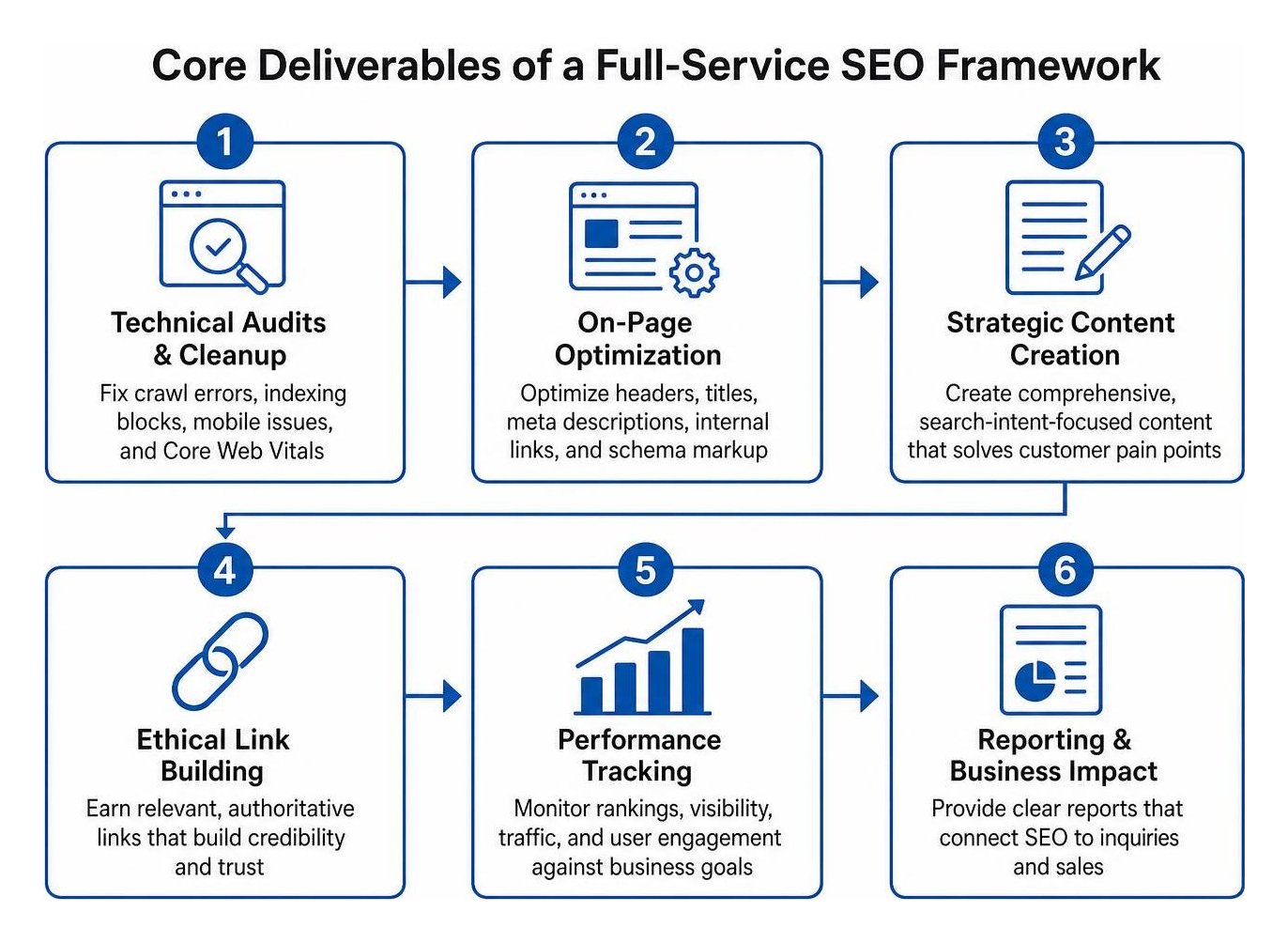
When partnering with a reputable provider, you should expect these core pillars:
- Technical Audits & Cleanup: Resolving crawl errors, indexing blocks, mobile responsiveness issues, and Core Web Vitals to ensure lightning-fast page speed.
- On-Page Optimization: Structuring header tags, updating meta descriptions, crafting descriptive title tags, mapping internal links, and adding schema markup.
- Strategic Content Creation: Writing comprehensive, search-intent-focused articles and service pages that solve customer pain points without artificial fluff.
- Authority Building & Off-Page SEO: Securing natural, white-hat backlinks from reputable publications and directories in your niche.
- Transparent Tracking: Automated dashboards linking keyword positions directly to phone calls, form submissions, and sales events.
To understand how full-service packages combine these deliverables into unified workflows, review The Ultimate Guide to Choosing a Full Service SEO Company.
How Do Local, E-Commerce, B2B, and Enterprise SEO Services Differ?
Direct answer: SEO strategies differ fundamentally based on your target audience: local companies target geographic proximity, e-commerce stores optimize product catalogs, B2B brands focus on high-intent lead generation, and enterprise sites manage complex technical scale.
With 64% of consumers searching for local businesses online, local SEO centers on Google Business Profile management, localized citations, and maintaining identical Name, Address, and Phone (NAP) details across directories like Small Biz SEO on MapQuest to win spots in the local 3-Pack.
E-commerce businesses need structured product schemas, category taxonomy optimization, and faceted navigation controls. B2B and B2C campaigns target longer sales cycles through educational white papers, case studies, and solution pages. Meanwhile, enterprise architectures require managing thousands of URLs, resolving crawl budget constraints, and executing multi-location international strategies.
How Is AI Changing Traditional Search Results?
Direct answer: AI-assisted search tools synthesize answers directly from web sources, meaning businesses must optimize their content for entity recognition and clear citations alongside classic search rankings.
Roughly 37% of consumers now begin their research journeys with AI platforms like ChatGPT, Gemini, or Perplexity rather than traditional engines alone. Even though 90% of global searches still occur on Google, features like AI Overviews extract concise data summaries directly onto the results page.
To earn visibility in these generative environments, brands rely on Generative Engine Optimization (GEO). This involves publishing answer-ready definitions, implementing clear structured data, answering conversational questions directly, and building strong third-party brand mentions so AI models recognize your company as a primary authority.
Maximizing ROI, Timelines, and Provider Selection for Your Business
Direct answer: Maximizing your SEO return on investment requires selecting an experienced partner, maintaining realistic multi-month timelines, and monitoring tangible business outcomes rather than vanity metrics.
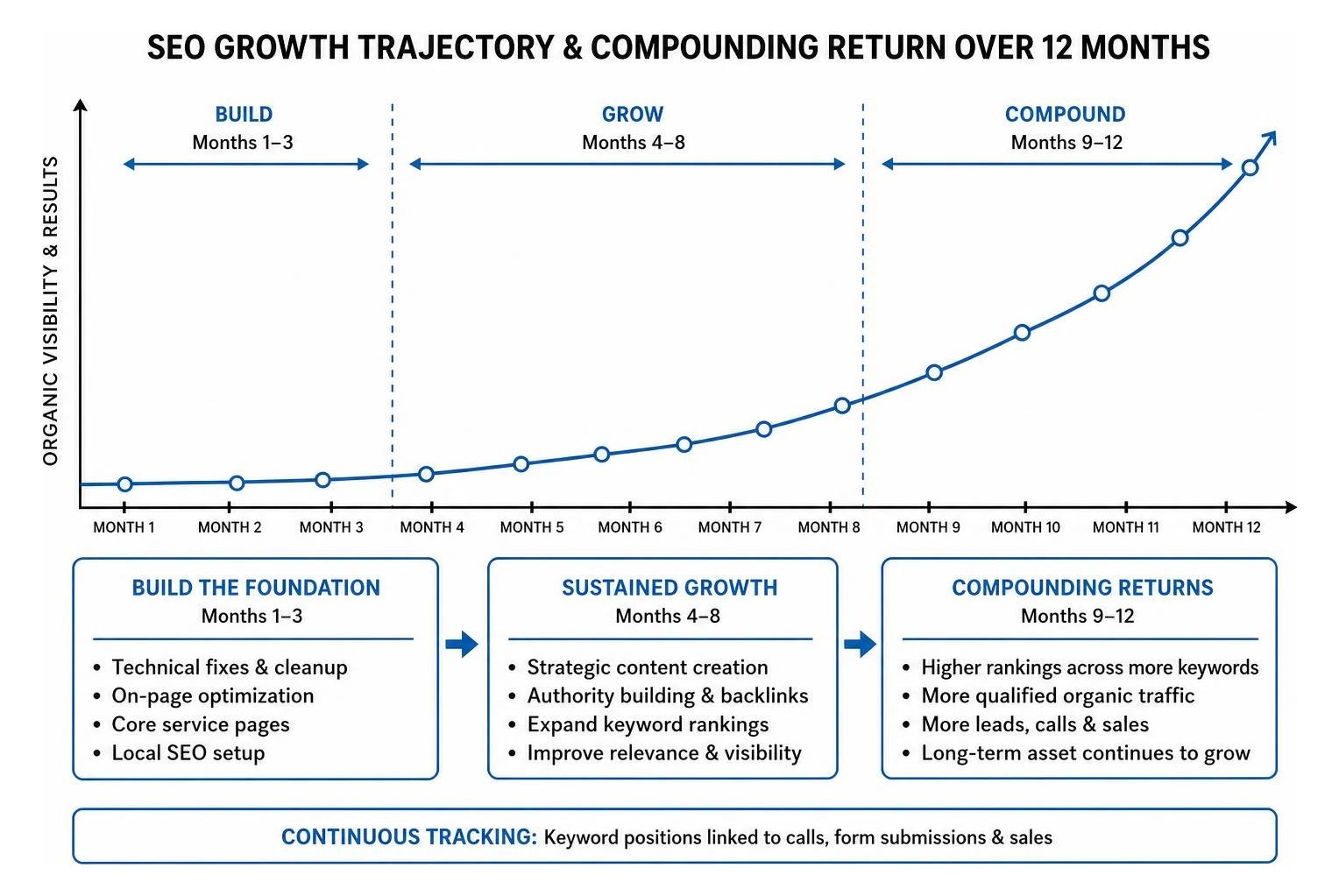
SEO functions as an asset that builds compounding equity over time. Unlike paid ads, which turn off the moment you stop paying, organic visibility continues generating qualified traffic long after the initial work is completed.
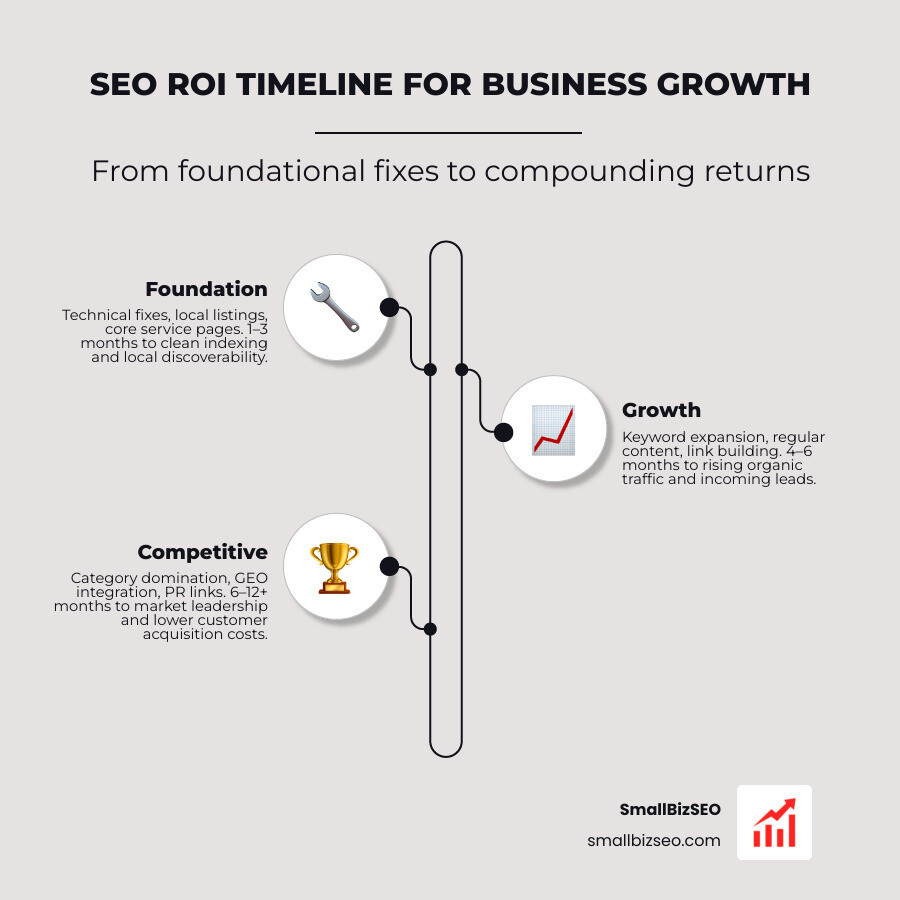
| Business Stage | Focus Area | Ramp-Up Period | Primary Outcome |
|---|---|---|---|
| Foundation | Technical fixes, local listings, core service pages | 1–3 months | Clean indexing, local discoverability |
| Growth | Keyword expansion, regular content, link building | 4–6 months | Rising organic traffic, incoming leads |
| Competitive | Category domination, GEO integration, PR links | 6–12+ months | Market leadership, lower customer acquisition costs |
Before committing your marketing budget, learn how to vet potential agencies in The Definitive Guide to Choosing a Professional SEO Company, or run a baseline assessment by requesting a free SEO visibility audit from our specialists.
How Much Does an SEO Service for Business Cost and What Drives Pricing?
Direct answer: Professional SEO services generally range from $500 to $10,000+ per month, with most small-to-midsize businesses investing between $700 and $3,500 per month on a retainer model.
| Retainer Tier | Typical Monthly Cost | Best Suited For | Key Deliverables |
|---|---|---|---|
| Starter / Foundation | $499 – $999 | Local businesses in low-competition areas | Google Business Profile, basic technical fixes, monthly citations |
| Growth / Expansion | $1,200 – $2,500 | Growing regional brands, niche e-commerce | Full technical maintenance, monthly content, active outreach |
| Competitive / Enterprise | $3,000 – $10,000+ | High-competition verticals, multi-location sites | Custom engineering, large-scale content, digital PR, GEO integration |
Pricing is influenced by your industry's competitive landscape, historical technical debt on your domain, geographic scope, and whether the provider handles hands-on implementation or merely provides recommendations.
How Long Does It Take to See Organic Results and Measure ROI?
Direct answer: Most businesses start seeing initial ranking shifts within 3 to 6 months, while substantial revenue growth typically takes 6 to 12 months as authority compounds.
Search engines take time to discover, crawl, and evaluate new content and external links. For an e-commerce business, a healthy SEO return is roughly $2.75 for every dollar spent—a 275% ROI.
To measure your true ROI, calculate the lifetime customer value and track site event values using Google Analytics 4:
Net SEO Return = (Total Organic Revenue Generated - Total SEO Service Cost) / Total SEO Service Cost × 100
Should You Hire an Agency, Freelancer, or In-House Team?
Direct answer: Choose an SEO agency for a full team of specialists at a predictable monthly cost, a freelancer for narrow one-off tasks, or an in-house hire if you have the budget to manage a full-time specialist internally.
Freelancers provide affordable help for single tasks like copywriting, but often lack cross-disciplinary tools. Hiring an in-house specialist offers dedicated focus, but requires paying a full-time salary, benefits, and expensive tool subscriptions.
A trusted agency provides access to technical developers, content strategists, and outreach specialists simultaneously. Beware of common industry red flags: avoid any provider promising "guaranteed #1 rankings," offering mysterious proprietary networks, or refusing to grant you ownership of your website assets and analytics. If you want to dive deeper into vetting prospective partners, explore our guide on Finding the Best SEO Company for Real Organic Growth.
Taking the Next Step Toward Sustainable Search Dominance
Direct answer: Sustainable organic growth begins with choosing a transparent partner who aligns technical execution and authoritative content with your real revenue goals.
Search optimization is not a one-time project—it is an ongoing business growth engine that protects your brand against rising ad costs and changes in consumer habits. By pairing technical SEO, helpful content, and modern AI search optimization, your business can secure the top rankings it deserves.
Ready to see how our data-driven Velocity framework can accelerate your search performance? Explore our flexible SEO packages, review our verified client results across our case studies, or reach out through our contact page to start building your search presence today.