Steal Their Strategy: How to Check Competitors Keywords Free Today

Steal Their Strategy: How to Check Competitors Keywords Free Today
How to Check Competitors Keywords Free (And Actually Use What You Find)
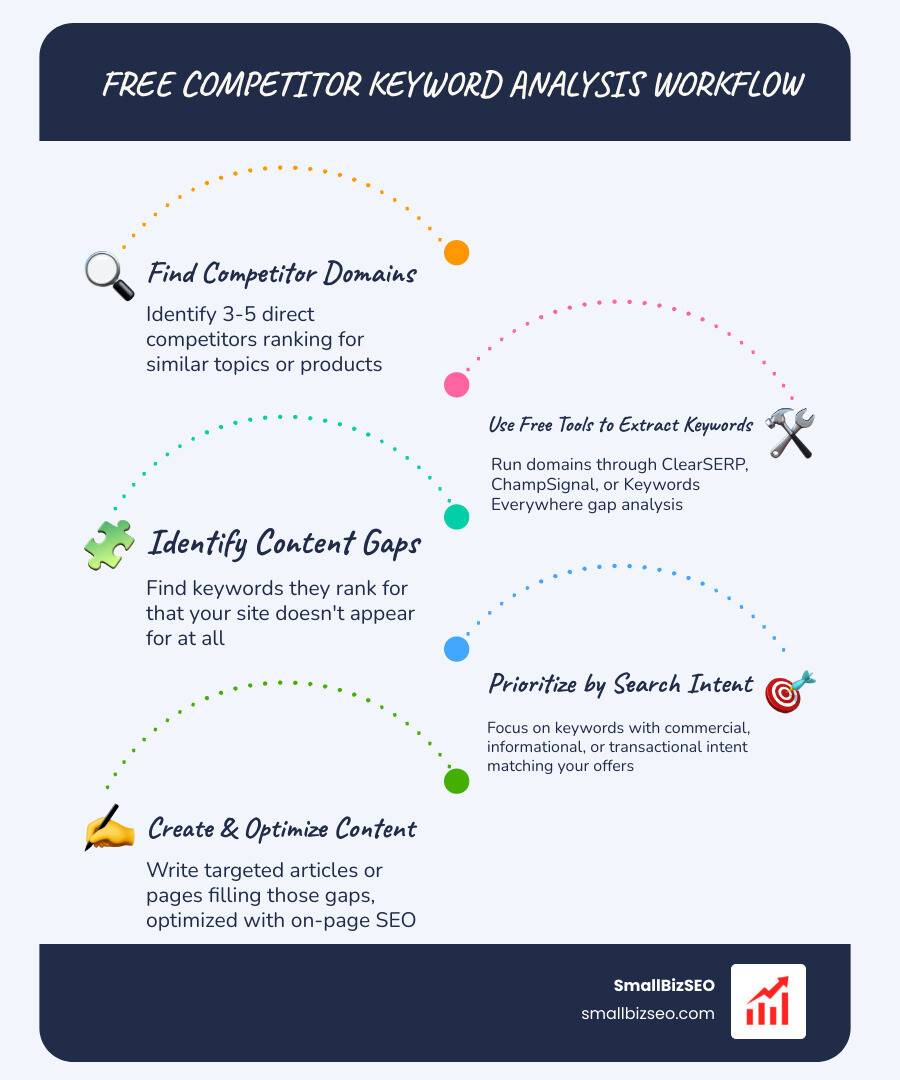
Want to check competitors keywords free right now? Here are the fastest ways to do it:
| Tool | What You Get Free | Signup Required? |
|---|---|---|
| ClearSERP | 50 ranked keywords per search, 5 searches/hour | No |
| ChampSignal | Top 10 organic keywords per site | No |
| Keywords Everywhere | Keyword gap vs. up to 10 competitors | No |
| KWFinder | Competitor domain keyword lookup | Yes (free trial) |
| Seobility | 5 keyword checks per day | Yes (free plan) |
| Google Ads Transparency Center | Competitor PPC ad copy | No |
Your competitors are already ranking for keywords you haven't even thought to target yet. That's traffic going to them instead of you — and it doesn't have to stay that way.
The good news? You don't need a $100/month tool subscription to find out what's working for them. There are several free and freemium tools that let you pull real keyword data from any competitor's domain in seconds — no spreadsheets, no guesswork.
Finding those keywords is just the first step. The bigger opportunity is using that data to close content gaps, sharpen your SEO strategy, and even refine your Google Ads campaigns — all without spending a dollar on research tools.
I'm Clayton Johnson, a digital PR and SEO strategist who has spent years helping businesses use competitive intelligence to improve search visibility — including finding ways to check competitors keywords free before committing to paid software. This guide walks you through the best free tools available and exactly how to put the data to work.
Why You Should Check Competitors Keywords Free for SEO Growth
When we start an SEO audit, we rarely begin with a blank page. Instead, we look at what is already succeeding in your niche. Running a competitive analysis reveals exact market demands, eliminating guesswork about what searchers want.
Analyzing rival domains highlights proven terms driving organic search traffic directly to your industry rivals. Learning How to Analyze Keywords allows us to reverse-engineer competitor search strategies, map out market trends, and capitalize on low-hanging opportunities.
How to Check Competitors Keywords Free to Identify Content Gaps
A proper keyword gap analysis identifies topics your rivals rank for while your site remains invisible. When two or three competitors rank on page one for a search query that you haven't written about, search engines see a content gap on your domain.
Identifying unranked terms helps build a structured topic strategy. Instead of publishing random blog posts, you address clear audience inquiries. If you want to dive deeper into missing content opportunities, check out our detailed guide on Keyword Gap Analysis: What It Is and How to Do It Right.
Bridging SEO and PPC Campaign Strategies
Competitive intelligence isn't limited to organic SEO. Examining paid search data exposes the commercial terms driving direct revenue for competing brands.
- Cost-Per-Click (CPC) Insights: High CPC terms signal strong commercial intent and high transaction rates.
- Ad Copy Variations: Studying competitor Google Ads copy highlights selling points and emotional hooks that resonate with buyers.
- Ad Split Testing: Reviewing historical ad variations shows which headlines survived long-term testing and which failed.
- Negative Keyword Lists: Identifying search terms competitors stopped bidding on helps build negative keyword lists to prevent wasted ad budget.
Top Free Tools to Check Competitors Keywords Free
You don't need expensive software to unlock competitive intelligence. Freemium and zero-cost competitor keyword tools deliver actionable search volume and ranking data without monthly fees.
| Tool | Daily/Hourly Limits | Best Use Case | Unique Feature |
|---|---|---|---|
| KWFinder | Restricted trial queries | Local SERP search volume | 50,000+ local SERP database |
| Seobility | 5 free checks per day | Domain gap analysis | Organic SERP metrics vs. PPC metrics |
| ClearSERP | 5 searches per hour | Fast non-branded checks | 10 instant results (50 via email) |
| ChampSignal | Unlimited single lookups | Instant snapshot checks | Top 10 organic ranking terms |
| Keywords Everywhere | 50 daily gap lookups | Multi-domain comparison | Side-by-side overlap across 10 sites |
KWFinder and Seobility
KWFinder offers access to over 200 million keywords across 258 million domains. It allows filtering keyword lists by localized SERPs across 34 countries. You can test these capabilities using the Free Competitor Keyword Analysis Tool.
Seobility provides 5 free checks per day on its Basic plan. It separates organic search data from Google Ads metrics, preventing paid ad competition scores from distorting organic difficulty evaluations.
Keywords Everywhere, ClearSERP, and ChampSignal
Keywords Everywhere offers a gap tool that compares your domain against up to 10 competitors side by side. Free accounts get up to 50 daily ranking lookups, making it ideal for domain overlap tracking. Discover how to compare domain profiles with the Keyword Gap Analysis - Free Keyword Research Tools.
ClearSERP's ranked keywords tool delivers up to 50 terms per domain search (10 instantly, 50 via email) with a cap of 5 searches per hour. ChampSignal offers a zero-signup lookup displaying a site's top 10 organic keywords alongside Keyword Difficulty (KD) scores from 0 to 100.
Google Ads Transparency Center and Exploding Topics
To evaluate paid search strategies, pair keyword research tools with creative ad transparency engines. The Google Ads Transparency Center lets you view active text, image, and video ads run by verified advertisers across regions.
Pairing this with the Free AdWords Competitor Analysis - See Their PPC Strategy highlights high-priority keywords based on historical ad spend, helping you differentiate landing page strategies from competing brands.
How to Conduct a Free Keyword Gap Analysis Step by Step
Running a competitor gap analysis requires a systematic workflow to convert raw search data into prioritized execution.
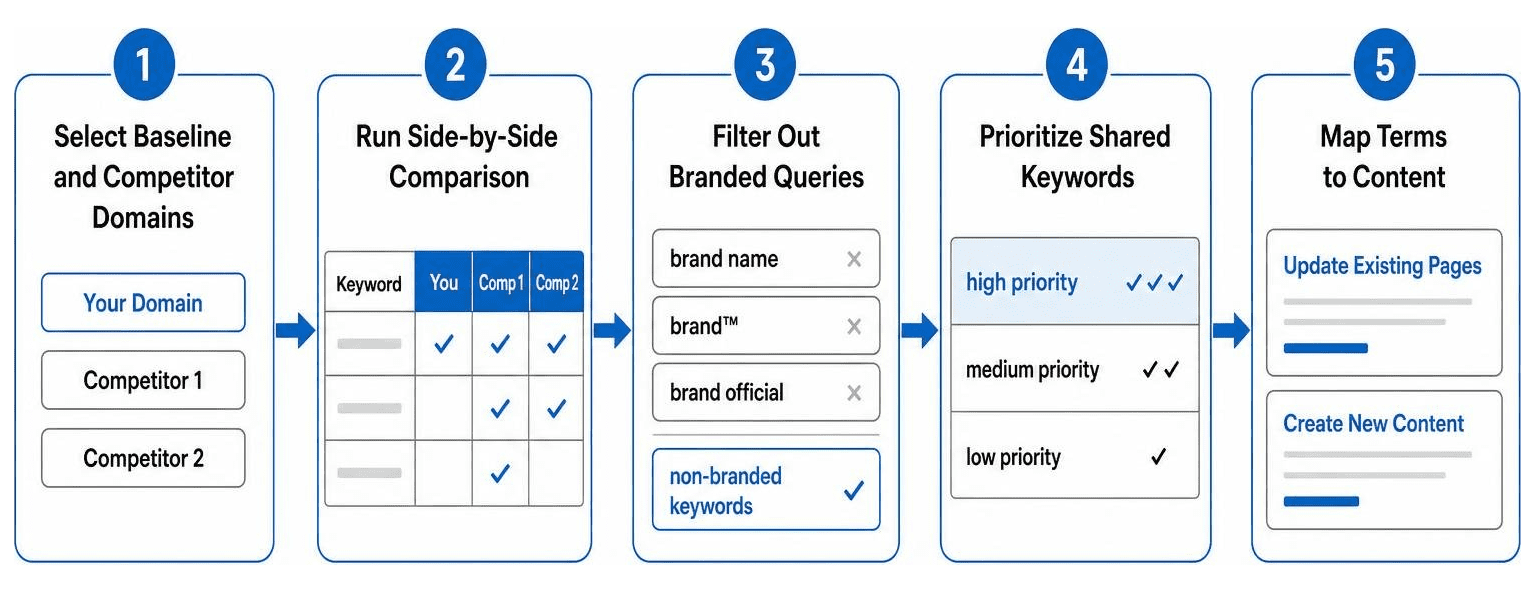
- Select Baseline and Competitor Domains: Identify two or three direct rivals of similar domain authority rather than dominating industry giants.
- Run Side-by-Side Comparison: Input your target URL alongside competitor domains into a free gap analyzer.
- Filter Out Branded Queries: Remove brand name variations to isolate non-branded organic terms.
- Prioritize Shared Keywords: Focus on terms where multiple competitors rank in top positions, confirming clear search intent.
- Map Terms to Content: Assign target terms to existing pages needing updates or outline new articles.
To master competitive audits, explore The Step-by-Step Guide to SEO Analysis for Competitors.
Interpreting Search Volume, Keyword Difficulty, and CPC Metrics
Analyzing competitive keyword tables requires evaluating three core metrics:
- Search Volume: Monthly query counts fluctuate seasonally. Treat volume as an indicator of relative interest rather than an absolute number.
- Keyword Difficulty (KD): Scores under 30 indicate low competition; scores between 30 and 60 represent moderate competition; scores above 60 require high domain authority and strong link profiles.
- Cost-Per-Click (CPC): High CPC values reflect commercial intent, signaling queries that drive customer conversions.
How to Check Competitors Keywords Free and Turn Data into Action
Data alone won't increase organic rankings. Once you identify high-value search queries, execute these steps:
- Develop Comprehensive Content Briefs: Review top-ranking competitor pages to evaluate structure, word count, subheadings, and featured media.
- Group Terms into Topic Clusters: Cluster related long-tail terms around a central pillar page to build topical authority.
- Optimize On-Page SEO: Incorporate primary keywords naturally into title tags, meta descriptions, H2 headers, and body copy.
- Maintain Content Freshness: Regularly update pages with revised figures, fresh expert insights, and improved internal links.
Free Keyword Tools vs. Paid Software Like SpyFu, Semrush, and Ahrefs

Free tools work well for quick audits, but enterprise platforms provide deeper data for large-scale campaigns.
- Database Scale: SpyFu indexes over 13.1 billion keywords across 152 million websites, updating 40,000 SERPs every second.
- Historical SERP Tracking: Enterprise tools store years of ranking logs, tracking competitor position shifts across core algorithm updates.
- Export and Quota Caps: Free tools limit daily exports and lookups, whereas paid tools like SpyFu - Competitor Keyword Research Tools for Google Ads offer unlimited data downloads starting at accessible pricing tiers.
If you are exploring enterprise platforms, review our guide on How to Use Ahrefs for Keyword Research Without Losing Your Mind.
Frequently Asked Questions About Competitor Keyword Research
Can I check competitor keywords for free without signing up for an account?
Yes. Tools like ClearSERP and ChampSignal provide instant domain keyword checks without account creation or credit cards. ClearSERP displays 10 instant rankings per search, while ChampSignal lists the top 10 organic search queries driving traffic to any website.
How do I track competitor keyword rankings over time for free?
You can monitor competitor rank shifts manually by maintaining a spreadsheet of target terms and auditing SERP positions monthly. Alternatively, setup free rank-tracking alerts through freemium dashboards to receive notifications when competitors gain or lose top page positions.
What is the difference between Google Keyword Planner and dedicated SEO keyword tools?
Google Keyword Planner was built for Google Ads advertisers. Its competition metrics reflect paid ad bidding rather than organic search difficulty. It also groups similar search queries and rounds search volume metrics. Dedicated organic SEO tools show exact keyword variations, organic SERP position histories, and backlink requirements.
Maximizing Growth with Competitive Search Intelligence

Uncovering your competitors' search strategies gives you a clear roadmap for search growth. By using free competitor keyword tools to spot content gaps, evaluate commercial intent, and refine on-page messaging, you turn rival search data into sustainable organic traffic gains.
At SmallBizSEO, we help small businesses scale search visibility using our data-driven "Velocity" framework. We combine technical optimizations with E-E-A-T compliant content creation to build organic search momentum. Ready to outrank your competition? Explore our SmallBizSEO Services today.