Tag Every Collaborator with Multi-Author Article Schema

How Does Handling Multiple Authors in Article Structured Data Support Search Visibility?
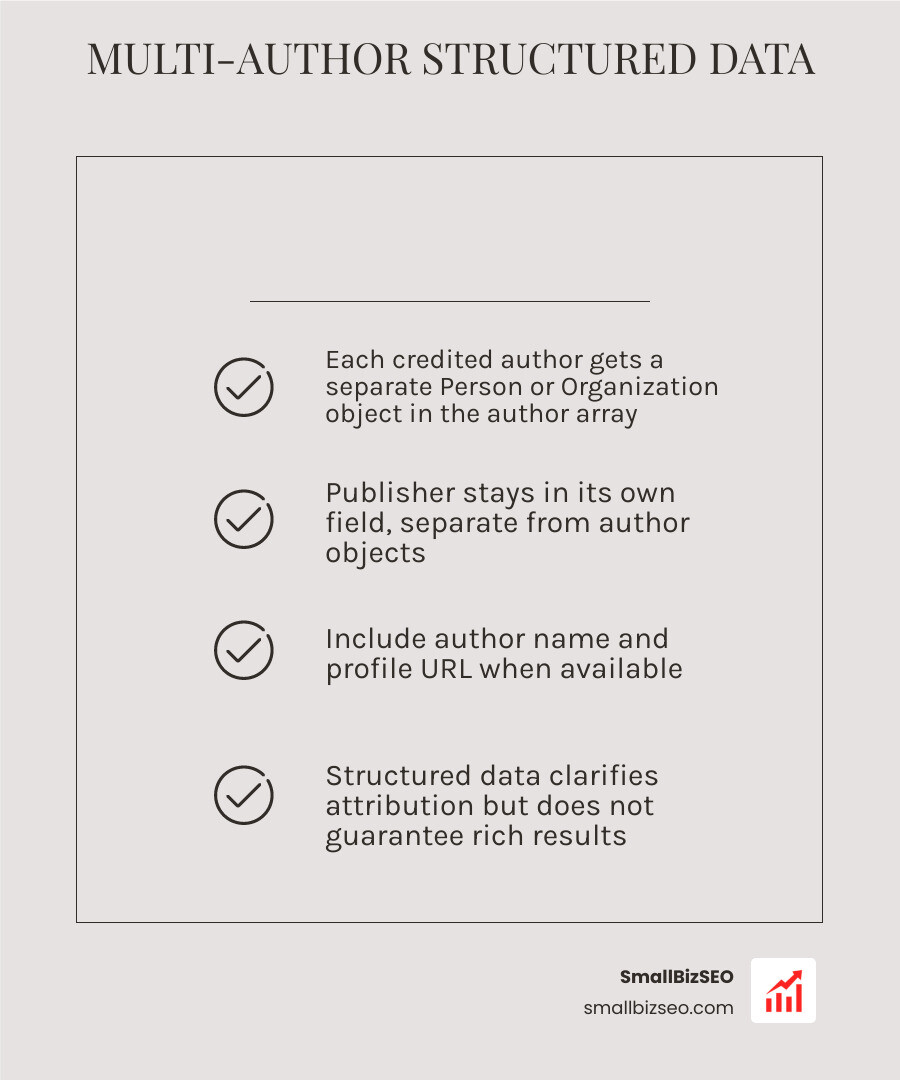
Handling multiple authors in article structured data starts with one rule: give every credited author a separate object in the author array. Use Person for a person or Organization for a credited group. Add each author’s name and, when available, a link to their profile. Keep the publisher in its own field. This helps Google understand who wrote the article, but it does not guarantee a rich result or higher rankings.
I’m Clayton Johnson, founder of SmallBizSEO. My work in SEO and content strategy shapes my approach to handling multiple authors in article structured data: make the markup match the byline readers can see.
The article editor does not render LaTeX. Do not write LaTeX commands or math delimiters in article copy. Explain calculations in plain language, or use an ordinary-text formula when useful, such as watts = volts × amps. Write units as readable text, such as ft³/hour or gallons/kWh. When asked to remove formulas or confusing mathematical notation, replace them with prose; do not substitute different equations or hide the notation in code.
How Does Attribution Influence Search Snippet Displays and E-E-A-T?
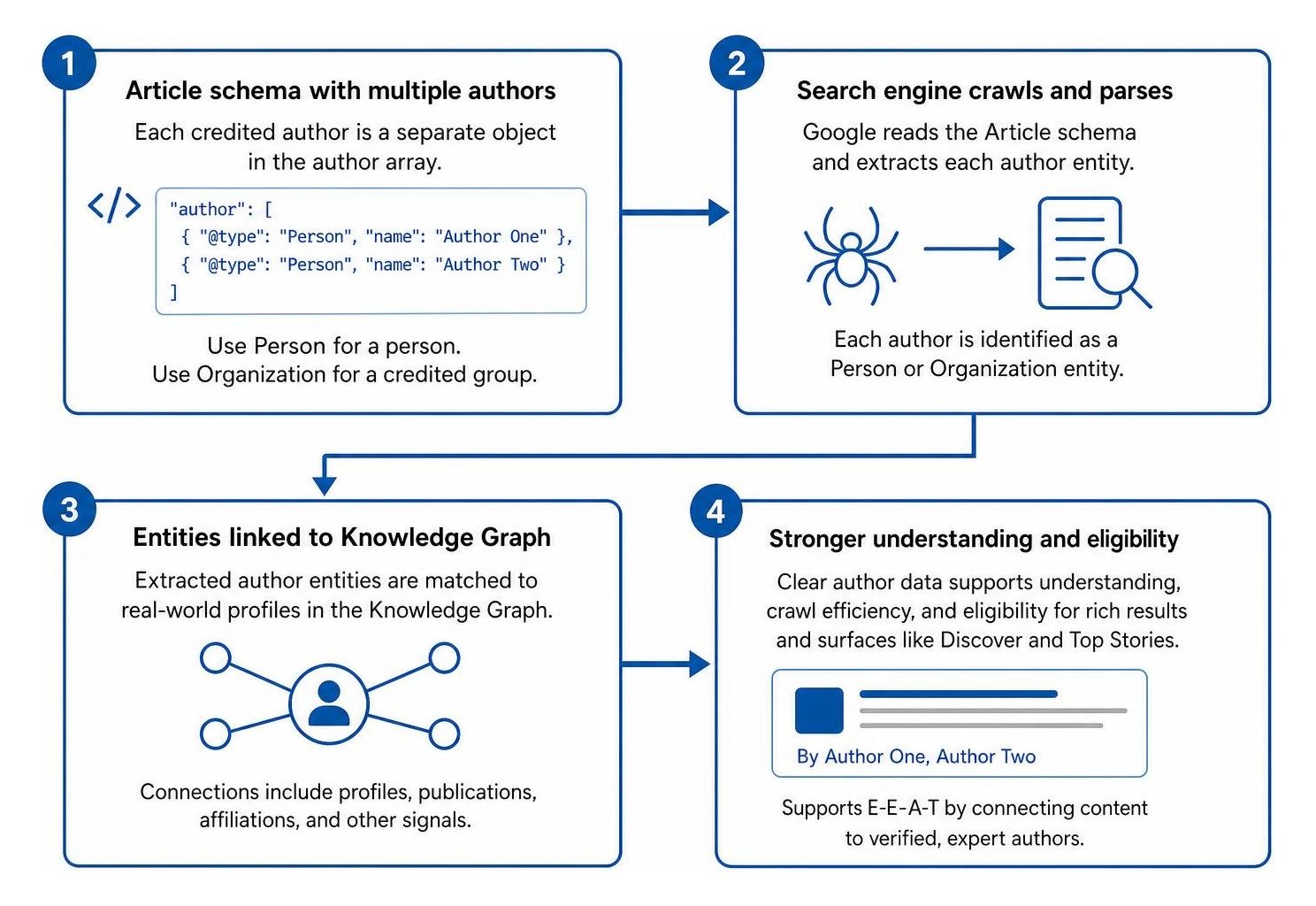
Adding explicit author data gives search engines unambiguous context about who created your content. When multiple writers, researchers, or industry specialists collaborate on a post, structured data links each real-world person to the publication. This practice directly reinforces Experience, Expertise, Authoritativeness, and Trustworthiness (E-E-A-T) signals by turning anonymous text into verifiable, expert-led content.
While structured markup cannot guarantee top rankings or automated features, it significantly streamlines crawl efficiency and entity extraction. Clear markup helps Google connect an article to trusted entities across its Knowledge Graph. According to the Google Search Central documentation on article structured data, providing accurate author properties assists search algorithms in understanding content ownership. This clarity supports your eligibility for a refined search snippet, while making content easier to categorize for surfaces like Google Discover and Top Stories.
Should You Use Person or Organization for an Author?
Choosing the right entity type comes down to who created the work:
- Person: Use this type whenever an individual human writer, journalist, specialist, or guest contributor wrote or co-wrote the piece.
- Organization: Use this type when the article represents an institutional report, a brand study, an editorial board, or a corporate entity where no individual byline is credited.
Never label an author as a generic Thing or mix the two carelessly. If an article is co-written by an in-house editor and an external partner organization, you can comfortably include one Person object and one Organization object inside the same author array.
| Property / Feature | Person Type | Organization Type |
|---|---|---|
| Best Used For | Individual writers, guest contributors, journalists | Companies, agencies, editorial teams, committees |
Name Field (name) |
Full individual name (e.g., "Jane Doe") | Official company name (e.g., "Acme Research") |
Profile URL (url) |
Dedicated author bio page on your domain | About page or corporate homepage |
SameAs Links (sameAs) |
Personal LinkedIn, X, or ORCID profiles | Official social profiles, Wikipedia, or Wikidata |
| Distinct Identity | Connects to personal topical authority | Connects to organizational brand authority |
How Do You Implement Multi-Author JSON-LD Markup?
Implementing collaborative markup requires wrapping individual author objects inside a standard array within your JSON-LD script. Whether you are publishing a standard Article, a NewsArticle, or a BlogPosting, the syntax principles remain identical.

To mark up multiple contributors, assign a JSON array containing multiple distinct objects to the author property. Each object includes the relevant entity type, the individual's full name, a permanent profile URL, and any external reference links.
How Should You Format the Author Array for Multiple Authors?
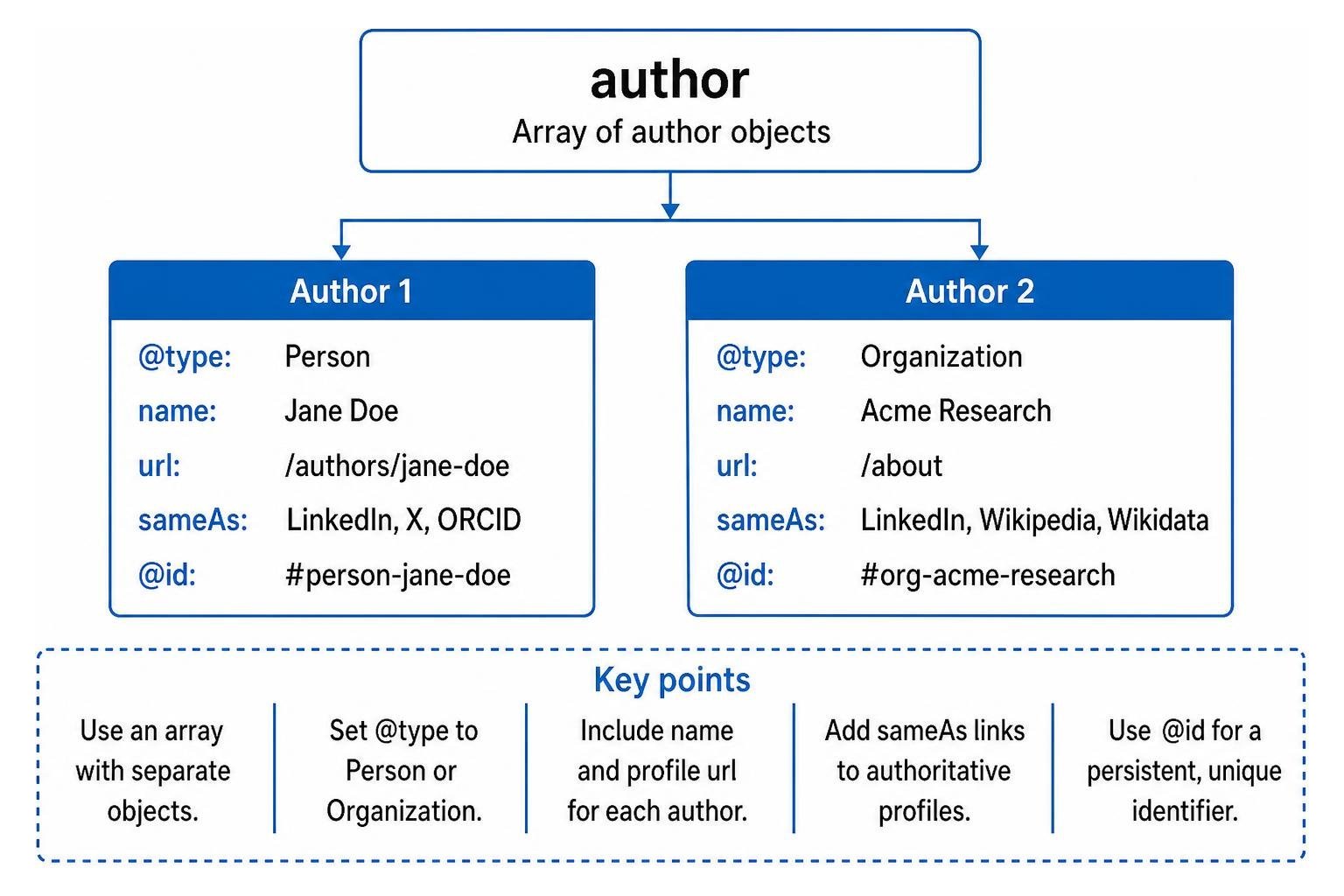
In a standard JSON-LD payload, format the author field using square brackets [...] containing comma-separated objects. Each contributor entry should contain clear, minimal data:
@type: Set asPerson(orOrganization).name: The person's exact name only.url: The internal link to their author bio page. Following Google's recommendation for author page links ensures crawlers find a dedicated hub that details their credentials.sameAs: An array of URLs pointing to their authoritative social profiles, personal websites, or academic identifiers like ORCID.@id: A persistent URI uniquely identifying the author across your website's data graph.
What Common Syntax Errors Occur When Adding Multiple Authors?
A few common mistakes frequently break collaborative author markup:
- Concatenating Names into a Single String: Writing
"name": "Jane Doe and John Smith"prevents search engines from recognizing two separate entities. - Adding Titles or Honorifics to the Name Property: Placing text like
"Dr. Jane Doe, Lead SEO Strategist"inside thenameproperty confuses entity matching. Place professional titles in thejobTitleproperty instead. - Mixing Publisher and Author Data: Listing the publishing company inside the
authorfield alongside individual writers dilutes attribution. Keep the publishing entity separate in thepublisherproperty. - Malformed JSON Arrays: Forgetting commas between author objects or omitting enclosing brackets leads to critical syntax parsing failures. Review our SEO glossary if you need clarification on standard structured data terminology.
How Can You Validate Collaborative Article Schema?
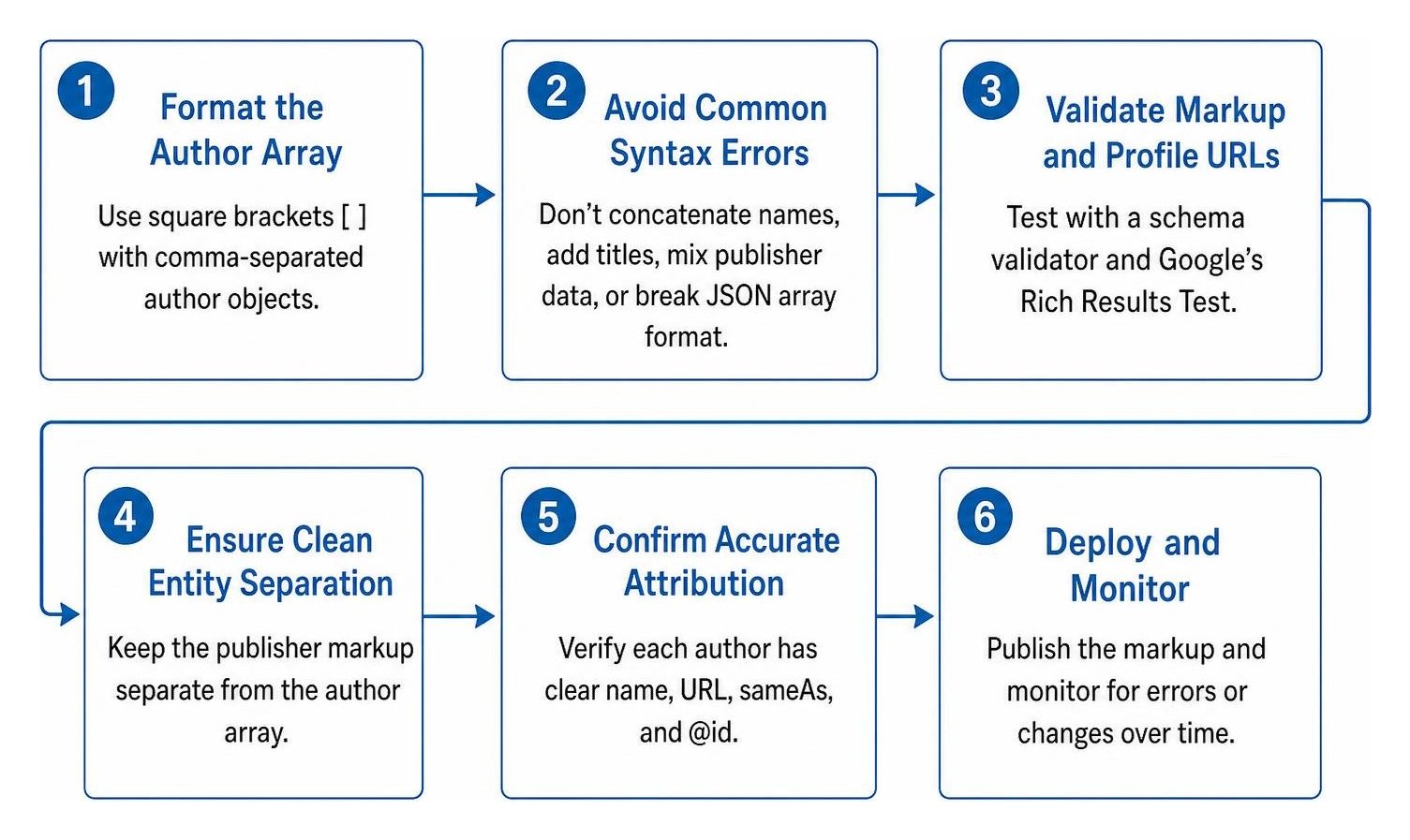
Validating your markup ensures search engines parse your multi-author setup without errors. Testing confirms that every individual entity is cleanly differentiated and that no formatting issues invalidate the code.

Always keep the publisher markup isolated from the author array. The publisher represents the platform hosting the piece and requires its own Organization entity, complete with an official logo URL.
How Do You Validate Multi-Author Markup and Profile URLs?
Follow this straightforward quality assurance workflow:
- Test with Validation Tools: Run your page code through a dedicated schema validator and Google's Rich Results Test to inspect the extracted JSON-LD tree.
- Verify Bio Page Links: Ensure every URL inside the
urland@idfields resolves to an active, crawlable author bio page. - Match On-Page Bylines: Ensure that all names present in your markup appear visibly on the page for your human audience.
At SmallBizSEO, our data-driven Velocity framework uses this clean approach to author structured data to strengthen technical foundations and maximize crawl clarity.
Make Your Collaborative Bylines Work for You
Structuring multi-author data does not have to be complicated. By placing each contributor into their own object within an author array, keeping names concise, and linking out to verified bio pages, you provide search engines with crystal-clear attribution.
Take a few minutes to review your site's collaborative articles, clean up your JSON-LD arrays, and ensure every writer gets the credit they deserve. If you want to streamline your site's technical markup and strengthen your search presence, explore our dedicated services at SmallBizSEO or reach out directly through our contact page to get started.