The Definitive Guide to a Local SEO Audit in NY
The Definitive Guide to a Local SEO Audit in NY
Why Every Business Needs a Local SEO Audit
Over 46% of all Google searches carry local search intent. When nearby consumers search for services, Google triggers the Local Pack--the map feature showcasing the top three business listings at the very top of search engine results pages. Winning one of these top three spots is game-changing because the Local Pack captures approximately 42% of total search clicks, yielding up to 700% more visibility than listings tucked further down the page.
Conducting a local SEO audit allows us to evaluate how effectively your brand captures this high-intent organic traffic. In dense commercial environments, search engine algorithms evaluate three core pillars: proximity, relevance, and authority. Without regular diagnostic audits, subtle technical glitches, incorrect categories, or citation discrepancies quietly suppress your ranking position, diverting prospective leads directly to your rivals. Integrating structured Local SEO Optimization and Small Business Growth strategies ensures that your online assets remain fully optimized to capture consistent revenue.
Winning Map Pack Visibility Across Local Markets
Navigating search visibility across local target areas requires recognizing that search behavior changes block by block. A searcher looking for professional services in one commercial district will encounter completely different Map Pack recommendations than someone typing the exact same query in a neighboring district.
Google relies heavily on localized proximity signals and geographic relevance to deliver Map Pack results. Through tailored local SEO services, an audit uncovers whether your localized landing pages and profile configurations align with location-specific search intent. Ensuring your digital footprint matches hyper-local search intent helps your business lock in top 3-pack placement where local buying decisions happen.
Beating Hyper-Competitive Local Competitors
Urban markets present some of the most intense search competition today. Your competitors are constantly refining their metadata, building local link authority, and gathering customer feedback. To outpace them, we must establish a clear competitive benchmark.
A localized audit goes beyond superficial rank checks by using multi-point geo-grid tracking. Geo-grid analysis measures your exact Google Maps visibility across a custom coordinate grid, mapping precisely where your business ranks #1 and where your coverage drops off. By isolating your competitors' exact strengths--such as superior review acquisition rates or tighter secondary category choices--we can implement focused optimizations that claim market share.
Step-by-Step Blueprint for Auditing Local SEO
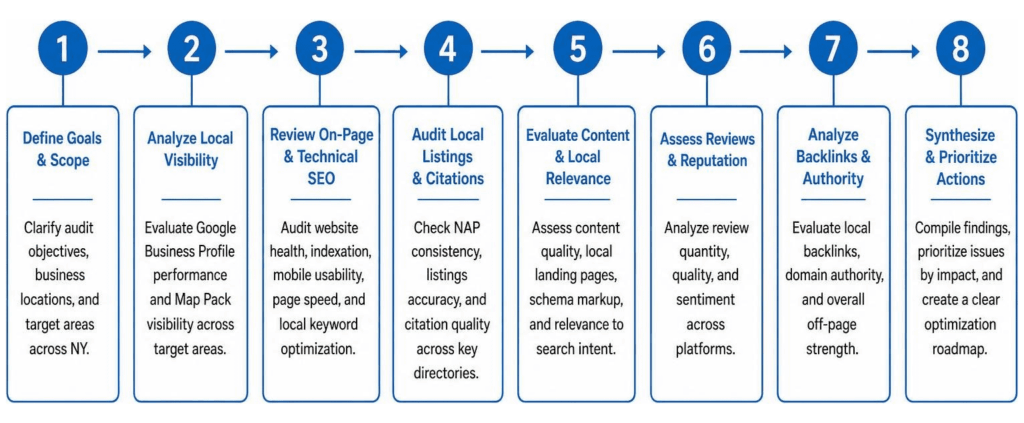
A successful audit requires a systematic approach. We examine technical site health, local listing accuracy, content architecture, and off-page authority signals to isolate performance blockers.
Step-by-Step Execution of a Local SEO Audit
Executing an audit involves working through distinct operational phases:
- Crawl & Technical Inspection: Run a full site crawl to evaluate crawlability, mobile responsiveness, SSL security, and indexation errors.
- Google Business Profile Review: Examine core listing elements including primary categories, business descriptions, attribute tags, and geo-tagged images.
- NAP & Citation Audit: Cross-reference Name, Address, and Phone number (NAP) data across major directory platforms and data aggregators.
- On-Page & Schema Validation: Verify localized header structure, meta tags, and
LocalBusinessstructured data deployment. - Review Profile Analysis: Evaluate star ratings, total review counts, sentiment trends, and owner response velocity.
- Backlink & Authority Assessment: Inspect incoming link profiles for local relevance, niche authority, and toxic link patterns.
Running a thorough SEO Visibility Audit establishes a clean technical foundation, ensuring Google's web crawlers can efficiently crawl, render, and index your location pages without encountering broken links or client-side routing hydration errors. Conducting a Detailed SEO Analysis ensures no technical detail gets missed.
Auditing Google Business Profile for Maximum Reach
Your Google Business Profile (GBP) functions as the core driver of local Map Pack rankings. Selecting the single most accurate primary category remains the most impactful local ranking signal. Businesses often jump multiple ranking positions simply by fixing a misconfigured primary category or filling out neglected profile fields.
Profiles featuring over 100 high-quality photos receive up to 520% more phone inquiries than incomplete profiles. Keeping your GBP active through weekly Google Posts and prompt review replies signals operational legitimacy directly to Google's ranking algorithm.
Local Citations, Directory Listings, and Backlink Profiles
Citation consistency across data aggregators like Data Axle, Neustar Localeze, and Foursquare builds trust with search engines. When your business name, address, or phone number varies across the web--even slightly--search engines hesitate to display your listing confidently.
Cleaning up duplicate profiles and building localized backlink profiles through partnerships, regional press releases, and civic sponsorships creates authentic community authority that generic directory blasts cannot replicate. Partnering with a specialized local SEO agency can help streamline this citation cleanup and local link acquisition process.
Keyword Analysis, Reviews, and Reputation Management
Understanding how customers search—and how they evaluate trust—is vital for converting organic impressions into phone calls and service bookings.
Analyzing Hyper-Local Keywords and Competitor Rankings
Generic keyword research falls short in localized environments. Customers search using specific neighborhood modifiers, borough references, and transactional "near me" phrasing. An effective audit identifies high-intent long-tail keywords that signal immediate purchasing intent.
By comparing your search queries against Google Search Console performance data and geo-grid rank tracking, we discover high-impression terms where your pages sit on page two. Optimizing meta descriptions, internal link anchor text, and heading tags for these target queries provides immediate traffic lifts. Avoid common setup traps highlighted in our guide on 5 Local SEO Mistakes Killing Your Visibility.
Evaluating Online Reviews and Trust Signals
Online reputation acts as both a direct algorithmic ranking factor and a major conversion driver. Research indicates that 98% of consumers read online reviews for local service providers before making a booking decision.
Maintaining a steady review velocity—consistently receiving fresh, organic 5-star ratings—outperforms having hundreds of old, stagnant reviews. Furthermore, responding to review feedback within 24 hours demonstrates customer commitment and inserts natural keyword relevance into your Google Business Profile.
Prioritizing Audit Findings into an Actionable Roadmap
An audit report is only useful if it leads to action. We filter raw crawl logs and algorithmic data into a clear execution matrix organized by technical effort and potential ROI impact.
| Priority Tier | Effort Level | Potential Impact | Focus Items |
|---|---|---|---|
| Tier 1: Quick Wins | Low | Immediate | GBP category fixes, core NAP standardization, resolving 404 indexing errors |
| Tier 2: Foundation | Medium | Moderate | On-page title tag optimization, adding LocalBusiness schema, building local citations |
| Tier 3: Growth | High | Long-Term | Programmatic neighborhood landing pages, local PR link acquisition, review workflows |
Categorizing recommendations into a structured 30-60-90 day execution schedule prevents client team burnout and keeps technical teams focused on high-yield fixes first. Learn more about turning data into growth in our article Analyze Your Way to the Top SEO Analysis for Better Rankings.
Essential Tools for Conducting a Local SEO Audit
Conducting a professional audit requires leveraging an interconnected suite of specialized search technologies:
- Google Search Console & GA4: Analyzes real user search queries, indexing health, click-through rates, and landing page conversions.
- Screaming Frog SEO Spider: Executes site-wide technical crawls to pinpoint canonical issues, broken links, missing meta descriptions, and schema code validation.
- BrightLocal & Whitespark: Scans over 100 local web directories to detect citation errors, missing listings, and duplicate profile instances.
- Geo-Grid Rank Trackers: Provides localized spatial visualization of Google Maps rankings block-by-block across target coordinates.
Audit Frequency and Ongoing Maintenance
A local search audit should not be treated as a single, set-it-and-forget-it event. Local search algorithms, competitor strategies, and business listings evolve continuously.
We recommend adopting a tiered audit cadence:
- Weekly: Monitor review velocity, Google Business Profile notifications, and core keyword positions.
- Monthly: Review Google Search Console impression trends, citation accuracy, and geo-grid coverage maps.
- Quarterly: Execute a full technical site crawl, inspect Core Web Vitals performance, and run competitive backlink gap analyses.
Regular maintenance ensures that small technical glitches are resolved long before they impact organic lead volume or revenue.
Frequently Asked Questions About Local SEO Audits
What is a local SEO audit and how long does it take?
A local SEO audit is a comprehensive diagnostic evaluation of a business's online search presence. It checks technical website health, Google Business Profile optimization, citation accuracy, online review sentiment, and localized ranking performance. A standard audit typically takes between 1 to 3 weeks to complete thoroughly, depending on site complexity and geographic coverage.
How often should a business audit its local SEO?
Businesses operating in competitive urban markets should conduct a comprehensive local SEO audit at least twice a year. In highly contested service categories, running quarterly technical passes alongside weekly profile checks ensures you stay ahead of algorithm updates and competitor optimizations.
Can a local SEO audit help beat map pack competitors?
Yes. An audit pinpoints the exact structural gaps causing competitors to outrank you—such as improper category choices, inconsistent NAP records, slow mobile page speed, or weaker local link profiles. Resolving these diagnostic gaps allows businesses to climb into the top 3 Map Pack results, often within 30 to 90 days.
Turn Your Local SEO Audit Into Market Dominance

Executing a thorough local SEO audit provides the empirical roadmap required to transform weak search visibility into consistent inbound lead volume. By systematic diagnosing technical bottlenecks, ensuring total citation alignment across directories, optimizing your Google Business Profile, and publishing targeted hyper-local landing pages, your business can claim and hold top Map Pack positioning.
At SmallBizSEO, our proprietary Velocity framework combines technical auditing precision, automated data insights, and high-authority link acquisition strategies to deliver fast, transparent search growth for local businesses. Rather than guessing why competitors rank higher, a structured audit gives you actionable metrics to outpace them.
Ready to dominate local search results in your market? Explore the Comprehensive Local SEO Guide or contact our team today to uncover your growth potential and secure your path to the top of Google Maps.