The Ins and Outs of SEO for Room Additions
How Can SEO for Room Additions Bring in Qualified Leads?
SEO for room additions starts with the searches homeowners make before they request an estimate. Create a page for each addition type you build, such as second-story additions or bump-outs. Show completed projects, explain your process, and answer local questions about costs, permits, and timelines. Keep your Google Business Profile accurate and ask customers for reviews after each project.
These steps help homeowners find your business while they plan and give them evidence to consider before they call. They also make your services and experience easier for search engines and AI tools to understand.
I'm Clayton Johnson, founder of SmallBizSEO, where I help small businesses build search visibility through technical SEO, content, and authority building. In this guide, I'll apply that experience to SEO for room additions, from the first homeowner question to the estimate request.
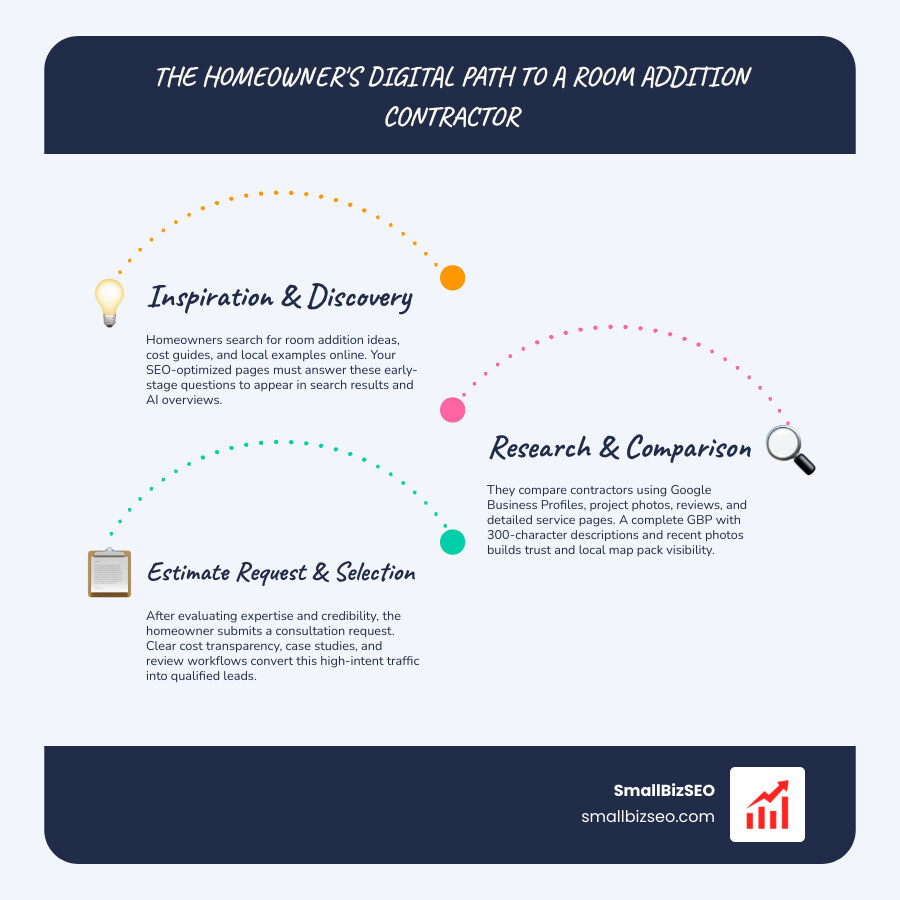
SEO for room additions vocab explained:
Why SEO for Room Additions Drives High-Ticket Remodeling Growth
Room addition projects represent some of the highest-value residential contracts in the construction industry, with project values routinely ranging from $40,000 to well over $150,000. Because expanding a home requires a significant financial commitment and structural alterations, homeowners do not make impulsive hiring decisions. Instead, 84% of homeowners use Google before choosing a contractor, spending weeks or months researching architectural concepts, municipal building codes, and pricing models.

Relying entirely on word-of-mouth referrals leaves residential builders vulnerable to seasonal revenue droughts and aggressive price competition. Shared bidding platforms often push businesses into price wars, resulting in typical lead close rates of only 1.7%. In contrast, organic search leads close at an average of 14.6% because homeowners actively seek your specific expertise. Industry research demonstrates that every $1 invested in strategic search marketing returns an average of $19.90 in the home trades, driving acquisition costs down to roughly $31 per organic lead. By implementing specialized contractor SEO services, home builders establish an evergreen inbound channel that captures high-intent homeowners during their active planning phase.
What Is the Difference Between SEO, AEO, and GEO for Contractors?
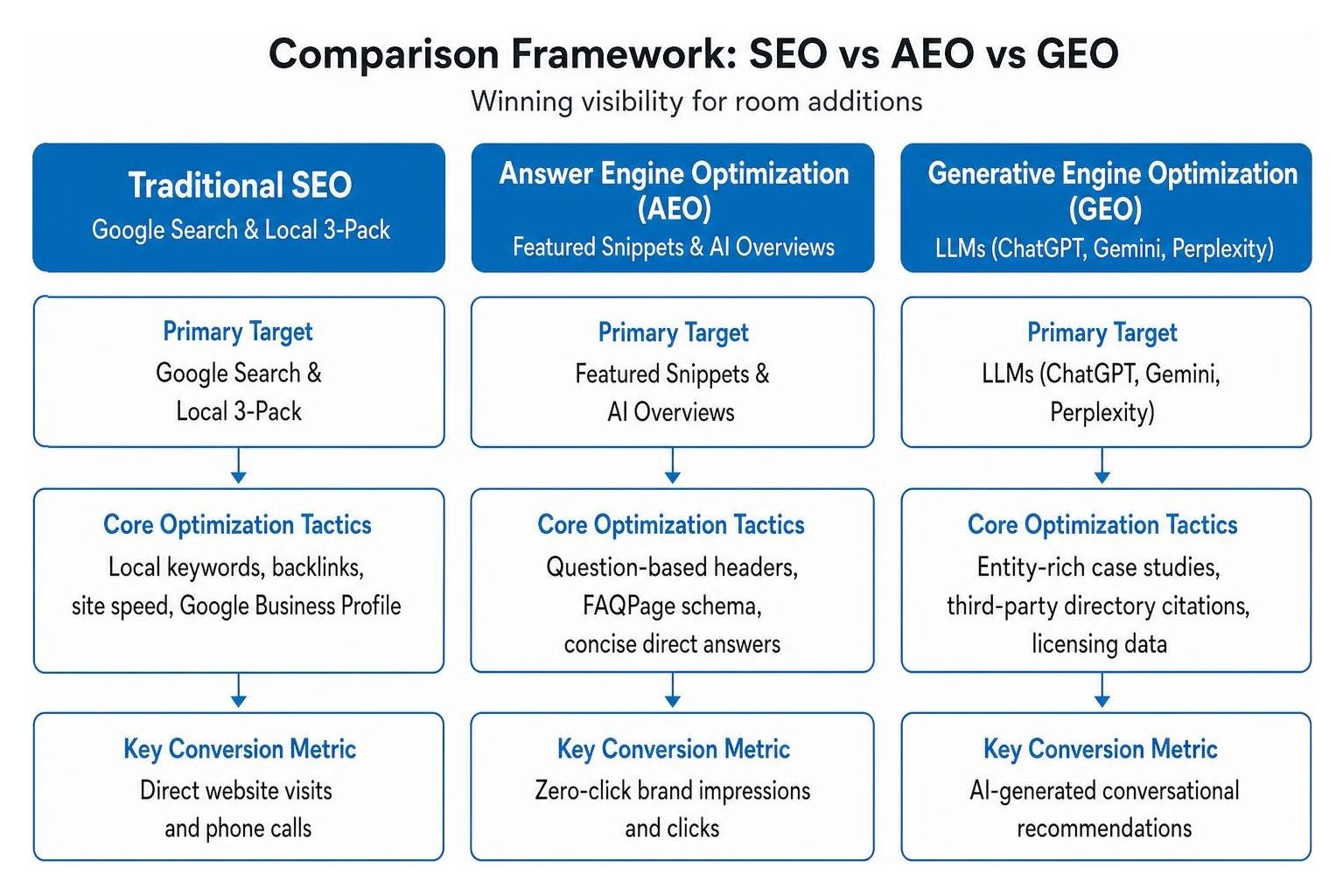
Homeowners no longer discover contractors solely through a list of blue website links. Today, 45% of consumers consult artificial intelligence platforms like ChatGPT, Gemini, and Perplexity for local home service recommendations alongside standard Google queries. Winning high-ticket remodeling contracts requires a synchronized search strategy across three interconnected pillars:
- Search Engine Optimization (SEO): Focuses on ranking your website and location assets in traditional organic search results and the Google Local Map Pack for high-intent geographic queries.
- Answer Engine Optimization (AEO): Formats your technical content with structured Q&A schema, concise summaries, and entity data so search engines can pull your answers directly into featured snippets and voice search responses.
- Generative Engine Optimization (GEO): Optimizes your brand citations, digital credentials, and project documentation across authoritative web ecosystems so large language models actively recommend your construction company when users ask complex conversational prompts.
| Strategy Pillar | Primary Target | Core Optimization Tactics | Key Conversion Metric |
|---|---|---|---|
| Traditional SEO | Google Search & Local 3-Pack | Local keywords, backlinks, site speed, Google Business Profile | Direct website visits and phone calls |
| AEO | Featured Snippets & AI Overviews | Question-based headers, FAQPage schema, concise direct answers | Zero-click brand impressions and clicks |
| GEO | LLMs (ChatGPT, Gemini, Perplexity) | Entity-rich case studies, third-party directory citations, licensing data | AI-generated conversational recommendations |
Which Core Mistakes Derail SEO for Room Additions Campaigns?
Contractors often invest in modern web design only to find their businesses buried on page ten of search results. Common technical and strategic errors prevent search engines from ranking even the most skilled builders:
- Homepage Keyword Cannibalization: Cramming every trade (kitchens, bathrooms, basements, room additions) onto a single generic services page. Search algorithms struggle to determine page relevance for specific high-ticket queries.
- Unedited AI-Generated Content: Publishing raw, generic text that lacks regional building knowledge, first-person insights, and authentic job site context. Search engines quickly devalue unedited automated copy.
- Thin Doorway Location Pages: Copy-pasting identical landing pages across multiple suburbs while simply swapping city names. Search systems filter out duplicate content that lacks unique local project evidence.
- Missing E-E-A-T Signals: Omitting verifiable general contractor licensing numbers, liability insurance details, safety accreditations, and trade association memberships from page footers and structured schema markup.
- Omitting Pricing and Cost Details: Avoiding transparent cost discussions out of fear of anchoring expectations. In reality, homeowners actively search for budget ranges, and pricing guides capture high-volume research queries while pre-qualifying prospects.
- Over-Reliance on Stock Photography: Using generic architectural stock photos instead of high-resolution, original before-and-after imagery from completed local projects.
Applying proven construction SEO strategies corrects these foundational errors and establishes lasting digital authority.
How to Execute a High-Converting Search Strategy for Addition Contractors
Capturing homeowners ready to invest in home expansions requires a structured website architecture that guides users from discovery to consultation requests. Search engines reward websites that provide clear topical depth, fast page loading, and verifiable local proof.
A high-converting website pairs dedicated local SEO optimization with logical internal linking silos. When your educational cost guides, individual service offerings, and neighborhood case studies link together seamlessly, search engine crawlers easily index your expertise while homeowners find immediate answers to their construction questions.
How Should Contractors Structure Service and Location Pages?
To rank effectively across competitive local markets, contractors must adopt a strict page-per-service architecture. Each distinct home addition category requires a dedicated, in-depth landing page targeting between 1,500 and 2,000 words to adequately address zoning, structural engineering, timelines, and material selections.
Contractors should build dedicated pages exploring creative home addition ideas for specific expansion types:
- Second-Story Additions: Addressing foundation load assessments, structural framing, roof removal, and vertical plumbing logistics.
- Ground-Floor Bump-Outs: Explaining exterior wall cantilevers, micro-foundations, and kitchen or living room expansions.
- In-Law Suites and ADUs: Detailing accessory dwelling unit regulations, private entrances, independent HVAC zoning, and kitchenettes.
- Sunrooms and Four-Season Rooms: Explaining thermal break glass, insulation standards, and integrated climate control.
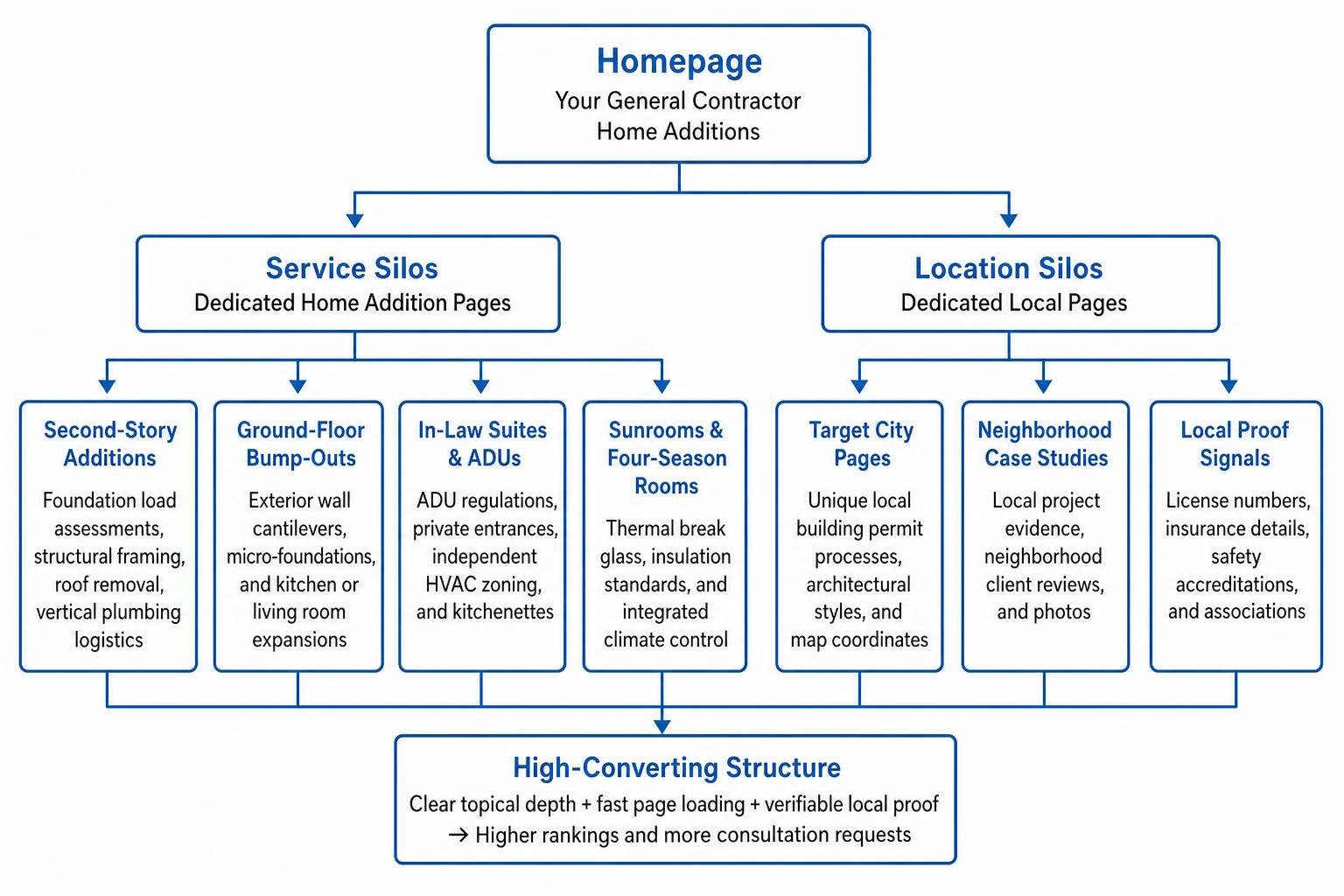
For geographic expansion, implement structured contractor service page templates across specific target cities. Each location page must feature unique local building permit processes, local architectural styles, neighborhood client reviews, and embedded map coordinates rather than duplicated text templates.
How Does Google Business Profile Optimization Power SEO for Room Additions?
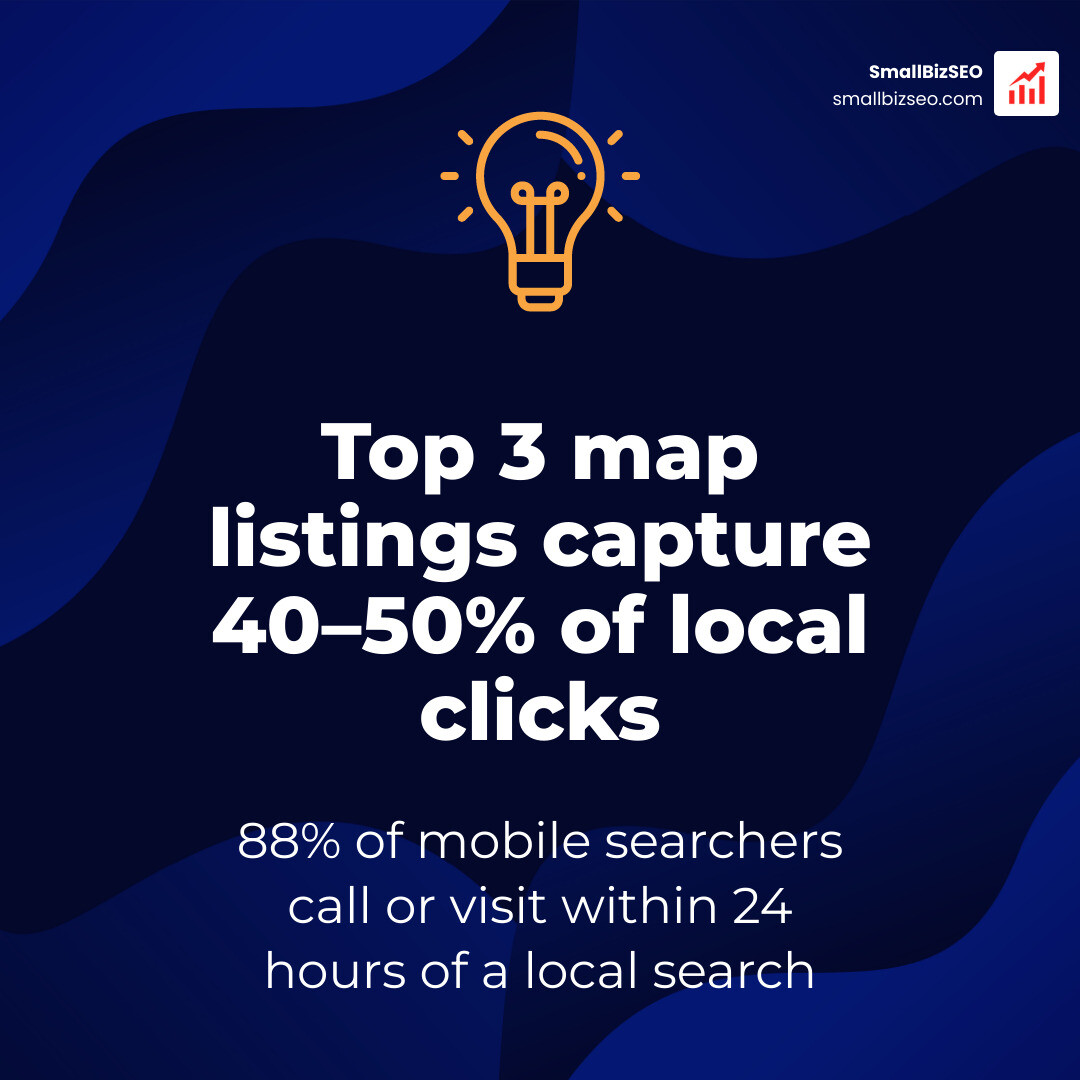
Your Google Business Profile (GBP) functions as your primary engine for local map pack visibility. The top three map listings capture between 40% and 50% of all local clicks, and 88% of mobile searchers call or visit a business within 24 hours of conducting a local search. Furthermore, fully optimized profiles generate 340% more discovery searches than incomplete listings.
Maximize your profile visibility using these proven optimization tactics:
- Select Strategic Categories: Set "General Contractor" or "Home Addition Contractor" as your primary category, adding secondary categories such as "Remodeler" or "Building Contractor."
- Utilize 300-Character Service Descriptions: Fill out every individual project type within the GBP Services tab, utilizing the full 300-character description limit to describe specific expansion offerings.
- Upload High-Resolution Project Proof: Maintain an active gallery of 30 to 40 before-and-after project photos, updating your profile with fresh job site photos every few weeks.
- Implement a Fast Review Workflow: Ask for a Google review during the final project walkthrough, and follow up with a direct SMS review link within 24 to 48 hours. Encourage homeowners to mention their specific project type and neighborhood in their feedback.
For additional guidance on enhancing your local map presence, review Google's official advice on improving local rankings.
What Early-Stage Content Captures Homeowner Research and AI Citations?
Homeowners spend months researching structural and financial logistics before requesting quotes. Publishing comprehensive guides that address these early research queries establishes early brand trust and provides rich source material for AI answer engines.
High-performing content assets include:
- Cost-Per-Square-Foot Pricing Guides: Clear breakdowns explaining how excavation, foundation work, plumbing rough-ins, and luxury finishes influence total square-foot pricing.
- Municipal Permitting and Setback Guides: Detailed explanations of local zoning requirements, lot coverage limits, and inspection schedules.
- Project Case Studies: Narrative breakdowns of completed builds detailing initial homeowner challenges, structural solutions, total square footage added, and final timelines.
Structuring this content with concise introductory answers, bulleted specification lists, and clear heading hierarchies ensures your site earns citations in conversational AI models.
What Are the Realistic Timelines, Budgets, and Tracking Metrics?
Search engine visibility builds cumulative equity over time rather than delivering instant overnight traffic. For high-ticket home additions, a realistic search marketing campaign follows a structured progression:
- Months 1 to 2: Foundational technical audit, site speed optimization, Google Business Profile restructuring, schema markup deployment, and service page architecture design.
- Months 3 to 4: Initial ranking gains for localized long-tail terms (e.g., specific addition costs or permit queries), improved local map pack impressions, and expanded page indexation.
- Months 5 to 6+: First-page rankings for competitive core terms (e.g., room addition contractor near me), consistent inbound phone calls, qualified estimate form submissions, and direct AI conversational citations.
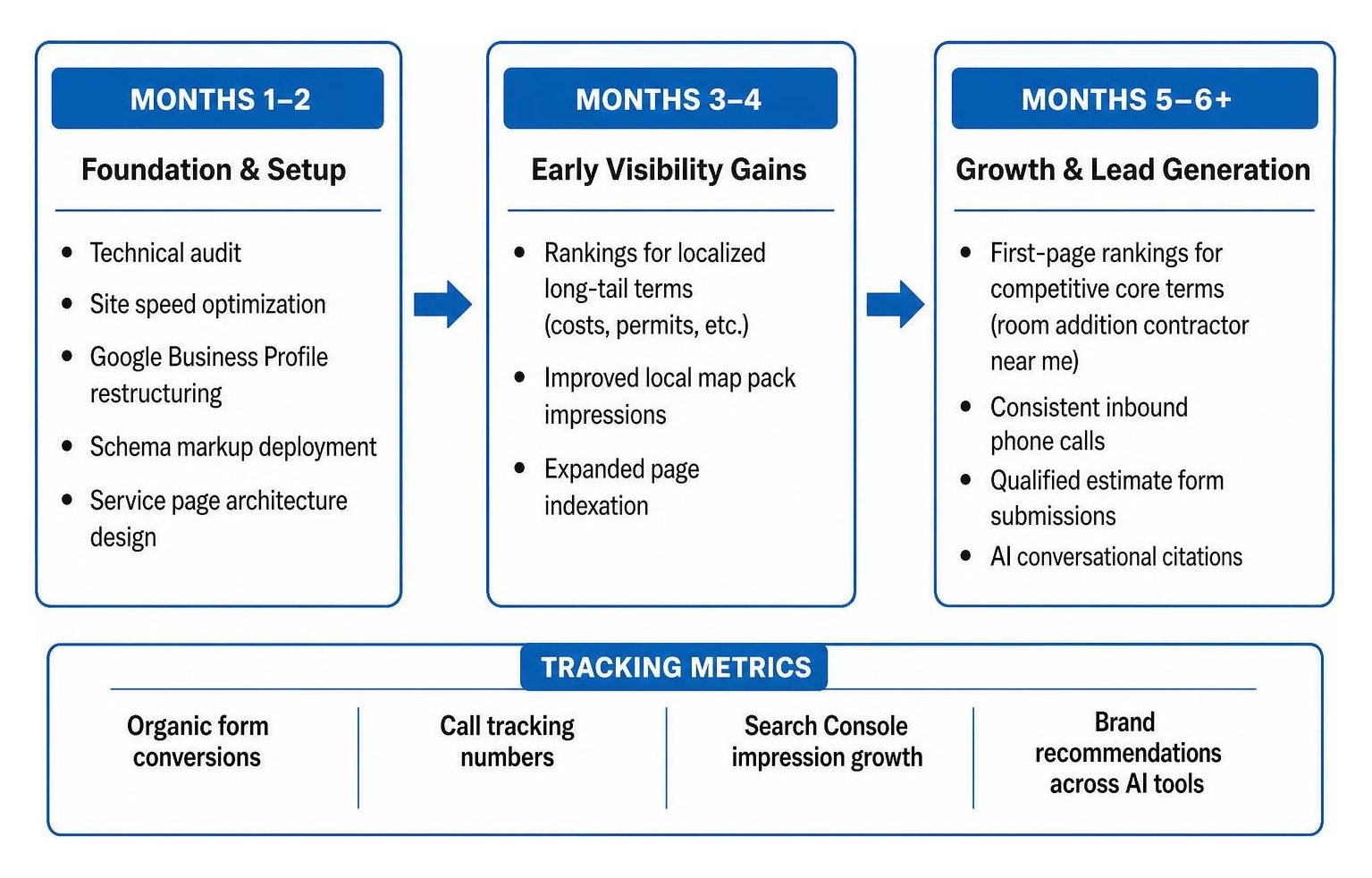
Professional contractor search campaigns typically require monthly investments between $1,500 and $5,000, depending on regional market competition. To measure genuine business growth, track organic form conversions, call tracking numbers, Search Console impression growth, and brand recommendations across AI tools.
Transforming Your Search Presence into a Predictable Lead Engine
Scaling a residential remodeling business requires moving away from unpredictable word-of-mouth referrals and taking full control of your digital pipeline. When your construction company combines comprehensive service pages, transparent cost guidance, active Google Business Profile optimization, and machine-readable technical schema, you build an asset that generates qualified, high-ticket addition projects month after month.
At SmallBizSEO, we help residential contractors dominate local search and generative discovery through our data-driven Velocity framework. Discover where your website stands in search results and uncover immediate growth opportunities by requesting a comprehensive SEO visibility audit today.