The Practical Link Builder’s Guide to Topical Relevance

How Can You Tell Whether a Backlink Is Relevant?
Knowing how to evaluate whether a backlink is relevant starts with the reader: Would someone on the linking page have a good reason to visit yours? Check that the page covers a related topic, the text around the link explains why it belongs there, and the link points to a useful destination. Then look at the site’s audience and quality. A high authority score alone cannot make an unrelated link a good fit.
I’m Clayton Johnson, founder of SmallBizSEO, where I connect SEO, content, and digital PR to help small businesses build authority. My approach to how to evaluate whether a backlink is relevant focuses on whether the link serves readers, not just whether it looks strong in a tool.
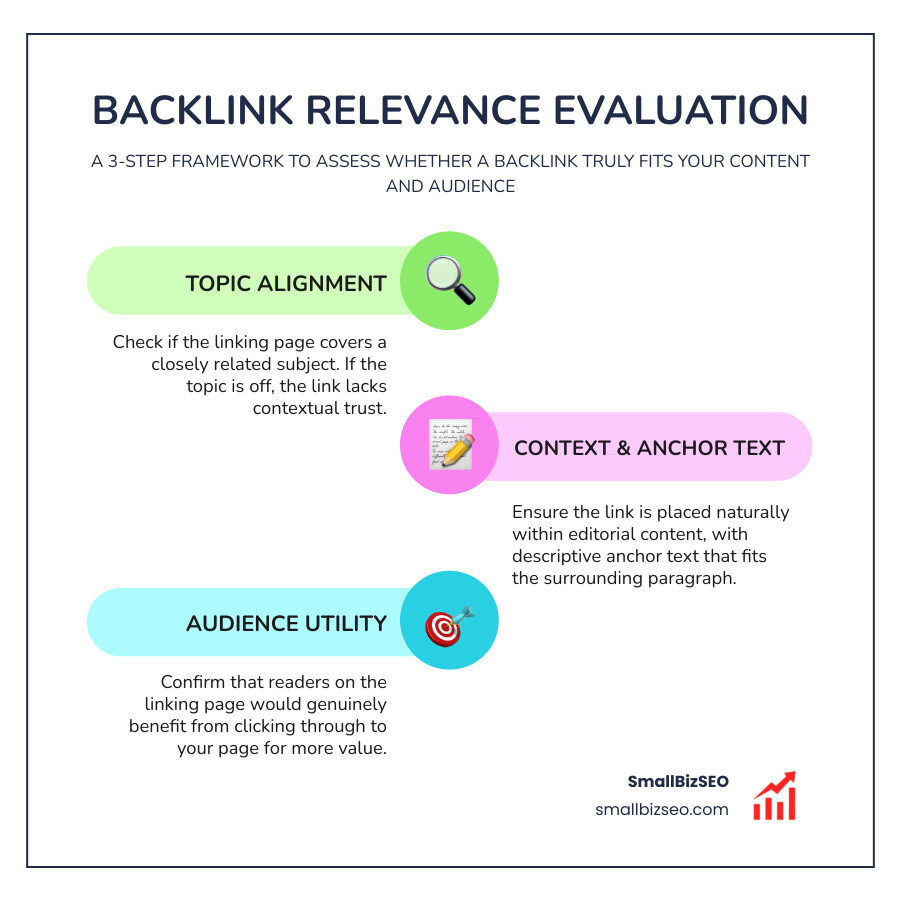
How to Evaluate Whether a Backlink Is Relevant: The 5-Dimension Framework
A backlink is genuinely relevant when it satisfies five core criteria: root domain alignment, page-level topical fit, natural paragraph context, editorial link placement, and audience utility. Evaluating these elements together prevents you from wasting outreach effort or acquiring links that search engines simply ignore.
Data shows that 93.8% of link builders prioritize link quality over raw quantity. Search engines do not treat all backlinks equally. The top-ranking result on Google averages 3.8 times more backlinks than positions 2 through 10, but those links carry weight because they represent contextual trust.
To systematically vet any opportunity, use this five-dimensional framework:
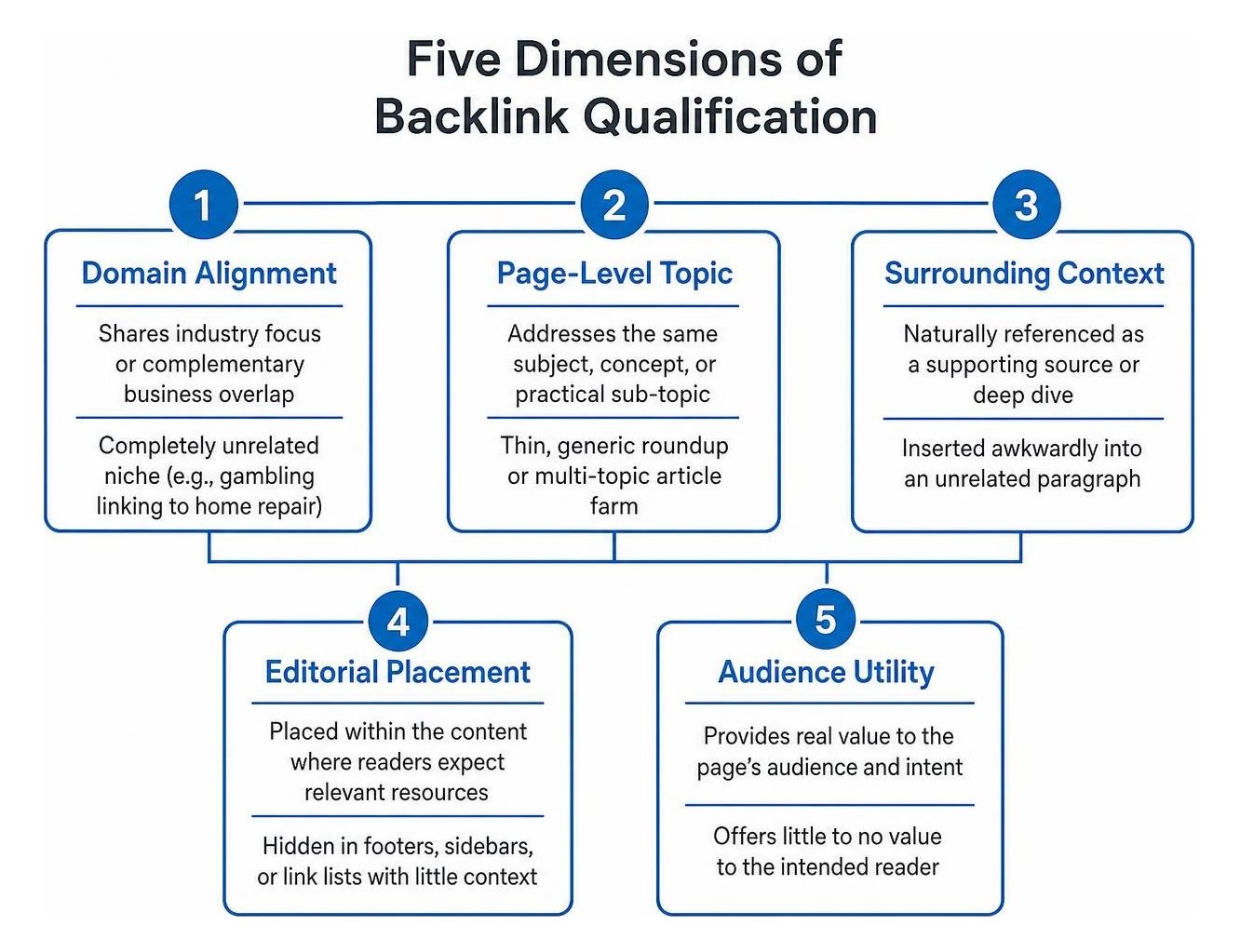
| Evaluation Dimension | High Relevance Signals | Low Relevance / Risk Signals |
|---|---|---|
| Domain Alignment | Shares industry focus or complementary business overlap | Completely unrelated niche (e.g., gambling linking to home repair) |
| Page-Level Topic | Addresses the same subject, concept, or practical sub-topic | Thin, generic roundup or multi-topic article farm |
| Surrounding Context | Naturally referenced as a supporting source or deep dive | Inserted awkwardly into an unrelated paragraph |
| Anchor Text | Natural phrase, branded mention, or descriptive topic words | Exact-match commercial keywords repeated unnaturally |
| Outbound Quality | Links out sparingly to reputable, topically related resources | Outlinks to hundreds of unrelated commercial affiliate sites |
When you analyze links using standard quality metrics, you ensure that your link profile builds genuine topical authority rather than artificial footprint patterns.
Step 1: How to Evaluate Whether a Backlink Is Relevant at the Domain and Page Level
To evaluate relevance at the macro and micro levels, first ask whether the referring domain regularly discusses your broader market, and second, whether the specific hosting page directly matches your subject matter.
- Domain-Level Fit: Look at the website's primary category. A cybersecurity company gaining a link from a software engineering blog represents strong alignment. If that same link comes from a lifestyle recipe blog, search algorithms will discount the topical connection.
- Page-Level Context: The individual URL must match your page's intent. If your target is an article on commercial plumbing fixtures, a page discussing commercial facility management is an ideal host.
- Outbound Link Profile: Inspect what else the host page links to. If an article links to your informative guide while simultaneously pointing to casino games and unrelated retail storefronts, it indicates automated link spam.
- Content Depth and Authorship: Legitimate editorial sources feature transparent authorship, real editorial guidelines, and comprehensive content rather than thin, scraped summaries.
Understanding these signals helps you avoid manipulative link networks and align with safe link practices.
Step 2: How to Evaluate Whether a Backlink Is Relevant Through Context and Anchor Text
Relevance at the sentence level depends on surrounding context and anchor text phrasing. A link should read like a natural citation that provides extra value to anyone reading the passage.
Anchor text should describe the underlying resource without triggering over-optimization filters. A healthy backlink profile consists of a natural mix:
- Branded Anchors: Using your company name or brand entity.
- Descriptive / Topical Anchors: Using partial-match phrases (e.g., "practical keyword research techniques").
- Generic Citations: Natural reading phrases (e.g., "view the breakdown", "source data").
Over-optimizing with repetitive, exact-match commercial keywords makes links appear unnatural. Furthermore, search engines treat attributes like nofollow and sponsored tags as hints. An editorial link surrounded by dense, relevant copy passes significant semantic context, whereas a link stuffed into an irrelevant paragraph provides zero contextual weight.
What Role Do Authority Metrics and Real Traffic Play in Link Quality?
Third-party domain metrics give a quick initial snapshot, but organic search traffic and keyword visibility are much more reliable indicators of whether search engines actually trust a domain.
A site boasting a high third-party authority metric can easily be a private blog network or a domain with artificially inflated scores. Before pursuing a link, check the domain using a free backlink checker to verify:
- Consistent Organic Traffic: The site should attract consistent, legitimate search visits each month.
- Traffic Trends: Look for stable or upward growth rather than sharp algorithmic drop-offs.
- Ranking Keywords: The linking page should rank for keywords in its own right, demonstrating search engine trust.
A niche-relevant website with modest authority scores and steady organic traffic routinely outperforms a bloated authority domain that receives zero search visits and covers hundreds of disconnected topics.
How Link Placement and Destination Pages Influence Relevance
Where a link sits on a page and where it leads on your website directly determines how search engines process its equity.
Editorial links embedded directly within the main body text carry the highest value. They sit where readers actively engage with content. In contrast, links hidden away in footers, sidebars, or massive link directories exhibit high link density (too many links competing for space) and pass minimal contextual equity.
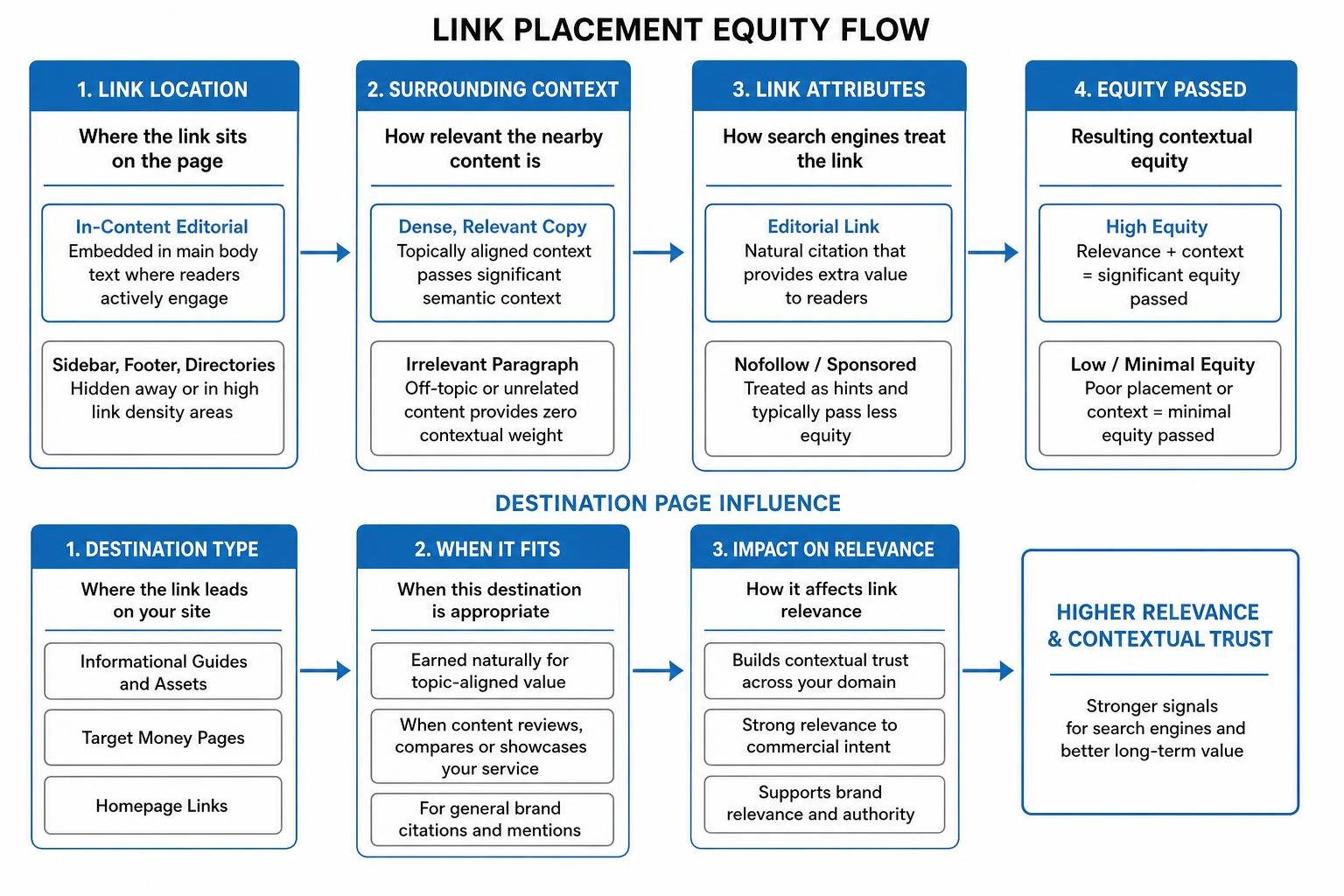
Equally important is your destination URL:
- Informational Guides and Assets: Topically relevant articles, original studies, and calculators earn in-content links naturally and build contextual trust across your domain.
- Target Money Pages: Direct commercial links should only be earned when the referring content specifically reviews, compares, or showcases your exact service.
- Homepage Links: Best suited for general brand citations, interviews, and corporate news mentions.
Ensuring your links point to contextually appropriate assets protects your overall site architecture and maximizes authority flow.
Keeping Your Link Profile Clean and Actionable
Maintaining an effective backlink profile requires ongoing hygiene. Even high-value links can degrade over time due to site redesigns, content updates, or domain expirations. Research shows that a meaningful share of backlinks break within a year of being placed, silently bleeding away hard-earned authority.

To keep your backlink equity intact:
- Monitor and Recover: Identify 404 errors on linked URLs to secure a reclaimed link via a 301 redirect or webmaster outreach.
- Capture Brand Mentions: Reach out to authors who mention your brand without linking. An unlinked mention converts into an active citation at rates between 30% and 55%, strengthening entity signals that support modern search features.
- Audit Low-Quality Links: When unnatural, manipulative links point to your domain, use the disavow links tool judiciously to protect your site from algorithmic link flags.
- Focus on Clean Acquisition: Pair your internal audits with proven acquisition frameworks, such as guest blogging for backlinks, to continuously add high-relevance citations.
At SmallBizSEO, we use our data-driven Velocity framework to evaluate every placement across topical, technical, and audience dimensions. If you want a clean, authority-building strategy tailored to your market, explore our data-driven link building services to build sustainable search visibility.