The Ultimate Guide to Hiring an SEO Consultant for Bounce Rate Optimization
The Ultimate Guide to Hiring an SEO Consultant for Bounce Rate Optimization
Why Hiring an SEO Consultant for Bounce Rate Optimization Can Transform Your Website
If you're struggling with visitors leaving your website almost immediately, working with an seo consultant for bounce rate optimization is one of the fastest ways to stop the bleeding and turn that traffic into real engagement.
Here's a quick answer to what that looks like in practice:
What does an SEO consultant do to fix bounce rate?
- Audit your analytics — Segment bounce rate by device, traffic source, and page type to find where users are dropping off
- Diagnose the root cause — Slow load times, mismatched content, poor mobile UX, or tracking errors
- Fix technical issues — Core Web Vitals (LCP, CLS, INP), script bloat, and mobile responsiveness
- Align content with search intent — Make sure landing pages deliver exactly what users expect
- Strengthen internal linking — Guide visitors to the next logical step instead of the back button
- Monitor and iterate — Track improvements using GA4 and adjust based on real data
The average website bounce rate sits around 53%. Most marketers consider anything above 55% a problem, while 40% or lower is the target. But those numbers mean very little without context — a food blog and an emergency plumber have very different expectations.
That's exactly why a one-size-fits-all approach doesn't work here.
I'm Clayton Johnson, a digital PR and SEO strategist who has spent years helping businesses diagnose why their sites underperform and building campaigns that drive meaningful engagement — including working as an seo consultant for bounce rate issues across a wide range of industries. The strategies in this guide reflect real-world data and proven frameworks, so you can move fast and see results.
Understanding Bounce Rate and Its True Impact on SEO
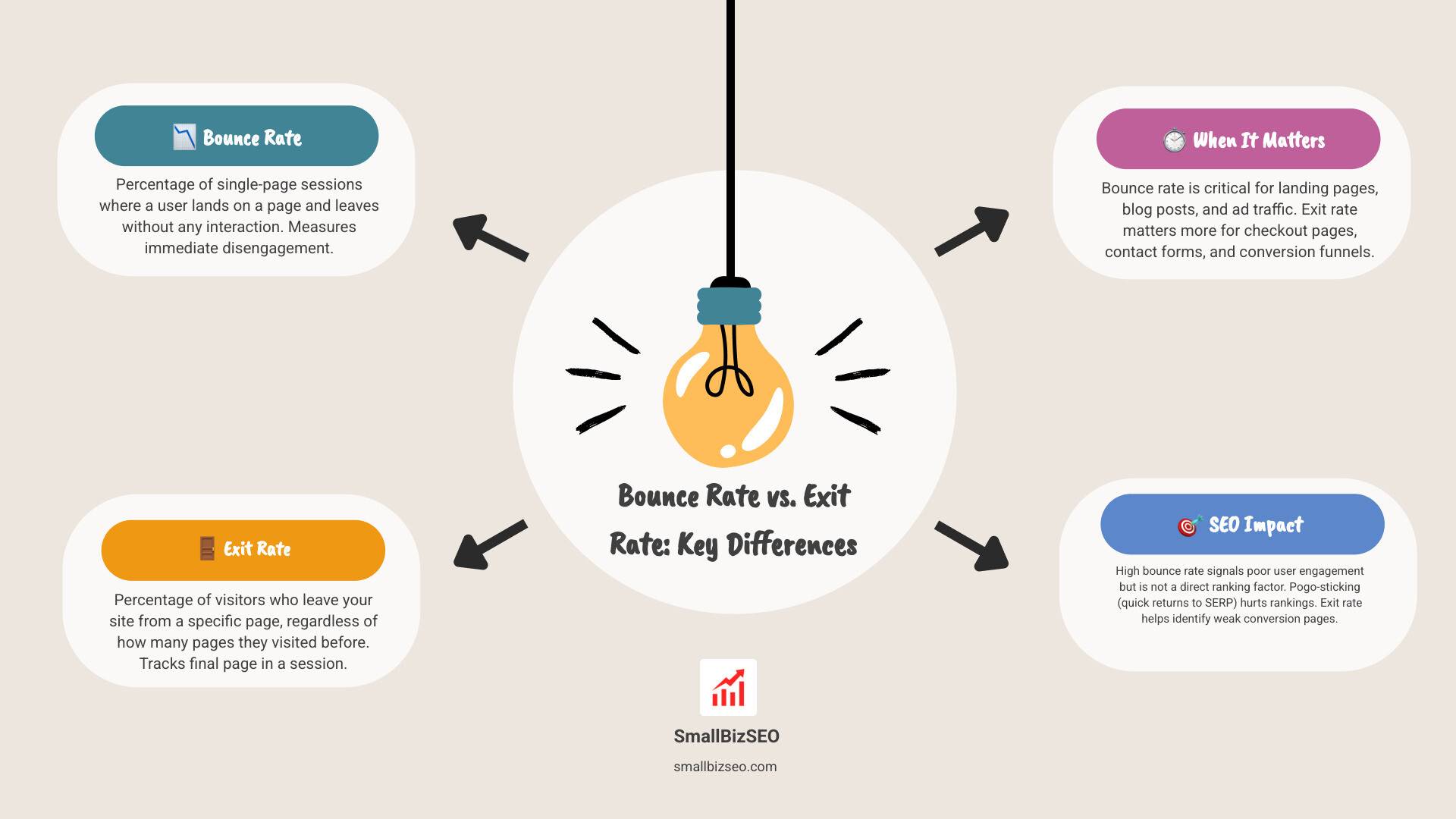
To solve a high bounce rate, we first need to understand what it actually measures. In website analytics, a "bounce" occurs when a user lands on a page and leaves without triggering any other interaction. The bounce rate is simply the percentage of all sessions on your site that are single-page sessions.
Many website owners confuse bounce rate with exit rate. While bounce rate only tracks users who land on a page and immediately leave, exit rate measures the percentage of visitors who leave your site from a specific page, regardless of how many other pages they visited before getting there.
Is bounce rate a direct ranking factor? According to Google's John Mueller, the answer is no. Google does not use Google Analytics bounce rate data directly in its ranking algorithms. Why? Because countless Google Analytics accounts are misconfigured, poorly tagged, or calculated incorrectly. Google cannot rely on a noisy, easily manipulated metric.
However, user behavior on the search engine results page (SERP) is a different story. If a searcher clicks your link, finds your page irrelevant or slow, and immediately clicks the back button to return to the search results to choose another link, Google notices. This behavior is called pogo-sticking. Backed by Google Patent US8954420, Google tracks these rapid returns to the SERP to determine if a page successfully satisfies user intent.
To see how your site measures up and where users are losing interest, we recommend starting with a Detailed SEO Analysis. To explore foundational strategies for keeping visitors engaged, you can also review this guide on How to Reduce Website Bounce Rate: 10 Proven Steps.
What is a Good Bounce Rate? Benchmarks by Industry and Website Type
A "good" bounce rate depends entirely on your industry, website type, and traffic source. For example, a visitor landing on a recipe blog wants to quickly grab a recipe and leave. That blog will naturally have a much higher bounce rate than an e-commerce site where users browse multiple products.
To put this in perspective, let's look at average benchmarks across different categories:
| Category | Benchmark / Average |
|---|---|
| Overall Web Average | ~53% |
| Good Threshold | 40% or lower |
| Needs Improvement | 55% or higher |
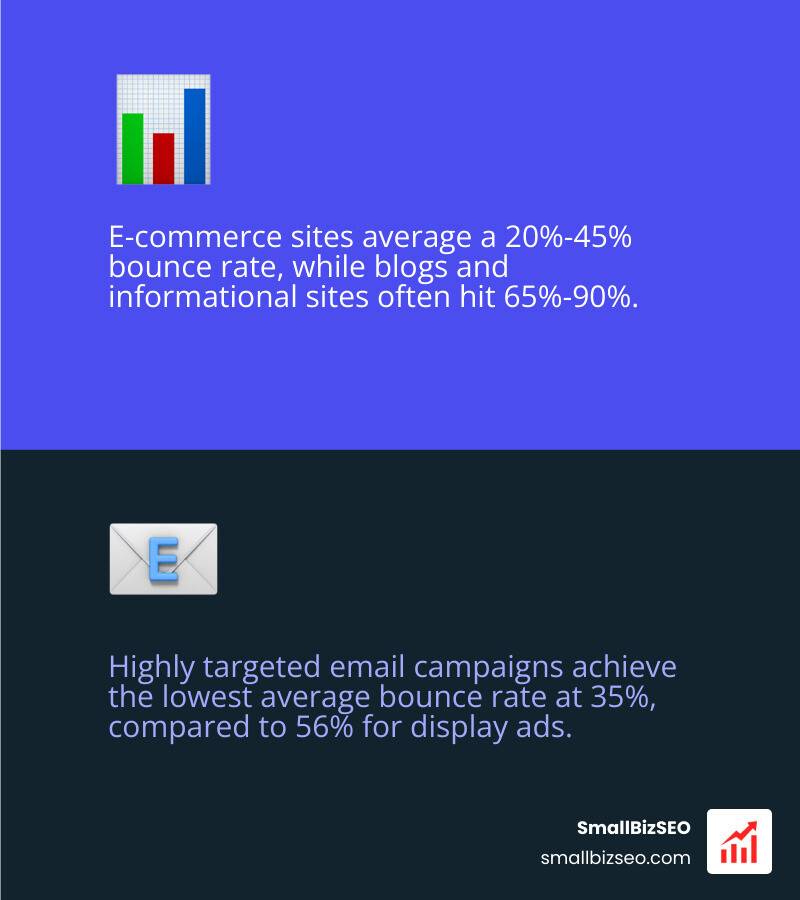
| E-commerce Sites | 20% - 45% |
| Blogs & Informational Sites | 65% - 90% |
| Landing Pages | 60% - 90% |
| Real Estate Industry | ~44.5% |
| Food & Drink Industry | ~65.5% |
Traffic sources also dramatically influence these numbers. Display ads typically carry a higher bounce rate of 56%, and social media traffic averages 54%. On the other hand, organic search averages 43%, and highly targeted email campaigns boast the lowest average bounce rate at 35%.
How an SEO Consultant for Bounce Rate Diagnoses the Root Causes
When you hire an seo consultant for bounce rate issues, we do not just guess what is wrong. We dive deep into your data using advanced analytics segmentation. Looking at a site-wide average bounce rate is useless; we must segment the data by channel, device, and landing page.
In Google Analytics 4 (GA4), the metric has shifted toward "Engagement Rate," which is the exact inverse of bounce rate. An engaged session is defined as one that lasts longer than 10 seconds, triggers a conversion event, or views two or more pages. If your engagement rate is low, we look for specific patterns:
- Device-Specific Issues: If your desktop bounce rate is 35% but mobile is 78%, we know there is a mobile responsiveness or rendering issue.
- Traffic Source Discrepancies: If paid search traffic has a massive bounce rate compared to organic, your ad messaging likely does not align with your landing page content.
- Internal Site Search Analysis: We look at what users are actively searching for once they land on your site. If they search for terms you do not cover, it reveals critical content gaps.
By running a comprehensive SEO Visibility Audit, we can pinpoint these technical and structural drops in user engagement before they damage your brand's search visibility.
Technical and Content Strategies to Reduce Website Bounce Rate
To keep visitors on your page, we must optimize both the technical performance of your site and the relevance of your content. If either of these pillars fails, your bounce rate will climb.
Why You Need an SEO Consultant for Bounce Rate Speed Fixes
Speed is the first conversion filter. If your page takes too long to load, visitors will leave before they even see your headline. Google's research shows that 53% of mobile site visits are abandoned if pages take longer than 3 seconds to load.
A skilled seo consultant for bounce rate speed fixes will focus on Google's Core Web Vitals:
- Largest Contentful Paint (LCP): We aim to get your main content loaded in under 2.5 seconds.
- Cumulative Layout Shift (CLS): We stabilize your layout so elements do not shift around while loading, preventing "rage bounces" where users accidentally click the wrong button.
- Interaction to Next Paint (INP): We ensure your site responds instantly when a user clicks a button or menu.
Often, slow loading times are caused by script bloat — excessive JavaScript from marketing tools and third-party tracking pixels. By auditing these scripts and prioritizing above-the-fold loading, we can dramatically improve perceived performance. In fact, page speed improvements alone have been shown to boost conversion rates by 30%. Our team can handle these complex technical adjustments through our dedicated SEO Services.
Aligning Content Relevance and Internal Linking Structures
Once your site is fast, we must ensure your content matches the user's search intent. If a user searches for "best organic dog food" and lands on a page that only sells cat toys, they will bounce instantly.
To prevent this, we optimize the above-the-fold experience. Your headline and hero image must immediately confirm that the visitor is in the right place. We also focus on content readability, aiming for an accessible reading level with short paragraphs, clear headings, and interactive jumplinks (tables of contents) that allow users to navigate long-form guides easily.
Additionally, we use strategic internal linking to guide the user journey. By placing relevant, natural links within your content, we give visitors a clear path to their next step. This not only reduces bounce rates but also builds search engine trust by establishing clear topical authority. You can learn more about aligning your content with search expectations in our guide on How to Optimize Your Content for E-E-A-T and Build Real Search Trust.
Balancing Engagement Metrics with Business Conversion Goals
It is important to remember that a high bounce rate is not always bad. If a user lands on your "Contact Us" page, finds your phone number, calls your business, and leaves, that is a highly successful interaction — even though it counts as a bounce.
As consultants, we balance bounce rate reduction with your overall business goals. We design landing pages around micro-moment marketing, placing clear, compelling calls-to-action (CTAs) above the fold for users ready to convert immediately, while providing internal links to deeper resources for those who need more information. Through continuous A/B testing, we find the sweet spot where user engagement and business conversions meet. We utilize targeted On-Page SEO strategies to make sure every page on your site serves a clear, measurable purpose.
Frequently Asked Questions about Bounce Rate Optimization
Is bounce rate a direct Google ranking factor?
No. Google's John Mueller has confirmed that Google does not use Google Analytics bounce rate as a direct ranking factor. Instead, Google monitors search engine results page (SERP) behavior, such as pogo-sticking, to determine if a page successfully satisfies user search intent.
How does a professional SEO consultant for bounce rate improve mobile performance?
We adopt a mobile-first design process. This includes optimizing touch targets so buttons are easy to tap, compressing images to WebP formats to speed up Largest Contentful Paint (LCP), and resolving layout shifts to ensure a seamless, frustration-free mobile user experience.
What is the difference between bounce rate and exit rate?
Bounce rate measures the percentage of users who land on a page and immediately leave without visiting any other pages. Exit rate measures the percentage of users who leave your site from a specific page, even if they previously browsed multiple other pages during their session.
Drive Real Engagement with SmallBizSEO
At SmallBizSEO, we do not believe in chasing empty metrics. We use our data-driven "Velocity" framework to deliver fast rankings, E-E-A-T-compliant content, and transparent, automated reporting that connects directly to your bottom line.
Whether you need a complete technical overhaul, a refined content strategy, or expert Digital Marketing Consulting | Naveen Konada India frameworks to guide your growth, our team is ready to help. Let us transform your website from a leaky funnel into a high-converting revenue engine. Reach out to an experienced SEO consultant at SmallBizSEO today, and let's get to work.