SEO for Title Search and Abstract Providers

What Should SEO Communicate for Title Search and Abstract Services?
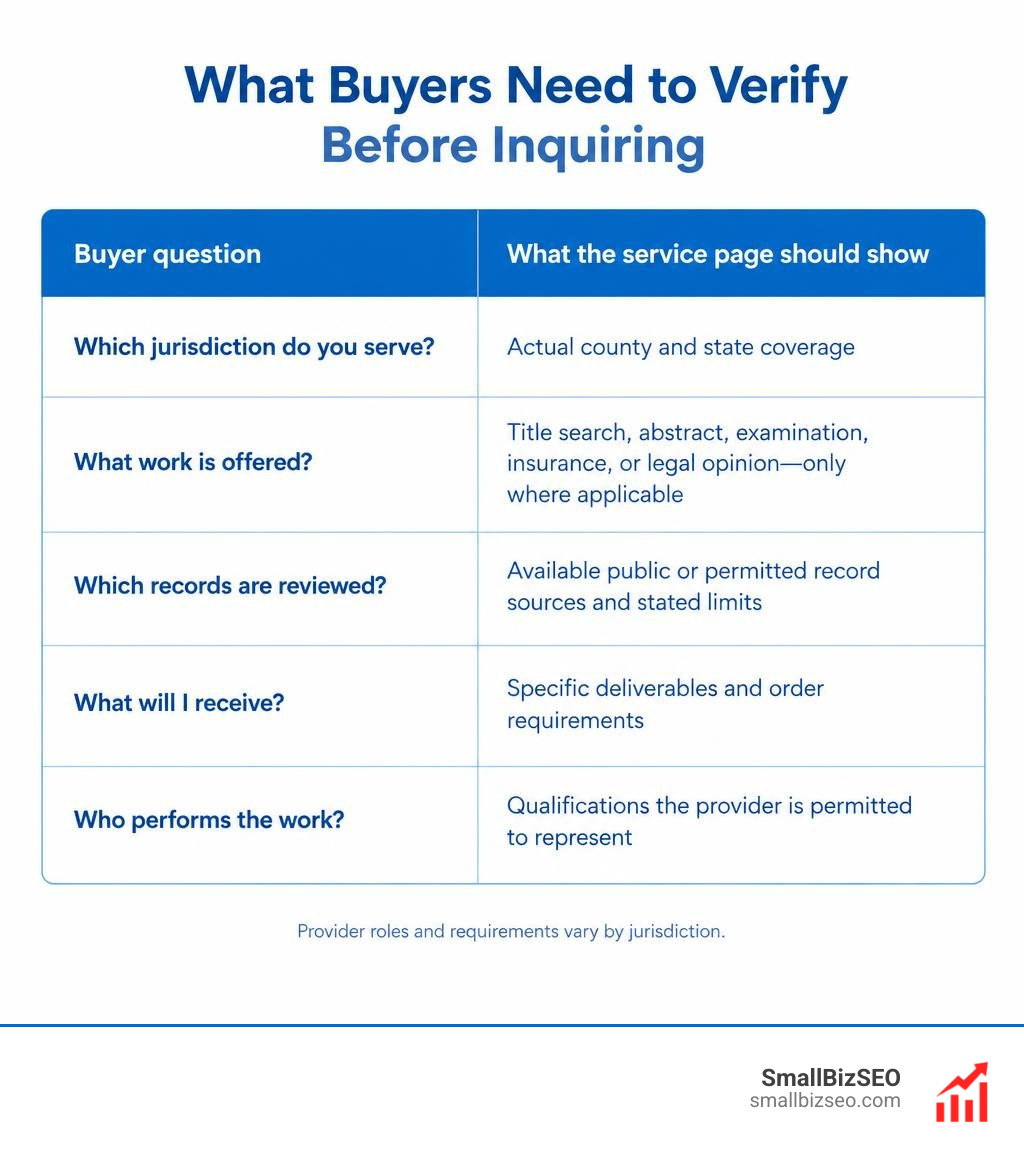
SEO for title search and abstract services should make the provider's actual scope easy to verify before a buyer inquires. Start with pages that state the jurisdictions served, record sources reviewed, search limits, deliverables, ordering steps, and the qualifications the provider is permitted to represent.
Professional buyers, including law firms, lenders, and title agencies, often need operational detail before assigning work. Consumer readers may instead be looking for general context about closing services. Keep those needs distinct, and avoid presenting consumer education as a universal requirement for every provider.
A useful service page answers practical questions without promising a legal conclusion, insurance coverage, or a particular outcome.
Related resources:
A title search, abstract, title examination, title insurance policy, and legal opinion are not interchangeable. Their meaning, the provider's role, and the qualifications required can vary by jurisdiction and transaction. Service pages should name the exact work offered rather than using broad labels that could mislead a buyer.
Describe what the search covers, which public or permitted record sources are used, and what is outside the scope. Do not imply that a search guarantees clear title, substitutes for legal advice, or follows one universal record period or industry standard.
What Information Should a Title-Search SEO Page Show?
The Google SEO Starter Guide can help structure a credible title-search SEO page that matches a specific buyer question with proof that the provider can perform that work. Build useful service and coverage pages around real operations, not a large set of thin pages that merely swap county names.
Use language that reflects the work buyers assign: document retrieval, a defined record search, abstract preparation, examination support, or another accurately named service. Pair each page with the supporting details that a qualified provider can verify, such as coverage boundaries, available record systems, permitted credentials, and the normal ordering route. For related local visibility practices, see this comprehensive local SEO guide.
What Do Professional Buyers Need Before They Inquire?
Professional buyers need enough detail to determine whether the service fits a live matter. Consumer-facing context can explain title-related closing services, but it should not blur the provider's actual deliverables or make legal recommendations. The Consumer Financial Protection Bureau offers consumer information about title service fees and shopping for title insurance and closing services; those materials are context, not a template for every provider's scope.
Use SEO content services to turn verified operational knowledge into pages buyers can evaluate. The goal is a clearer, more trustworthy path to an inquiry, not a promise of rankings, lead volume, or transaction outcomes.
| Buyer question | Helpful page | Proof to include | Next action |
|---|---|---|---|
| Can this provider handle this jurisdiction? | Coverage page | Actual counties or states served and any stated limits | Request a scope check |
| What records and deliverables are included? | Service page | Record sources, search parameters, report format, and exclusions | Submit property or order details through the stated process |
| Is the provider qualified for this assignment? | Qualifications page | Permitted licenses, affiliations, or experience stated accurately for the jurisdiction | Confirm assignment requirements before ordering |
| When can work be completed? | Ordering page | Verified turnaround ranges and factors that may affect them | Request current availability |
How Should a Provider Use a Google Business Profile?
Use a Google Business Profile only when the business is eligible and the profile accurately represents real operations. Google's Business Profile guidelines call for an accurate business identity, address or service area, and the fewest categories needed to describe the core business.
- Match the real-world business: Use the real business name and accurate contact details.
- Choose categories carefully: Select only categories that match actual services and qualifications. Do not choose a category simply because it attracts a query.
- Describe scope accurately: State the services, coverage boundaries, and ordering route without implying work the provider does not perform.
- Request reviews ethically: Invite honest feedback without incentives, review gating, or requested wording. Do not direct reviewers to use particular keywords.
For an operational review of local visibility, use an SEO visibility audit. Treat it as a way to identify gaps to investigate, not as a promise of a particular local ranking.
How Should Coverage and Record Scope Be Explained?
Coverage pages should state the actual county or state scope, the record repositories or systems the provider can access, and material limits on the work. Add a distinct page only when it provides meaningful, verified information for that jurisdiction; do not create a series of near-duplicate location pages.
Use a clear scope checklist rather than unsupported jurisdiction-specific claims:
- Geographic coverage: List only the jurisdictions the provider actually serves.
- Record scope: Identify the public, proprietary, or permitted record sources reviewed when that information can be disclosed.
- Deliverables: Describe the report, document copies, or other output the buyer receives.
- Limits and handoffs: Explain exclusions, dependencies, and when the matter requires a title insurer, attorney, or another qualified professional.
- Ordering details: Give the documents or property information needed to begin and a verified way to request current turnaround.
How Can Providers Make Pages Easier to Evaluate?
Make each page easy to read on common devices, use descriptive headings, and keep the service information consistent across relevant pages. Structured data may help search engines interpret eligible details, but it should reflect the real business and never replace clear on-page explanations.
- Service clarity: Use one page for each genuinely distinct service or buyer need.
- Evidence: Include verified coverage, scope, deliverables, ordering steps, and qualifications.
- Useful answers: Publish plainly written answers to recurring buyer questions, then refresh them when operations or rules change.
- Accessible navigation: Connect related service, coverage, qualification, and ordering pages with useful internal links.
A consistent editorial process, regular content refreshes, useful internal links, and relevant earned outreach can support long-term discoverability without guaranteeing a ranking or visibility outcome.
How Should Providers Measure and Maintain Their SEO Content?
Measure whether the site is helping relevant buyers find accurate information and take an appropriate next step. Avoid broad pages that combine materially different services without explaining scope, qualifications, or limits.
Review Search Console data, inquiry quality, and page engagement alongside the accuracy of the content. An SEO visibility audit can help identify technical or content issues to investigate, but performance data should be interpreted in context.
Which Signals Are Worth Reviewing?
Review search impressions, clicks, query themes, page engagement, and qualified inquiries over a meaningful period. Use changes as prompts to inspect content, technical health, and buyer fit rather than as proof that a single tactic caused a result.
- Coverage and accuracy: Confirm that stated jurisdictions, services, qualifications, and turnaround information remain current.
- Buyer questions: Identify recurring queries and add or improve answers where the business can provide verified information.
- Inquiry quality: Track whether professional buyers can complete the stated ordering path and whether consumers are directed to appropriate educational context.
- Content maintenance: Refresh useful pages, strengthen internal links, and pursue relevant earned outreach when there is a genuine reason to reference the resource.
Prioritize accuracy and usefulness over volume. A well-maintained resource that explains real capabilities gives prospective buyers a more reliable basis for deciding whether to inquire.
Build Trust Before the Inquiry
A useful title-search website helps each visitor understand what the provider can and cannot do before they reach out. Lead with verified coverage, record scope, deliverables, ordering steps, and qualifications. Keep consumer context separate from professional assignment information, update pages as operations change, and avoid promises that the provider cannot substantiate.
Book a SmallBizSEO consultation about your SEO content to discuss a clearer, more useful website for title-search and abstract services.