Lawyer SEO Services: What to Compare Before Hiring a Provider
Which Lawyer SEO Services Matter Most?
The most useful lawyer SEO services connect a clear scope of work to evidence a firm can review: practice-area resources, technically sound pages, eligible local visibility, and reporting that distinguishes traffic from meaningful intake activity. This is a buyer’s comparison guide, not legal advice.
Start by matching the work to the practice. A solo practice may prioritize a small set of high-value service pages, an accurate Google Business Profile for a real, eligible office, and a usable intake path. A firm with several offices or practice areas may need distinct, useful pages that reflect real services and responsible attorneys, rather than thin or duplicative pages built only to capture similar searches.
Ask each provider to show how its scope supports the path from search click to qualified inquiry, consultation, and, where the firm tracks it, signed matter. Attribution is directional rather than perfect: intake data can be aggregated, and any call recording, client information, or matter data should be handled under the firm’s confidentiality, consent, and recordkeeping requirements.
For a contextual overview of local law-firm SEO, see this law firm local SEO guide.
How Is Legal SEO Different from General SEO?
Legal SEO needs the same technical and editorial discipline as other competitive fields, with an added review layer for attorney advertising, privacy, and jurisdiction-specific accuracy. A provider should not present the ABA Model Rules as automatically controlling every firm. They are model rules; the applicable state or local rules, court rules, and the responsible licensed lawyer’s review control the final decision.
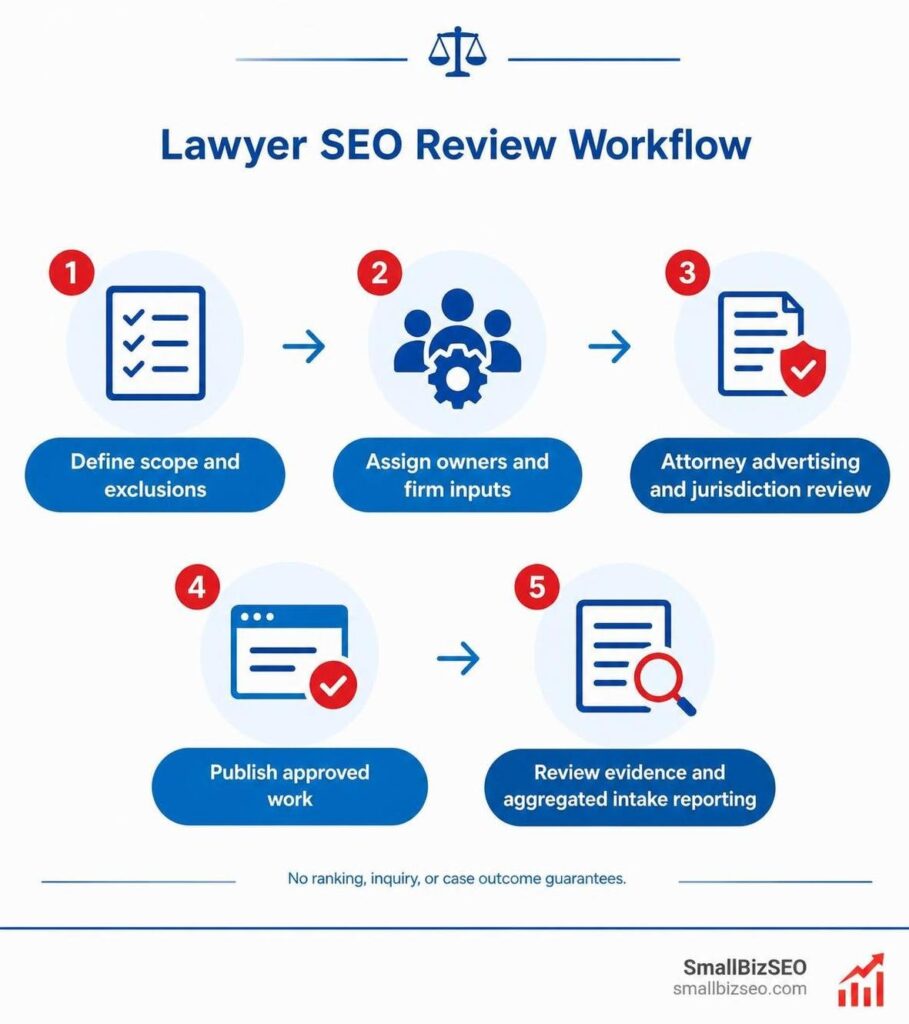
A sound workflow assigns an owner for each approval: the SEO team prepares the page, a qualified firm reviewer checks attorney credentials, practice descriptions, testimonials, comparisons, and required notices, and the firm approves publication. Keep a record of the reviewer, the jurisdictional scope, the source material used, and the internal review status. Revisit practice-area resources when relevant law, procedure, or firm information changes.
The ABA Model Rules of Professional Conduct include the current lawyer-communication and advertising rules, but they are a starting point for research, not a blanket compliance certification. Avoid publishing matter-specific or confidential client details, invented outcomes, or firm-specific legal advice in marketing content.
Google’s guidance likewise emphasizes helpful, reliable content created for people. In practical terms, that means original explanations from knowledgeable reviewers, clear author and reviewer credentials where relevant, accurate sources, and updates when the underlying information changes. Google’s people-first content guidance is a useful editorial reference.
What Should a Lawyer SEO Scope Include?
A credible scope balances content, local visibility, technical foundations, and reviewable evidence. It should explain what will be created, who owns each task, what the firm must supply, and what is explicitly excluded.
Practice-Area Resources That Help Real Prospects
Build practice-area pages and supporting resources around the questions prospective clients genuinely ask. Each page should be distinct, supported by reliable sources, and reviewed for jurisdictional accuracy. Helpful internal links can guide readers to related services without creating near-duplicate pages for every similar query.
A content scope can include editorial briefs, attorney or firm-subject-matter review, source citations, revision ownership, and a documented update process. For broader content production, compare the deliverables in SEO content services.
AI Search Visibility Without Citation Promises
AI-assisted search can surface clear, well-supported answers, but no provider can promise citation, referral traffic, or visibility in a particular AI product. Focus instead on useful original commentary, readable answer-first sections, transparent authorship, and reliable source links. These practices improve the page for readers and make its claims easier to assess.
Structured data may help systems understand visible page facts when it accurately reflects the page. LegalService or Person markup should describe real, visible services or people, not manufacture authority. It is not a ranking guarantee, and Google does not guarantee that structured data will produce a particular search appearance. See Schema.org’s LegalService definition and Google’s structured-data documentation.
Eligible Local Visibility and Editorial Outreach
For eligible real offices, local work can include accurate business details, category selection, service information, and a Google Business Profile maintained under Google’s rules. Do not use virtual offices or unsupported practitioner setups to create local listings. Review Google’s Business Profile guidelines before making location-related changes.
Authority work should favor earned legal or local editorial coverage, useful professional resources, and relevant community references. Any outreach copy and resulting link placements should go through the same advertising-ethics review as other marketing materials. Link-building services can be compared alongside the provider’s disclosure, approval, and quality-control process.
What Should You Ask Before Hiring a Lawyer SEO Provider?
Use a buyer worksheet to compare proposals on the same terms. The goal is not a promise of rankings or case outcomes; it is a documented plan with accountable owners, review points, and evidence of completed work.
| Buyer worksheet item | What to request | What to clarify |
|---|---|---|
| Deliverables | Named pages, technical tasks, local-profile work, content briefs, and outreach activities | What is excluded or treated as an extra project? |
| Owner | The person or team accountable for each workstream | What must the firm provide and approve? |
| Legal review | A review step for advertising-sensitive content | Which licensed lawyer approves material for the applicable jurisdiction? |
| Evidence | Source links, change logs, page drafts, technical findings, and reporting definitions | How is completed work documented? |
| Intake reporting | Clicks, qualified inquiries, consultations, and signed matters when the firm elects to track them | What attribution limits, privacy controls, and call-recording consent requirements apply? |
| Account access | Ownership and access to the website, analytics, profiles, and content files | What access remains with the firm if the engagement ends? |
Which Technical Work Matters?
Technical SEO should make the site easier to crawl, use, and maintain. Ask for an audit that prioritizes issues by likely user and search impact, then documents changes with before-and-after evidence. Typical work includes responsive performance, indexability, internal linking, accessible page structure, and structured data that matches visible content.
Avoid proposals that treat schema as a shortcut. For example, use person or organization details only when they are true, visible, and maintained by the firm. Technical work can improve clarity and usability, but it does not guarantee rankings, inquiries, or matters.
What Should Pricing and Retainer Terms Cover?
The following illustrative monthly work plan shows how a provider and firm might assign responsibilities and document completed work. It is not a promised volume of work or a promise of rankings, inquiries, consultations, or signed matters.
| Illustrative workstream | Named owner | Deliverable evidence |
|---|---|---|
| Attorney-reviewed resource production | SEO content lead and designated firm reviewer | Approved brief, draft, source list, reviewer record, and published-page link |
| Refreshing outdated practice pages | SEO lead and practice-area reviewer | Update log, source or firm-information notes, reviewer approval, and revised-page link |
| Technical and local maintenance | Technical SEO specialist and firm operations contact | Prioritized findings, change log, validation notes, and local-profile update record for eligible offices |
| Relevant earned outreach | Outreach lead and firm reviewer | Approved outreach materials, placement records, and notes showing editorial or community relevance |
| Privacy-aware intake reporting | Analytics lead and firm intake contact | Aggregated reporting definitions, attribution notes, and documented privacy and consent considerations |
Contract length alone does not determine quality. Compare the renewal and exit terms, minimum commitments, deliverable cadence, change-request process, ownership of accounts and content, access to data, and what happens to unfinished work. For package comparisons, review SEO packages.
Frequently Asked Questions About Legal Search Marketing
How long does legal SEO take?
There is no responsible universal timeline. Progress depends on the site’s starting condition, the scope of work, competition, the firm’s review speed, and changes in search behavior. A provider should explain what it will measure, how often it will report, and which leading indicators it will use without presenting traffic, rankings, consultations, or signed matters as guaranteed outcomes.
How should a firm handle advertising-rule review?
Treat the applicable jurisdiction’s rules and the responsible licensed lawyer’s review as the decision point. The ABA Model Rules can inform research, but they do not replace local requirements or professional judgment. A sound approval process identifies the reviewer, the claims being reviewed, supporting evidence, and any required disclosures.
What is the difference between SEO and AI-search optimization for law firms?
SEO focuses on making a firm’s pages discoverable, useful, technically accessible, and relevant to searchers. AI-search optimization uses many of the same fundamentals: direct answers, original expertise, reliable sources, and clearly supported claims. Neither approach can guarantee that a search engine or AI system will feature, cite, or recommend a firm.
Choose a Reviewable SEO Partnership
The strongest lawyer SEO engagement is one a firm can inspect: the provider defines the work, identifies owners and exclusions, supplies evidence, protects account access, and gives the responsible lawyer a meaningful approval role. That framework helps the firm evaluate progress without relying on inflated claims about rankings or outcomes.
For a provider comparison and next-step discussion, explore lawyer SEO services or book a consultation.