How to Choose an SEO Consulting Company: Advisory vs. Execution

How Do You Choose an SEO Consulting Company?
Choose a consulting company by matching its delivery model to the work your team can actually complete. A strong partner can diagnose issues, turn findings into prioritized work, name owners and acceptance checks, and show how progress will be verified.
SEO consulting is not the same as ongoing execution. Some providers supply a focused audit and roadmap, some act as a fractional SEO lead for an internal team, and others manage implementation across technical work, content, internal linking, and earned outreach. Ask each provider to define exactly what it will do, what your team must do, and what will count as complete.
Disclosure: SmallBizSEO publishes this guide and also offers SEO services. Use the questions below to compare SmallBizSEO with any other provider, rather than treating this page as an independent ranking of companies.
Before signing, ask for a sample deliverable with sensitive details removed, the roles assigned to your account, the reporting cadence, and a written description of the decisions that require your approval. A consultant should be able to explain what is included without promising rankings, indexing, or results that depend on work outside its control.
Consulting, Fractional SEO Leadership, or Managed Execution?
The best option depends on who will implement the work. An advisory audit is useful when a capable internal team needs direction; fractional SEO leadership suits teams that need ongoing prioritization and review; managed execution fits businesses that need a provider to coordinate and complete the work.
| Delivery model | Provider responsibilities | Buyer responsibilities | Questions and controls |
|---|---|---|---|
| Advisory audit | Diagnose issues, prioritize work, document rationale, and define acceptance checks | Assign owners, authorize changes, and complete implementation | Who resolves blockers? What evidence closes each ticket? How many revisions are included? |
| Fractional SEO leadership | Maintain a backlog, coordinate specialists, review releases, and adjust priorities | Provide meeting access, stakeholders, and implementation capacity | Who attends working sessions? Who approves scope changes? What is the escalation path? |
| Managed execution | Plan and carry out agreed technical, content, internal-linking, and outreach work | Give access, timely approvals, and subject-matter input | Which tasks are included? Which require developer spend or separate vendors? What permissions are needed? |
What Should You Ask Before Hiring a Provider?
Ask prospective providers to describe their current services in writing, including the scope of technical analysis, content support, implementation, reporting, and any outreach. Confirm whether they will work inside your systems or only make recommendations, and ask who owns the work product, access credentials, and documentation when the engagement ends.
A provider can protect client confidentiality while still showing credible evidence of its process. If a case study is limited by an NDA, ask for anonymized examples, a walkthrough of the decision process, references where appropriate, and a clear explanation of what cannot be shared. An NDA constraint is not an automatic disqualifier; vague answers about methods, responsibilities, or verification are the concern.
What Does a Verified SEO Recommendation Look Like?
A useful recommendation becomes a trackable work item. For example, a hypothetical audit may find that several equivalent pages compete because their canonical signals are inconsistent. The consultant should create a prioritized ticket, name the page owner or developer, specify the intended canonical destination, and define an acceptance check such as confirming the canonical markup and internal links after deployment. That technical check confirms the requested signals are present, but it does not guarantee that Google will select the intended canonical. The consultant then rechecks the live pages, records whether the fix is verified or needs follow-up, and may review Search Console later when enough data is available.
This approach is more valuable than a long audit document alone because it connects an observation to an owner, a completion standard, and a recheck. Google’s guidance emphasizes helpful, reliable content created for people, so content recommendations should also identify the audience need, the subject-matter input required, and the review process rather than simply calling for more pages. Read Google’s people-first content guidance.
Which Red Flags Matter Most?
Be cautious when a provider guarantees rankings, promises instant indexing, hides its methods, or cannot explain how work is prioritized and reviewed. Also question a proposal that treats automated reports as completed work, leaves implementation ownership undefined, or makes renewal and cancellation terms hard to find.
The practical test is whether the provider can describe its scope, dependencies, permissions, risks, and verification process in plain language. A clear answer is stronger evidence than a famous name or a broad claim about expertise.
How Does Consulting Differ From Ongoing SEO Services?
Consulting gives a team direction and oversight; ongoing services add recurring execution. Depending on the agreed scope, ongoing work may include expert content development and review, refreshing existing pages, improving internal links, and pursuing earned outreach. An audit can set priorities, but sustained progress usually requires the approved work to be completed and reviewed over time.
Illustrative monthly execution can combine several workstreams, but it is not a fixed package. The agreed scope, capacity, approvals, and evidence should be documented for the engagement.
| Workstream | Illustrative monthly work | Owner | Approval | Evidence of completion |
|---|---|---|---|---|
| Expert content development | Draft and review priority content using subject-matter input | Content specialist and subject-matter reviewer | Business owner or designated reviewer | Approved draft, published URL, and documented review notes |
| Content refresh | Update agreed existing pages for accuracy, usefulness, and search intent | Content specialist | Page owner or subject-matter reviewer | Change log, approved copy, and live-page check |
| Internal links | Add or improve contextual links between priority pages | SEO specialist and publisher | Page owner when required | Link map and live-page verification |
| Earned outreach | Identify relevant publications or resources and conduct approved outreach | Outreach specialist | Business owner for messaging or offers | Outreach log, approval record, and any confirmed placement |
| Measurement | Review adopted recommendations, verified fixes, and agreed business indicators | SEO lead and business stakeholder | Stakeholder review of reporting | Delivery summary, verification record, and agreed next actions |
For a service-based engagement, compare the documented scope with the capabilities described in SEO services, SEO content services, and link-building services. The right choice is the one whose responsibilities, approvals, and delivery controls fit your team.
How Should You Scope, Deliver, and Measure SEO Consulting?
Scope an SEO engagement around completed work, verified fixes, and business-relevant outcomes, not unsupported benchmarks. Agree on the baseline evidence, the work backlog, the people responsible for approvals and implementation, and the limits of attribution before the work begins.
Site performance matters when it affects users and business goals, but the right action depends on the issue, the affected pages, and the resources available to resolve it. A consultant should explain the suspected impact, the proposed fix, and how the change will be checked after release.

What Can an Illustrative 90-Day Delivery Plan Include?
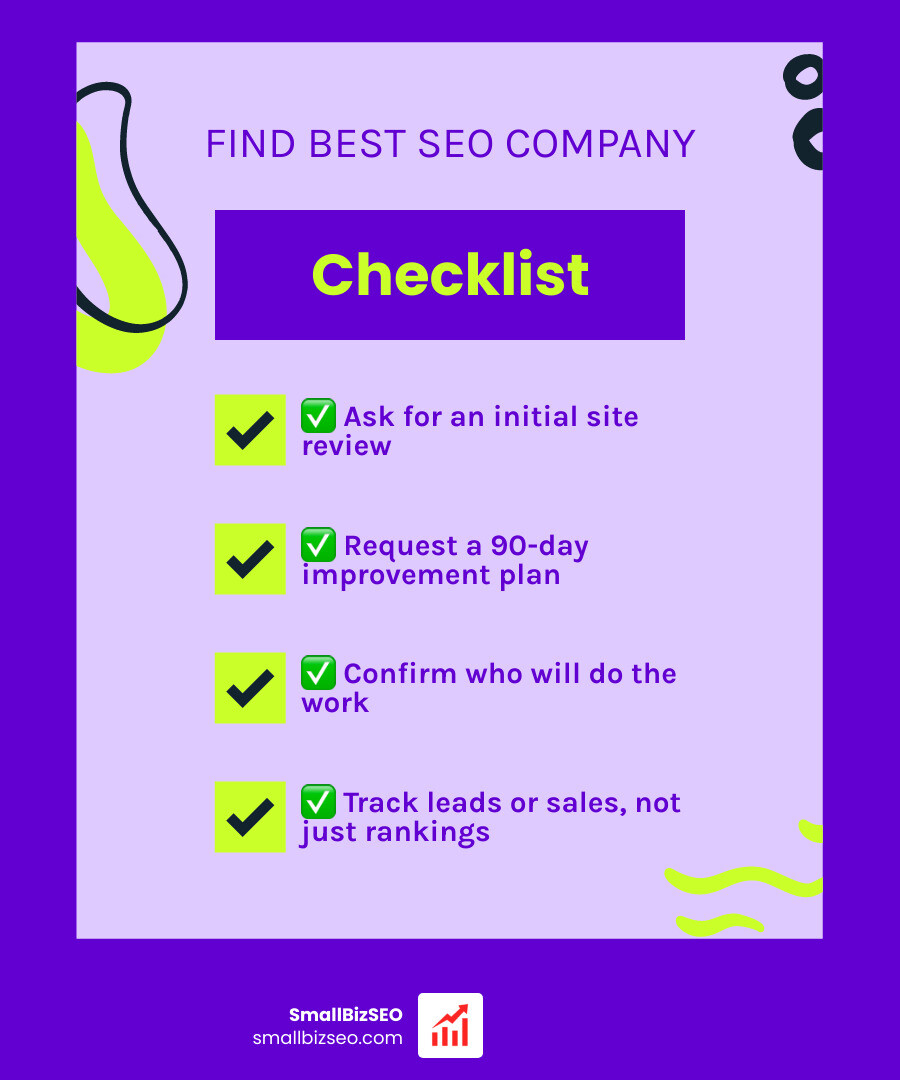
A 90-day plan is a delivery framework, not a ranking promise. The early work normally depends on access to analytics, Search Console, the CMS, development resources, and the people who can approve changes.
- Initial phase: Confirm goals, access, priority pages, technical constraints, and the implementation owner for each finding.
- Build phase: Turn approved findings into tickets, publish or refresh agreed content, improve internal linking, and complete releases that have passed review.
- Verification phase: Recheck completed work, review what remains blocked, refine the next backlog, and agree on the ongoing cadence for content, technical review, and earned outreach.
A useful plan states dependencies rather than assuming them away. For example, a technical recommendation may require a developer, a release window, QA, and a recheck before it can be counted as completed. A content recommendation may require subject-matter review, legal approval, and publishing access.
What Should the Contract and Scope Cover?
Clarify which activities are included, which implementation resources the buyer supplies, and whether developer work, specialist writing, design, or third-party tools create separate costs. The agreement should also cover meeting access, response times, revision limits, confidentiality, ownership of deliverables, permissions in your systems, renewal terms, and cancellation terms.
If you need a packaged scope to compare against a proposal, review the service details in SEO packages. The important point is not a standard price band; it is whether the scope identifies the work, owner, review path, and exclusions.
Which Metrics Show Useful Progress?
Measure whether recommendations were adopted, whether technical or content changes were verified after release, and whether qualified leads or other agreed business outcomes changed over an appropriate period. Use rankings and organic traffic as context, not as the sole proof of value.
Attribution has limits: a lead or sale may be influenced by brand activity, sales follow-up, seasonality, paid campaigns, and many other factors. Reporting should distinguish verified delivery from observed outcomes and avoid claiming that every optimization directly created revenue.
For a starting view of opportunities and implementation priorities, request an SEO visibility audit.
Choose a Partner You Can Hold Accountable
The right SEO consulting company gives your team a clear scope, practical priorities, named owners, and a way to verify completed work. Compare providers on their process, delivery controls, and willingness to explain dependencies, not on broad promises or reputation alone.
Use the proposal review to confirm what will be implemented, who approves changes, how progress is verified, and how the engagement can be adjusted or ended. That makes it easier to choose support that fits your resources and creates a workable path from advice to execution. If you want to discuss which delivery model fits your team, book a consultation.