Ecommerce SEO Services USA: Agency Comparison Checklist
Ecommerce SEO Services USA: How to Compare Agencies
Ecommerce SEO services should be compared by the work an agency can document, the people who will own it, and the limits of its reporting, not by a superlative label. This article is published by SmallBizSEO, so SmallBizSEO is an affiliated provider rather than an independent recommendation.
A useful comparison starts with each provider’s current service page and a discovery call. Confirm the catalog size and platform the team supports, whether it can implement recommendations or only advise, and who is responsible for technical fixes, content, outreach, analytics, and quality assurance.
| Provider | Publicly described scope to verify | Potential fit to explore | Questions to ask before signing |
|---|---|---|---|
| SmallBizSEO | Ecommerce SEO services, technical SEO, content strategy, and link building | Businesses seeking a scoped SEO engagement | Which deliverables, owners, and reporting inputs are included? |
| OuterBox | Catalog SEO, technical work, content, digital PR, conversion work, analytics, and development support | Complex catalogs needing coordinated technical and marketing work | Which specialists will work on the account, and what implementation help is included? |
| Coalition Technologies | Ecommerce technical SEO, product and category optimization, content, outreach, and conversion work | Stores that want a broad in-house digital marketing scope | Which services are in the SEO scope versus separate retainers? |
| Uproer | Ecommerce SEO across common commerce platforms and custom builds | Teams evaluating an ecommerce-focused specialist | What platform work, content production, and reporting cadence are included? |
Provider pages describe their own services and marketing claims, not independently verified outcomes. Treat the table as a starting point for due diligence, then request examples relevant to your catalog, platform, and operating constraints.
What Does a Sound Ecommerce SEO Scope Include?
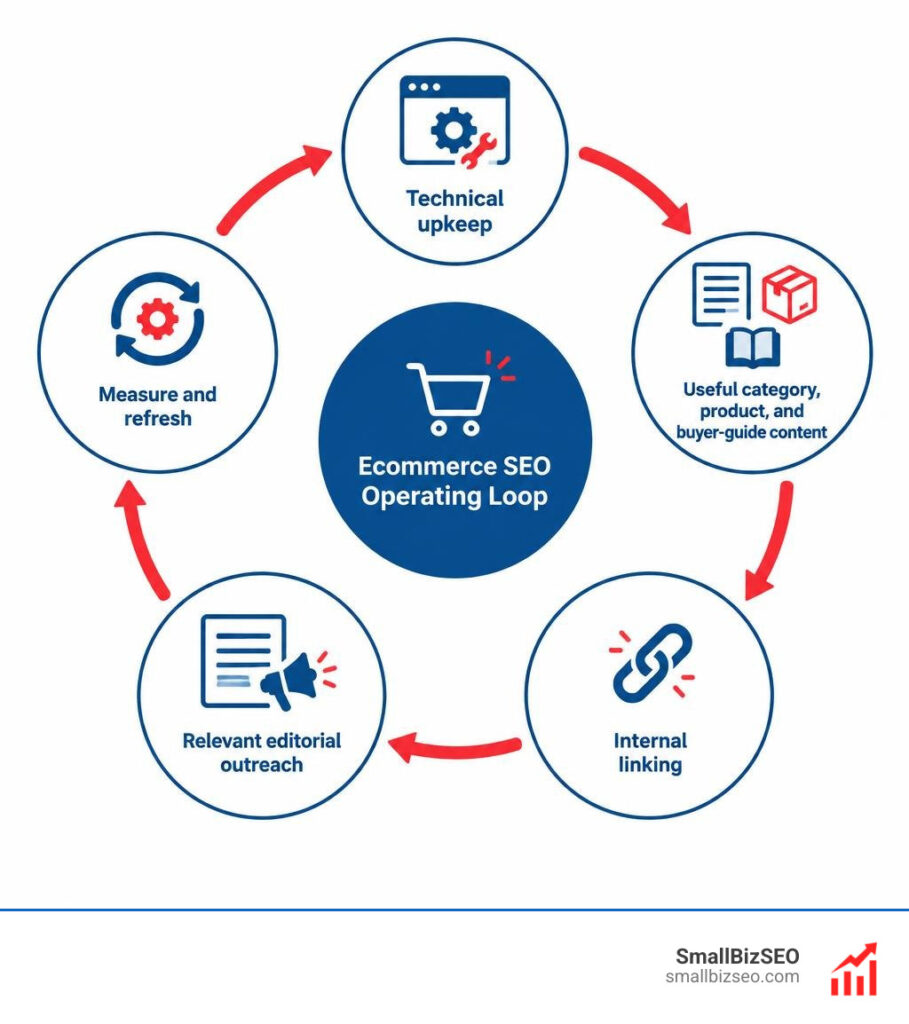
A sound ecommerce SEO scope maintains the site while improving the pages shoppers need to use. The work should cover technical controls, useful category and product content, buyer guides, editorial outreach, and a repeatable measurement and refresh process.
Technical maintenance that supports discovery
Start with a crawl and indexation review, then prioritize fixes by customer value, business risk, and implementation effort. Agencies should explain which templates, URLs, and data sources they reviewed rather than presenting a generic audit score.
For faceted navigation, decide which filtered pages serve a real search need and deserve indexation. Limit or consolidate low-value combinations that create duplication or crawl waste. Do not rely on a robots block to control canonical or noindex signals: when crawlers cannot fetch a page, they cannot see those instructions. Use crawl controls, canonicalization, and indexation directives for their distinct purposes.
Use Product markup for product-page details and Offer markup for the purchasable offer. Include availability as an accurate offer property, and add review data only when reviews are real, eligible, and visible on the page. Structured data can clarify page information for search engines, but it does not ensure a rich result.
Inventory changes need case-specific handling
Temporary out-of-stock product pages should generally remain live and useful. Keep the product information, clarify availability, and offer relevant alternatives or a way to be notified. When an item is permanently discontinued, choose the response based on the page’s value and the closest relevant replacement: a relevant redirect may fit, while a genuinely retired page without a suitable replacement may need a 404 or 410. A blanket redirect to a category is not a sound default.
Content and outreach belong in the operating plan
Technical maintenance alone rarely answers every buyer question. A complete scope should include useful category copy, differentiated product detail, and buyer guides that help shoppers compare options. Pair that work with editorial outreach for genuinely useful resources, then measure visibility, qualified traffic, conversions where they are reliably configured, and content gaps. SEO content services and link-building services can be evaluated as separate or integrated workstreams.
How Should Ecommerce SEO Change by Platform?
Platform choice affects the implementation path, not the fundamentals. Every store needs clear information architecture, accessible product and category pages, dependable rendering, fast customer-facing experiences, and a way to manage duplicates created by variants, filters, and internal linking.
Questions to ask about implementation
Ask the agency which platform features, theme settings, extensions, feeds, and development resources it expects to use. Confirm who approves changes, who deploys them, and how rollbacks are handled. A credible plan identifies the specific templates and workflows to review instead of assuming that every platform has the same limitations.
What to measure after changes
Agree on a baseline before work begins. Reporting can track indexation patterns, template health, important page visibility, organic entrances, assisted conversions, and revenue only where analytics configuration supports that interpretation. Treat reports as decision tools, not proof that SEO alone caused a sale. Revisit priorities as inventory, site releases, and search demand change.
Agency Evaluation Worksheet and Illustrative Work Plan
Use this worksheet to compare proposals on evidence and accountability rather than promises.
| Evaluation item | What to request | What a useful answer includes |
|---|---|---|
| Evidence | Relevant examples and references | Comparable catalog or platform constraints, clear limitations, and permission to verify claims |
| Deliverables | A written scope | Technical tasks, content responsibilities, outreach boundaries, and implementation assumptions |
| Owner | Named roles | Who leads strategy, who handles technical work, who produces content, and who reports results |
| Costs and exclusions | A quote with scope | Included work, change-order triggers, software or development exclusions, and renewal terms |
| Baseline | Starting-state summary | Agreed pages, templates, business goals, and measurement limitations before changes begin |
| Reporting | Sample report and meeting cadence | Definitions, data sources, uncertainty, and decisions the report is meant to support |
Illustrative work plan, not a results timeline
A responsible plan may begin with discovery, technical priorities, and measurement setup. It can then move into template improvements, product and category content, buyer guides, internal linking, and editorial outreach. Later reviews should refresh pages, resolve newly discovered issues, and shift effort toward the opportunities that remain valuable.
That sequence is illustrative. Rankings, traffic, leads, and revenue depend on competition, inventory, implementation quality, demand, site changes, and measurement quality. No agency should promise a specific position or business result on a fixed schedule.
How are ecommerce SEO services priced?
Treat pricing as quote-based unless a provider publishes a current price that clearly states the service scope and terms. Ask for a written proposal that separates strategy, implementation, content, outreach, reporting, software, and optional development support. Review SEO packages for the provider’s available package information, then confirm the exact scope in writing.
Ecommerce SEO Services Questions
What should an ecommerce SEO proposal include?
It should identify the store goals, templates or page types in scope, technical and content deliverables, responsible roles, assumptions, exclusions, reporting sources, and approval process. It should also state what the agency needs from your team to complete the work.
Can schema improve an ecommerce store’s search appearance?
Accurate product and offer data can help search engines understand product pages. Ratings and reviews should be marked up only when they are real, eligible, and visible to customers. Search engines decide whether any rich result is shown.
How should a store handle faceted pages and discontinued products?
Use a documented decision process. Keep search-demand pages that help shoppers and search engines, while consolidating or restricting low-value duplicates. Keep temporary out-of-stock pages useful when the product is expected back. For permanently discontinued products, select a relevant alternative or return an appropriate retirement status when no useful replacement exists.
Does AI search optimization guarantee citations?
No. Clear product information, helpful comparison content, structured data, accessible pages, and independent editorial coverage can improve the usefulness and discoverability of a site, but no provider can guarantee inclusion in an AI-generated answer.
Choose a Scope You Can Audit
The right ecommerce SEO partner provides a scope that your team can inspect: evidence behind recommendations, owners for every deliverable, clear exclusions, and reporting that acknowledges its limits. Use the worksheet to compare proposals, then choose a plan that matches your catalog, internal resources, and commercial priorities.
If you want to discuss a scoped ecommerce SEO engagement, book a consultation.