Turn Your Coaching Blog into a Consistent Client Engine

Turn Your Coaching Blog into a Consistent Client Engine
How Can SEO Help Your Coaching Business Get Clients?
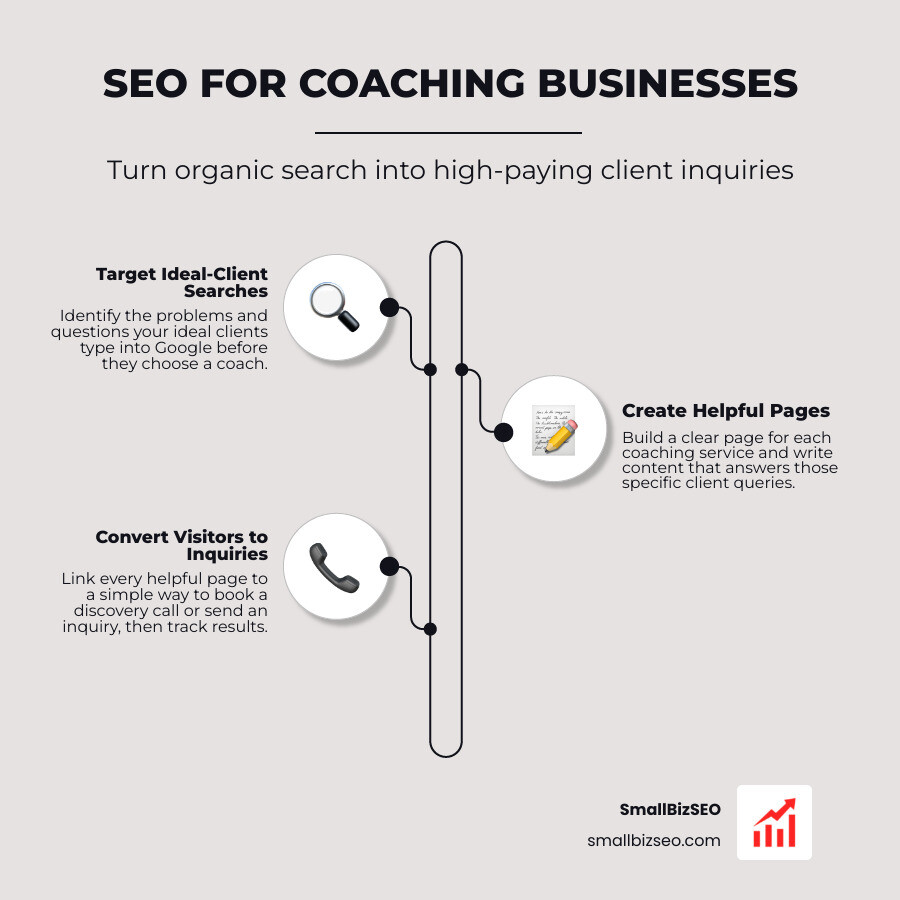
SEO for coaching businesses starts with the searches your ideal clients make. Create a clear page for each coaching service, write helpful answers to the problems those clients search for, and link those answers to a simple way to inquire or book a call. Then track which pages bring in search visitors and client inquiries.
You do not need to reach everyone. A smaller number of visitors looking for your specific help can be more useful than a large audience with no interest in coaching.
I'm Clayton Johnson, founder of SmallBizSEO. My work connecting content, technical SEO, and online authority to qualified leads shapes this guide to SEO for coaching businesses.
Explore more about SEO for coaching businesses:
How Can Coaches Build a Roadmap for SEO?
Coaches can build a practical SEO roadmap by identifying what ideal clients search for, organizing their website pages around clear coaching offers, and publishing helpful guides that solve specific client challenges.
When you align your website with search engine standards, you make it easy for search platforms to index your expertise. A foundational starting point is following the official Search Engine Optimization SEO Starter Guide, which outlines fundamental crawlability and structural requirements.
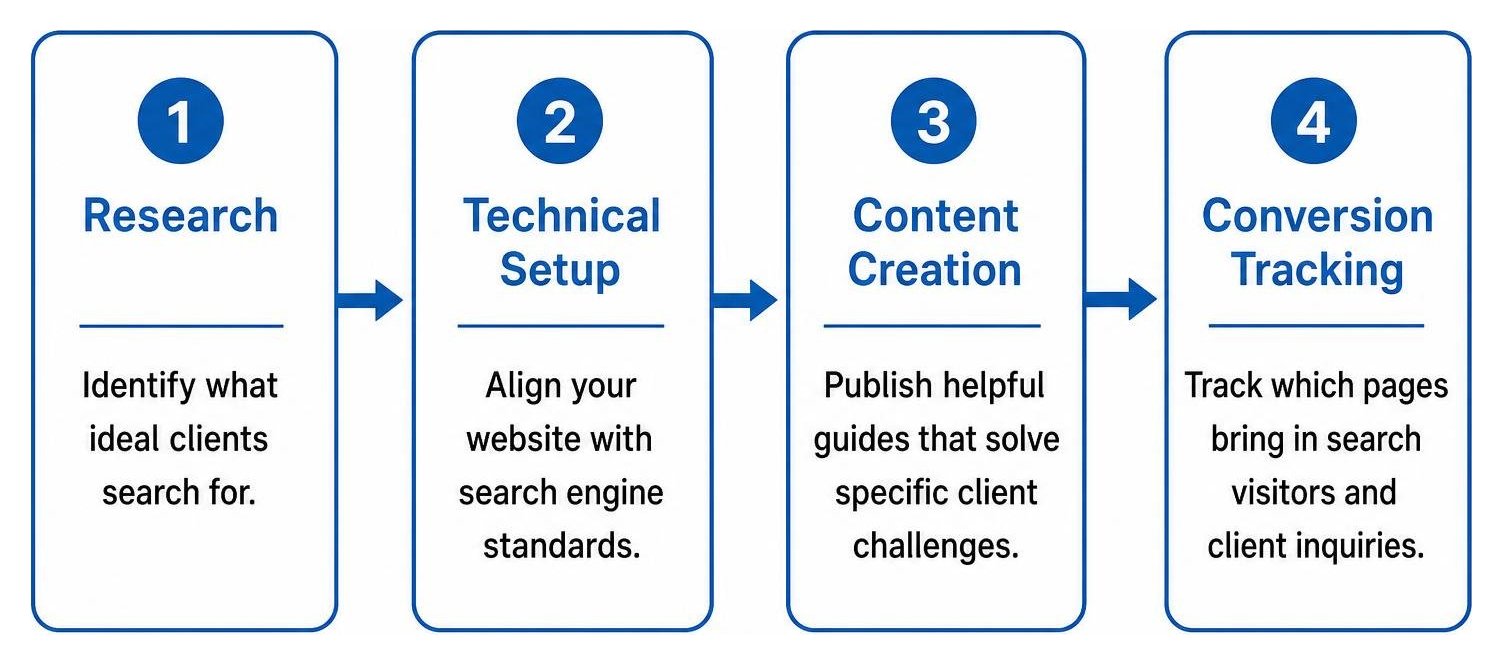
Building a complete SEO engine requires three core steps:
- Targeting search intent: Map the exact phrases prospects enter when they feel stuck in their career, health, leadership, or relationships.
- Structuring core pages: Build separate, dedicated service pages for each coaching program alongside informative articles.
- Connecting visitors to calls: Guide readers through internal links toward clear booking forms and email resources.
Why Does SEO for Coaching Businesses Generate Higher ROI Than Social Media?
SEO delivers a higher return on investment because search traffic captures high-intent prospects at the exact moment they need help, producing sustainable organic visibility without daily posting.
While social media content often disappears from feeds within hours, an optimized article or service page continues attracting qualified visitors for months and years. Over 53% of all trackable website traffic comes from search engines, and 90% of online experiences start with a search engine. Search engine leads close at an average rate of 14.6%, delivering highly qualified prospects who are already actively seeking solutions.
When evaluating sustainable growth through search engine optimization, the compounding nature of organic search consistently outperforms short-lived social campaigns:
| SEO Investment Phase | Implementation Focus | Traffic Momentum | Lead Conversion Rate | Acquisition Impact |
|---|---|---|---|---|
| Initial Foundation | Keyword research and technical setup | 1 to 3 months | Baseline tracking | Establishes crawlability and indexing |
| Content Expansion | High-intent service and problem guides | 3 to 6 months | ~14.6% | Generates targeted search visibility |
| Compounding Authority | Topical authority and internal links | Ongoing | ~14.6% | Produces consistent, high-value inquiries |
Because high-ticket coaching programs have significant client lifetime value, attracting even two or three high-intent clients each month via search delivers exceptional ROI. While initial rankings typically take three to six months to build momentum, the resulting pipeline remains stable over the long term.
How Do You Find High-Intent Keywords That Ideal Clients Search For?
You find high-intent keywords by identifying the specific problems, questions, and desired outcomes your coaching clients research before hiring a professional.

Many coaches make the mistake of optimizing only for broad terms like "life coach" or "business consultant." These short-tail phrases carry extreme competition and vague search intent. Instead, successful organic acquisition relies on building topical authority in coaching niches by focusing on precise, long-tail queries.
Consider how clients search across different stages of awareness:
- Problem-Aware Queries: Prospective clients experiencing friction search for immediate answers (e.g., "how to overcome executive burnout," "why am I tired in my 40s," or "improving team performance after rapid growth").
- Solution-Aware Queries: Prospects researching professional guidance look for specific frameworks (e.g., "mindset coaching for entrepreneurs," "career transition strategies for executives").
- Offer-Specific Queries: Ready-to-hire clients seek exact services (e.g., "executive leadership coach for women," "nutrition coach for gut health").
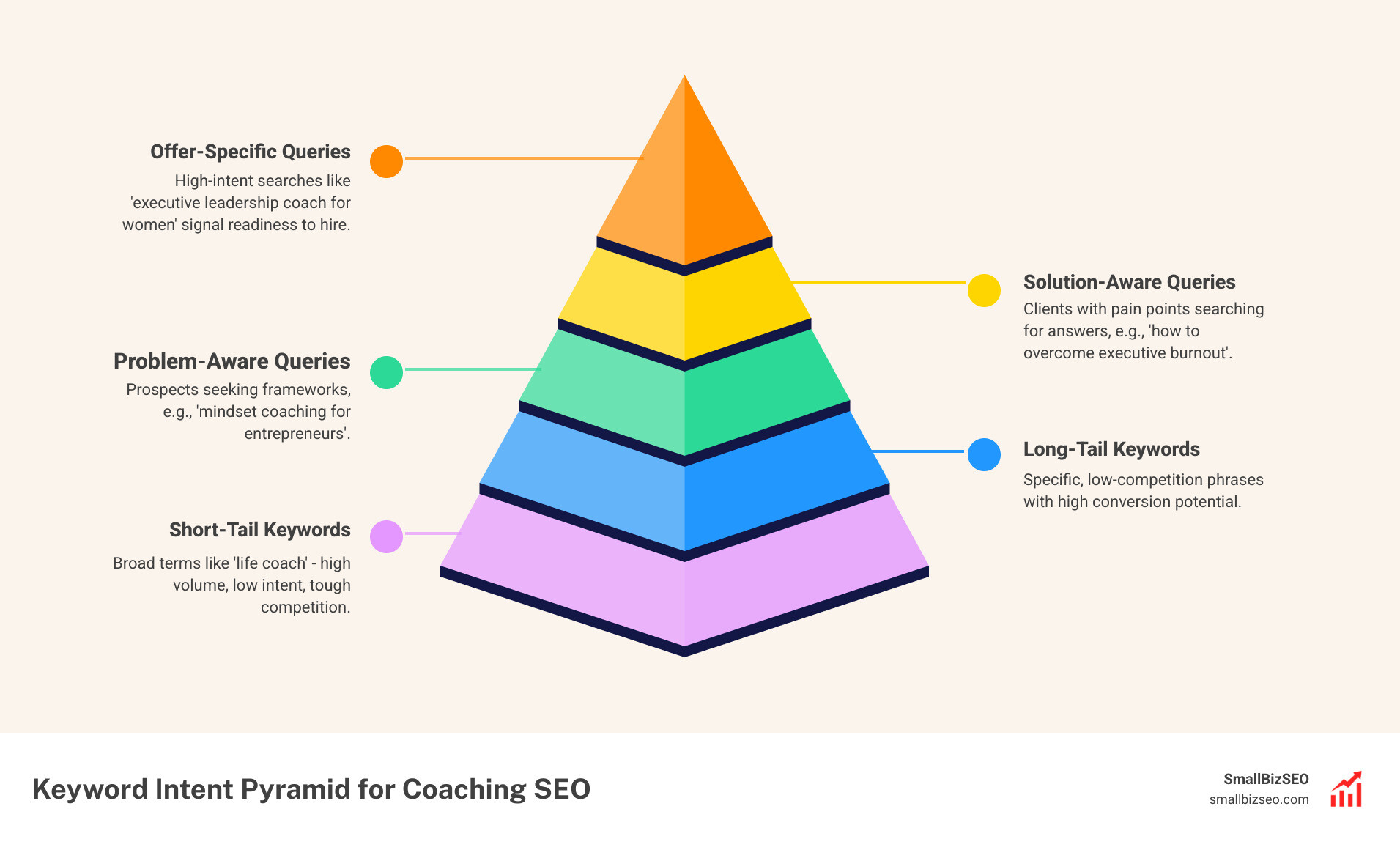
By balancing manageable search volume with high transactional intent, you capture searchers who are actively seeking transformation rather than casual browsing.
How Do Coaches Execute Content and On-Page SEO Step-by-Step?
Coaches execute on-page SEO by creating well-structured service pages and comprehensive educational articles optimized for search crawlers and human readers alike.
Google places tremendous weight on E-E-A-T (Experience, Expertise, Authoritativeness, and Trustworthiness), especially in personal development, health, and business guidance. Establishing these signals requires careful implementation of strategic on-page SEO best practices alongside authority-building content marketing.
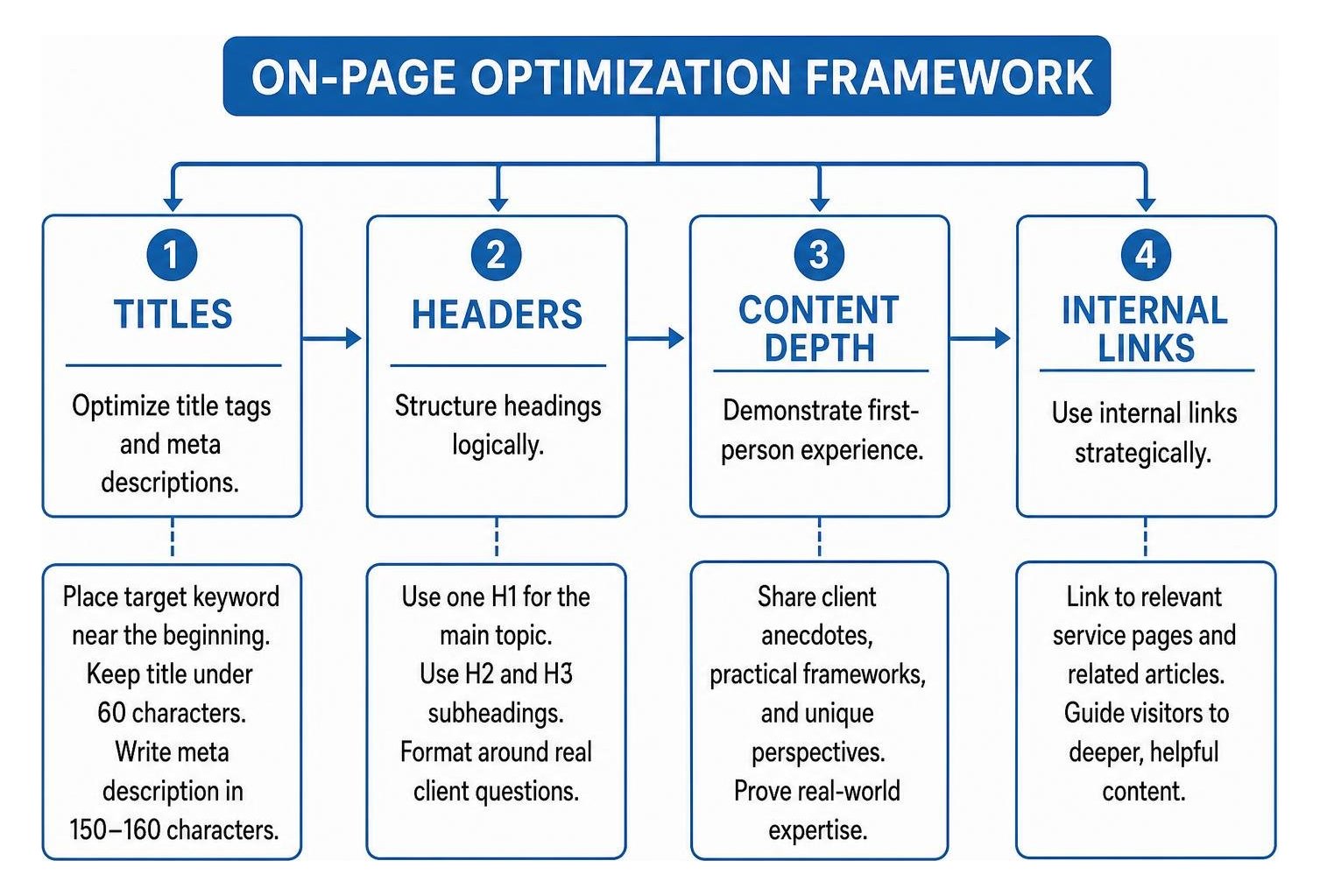
Follow this step-by-step checklist for every page you publish:
- Optimize Title Tags and Meta Descriptions: Place your target keyword near the beginning of your title tag (under 60 characters) and craft a compelling meta description (150–160 characters) highlighting the concrete transformation you provide.
- Format Clean URL Slugs: Keep your URLs short, descriptive, and keyword-focused (e.g.,
/career-transition-coaching/). - Structure Headings Logically: Use a single H1 for your main topic, followed by clear H2 and H3 subheadings formatted around real client questions.
- Demonstrate First-Person Experience: Share genuine client anecdotes, practical frameworks, and unique perspectives to prove real-world expertise.
- Establish Clean Internal Links: Connect educational blog posts directly to relevant service pages, reinforcing your site architecture and guiding readers naturally toward working with you.
How Do Coaches Convert Website Visitors into High-Paying Clients?
Coaches convert organic visitors into paying clients by offering relevant lead magnets, embedding clear calls to action (CTAs), and providing a frictionless path to schedule a discovery call.

Driving traffic to your site is only half the battle; your pages must actively turn readers into inquiries. Over 60% of consumers perform online research before purchasing, meaning search visitors need immediate clarity on how you help them succeed.
Implement these conversion touchpoints across your site:
- Direct Discovery CTAs: Place simple scheduling buttons or calendar embeds on all core service pages and within high-traffic educational posts.
- High-Value Lead Magnets: Capture early-stage searchers with targeted downloadable assets like self-assessments, diagnostic scorecards, or private audio workshops.
- Nurturing Sequences: Use automated email sequences to deliver consistent value, share case studies, and invite subscribers to book an introductory consultation.
How Are AI Search Trends and Professional SEO Services Changing Coaching SEO?
Modern search engines and artificial intelligence tools now analyze full web pages to provide direct answers, rewarding websites that publish original, authoritative, and structured content.
How Does Generative AI Search Impact Coaching Websites?
AI-powered search features, such as Google AI Overviews, ChatGPT Search, and Perplexity, extract information from authoritative websites to provide synthesized answers to complex user prompts.
Rather than replacing traditional SEO, AI discovery amplifies the value of foundational SEO best practices. When AI platforms compile answers for queries like "how to choose an executive coach," they pull data directly from credible, top-ranking web pages that feature clear answers, structured headings, and verified author credentials.

To maximize your visibility across both traditional search results and AI-driven platforms:
- Answer specific client questions directly and concisely at the start of your articles.
- Add structured schema markup (such as Person, Service, and FAQ schemas) to help search models accurately read your credentials and offerings.
- Publish original client case studies and proprietary coaching frameworks that AI cannot replicate or summarize from generic sources.
Should You DIY or Hire an Agency for Coaching SEO?
You can manage basic keyword research and content creation yourself, but partnering with an experienced agency accelerates results by handling technical optimization, link acquisition, and comprehensive strategy.
A do-it-yourself approach is practical when you are just launching your practice and validating your offers. However, scaling organic traffic while managing client delivery often creates bottlenecks. When evaluating outside support, carefully review guidelines on selecting the right SEO agency to ensure your partner focuses on actual client acquisition rather than superficial vanity metrics.
At SmallBizSEO, we provide small businesses with a data-driven Velocity framework that combines technical health, high-intent content strategy, and authoritative link building. To understand where your website currently stands and uncover high-impact ranking opportunities, you can claim a comprehensive website visibility audit to kickstart your organic client acquisition plan.
Scaling Your Coaching Practice Through Search
Building a sustainable client pipeline through organic search does not require endless social media posting or complex technical maneuvers. By identifying the exact challenges your ideal clients research, publishing structured content that showcases your expertise, and guiding visitors toward clear discovery calls, you create an automated asset that grows your practice predictably.
Focus on helping your searchers solve meaningful problems, organize your site around distinct coaching offerings, and let search engines deliver your best prospective clients directly to your calendar.