How to Compare Ongoing SEO Packages by Scope and Proof
How Should You Compare Ongoing SEO Packages?
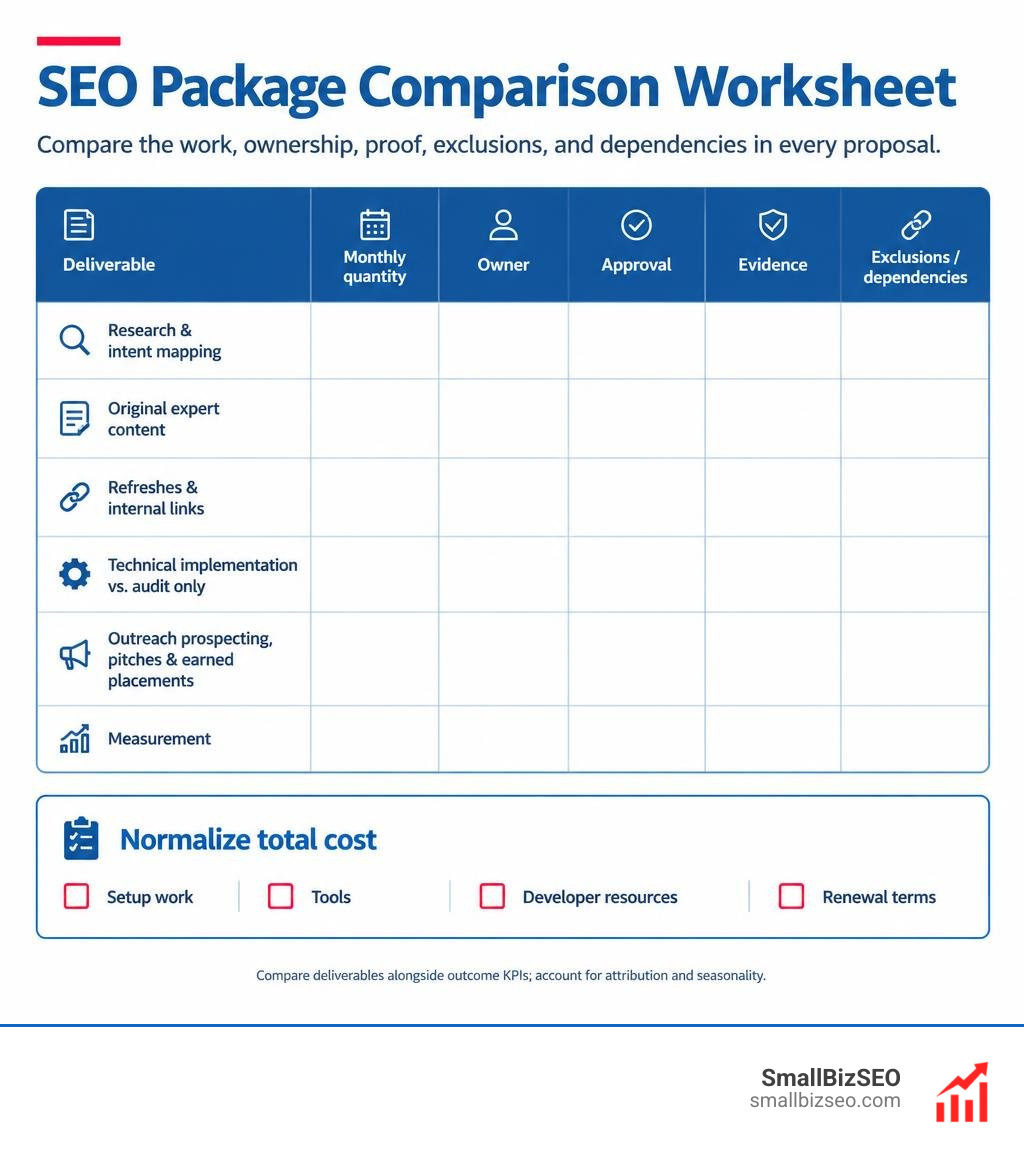
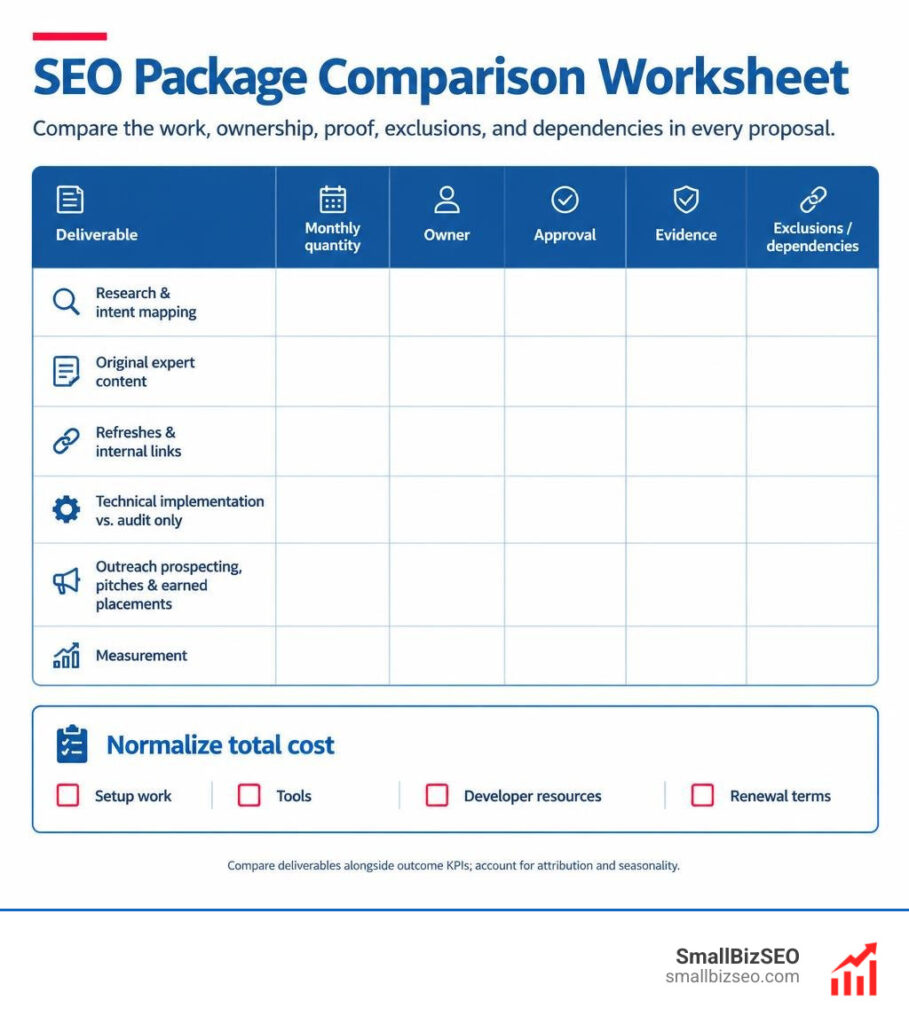
The best way to compare SEO packages is to compare the work that will actually be completed, who owns each task, and what proof you receive. A package name does not explain whether the provider will implement technical fixes, create original content, earn placements, or simply send recommendations and reports.
Use the same worksheet for every proposal. List the monthly work, quantities, approval steps, exclusions, dependencies, and evidence required for each deliverable. Then compare the total operating cost, including setup work, tools, developer support, and renewal terms.
This guide is for business buyers comparing ongoing SEO package scope. It is not a ranked agency list or a generic hiring checklist.
What Does an Ongoing SEO Package Actually Cover?
An ongoing SEO package should describe a repeatable operating plan, not a vague promise of visibility. The useful question is not whether a provider offers SEO. It is which workstreams they perform each month and which responsibilities remain with your team.
A complete proposal may include research, content, technical work, outreach, and measurement, but not every business needs every workstream at the same depth. A local service business may prioritize service-page improvements and technical implementation. An ecommerce business may need category-page work and template support. A B2B team may need subject-matter input, original expert content, and longer approval cycles.
Compare deliverables with outcome KPIs. Deliverables are the actions a provider commits to complete, such as content briefs, implemented fixes, outreach pitches, or internal-link updates. Outcome KPIs track the results those actions may influence, such as qualified organic leads, revenue from attributable organic sessions, or assisted conversions. KPIs matter, but they should not replace a clear scope of work.
Which Deliverables Should You Compare Side by Side?
Compare proposals by workstream and by operating detail. The matrix below makes it easier to see whether two packages are truly comparable.
SEO Package Comparison Matrix
| Workstream | What to ask for | Evidence to request | Ownership and dependencies |
|---|---|---|---|
| Research and intent mapping | Which pages, topics, and search intents will be prioritized? How often is the plan refreshed? | Prioritized roadmap, page-to-intent map, and decision notes | Provider researches; business validates offers, audience, and priorities |
| Original expert content | How many original pieces or page improvements are included? Who interviews experts and who approves drafts? | Briefs, drafts, revision history, and published URLs | Provider writes and edits; business supplies expertise and approval |
| Refreshes and internal links | Which existing pages will be refreshed? How are internal links selected and implemented? | Before-and-after page list and internal-link log | Provider recommends or implements; business may need CMS access |
| Technical SEO | Are fixes implemented or only identified in an audit? Which templates or issues are excluded? | Ticket list, implementation log, validation notes, and unresolved-item list | Provider, developer, or both must be named clearly |
| Outreach and earned placements | Does the scope include prospecting, pitch writing, follow-up, and earned placements? | Prospect list, pitch activity, placement URLs, and disclosure of unavailable outcomes | Provider runs outreach; approvals and brand constraints come from the business |
| Measurement | Which KPIs, sources, and attribution rules are used? How are changes explained? | Dashboard definitions, annotations, and recurring decision summary | Provider reports; business confirms lead quality and revenue data |
How Do You Compare Scope Rather Than Labels?
For each row, record the quantity, cadence, approval process, exclusions, owner, and evidence. A proposal that says “content” should state whether it covers research, drafting, expert review, revisions, publishing, refreshes, and internal linking. A proposal that says “technical SEO” should state whether it includes implementation or only an audit.
Use the same discipline for outreach. Prospecting and pitches are controllable activities. Earned placements depend on editorial decisions outside the provider’s control, so a credible proposal separates outreach activity from guaranteed placement claims. For a broader implementation reference, see this comprehensive SEO services guide.
For examples of service components, review SEO packages, SEO content services, and link-building services in the context of the worksheet rather than as interchangeable package labels.
How Can Two SEO Proposals Have the Same Budget but Different Value?
Two proposals can use the same hypothetical monthly budget of 100 planning units and still require very different internal resources. These examples are illustrations only, not market pricing or performance claims.
Hypothetical Proposal A: Implementation-Led
Proposal A allocates the budget to research and intent mapping, targeted page refreshes, internal-link implementation, technical issue resolution, and measurement. The provider has CMS access and a named developer contact for deeper template changes. Content creation is limited because the proposal assumes the business can supply approved expert material.
This proposal may fit a business with strong in-house expertise and a website that needs hands-on optimization. Its dependency is fast access to subject-matter reviewers, the CMS, and development resources. For context on related operating models, compare tailored ecommerce optimization and scalable enterprise strategies.
Hypothetical Proposal B: Content and Outreach-Led
Proposal B uses the same hypothetical budget for original expert-content production, content refreshes, outreach prospecting, pitch writing, follow-up, and measurement. Technical work is limited to audit findings and prioritized recommendations, with implementation assigned to the business or its developer.
This proposal may fit a business whose site foundation is stable but whose topical coverage and authority need attention. Its dependency is a reliable approval process, expert input, and a separate owner for technical implementation.
How Do You Normalize Total Cost Before Choosing?
Normalize each proposal over the same evaluation period. For a hypothetical six-month comparison, calculate six monthly fees plus setup work, required tools, estimated developer time, and estimated internal review time. Use only the costs each proposal actually requires, without assuming market pricing. Then compare the resulting totals alongside the documented deliverables and dependencies, rather than dividing costs by a vague unit of work.
The goal is not to find the lowest headline number. It is to identify the proposal that funds the work your business needs and makes its dependencies visible.
What Should Happen Each Month Beyond Reporting?
A useful SEO package produces a documented cycle of work. Reporting should explain decisions and results, but it should not be the only recurring deliverable.
A practical monthly cycle can include:
- Prioritizing pages, topics, and technical issues by business value and search intent
- Producing original expert content or improving existing pages
- Refreshing important pages and strengthening relevant internal links
- Implementing agreed technical improvements or moving them through a named developer owner
- Prospecting, pitching, and following up for relevant earned placements when outreach is in scope
- Reviewing measurement, attribution, seasonality, and next-step decisions
Why Does Technical Implementation Matter?
An audit can identify problems, but it does not resolve them. Ask the provider to label every technical item as implemented by the provider, implemented by your developer, recommended only, or out of scope. This distinction prevents a plan from appearing more complete than it is.
How Should You Evaluate Content and Outreach Work?
Content and outreach should include a trail of evidence. For content, ask for the brief, draft, review path, published URL, and refresh plan. For outreach, ask for the prospecting criteria, pitches, follow-up activity, earned-placement evidence, and exclusions. The provider should describe the work it controls without treating editorial responses as guaranteed. If conversational search is part of your scope, advanced AI search optimization can help frame the work, while the comparison worksheet keeps the content component tied to specific deliverables and approvals.
If the goal is a broader operating plan, SEO services can provide useful context. Use it to clarify the work you need, not as a substitute for comparing a proposal line by line.
Frequently Asked Questions About Comparing SEO Packages
What Is the Difference Between an SEO Deliverable and an SEO KPI?
A deliverable is work the provider can complete, such as a content brief, implemented fix, internal-link update, or outreach pitch. A KPI is an outcome used to assess progress, such as qualified organic leads or attributable revenue. Compare both, but require a concrete deliverable list before treating KPIs as a plan.
How Should You Assess ROI From an SEO Package?
Calculate ROI as (incremental attributable contribution profit before SEO program costs minus total SEO program costs) divided by total SEO program costs. Contribution profit should reflect the additional profit reasonably linked to the work before subtracting SEO program costs, which avoids subtracting those costs twice. Total SEO program costs should include the package, setup work, tools, developer time, and internal review time. Multiply the ratio by 100 to express it as a percentage.
Treat ROI as a decision model, not a promise. Attribution can be incomplete, sales cycles can delay recorded revenue, and seasonality can change demand independently of SEO work. Record assumptions and compare them consistently across proposals.
Should You Choose a Package That Includes Every SEO Service?
Not necessarily. Choose a package that covers the work blocking your next stage of progress, with clear ownership for the rest. A local business, ecommerce business, and B2B business can need different combinations of implementation, content, outreach, and measurement.
Choose the Proposal You Can Verify and Operate
The strongest SEO proposal is the one you can read as an operating plan. It shows what happens each month, what is excluded, who approves work, who implements changes, and what evidence you receive.
Before signing, use the comparison matrix to normalize costs and dependencies. Ask each provider to fill the same rows, attach the same evidence, and separate controllable work from outcomes influenced by competition, demand, attribution, and seasonality.
When you are ready to discuss a proposal using this worksheet, book a consultation.