Protect Your Brand Reputation by Verifying AI Sources Before You Publish
Why an AI Citation May Not Support Your Business Claim
To verify that an AI citation supports a business claim, open the cited source and find the exact passage. Break the claim into details such as the product, plan, date, and location. Check each detail against the passage. A working link proves the page exists; it does not prove the page backs everything the AI said.
For example, a supplier page might confirm email support but say nothing about the AI's claim of 24/7 phone support. Before you publish, narrow the claim to what the source confirms or leave it out. That small check can keep an unsupported promise out of your marketing.
I'm Clayton Johnson, founder of SmallBizSEO. My work in SEO and AI search has made learning how to verify that an AI citation supports a business claim an important part of creating content people can trust.
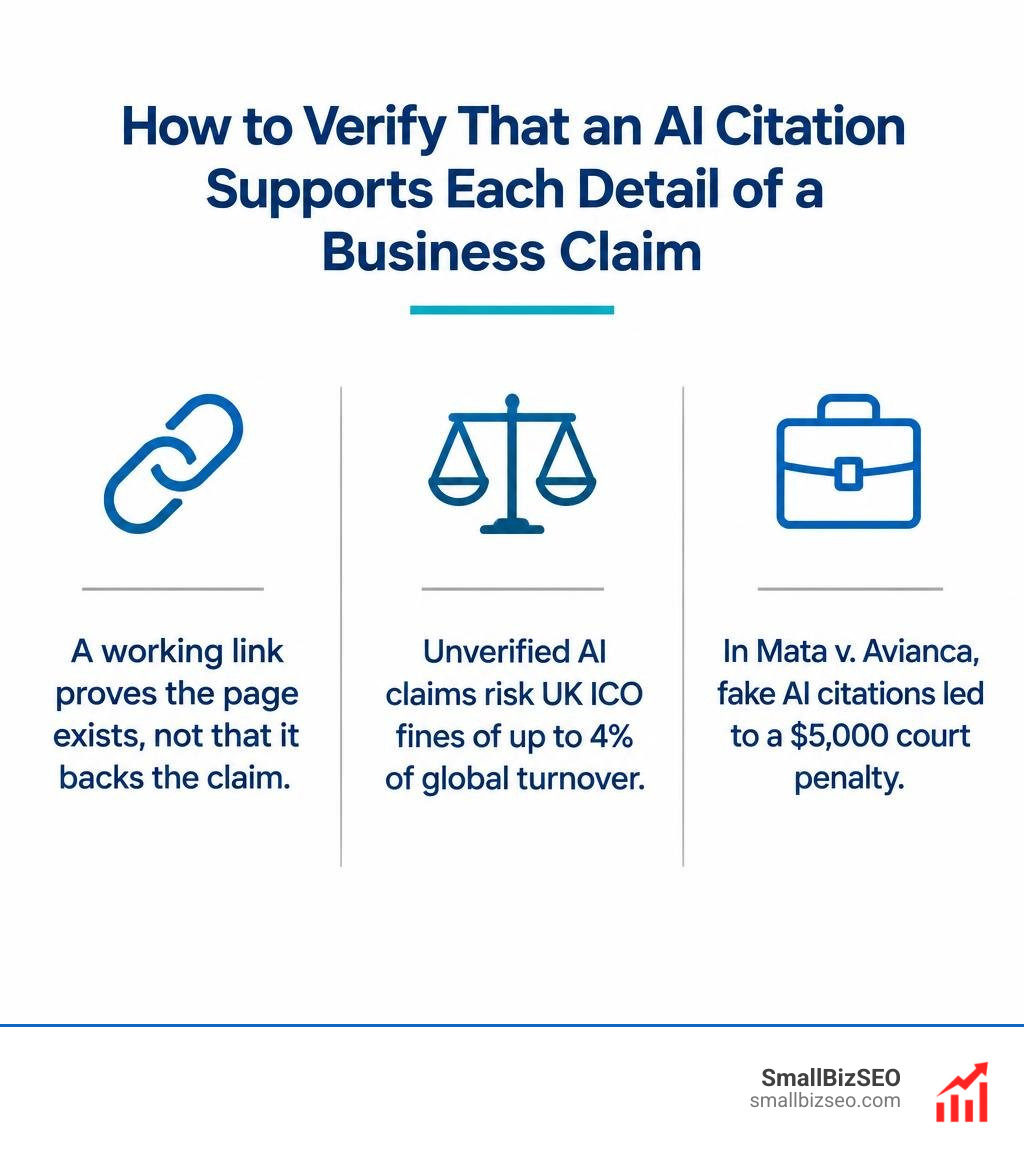
Artificial intelligence tools can generate fluent, persuasive text in seconds. However, fluency is not factual accuracy. Generative engines frequently display source links that look legitimate while hallucinating the underlying substance. In the legal case Mata v. Avianca, Inc., attorneys relied on fabricated AI-generated legal citations and faced a $5,000 court penalty along with mandatory corrective actions. In business, relying on unverified AI citations risks client trust, contract disputes, and serious regulatory penalties. For example, UK ICO administrative fines can reach £17.5 million or 4% of global annual turnover for severe data accuracy failures.
Step-by-Step Framework: How to Verify an AI Citation Supports a Business Claim
Verifying an AI-generated reference requires a structured, repeatable process. Rather than assuming a hyperlinked snippet is accurate, businesses need a systematic workflow that validates the source's reality and its underlying evidence.
Why Checking Source Existence Differs from Validating Factual Support
A source link can be active and still fail to support the sentence attached to it. AI models often practice "source laundering," where an algorithm attaches a genuine, high-authority domain to an unsupported claim, giving a false sense of security.
To test true factual support, apply lateral reading strategies. As highlighted by Brodsky et al. in their research on fact-checking behaviors, individuals dramatically improve their accuracy when they leave the initial AI response and open new tabs to independently investigate the claims. Rather than simply asking an AI model to confirm its own work, reference established academic verification techniques to check the original text. You can also explore ai citation rate 101 understanding impact accuracy to better understand how generative tools process web sources.
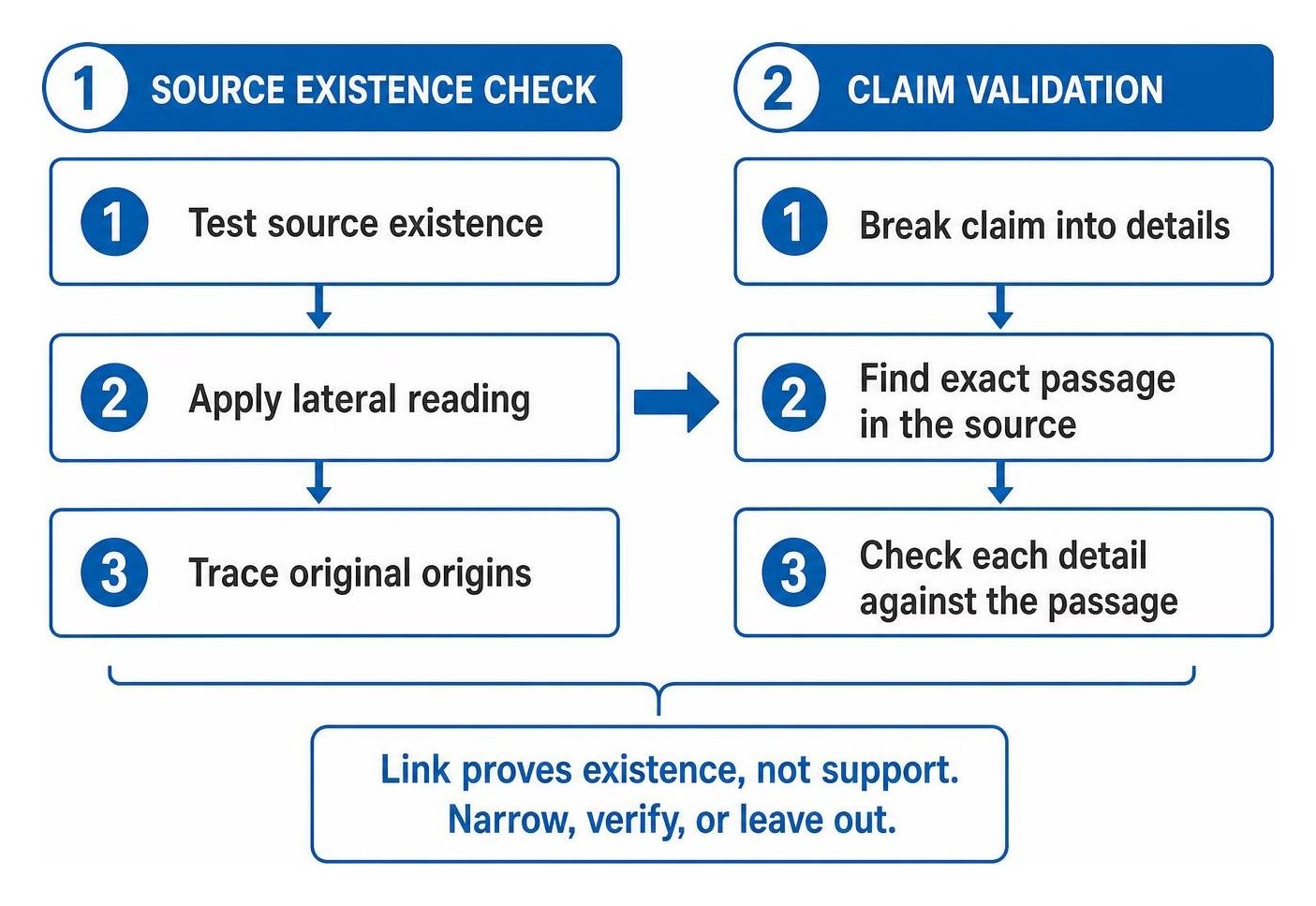
Always verify the source first, then verify the claim:
- Test Source Existence: Click the link to ensure it is not a hallucinated or broken 404 URL.
- Apply Lateral Reading: Use search engines to confirm the author, publisher, and host domain are legitimate.
- Trace Original Origins: Follow secondary references back to the primary study, official filing, or product documentation.
How to Verify an AI Citation Supports a Business Claim in Four Steps
Validating an AI citation requires decomposing complex sentences into atomic claims. An atomic claim is a single verifiable fact containing specific parameters such as plan tier, feature availability, pricing, contact channel, or geographical jurisdiction.
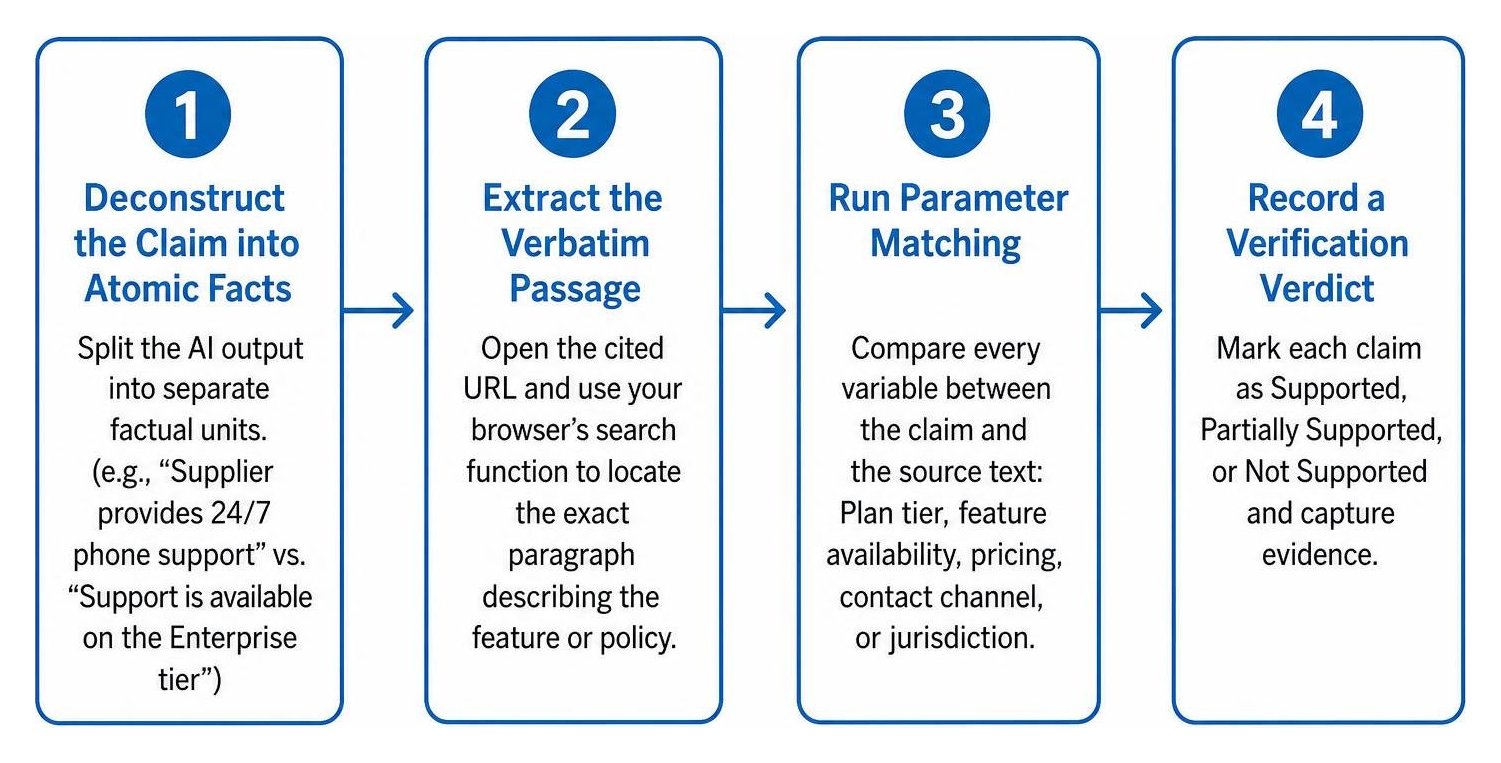
Follow this four-step sequence outlined in our practical checklist for citation verification:
- Deconstruct the Claim into Atomic Facts: Split the AI output into separate factual units (e.g., "Supplier provides 24/7 phone support" vs. "Support is available on the Enterprise tier").
- Extract the Verbatim Passage: Open the cited URL and use your browser's search function to locate the exact paragraph describing the feature or policy.
- Run Parameter Matching: Compare every variable between the claim and the source text:
- Contact Channel: Does the source specify phone, chat, or email?
- Plan Tier: Is the feature available on all plans or restricted to enterprise tiers?
- Language Support: Does the translation apply to all markets or a single region?
- Jurisdiction: Does the rule apply to your specific regulatory framework?
- Determine the Support Level: Categorize whether the text fully backs, partially backs, or contradicts the statement.
How to Verify That an AI Citation Supports a Business Claim with a Source-Strength Rubric
Not all citations carry equal weight. When evaluating whether a source provides sufficient proof, review it against core criteria: provenance, authority, claim fit, freshness, and extractability. Knowing how to calculate and boost brand authority helps teams judge whether a publisher has the standing to validate technical claims.
| Source Type | Authority Level | Claim Fit & Best Use Cases | Verification Action |
|---|---|---|---|
| Primary Documentation (Official product docs, regulatory filings, peer-reviewed papers) | High | Definitive proof for pricing, platform rules, technical capabilities, and legal compliance. | Verify exact passage wording and check for document version updates. |
| Secondary Industry Reports (Analyst research, third-party benchmarks) | Moderate | Broad market trends, industry growth metrics, and aggregate consumer behavior. | Trace citations to the original survey methodology and sample size. |
| Aggregator Blogs & Forums (Community posts, generalized marketing summaries) | Low | Contextual brainstorming, user sentiment, and conversational insights. | Reject as factual proof; replace with primary documentation. |
How to Create a Structured Citation Log to Document Gaps
Maintaining an audit trail ensures internal accountability and protects your organization during external reviews. A citation log records the exact source passage alongside the AI statement, highlighting any discrepancies.
A standard ten-minute audit protocol uses four standardized labels:
- Fully Supported: Every atomic detail matches the primary text.
- Partly Supported: The source confirms core concepts but omits specific claims (e.g., confirming ticket support but omitting 24/7 phone availability).
- Contradicted: The source directly refutes the AI claim.
- Unverified: The source does not contain the information or cannot be accessed.
Applying citation logging best practices creates an audit trail that documents due diligence and protects business credibility.
Risk-Based Governance: Handling Unsupported and Partial AI Claims
How much verification effort should your team invest? The level of review should directly match the business risk of the published asset.
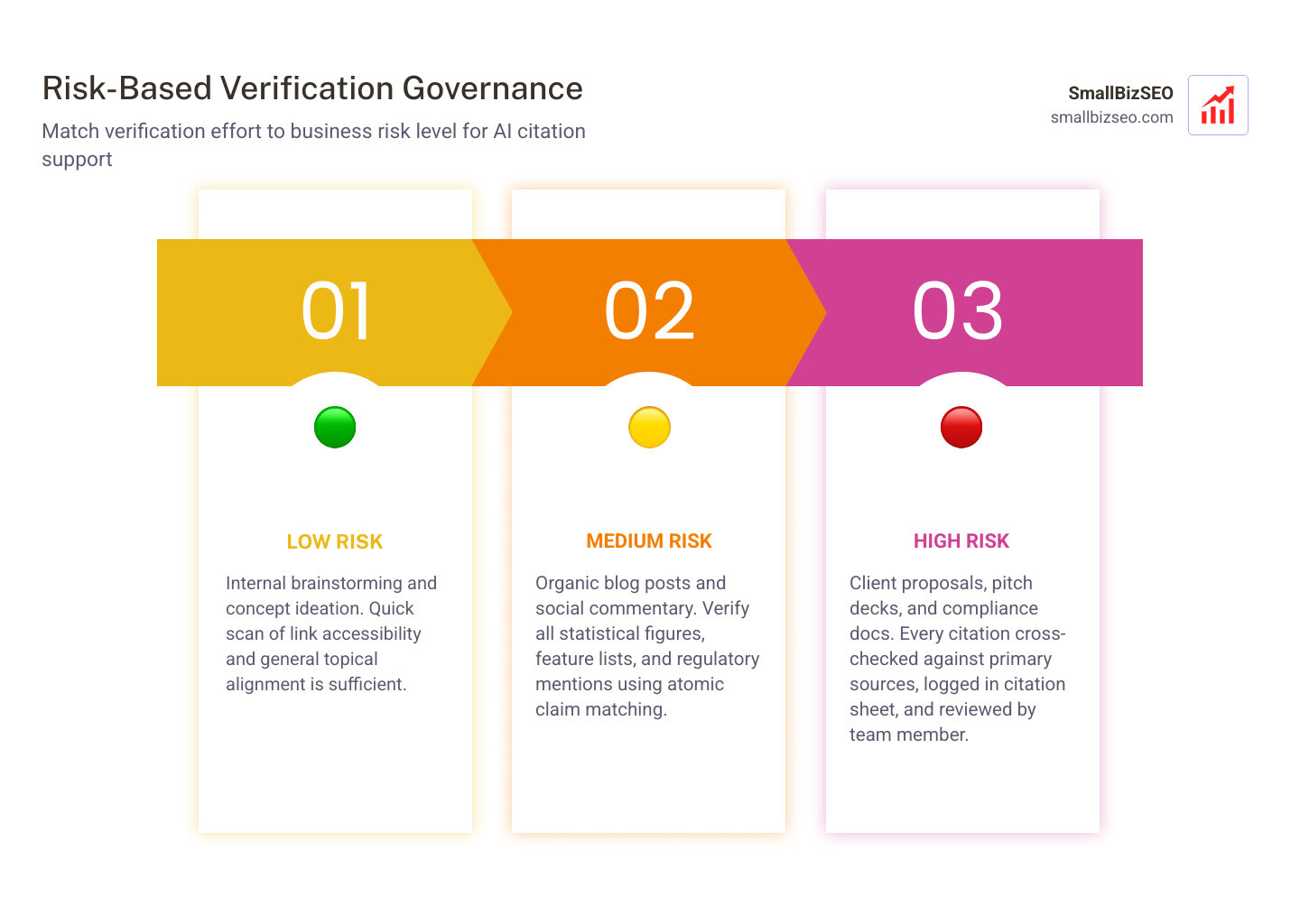
- Low-Risk Contexts (Internal Brainstorming, Concept Ideation): A quick scan of link accessibility and general topical alignment is usually sufficient.
- Medium-Risk Contexts (Organic Blog Posts, Social Commentary): Verify all statistical figures, feature lists, and regulatory mentions using atomic claim matching.
- High-Risk Contexts (Client Proposals, Pitch Decks, Compliance Documentation): Every citation must be cross-checked against primary sources, logged in a citation sheet, and reviewed by a team member.
When a claim cannot be verified, follow these remediation rules:
- Partially Supported Claims: Rewrite the text to state only what the source explicitly confirms. Remove unsupported qualifiers like "guaranteed," "instant," or "24/7."
- Contradicted or Hallucinated Claims: Drop the statement entirely. Do not attempt to force a weak or irrelevant citation to fit an unverified claim.
- Unverified General Statements: If the concept is useful but unbacked by hard data, present it transparently as an observation rather than an established empirical metric.
Build Long-Term Authority with Verified Search Strategy
Maintaining factual integrity across your digital presence is essential for long-term search performance and brand reputation. As search engines and answer platforms prioritize reliable, evidence-backed information, published content must meet high standards of accuracy and transparency.
SmallBizSEO helps businesses strengthen their digital footprint through technical SEO, structured content strategy, and authoritative link building. Our data-driven "Velocity" framework delivers sustainable, transparent growth while ensuring your brand remains a trusted authority in your market. Schedule an AI citation audit with our team to protect your brand reputation and ensure your digital content drives measurable results.