How to Choose a BigCommerce SEO Company: Scope and Evidence

BigCommerce SEO Implementation Scope: What a Buyer Should Verify
A BigCommerce SEO engagement should define what will be changed, who can approve and deploy it, and what evidence will confirm the result. The right fit depends less on an agency label than on platform knowledge, access, and a workable implementation process.
Before choosing a provider, ask for a written scope covering catalog architecture, faceted navigation, templates, structured data, performance measurement, content ownership, and reporting. The provider should identify which tasks require your developer, merchandiser, or legal approval rather than assuming it can make every change.
SmallBizSEO can help evaluate that scope, but the decision should rest on relevant examples, named owners, a staging and rollback process, and evidence that the finished implementation works as intended.
Technical Scope to Review on a BigCommerce Store
A useful technical review starts with the store's real architecture and the implementation path. BigCommerce Stencil themes and Catalyst are distinct storefront approaches, so the scope should state which one the store uses and which team owns the code change.
How Should Faceted Navigation Be Reviewed?
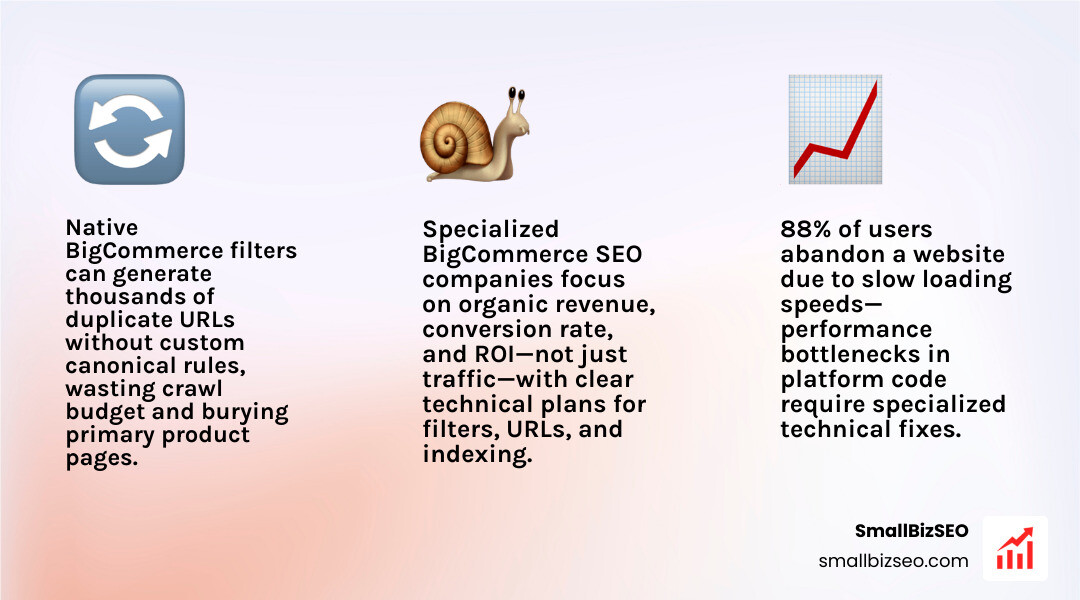
Facets can help shoppers discover products, but not every filter combination deserves an indexable page. Review representative category pages with the merchandiser and developer, then decide which combinations have distinct customer value and unique supporting content.
For example, a running-shoes category filtered by a major brand may merit a dedicated landing page when the assortment, page copy, and shopper intent are genuinely distinct. A sort-by-price parameter usually changes presentation rather than the product set, so it is typically not a standalone search destination.
Google describes canonicalization as a signal, not a crawl-control mechanism. A robots.txt disallow can prevent crawling, which also means Google cannot read a noindex directive on a blocked URL. A noindex directive needs the page to be crawlable, and a canonical should not be used to consolidate unrelated content. Avoid blanket rules: select the treatment for each filter pattern based on user value and technical behavior. Google's faceted-navigation guidance and its robots guidance are useful references for this review.
What Should the Implementation Team Prove?
The agreed scope should name an implementation owner for each change and confirm access, approvals, a staging environment, and a rollback plan before production work begins. After deployment, verify the rendered HTML rather than relying only on source templates: important links, titles, meta descriptions, canonical tags, robots directives, and structured data should be available to crawlers in the delivered page.
For Multi-Storefront builds, hreflang belongs on true language or regional alternatives, not as a general-purpose duplication fix. Each indexable version should use a self-referencing canonical when appropriate. For B2B experiences, customer-specific or gated pricing should remain private; public structured data must reflect the offer and availability that a public visitor can actually see.
Use Product and Offer markup only for accurate, visible product details. Review markup needs to reflect genuine customer reviews and the content shown on the page, and valid markup does not guarantee a rich result. Google's product structured-data documentation explains the eligibility requirements.
How Should Performance and Data Access Be Scoped?
Core Web Vitals should be evaluated with field data at the 75th percentile: Largest Contentful Paint at or below 2.5 seconds, Interaction to Next Paint at or below 200 milliseconds, and Cumulative Layout Shift at or below 0.1. These thresholds are performance targets, not proof that rankings or revenue will increase. web.dev's Core Web Vitals guidance provides the primary definitions.
Do not assume an outside provider has server-log access on a SaaS storefront. Confirm the available BigCommerce, analytics, Search Console, tag-management, and consent-controlled data sources first. Any store-specific data-layer terminology should be defined in the scope, along with required permissions and consent responsibilities.
Evidence-Based BigCommerce SEO Scope and Decisions
A strong engagement explains what is being assessed, what evidence informs the choice, who implements it, and how the outcome will be checked. That is more useful than comparing broad agency labels.
| Decision area | Evidence to review | Implementation owner and verification |
|---|---|---|
| Facet landing pages | Search demand, unique product set, useful copy, and shopper intent | Merchandiser and developer create or approve a dedicated page; verify indexability, canonical behavior, and internal links |
| Redundant filters and sort orders | Duplicate product sets, parameter patterns, and crawl behavior | Developer applies the selected canonical, robots, or linking treatment; verify crawler access and rendered directives |
| Storefront templates | Whether the store uses Stencil or Catalyst, plus rendered HTML | Store developer deploys through staging; verify crawlable links, metadata, canonicals, and structured data after release |
| Public product data | Visible price, availability, identifiers, and genuine reviews | Merchandising and development owners validate page-to-markup consistency; test eligibility without promising rich results |
| B2B and Multi-Storefront rules | Public versus gated content and true regional or language variants | Platform owner confirms access rules; apply hreflang only where equivalent regional or language pages exist |
| Revenue reporting | Orders attributed to organic search, refunds, discounts, margin, and reporting definitions | Analytics owner documents the model and its limitations; review trends without presenting attribution as a guarantee |
A technical audit is only one part of the work. Ongoing results also depend on merchandisers and subject experts who can improve buyer guides, category copy, product information, internal links, and useful original assets. Relevant editorial outreach can earn industry mentions and links when it is selective and genuinely useful, rather than relying on automated link schemes.
For broader support, an ecommerce SEO company can coordinate technical, content, and measurement work. Use SEO content services when the priority is buyer-focused guides and category content, and link-building services when a documented outreach process is needed.
What Does an Illustrative Monthly Work Plan Look Like?
A monthly plan should assign each activity to an owner and leave a reviewable trail of evidence:
| Recurring deliverable | Responsible owner | Evidence to retain |
|---|---|---|
| Buyer guide or category content update | SEO lead with merchandiser or subject-expert review | Approved brief, published URL, internal-link placements, and notes showing the buyer question addressed |
| Product-information refresh | Merchandiser or subject expert | Updated availability, specifications, public offer details, and page-to-markup validation where relevant |
| Internal-link review | SEO lead and content owner | Pages reviewed, links added or revised, anchor context, and confirmation that destination pages remain useful |
| Useful original asset | Content owner with subject expert | Source material, approval record, and the live asset or page section that uses it |
| Selective earned outreach | Outreach owner and subject expert | Prospect rationale, outreach record, placement or mention evidence, and relevance review rather than automated-placement counts |
| Organic-search reporting review | Analytics owner and SEO lead | Reporting definition, trend notes, treatment of refunds, discounts, margin, and attribution limitations |
- Platform owner: approves access, priorities, staging, release windows, and rollback steps.
- Developer: implements template, navigation, rendering, or structured-data changes and records the release.
- Merchandiser or subject expert: validates product availability, category logic, buyer questions, and public offer details.
- SEO lead: documents the hypothesis, checks crawl and indexing signals, reviews field performance data, and records remaining risks.
- Analytics owner: defines how organic revenue is attributed, including the treatment of refunds, discounts, and margin.
The work plan should be updated as evidence changes. It should not promise rankings, revenue, or a fixed outcome.
Questions to Ask Before Approving the Work
Ask prospective providers to show a comparable implementation, identify the people responsible for technical and content work, and explain the evidence they will use to validate each change. A written scope should separate recommendations from changes that have been approved and deployed.
Which Questions Reveal a Reliable Implementation Process?
Use these questions to make the buying process more concrete:
- Which storefront architecture is in use, and who can change it?
- Which filter patterns are candidates for unique landing pages, and which are redundant navigation states?
- What happens in staging before a change reaches production, and who can roll it back?
- How will rendered HTML, crawlability, structured data, and field performance be checked after release?
- Which public product facts support the markup, and how will gated B2B information remain private?
- What access is available to BigCommerce, analytics, Search Console, and consent-controlled data?
- How does the reporting model handle refunds, discounts, margin, assisted conversions, and attribution gaps?
What Should Continue After the Technical Review?
After the initial implementation work, maintain the store with product refreshes, category improvements, internal-link updates, customer-question research, and original resources that help buyers make decisions. Continue reviewing facets as the catalog and navigation evolve, and use earned industry outreach selectively to support useful pages.
A clear scope, documented ownership, and repeatable evidence checks make it easier to evaluate progress without relying on generic promises. For an overview of related ecommerce planning, see this ecommerce SEO services guide.
Build a Verifiable BigCommerce SEO Plan
A buyer-ready BigCommerce SEO plan connects platform implementation, merchandising, content, and measurement. Start with the filter patterns and storefront architecture that matter most, assign each change to an accountable owner, and require evidence after deployment.
If you need help defining the scope, view SmallBizSEO's service options or book a consultation to discuss implementation responsibilities and measurement requirements.