7 Actionable SEO Strategies for Aircraft Charter and Rental Companies

Why Do Aircraft Charter and Rental Brands Need Search Visibility?
SEO for aircraft charter, rental, and leasing helps buyers find you when they search for a route, aircraft type, airport, or lease arrangement. Start with clear pages for the services you offer. Add useful fleet details, route information, and pricing guidance where you can. Then make it easy to request a quote and track which pages bring in qualified leads.
This matters because a buyer may find a broker before they find the company that operates the aircraft. Useful pages and a fast, easy-to-use site give you a better chance to earn that inquiry directly.
I’m Clayton Johnson, founder of SmallBizSEO. My work in technical SEO, content strategy, and authority building informs this guide to SEO for aircraft charter, rental, and leasing; the seven strategies below focus on turning search visibility into better leads.
Quick SEO for aircraft charter, rental, and leasing definitions:
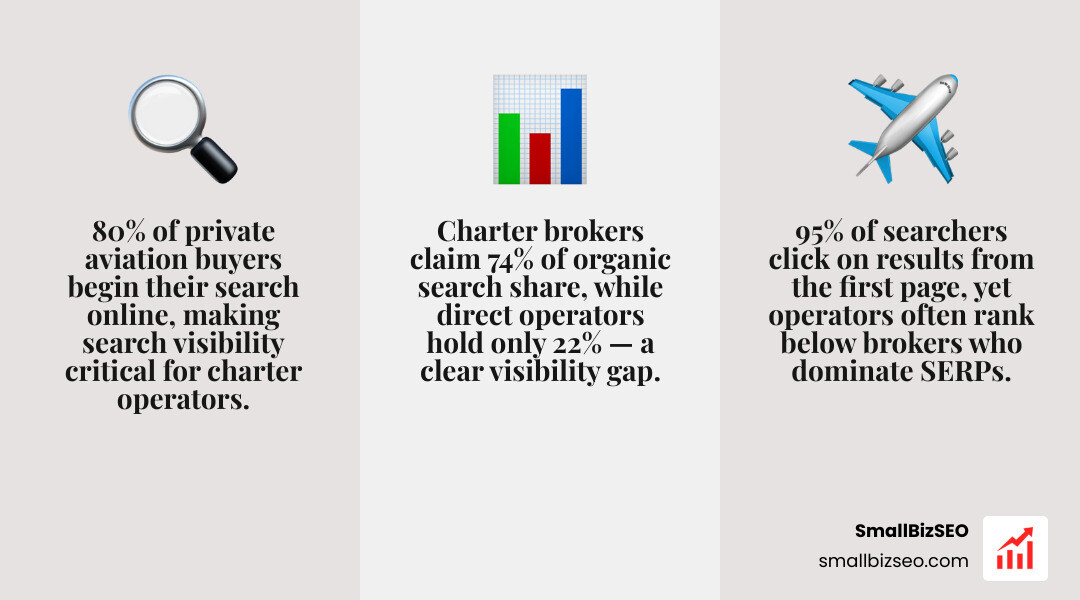
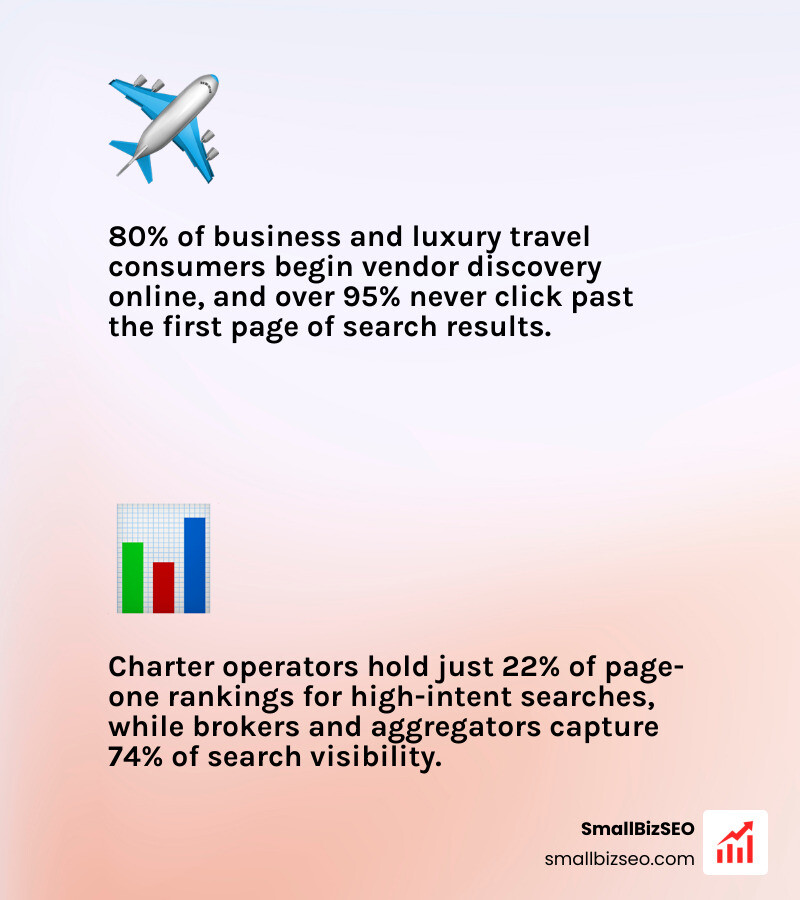
Roughly 80% of business and luxury travel consumers begin their vendor discovery online, and more than 95% never click past the first page of search results. In private aviation, charter operators hold just 22% of page-one rankings across high-intent search corridors, while third-party brokers and aggregator marketplaces capture 74%. Without a dedicated search strategy, direct operators lose high-value flight opportunities to middlemen who collect healthy commissions on flights they do not operate.
What Are the Core SEO Pillars for Aircraft Charter, Rental, & Leasing?
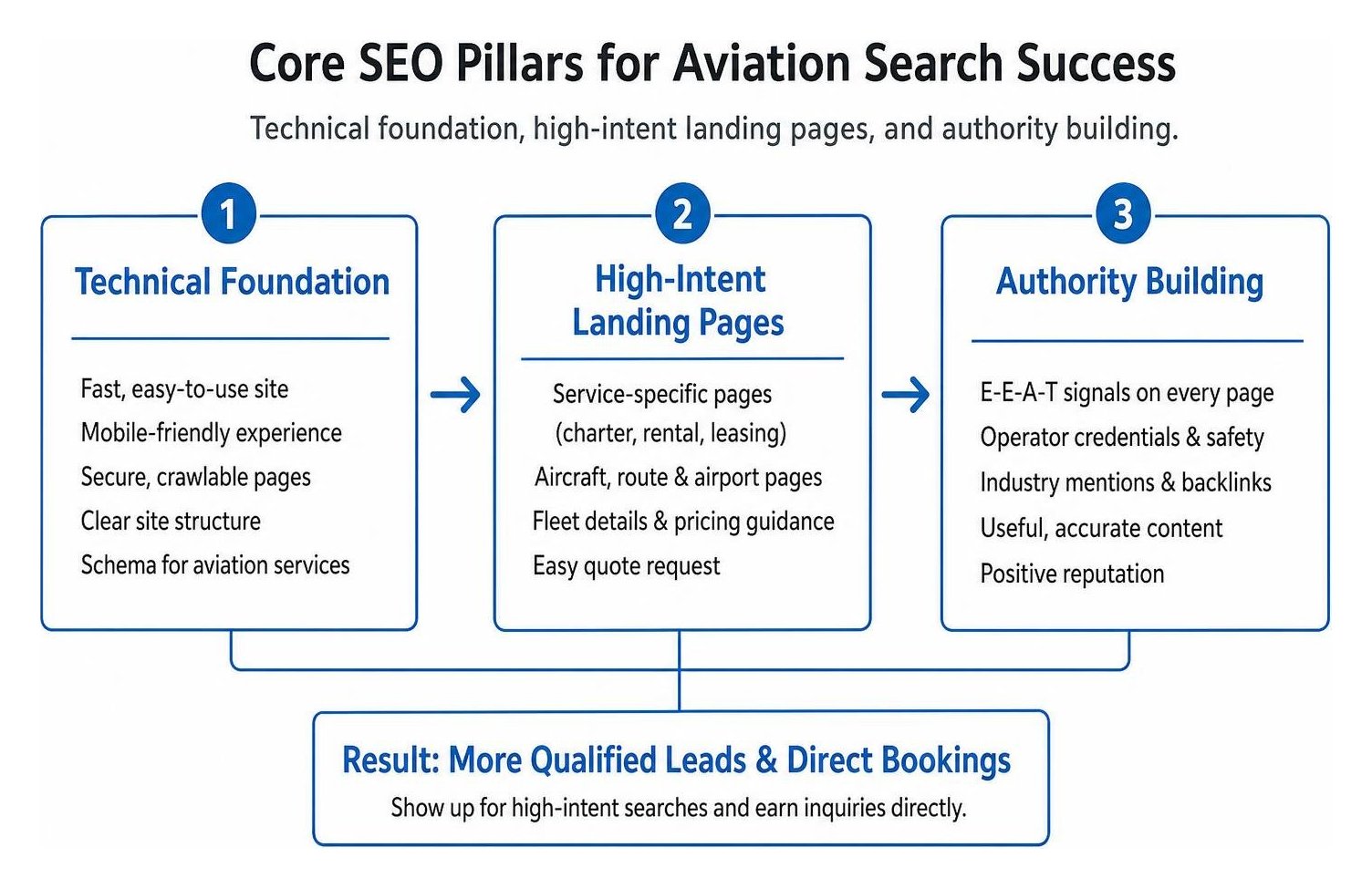
Direct booking growth requires a solid technical base, service-specific landing pages, and visible trust signals that satisfy search algorithms and high-net-worth buyers.
Building sustainable organic search traffic depends on adhering to Google Search Essentials while catering to the unique needs of corporate travel managers and private individuals. High-intent aviation queries represent transactions worth tens of thousands of dollars per flight or millions across long-term leases. Securing high rankings requires proving your operational credibility through Experience, Expertise, Authoritativeness, and Trustworthiness (E-E-A-T) signals across every commercial page.
Why Is SEO for Aircraft Charter, Rental, & Leasing Different from Generic Travel?
Aviation buyers search for specific airframe models, range limits, airport codes, and regulatory structures rather than standard vacation packages or cheap airline seats.
Commercial travel SEO focuses on budget comparisons and broad destination queries. In contrast, private aviation search requires value-based intent optimization. Corporate travel coordinators care about ramp access, baggage volume, cabin layout, and whether an operator holds active Part 135 certification. Long-term B2B transactions require content that addresses dry leasing versus wet leasing (ACMI) arrangements and multi-month corporate retainers.
| Search Factor | Commercial Travel SEO | Aircraft Charter & Leasing SEO |
|---|---|---|
| Primary Intent | Lowest seat price, broad routes | Value, privacy, safety protocols, specific airframes |
| Audience Profile | General public tourists | Ultra-high-net-worth individuals, corporate travel managers |
| Target Keywords | "Cheap flights to London" | "Heavy jet charter Teterboro to Geneva," "King Air 350 lease rates" |
| Sales Cycle | Instant single-ticket purchase | High-touch consultation, RFQ submission, contract review |
| Regulatory Focus | Commercial airline schedules | FAA Part 135 compliance, Part 91, ARGUS/Wyvern safety ratings |
Capturing these searches requires specialized aviation search optimization that addresses specific operational capabilities rather than generic travel tips.
How Can Fleet Operators Compete with Charter Brokers in Search?
Operators can outrank digital brokers by building authoritative fleet pages, publishing transparent pricing insights, and securing relevant aviation backlinks.
Brokers dominate search engines largely because of an authority gap: the average charter operator website carries an Ahrefs Domain Rating of 33, whereas top charter brokers average a Domain Rating of 55. Data from private jet search research highlights that out of nearly one hundred operators studied, only a small handful match the backlink strength of leading aggregator directories.

To close this gap and start capturing executive aircraft leases, direct operators must execute targeted digital PR and link acquisition. Earning media coverage around fleet modernization, local airport facility upgrades, and executive safety milestones builds the topical authority necessary to rank on competitive keywords.
How Should You Optimize Route, Fleet, and Airport Pages?
Organize your site architecture into dedicated route pairs, individual airframe specs, and regional airport hubs optimized for Core Web Vitals and structured data.
High-converting aviation websites use clean hub-and-spoke content structures. A main "Routes" hub should link down to specific city-pair corridors that feature flight times, recommended cabin classes, and local Fixed-Base Operator (FBO) options. Every route page must feature fast-loading imagery and structured data that includes IATA and ICAO airport identifiers.
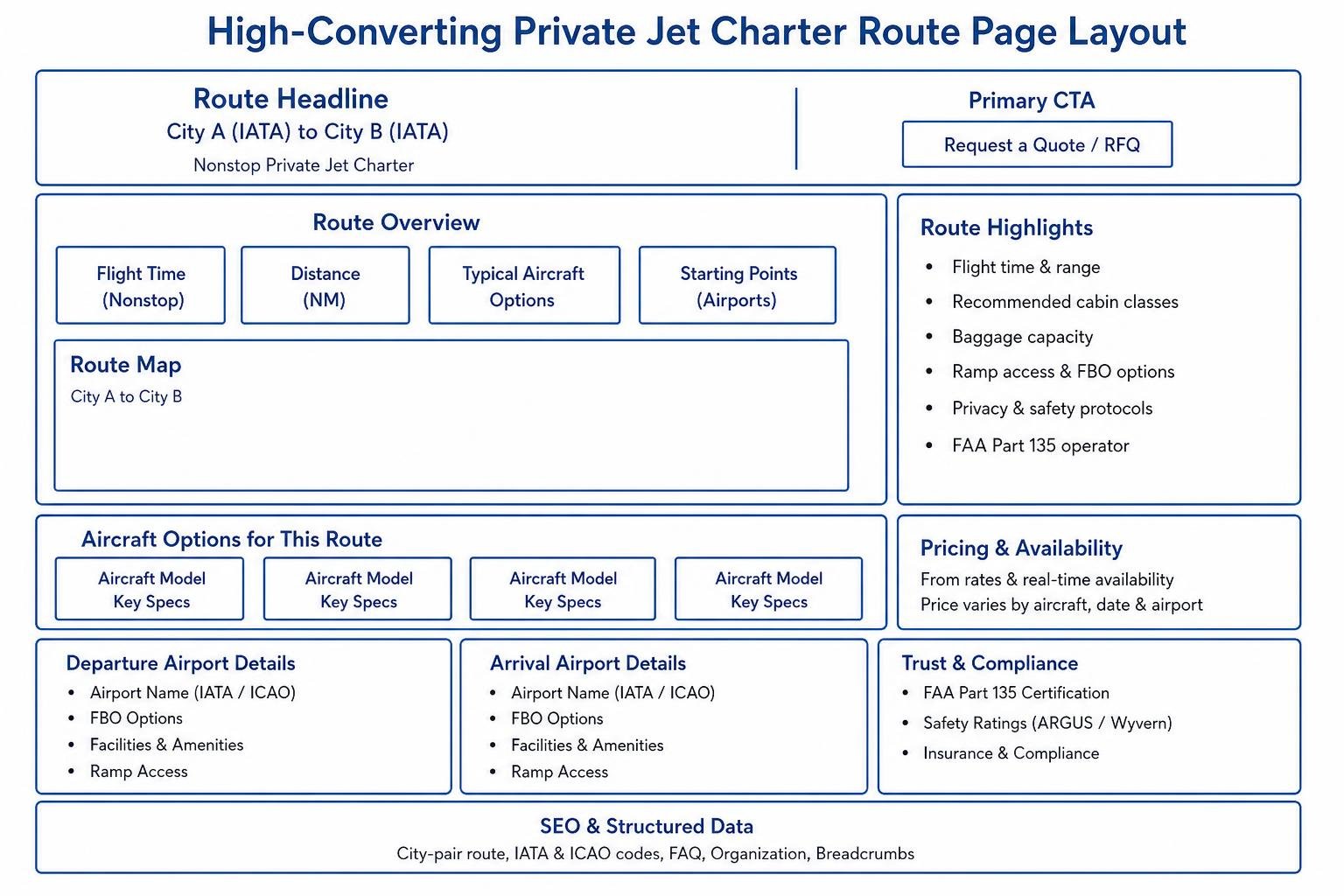
Combine these layouts with dedicated regional airport search tactics and insights on dynamic pricing in charter aviation to capture buyers searching for specific departure facilities.
How Can You Prepare Aircraft Charter, Rental, & Leasing SEO for AI Search?
Structure content with direct answer summaries, technical comparison tables, and FAQPage schema so conversational AI engines can cite your aircraft services.
Generative tools like ChatGPT, Perplexity, and Google AI Overviews now answer complex flight queries directly. In high-intent private aviation queries, up to 68% result in immediate answers where AI surfaces only a select shortlist of recognized providers. To ensure your brand gets recommended by conversational answer engines, incorporate Answer Engine Optimization (AEO) and Generative Engine Optimization (GEO) principles:
- Include Direct Data Summaries: Place clear specifications (passenger capacity, flight range, baggage limits) directly under main headings.
- Deploy FAQPage Schema: Add structured question-and-answer markup on all fleet and route pages to simplify data extraction.
- Establish Consistent Entity Citations: Ensure company name, fleet designations, operating certificates, and service bases match across all industry profiles.
What Content Helps Turn Aviation Searches into Leads?
Publishing honest rate ranges, live empty-leg availability, and detailed mission profiles turns passive website visitors into qualified quote requests.
Transparency builds trust with high-value prospects. While final flight pricing fluctuates based on repositioning and fuel fees, providing estimated hourly operating rates by aircraft class attracts serious buyers.

Empty-leg pages represent one of the few query types where direct operators routinely outrank national brokers. Coupling regular repositioning updates with B2B aviation digital growth campaigns creates reliable lead velocity. Highlighting real-world transport scenarios, executive group travel itineraries, and specialized aircraft leasing case studies consistently improves lead conversion rates.
How Can You Avoid Aviation-Specific SEO and Lead-Tracking Mistakes?
Prevent ranking drops by maintaining correct regulatory terminology, updating aircraft model pages, and tracking phone calls alongside digital quote requests.
Generic digital marketing audits frequently miss critical aviation search nuances:
- Regulatory Vocabulary Gaps: Failing to differentiate between on-demand Part 135 charter, owner-operated Part 91 flights, or cargo operations covered by logistics and package cargo search blueprints.
- Missing Fleet Inventory Pages: Grouping an entire fleet into one generic page instead of building dedicated URLs for every specific airframe model you fly.
- Incomplete Citation Profiles: Missing listings across aviation-specific directories and FBO partner networks.
- Flawed Conversion Attribution: Failing to track direct phone calls and custom Request for Quote (RFQ) submissions originating from specific search landing pages.
How Can You Transform Search Visibility into Direct Bookings?
Consistently improving technical site health, expanding route coverage, and earning authoritative links turns search engines into your most profitable booking channel.
Private aviation brands that implement focused search strategies typically see measurable ranking movement within 3 to 4 months, followed by sustained increases in qualified flight inquiries and long-term lease negotiations within 6 to 8 months.
If you are ready to identify technical gaps, outrank aggregator brokers, and claim direct high-value bookings, request a comprehensive aviation visibility audit from our team today.