10 Artificial Intelligence Statistics on Adoption, Spending, and Business Impact

What Are the Top 10 Artificial Intelligence Statistics You Need to Know?
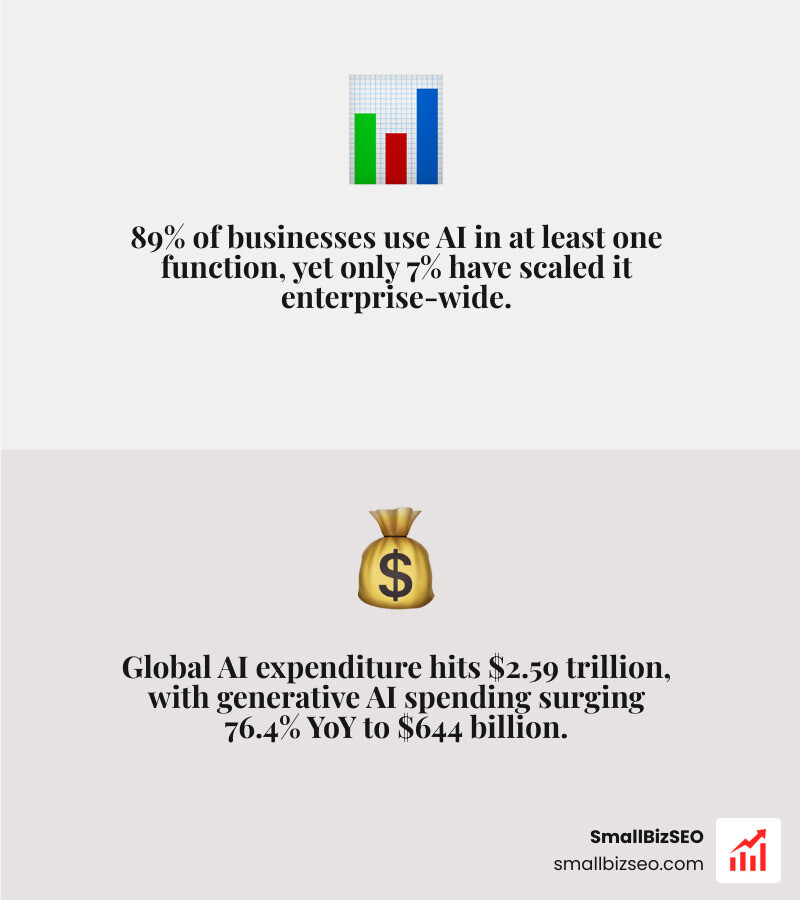
Artificial intelligence has transitioned from an experimental novelty into core operational infrastructure, with roughly 89% of organizations deploying AI tools across their daily workflows while only 7% have successfully scaled them across the entire enterprise.
To help you understand the state of modern machine learning, automation, and generative platforms, we compiled the ten most critical metrics shaping enterprise strategy and execution.
| Category | Key Metric | Strategic Business Implication |
|---|---|---|
| Global Enterprise Adoption | 89% of businesses use AI in at least one function | Basic AI adoption is now table stakes across modern organizations. |
| Full Enterprise Scaling | Only 7% have scaled AI across the entire organization | The vast majority of companies remain stuck in fragmented pilot stages. |
| Worldwide AI Expenditure | $2.59 trillion total market spend | Capital allocation toward specialized compute and services is accelerating rapidly. |
| Generative AI Spend | $644 billion annual expenditure (up 76.4% YoY) | Generative tools represent the fastest-expanding segment of software budgets. |
| Individual Productivity | 80% of workers report measurable time savings | Employees achieve immediate efficiency gains even without top-down rollouts. |
| EBIT Contribution | 37% of firms attribute earnings growth to AI | Converting personal productivity into bottom-line profit remains a major challenge. |
| AI High Performers | 6% of firms generate over 5% of EBIT from AI | A select group of mature adopters captures the vast majority of financial value. |
| In-House Software Shift | 32% build internal tools using coding agents | Agentic development is reducing reliance on traditional off-the-shelf SaaS. |
| Customer Support Automation | 56% of support touchpoints involve autonomous agents | Frontline customer interactions are shifting heavily toward automated systems. |
| Net Global Labor Impact | 78 million net new jobs projected globally | Job creation in specialized roles is significantly outstripping role displacement. |
These ten data points highlight a central reality: while workers readily adopt AI tools to streamline individual tasks, organizational leadership must restructure workflows to translate those individual efficiencies into enterprise-level profitability.
How Rapidly Are Businesses Adopting Artificial Intelligence Across Industries?
Nearly nine out of ten businesses report active use of AI within at least one operational department, representing a massive jump from earlier adoption cycles where machine learning was confined to data science teams.
Despite widespread experimentation, an adoption bottleneck persists: only 7% of organizations report scaling AI fully across every enterprise department. Larger corporations maintain a clear lead in overcoming this bottleneck, with 54% of enterprises earning over one billion dollars in annual revenue successfully scaling solutions, compared to just 33% of mid-market and small businesses.
Sector-specific adoption rates demonstrate where automation delivers the fastest operational impact:
- Software and Technology (76% adoption): Leading all sectors through native integration of autonomous code assistants and internal workflow automation.
- Banking and Financial Services (67% adoption): Deploying algorithmic risk modeling, automated fraud detection, and portfolio analysis.
- Healthcare and Life Sciences (61% adoption): Scaling diagnostic imaging analysis, clinical documentation workflows, and automated intake systems.
- Retail and E-Commerce (58% adoption): Utilizing dynamic pricing engines, automated catalog creation, and predictive inventory management.
Recent Federal Reserve research on monitoring AI adoption in the economy reveals that high-value cognitive industries experience the deepest market penetration. As machine intelligence becomes the primary mechanism through which users discover products and information, forward-thinking brands are actively updating search engine optimization for the AI era to capture organic visibility in conversational interfaces.
Which Sectors Are Leading in Autonomous Agent Deployment?
Autonomous software agents represent the next major frontier of deployment. Technology companies lead this transition, with 40% of large tech enterprises scaling multi-agent systems that autonomously execute multi-step workflows such as code testing, continuous integration, and database maintenance.

In the financial sector, automated risk modeling algorithms process compliance documentation and review loan applications in seconds, eliminating manual bottlenecks. Meanwhile, healthcare institutions are implementing clinical documentation agents that summarize patient encounters directly into electronic health records, reducing administrative overhead while maintaining rigorous validation standards.
How Much Are Companies Spending on AI Infrastructure and Software?
Global expenditure on AI infrastructure, foundational models, and deployment services is projected to reach $2.59 trillion, representing a massive 47% year-over-year jump as businesses build the computational backbone for automation.
Generative AI spending accounts for $644 billion of this total, surging 76.4% year-over-year. Organizations are rapidly adjusting their IT budgets to fund these initiatives:
- Dedicated ICT Budget Share: 28% of organizations now allocate more than 10% of their total information and communication technology budget directly to AI software, cloud compute, and fine-tuning frameworks.
- Custom In-House Tooling: 32% of companies report deciding against buying third-party SaaS subscriptions because internal developers used agentic coding assistants to build custom solutions in-house.
- Compute Constraints: Operational expenses, specifically model inference and token consumption fees, actively constrain usage for 20% of adopting companies.
According to McKinsey's Global Survey on the state of AI, companies that successfully scale their deployments focus heavily on optimizing compute architecture, balancing commercial proprietary models with lean, specialized open-source models to keep inference expenses sustainable.
Where Is Private Capital and Venture Funding Flowing?
Private investment in generative AI startups reached $33.9 billion out of a broader $252 billion worldwide investment pool dedicated to artificial intelligence.
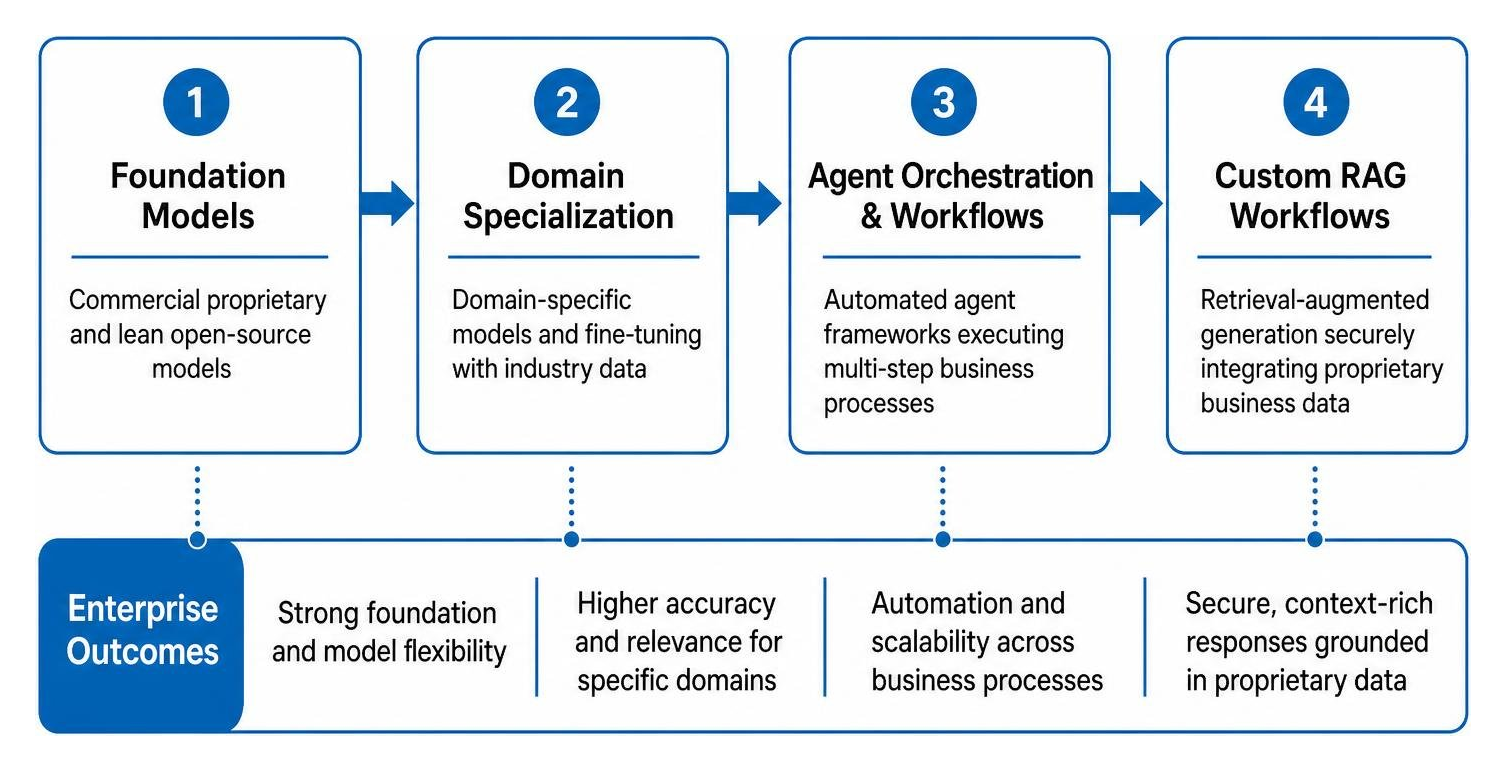
Rather than backing generic conversational interfaces, venture capital and private equity firms are directing funds toward domain-specific language models, automated agent orchestration frameworks, and retrieval-augmented generation (RAG) architectures that securely integrate proprietary business data with generative systems.
What Real Business Impact and ROI Are Organizations Achieving From AI?
Organizations deploying mature artificial intelligence frameworks achieve an average return of $3.70 for every dollar invested, though bottom-line financial gains remain concentrated among a small percentage of advanced operators.
While 80% of employees state that generative tools make them noticeably more productive in their daily roles, only 37% of organizations attribute any measurable EBIT (earnings before interest and taxes) improvement to their AI initiatives.
The companies capturing real enterprise value belong to an elite tier of "AI high performers" — representing roughly 6% of surveyed organizations — who attribute 5% or more of their total enterprise EBIT directly to AI integration.
High performers achieve measurable operational benchmarks that outpace typical pilot projects:
- Task Throughput: A 66% average acceleration across structured content, coding, and customer inquiry workflows.
- Time-to-Market: A 23% reduction in product development and campaign launch cycles.
- Early Implementation Returns: Independent G2 market research on AI statistics and agent deployment indicates that 88% of early adopters report positive initial investment returns once autonomous agents move into live operational environments.
To convert digital efficiency into sustained customer acquisition, businesses are combining automated internal processes with dedicated AI SEO services, securing prime citation placement inside AI-generated overviews and large language model search answers.
Why Are Some Companies Failing to Translate AI Use into Profit?
Companies often fail to achieve bottom-line financial returns when they treat AI as a standalone productivity add-on rather than redesigning underlying operational processes.
Consumer-grade chat assistants experience an average monthly user churn rate of roughly 4% — nearly four times higher than standard enterprise software — because individual employees frequently test isolated prompts without embedding the output into standardized business systems. Without centralized governance, data validation protocols, and structured prompt engineering, organizations face high hallucination rates and uncoordinated expenses that erode net returns.
How Is Artificial Intelligence Reshaping Workforce Productivity and Jobs?
Artificial intelligence is projected to create 170 million new roles globally while displacing approximately 92 million traditional positions, resulting in a net positive gain of 78 million jobs worldwide over the coming years.
Rather than wholesale workforce elimination, AI primarily transforms how existing knowledge workers manage their time. The average employee using generative tools saves 2.2 hours per week — equivalent to 5.4% of total working hours — which is redirected into strategic analysis, customer relationship building, and creative execution.
This workplace evolution creates significant compensation shifts and technical requirements:
- The AI Skill Wage Premium: Professionals who demonstrate verified proficiency in prompt architecture, autonomous agent workflows, and AI tool orchestration earn a 56% wage premium compared to peers in identical roles without AI skills.
- The Executive Readiness Gap: 73% of hiring managers prioritize candidates with practical AI capabilities, yet 54% of senior corporate executives admit their leadership teams feel unprepared to manage AI-augmented workforces.
- Developer Acceleration: Software engineers leveraging agentic coding tools achieve pull-request throughput increases ranging from 26% to 126%, fundamentally changing software deployment timelines.
To maintain organic search dominance as technical workflows evolve, marketing teams rely on proven strategies for showing up in LLM answers, ensuring their brand remains authoritative across both human and synthetic search queries.
How Is Agentic AI Transforming Customer Support and Operations?
Autonomous agent systems are handling more than 56% of enterprise customer support interactions, taking action across connected databases, ticketing queues, and payment gateways without requiring manual agent intervention.
By resolving Tier-1 inquiries instantly, automated support architectures help enterprises achieve a 30% reduction in operational support costs while increasing first-contact resolution rates. Leading organizations implement strict human-in-the-loop validation checkpoints for edge cases, ensuring customer trust remains high while automating routine account queries.
What Are the Most Frequently Asked Questions About Business AI Adoption?
What percentage of companies are actively using artificial intelligence?
Nearly 89% of organizations actively use artificial intelligence in at least one operational function, such as marketing copywriting, software coding, customer inquiries, or data analysis. However, only 7% of organizations have fully scaled and integrated AI workflows across their entire enterprise ecosystem.
Is artificial intelligence creating more jobs than it displaces?
Yes. Global economic labor studies indicate that artificial intelligence will generate approximately 170 million net new positions across software engineering, data management, AI ethics, systems integration, and AI-augmented creative roles, while displacing roughly 92 million routine administrative and data-entry positions, creating a net expansion of 78 million jobs worldwide.
What is the average return on investment businesses see from AI implementations?
Mature AI adopters achieve an average return of $3.70 for every dollar invested. Top-performing enterprises that redesign workflows and connect internal proprietary data capture more than 5% of their total company EBIT directly from AI-enabled systems.
How Can Businesses Turn AI Adoption Into Sustainable Revenue Growth?
Turning artificial intelligence from an isolated expense into a predictable growth driver requires shifting away from one-off employee experimentation toward structured, system-wide workflow integration.
To bridge the gap between pilot usage and bottom-line profit, we recommend taking three immediate strategic steps:
- Audit Operational Workflows for Agentic Automation: Map out repetitive cognitive bottlenecks across customer support, content publishing, and administrative intake where autonomous agents can execute multi-step workflows.
- Establish Clear Inference and Token Budgets: Implement model-routing frameworks that deploy lightweight, cost-effective models for routine queries while reserving resource-intensive frontier models for complex analytical tasks.
- Optimize Digital Brand Authority for Machine Retrieval: Structure your enterprise knowledge base and public-facing content so large language models and answer engines recognize your business as the verified, authoritative source in your niche.
At SmallBizSEO, we help growth-focused companies build compounding search visibility and organic authority through our proven Velocity framework. Whether you are modernizing your technical infrastructure or scaling organic search acquisition across modern generative engines, partnering with an experienced small business SEO company ensures your business leads the market in visibility, authority, and measurable revenue growth.