7 SEO Tactics Every Freight Brokerage Needs to Rank Higher

How Can Freight Agents and Brokers Get Found Before Shippers Request Quotes?
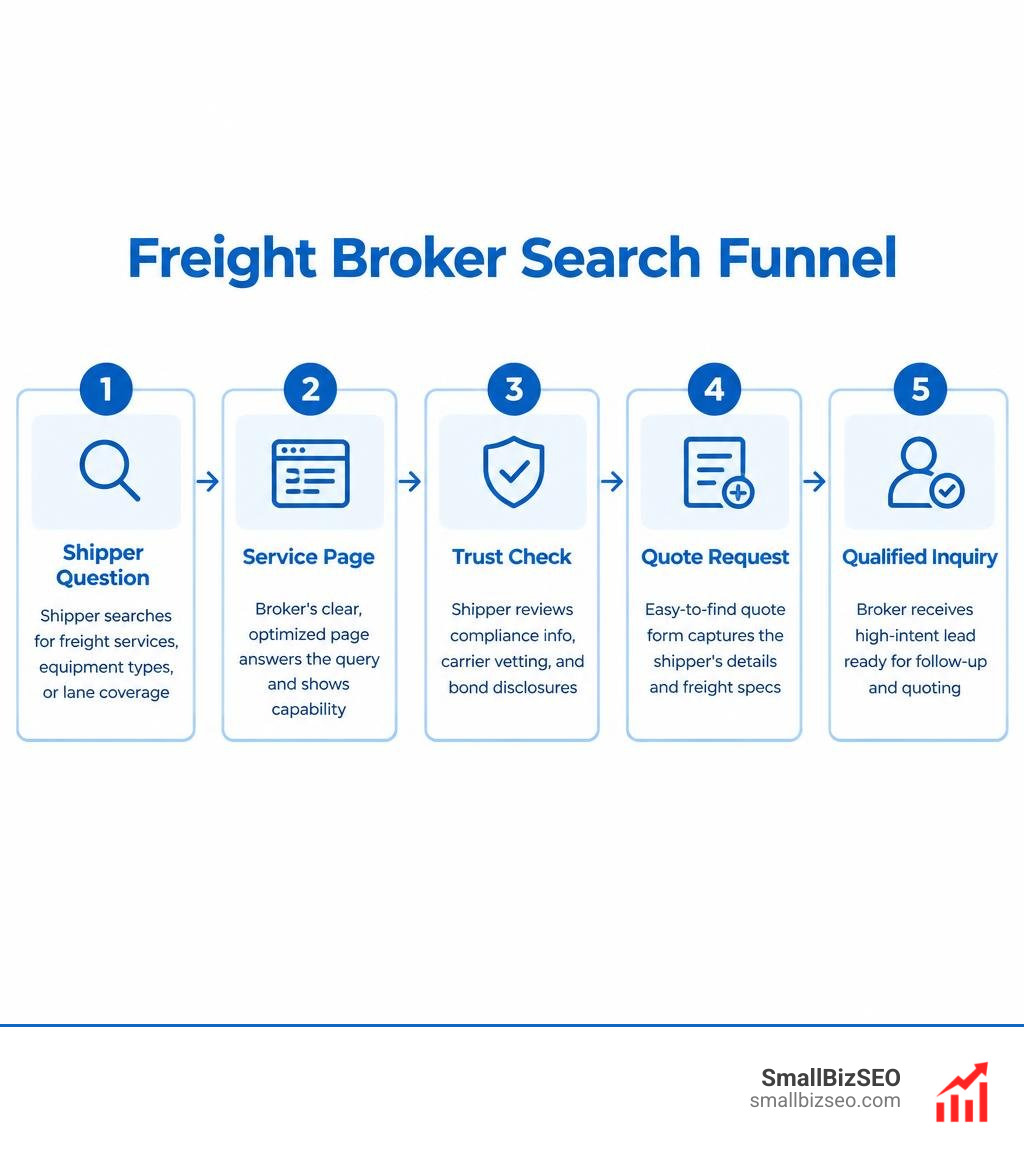
SEO for freight agents & brokers starts with the freight you can actually handle. Build clear pages for your services, equipment types, and strongest lanes. Answer the questions shippers ask before requesting a quote, show how you vet carriers, and make the quote form easy to find. Give carriers a separate path to learn about onboarding. Then check which pages bring in qualified shipper inquiries, not just traffic.
I’m Clayton Johnson, founder of SmallBizSEO. My work in technical SEO, content strategy, and link building informs this guide to SEO for freight agents & brokers, including how to make useful answers easier to find in search and AI results.
SEO for freight agents & brokers vocabulary:
- SEO for Air Cargo & Package Express Services
- SEO for IT Support & Managed Services
- SEO for Moving Company
Core Pillars of SEO for Freight Agents & Brokers
Freight brokerage search visibility requires answering complex logistics questions before a request for proposal (RFP) is even written. Over 70% of B2B buyers start their vendor research online, and prospective shippers typically review three to seven pieces of content before contacting a sales representative. If your website only features a generic homepage and a brief contact form, search engines and AI answer tools cannot identify what freight you specialize in moving.
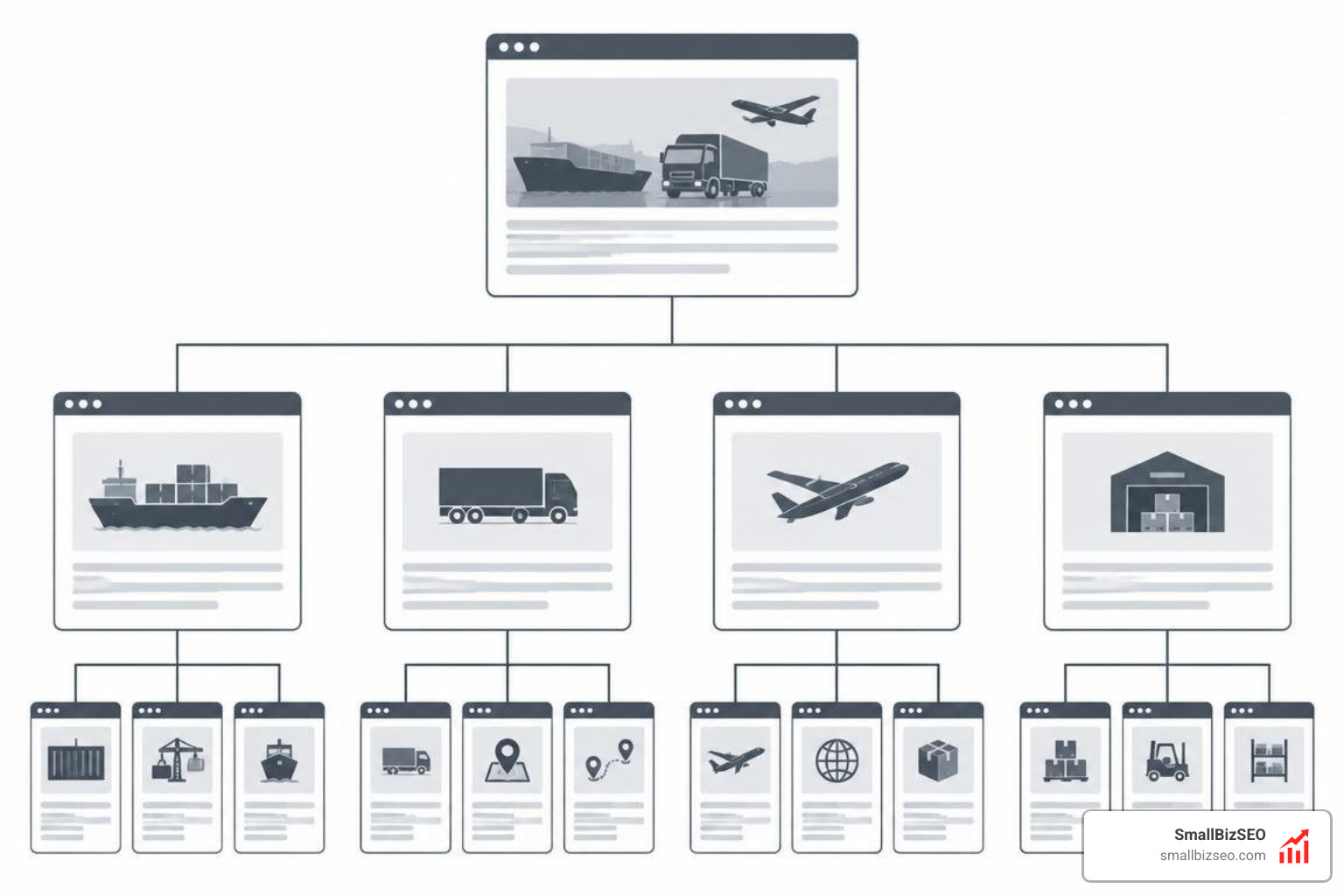
Effective search optimization creates trust upfront. Research shows that 94% of business buyers view website design and clarity as critical factors in evaluating vendor credibility. When you provide comprehensive operational breakdowns—such as transit requirements, trailer specifications, and regional lane constraints—you establish direct authority. Reviewing proven freight broker SEO strategies alongside the foundational Google Search Central SEO Starter Guide highlights that indexing specialized landing pages directly captures buyers when their shipping intent is highest.
How Should You Structure Your Website for Shippers and Carriers?
You must split your website into two clear, distinct user journeys: one path for cargo owners needing capacity and another for motor carriers seeking available loads. Blending these audiences into a confusing single interface increases bounce rates and harms lead conversion.
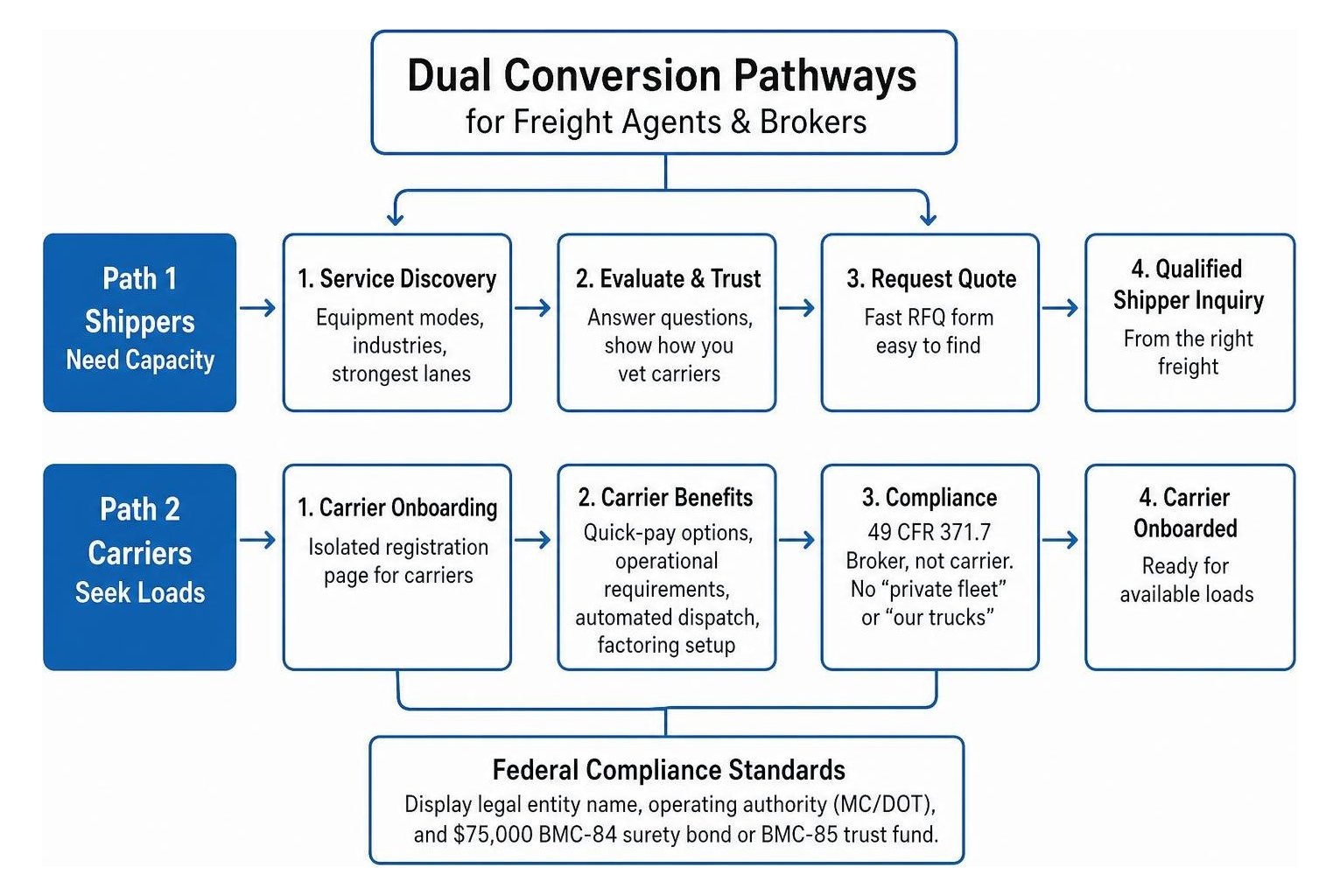
Your site structure should execute these core requirements:
- Shipper Conversion Paths: Dedicated landing pages for equipment modes (dry van, flatbed, refrigerated) and niche industries (food manufacturing, construction, industrial machinery) that link directly to fast request-for-quote (RFQ) forms.
- Carrier Onboarding Portals: Isolated registration pages that detail quick-pay options, operational requirements, automated dispatch features, and factoring setup.
- Federal Compliance Standards: Under 49 CFR 371.7, freight brokers must clearly advertise as brokers rather than motor carriers. Never use phrases like "our private fleet" or "our trucks." Prominently display your legal entity name, operating authority (MC/DOT numbers), and proof of your mandatory $75,000 BMC-84 surety bond or BMC-85 trust fund.
Structuring your digital assets in this manner mirrors an effective B2B SEO strategy, converting inbound researchers into legitimate commercial accounts.
Which Keywords Drive High-Intent Traffic in SEO for Freight Agents & Brokers?
High-converting search traffic targets specific logistics challenges rather than broad industry terms. While broad terms carry high cost-per-click values ($4 to $20 in paid auctions), niche equipment and route-level queries generate 100 to 1,000 monthly searches with significantly higher closing rates.
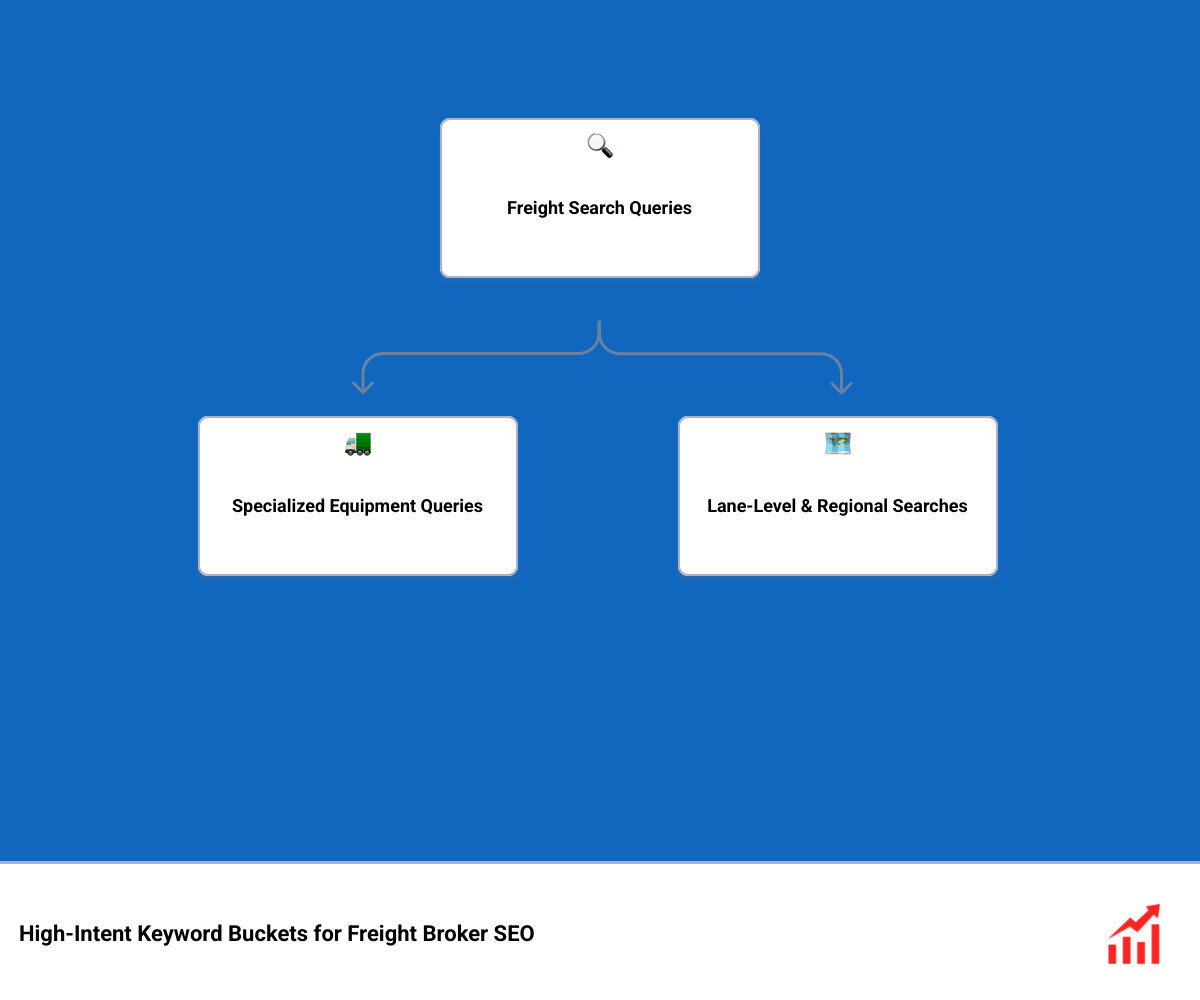
Focus your keyword research on three high-intent buckets:
- Specialized Equipment Queries: Phrases such as "flatbed heavy haul brokerage," "refrigerated food-grade transport," and "overdimensional machinery transport."
- Lane-Level and Regional Commercial Searches: Regional terms connecting production hubs to distribution centers, such as cross-border transport corridors or dedicated Midwest manufacturing lanes.
- Problem-Solving Queries: Specific logistics questions like "how to ship temperature-sensitive pharmaceuticals" or "recovering from a dropped flatbed load."
Aligning with an experienced Logistics SEO Company helps identify search intent gaps across your primary operating lanes.
What Technical SEO and Compliance Standards Must Brokerages Meet?
A secure, high-performance website ensures that search spiders index your content correctly and busy logistics managers complete quote forms without friction. Technical optimization must focus on clean crawlability and strict adherence to Google's Core Web Vitals.
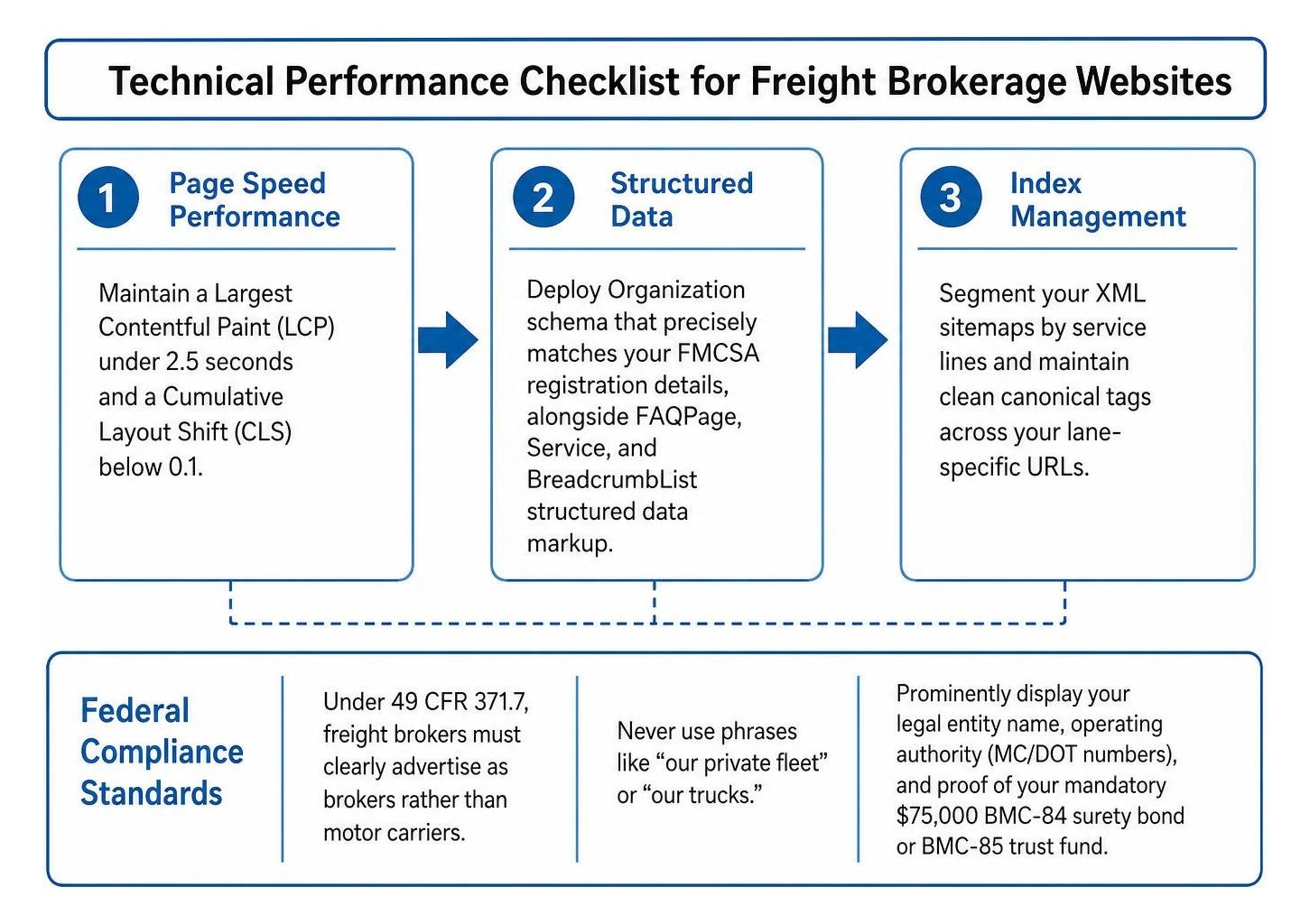
Implement these essential technical safeguards:
- Page Speed Performance: Maintain a Largest Contentful Paint (LCP) under 2.5 seconds and a Cumulative Layout Shift (CLS) below 0.1 to avoid losing prospective shippers on mobile devices.
- Structured Data: Deploy Organization schema that precisely matches your FMCSA registration details, alongside FAQPage, Service, and BreadcrumbList structured data markup.
- Index Management: Segment your XML sitemaps by service lines and maintain clean canonical tags across your lane-specific URLs.
Reviewing our Technical SEO Guide provides the necessary steps to eliminate indexation errors and build a fast technical foundation.
Step-by-Step Implementation and Scaling Strategy
Scaling organic search visibility requires systematic execution rather than sporadic blogging. Deploying a structured pillar page supported by 20 to 30 targeted cluster articles can increase qualified organic leads by 20% to 60% within 6 to 12 months. While technical fixes provide measurable ranking improvements in 4 to 8 weeks, reliable commercial intent rankings mature over 3 to 9 months.
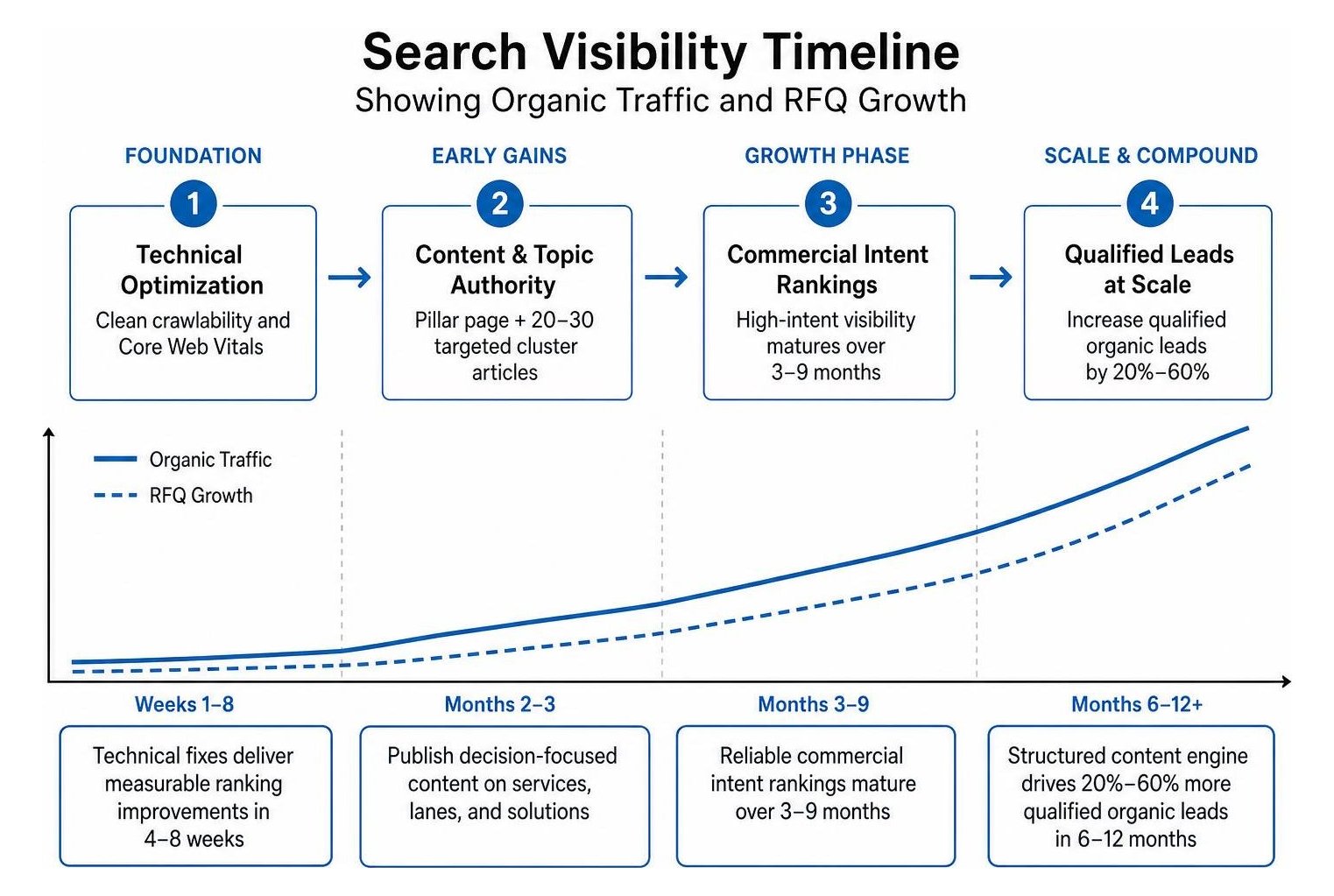
To build a repeatable search engine:
- Conduct a Service Inventory: Map your highest-margin freight modes, regional strongholds, and unique handling capabilities.
- Draft Decision-Focused Content: Write comprehensive guides addressing shipment preparation, accessorial fees, transit timing, and carrier qualification.
- Automate Internal Linking: Connect all supporting cluster articles back to your primary commercial service pages using natural, relevant anchor text.
- Integrate Analytics and CRM: Use UTM tracking across all RFQ submission buttons to measure customer acquisition costs and pipeline value directly within your transportation management system (TMS).
Following a data-driven freight broker marketing plan ensures your publishing schedule directly fills your active sales pipeline.
How to Optimize SEO for Freight Agents and Brokers for AI Search Engines
Modern shippers increasingly use generative tools like ChatGPT, Gemini, Claude, and Perplexity to identify logistics partners before reaching out directly. Winning in generative engine optimization (GEO) and answer engine optimization (AEO) demands clear factual definitions and verifiable entity data.
- Provide Direct Answers: Lead landing pages and sections with direct, 2-to-3 sentence answers defining exact trailer capabilities, pallet dimensions, transit limitations, and weight maximums.
- Build Strong Entity Signals: Keep your brand name, legal entity status, and industry credentials uniform across state registries, industry associations, and business citations.
- Maintain Local Optimization: For physical, staffed offices, maintain an active, fully verified Google Business Profile. For complete local implementation, follow our Local SEO Guide to dominate regional logistics searches.
What Tools and Metrics Track Search Success and Pipeline Revenue?
Tracking search performance requires monitoring qualified quote volume, cost-per-quote reductions, and closed-account margins rather than vanity impression counts.
| Metric / Tool Category | Manual Tracking Method | Automated Analytics Platform | Strategic Brokerage Impact |
|---|---|---|---|
| Search Engine Health | Periodic manual keyword checks in search engines | Google Search Console API and automated rank tracking | Identifies lane-level impression drops and emerging shipper queries |
| Technical Crawl Audits | Manual page-by-page visual checks | Automated crawling via Screaming Frog SEO Spider | Detects broken links, slow-loading assets, and schema errors |
| Local Search Citations | Spreadsheet logging of business directory submissions | BrightLocal citation monitoring and review aggregation | Maintains uniform entity consistency across all active branch offices |
| AI Answer Tracking | Manual prompt testing in chat tools | Automated LLM brand-mention and citation trackers | Verifies if generative assistants recommend your brokerage for niche lanes |
| Lead Pipeline Attribution | Asking new clients where they found you on sales calls | CRM integration with automated UTM source tracking | Measures cost-per-quote reduction (typically 25%+) and revenue ROI (2x–5x) |
SmallBizSEO delivers these outcomes using our data-driven "Velocity" framework, giving small businesses fast rankings, E-E-A-T-compliant authority, and complete visibility through automated reporting.
Transform Your Inbound Logistics Pipeline
Cold calling and chasing spot-market load boards creates an unpredictable revenue cycle. By transforming your brokerage website into an educational, high-converting digital platform, you position your brand as the trusted choice for high-margin freight. When prospective shippers find direct answers to their complex freight challenges, they reach out ready to book.
Ready to dominate high-value shipping lanes? Claim your comprehensive SEO visibility audit with our team today, and let us build an inbound pipeline that drives sustained brokerage growth.