Guide to SEO for IT Support & Managed Services

How Can IT Support and Managed Services Companies Get Found by Better-Fit Buyers?
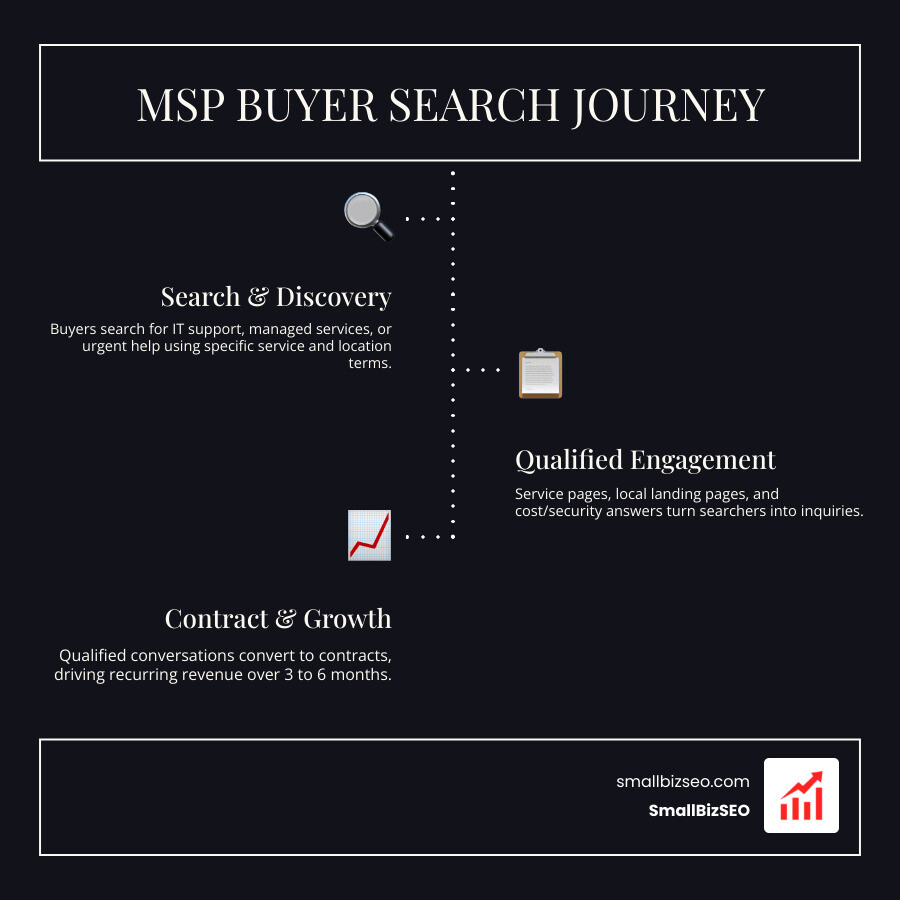
SEO for IT support & managed services starts with the searches most likely to lead to a contract. Build clear pages for each core service, show where you provide on-site support, and answer the questions buyers ask about cost, security, and switching providers. Then fix technical issues that keep those pages from loading well or appearing in search.
This is not just a rankings project. An MSP may need to reach a local business owner looking for urgent help and an IT director comparing long-term support options. The goal is to turn both searches into qualified conversations. Early improvements may appear sooner, but it often takes three to six months to see measurable progress from a new SEO program.
I’m Clayton Johnson, founder of SmallBizSEO. My work in technical SEO, content strategy, and link building for small businesses informs this guide to SEO for IT support & managed services.
Key terms for SEO for IT support & managed services:
- SEO for Software Design & Development
- SEO for Graphic Design Studios
- SEO for Architectural Design Firms
The Complete Playbook for SEO for IT Support & Managed Services
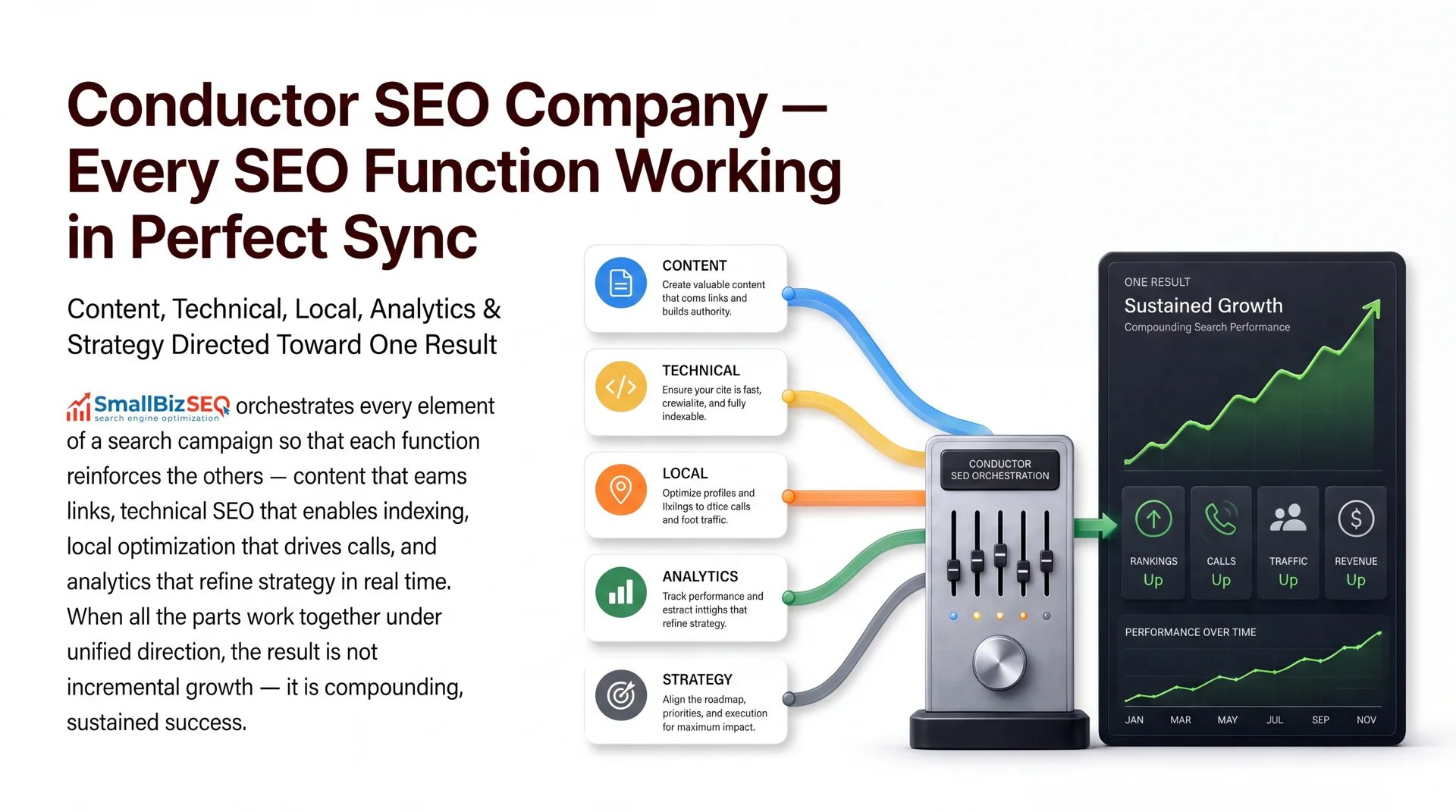
To win high-value contracts consistently, technology companies must treat search as an engine for pipeline generation rather than an afterthought. Most IT providers rely heavily on word-of-mouth referrals. While referrals are wonderful, they eventually hit a ceiling. When you partner with a dedicated IT Support and Managed Services SEO Company, you build a multi-layered framework that captures high-intent prospects right when they face an IT crisis or consider replacing an incumbent vendor.
A comprehensive search strategy balances three key pillars:
- Foundational Technical Health: Making certain search bots can crawl, render, and index your critical pages without hitting technical roadblocks.
- Local and Regional Dominance: Capturing immediate, on-site service searches through optimized business profiles and local landing pages.
- Mid-to-Bottom Funnel Content: Publishing the precise compliance guides, pricing breakdowns, and service matrices that convince buying committees to book a discovery call.
Implementing proper structured data on your primary pages helps search engines parse your operational details accurately. Using standard schemas like Local Business LocalBusiness Structured Data | Google Search Central | Documentation | Goo gives search platforms clear signals about your business hours, customer review ratings, and dispatch coverage.
What Makes SEO for IT Support & Managed Services Unique for B2B Buyers?
SEO for IT support and managed services differs from consumer SEO because purchase decisions involve multiple stakeholders, long sales cycles, and complex risk calculations. Buyers are rarely impulsive shoppers looking for a quick fix; they are evaluating an operational partnership that could make or break their business continuity.
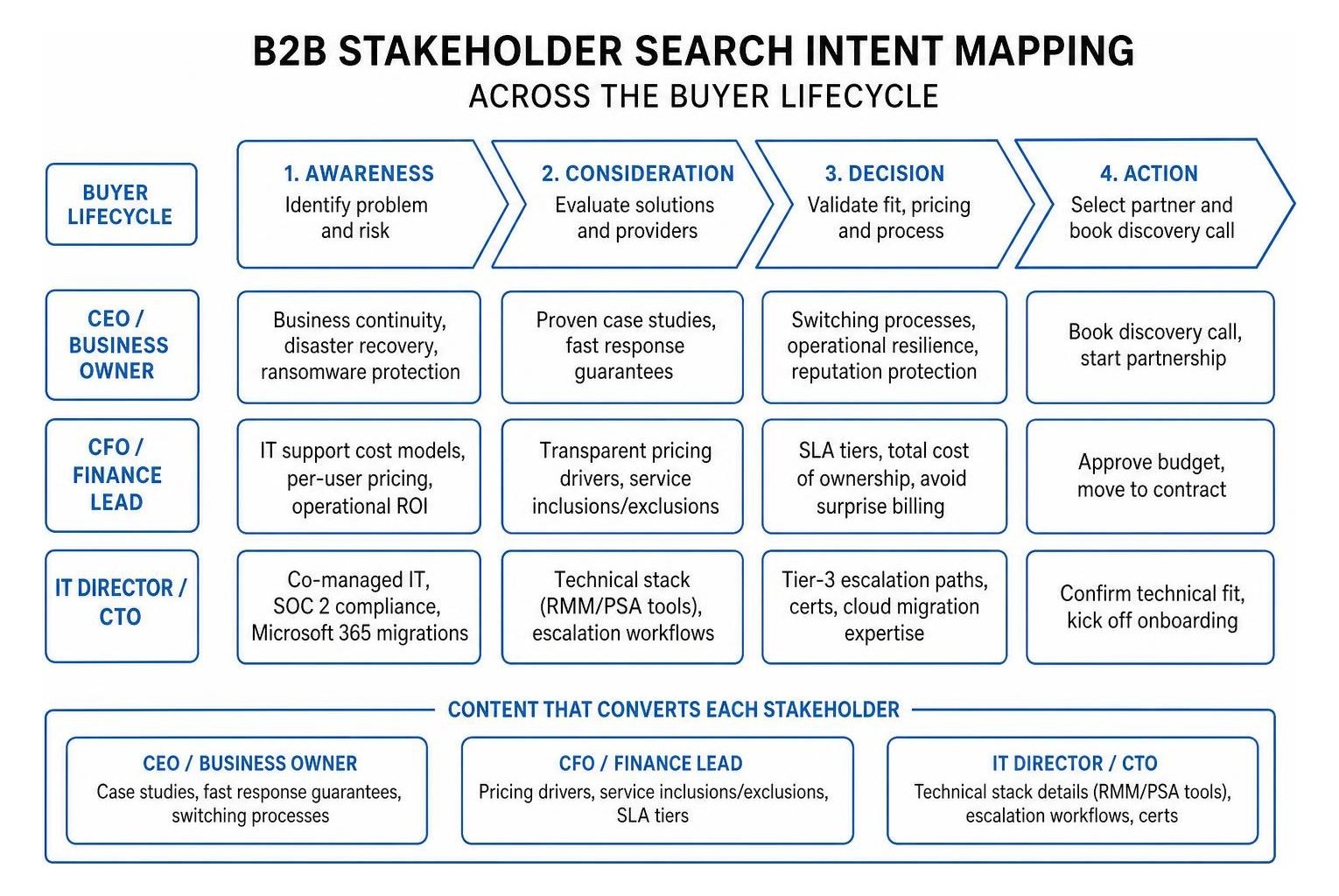
A standard B2B buying committee includes several personas, each searching with distinct pain points:
- The Chief Executive Officer (CEO) cares about operational resilience, mitigating downtime, reducing cybersecurity risk, and protecting the company's reputation.
- The Chief Financial Officer (CFO) focuses on predictable monthly recurring revenue (MRR), total cost of ownership, transparent service-level agreements (SLAs), and avoiding surprise billing.
- The IT Director looks for co-managed support, advanced tier-3 escalation paths, cloud migration expertise, and relief for an overworked in-house engineering team.
| Stakeholder Role | Primary Search Focus | Key Information Needed to Convert |
|---|---|---|
| CEO / Business Owner | Business continuity, disaster recovery, ransomware protection | Proven case studies, fast response guarantees, switching processes |
| CFO / Finance Lead | IT support cost models, per-user pricing, operational ROI | Transparent pricing drivers, service inclusions/exclusions, SLA tiers |
| IT Director / CTO | Co-managed IT, SOC 2 compliance, Microsoft 365 migrations | Technical stack details (RMM/PSA tools), escalation workflows, certs |
To capture these personas, you need a firm grasp of understanding B2B search intent. Creating generalized blog posts about "what is cloud computing" will not convert a sophisticated technical director. Instead, your site must showcase real-world operational mastery by demonstrating proven E-E-A-T signals across every page. This means naming specific regulatory frameworks—such as HIPAA for healthcare, SOC 2 for SaaS firms, or CMMC and NIST 800-171 for defense contractors—and outlining clear escalation procedures.
How to Build a Local and Programmatic Content Architecture
An effective search architecture pairs robust local map-pack optimization with structured programmatic topic hubs to capture both nearby and industry-specific demand. IT buyers prefer working with providers who can deploy technicians on-site when hardware fails, making local visibility paramount.
To dominate local search, begin by fully optimizing Google Business Profile listings. Keep your Name, Address, and Phone (NAP) details uniform across industry directories. Consistently gather verified client reviews that mention specific technical resolutions, like reducing helpdesk wait times or executing an emergency server restore.
When expanding beyond a single service hub, building distinct landing pages for every combination of service, industry, and municipality is critical. You can scale your visibility cleanly by scaling programmatic landing pages while respecting search guidelines.
To succeed with programmatic and modular pages without producing duplicate copy:
- Enforce Strict Quality Gates: Every programmatic page must contain unique operational facts, such as dedicated local response SLAs, common regional compliance mandates, and local customer quotes.
- Structure Topic Clusters: Interlink localized pages to high-level core service hubs by building topic clusters that guide visitors toward deeper technical reading.
- Establish Real Topical Authority: Cover your core competencies from all angles by establishing topical authority through comparison guides, migration roadmaps, and security checklists.
How Does AI Search Optimization Impact SEO for IT Support & Managed Services?

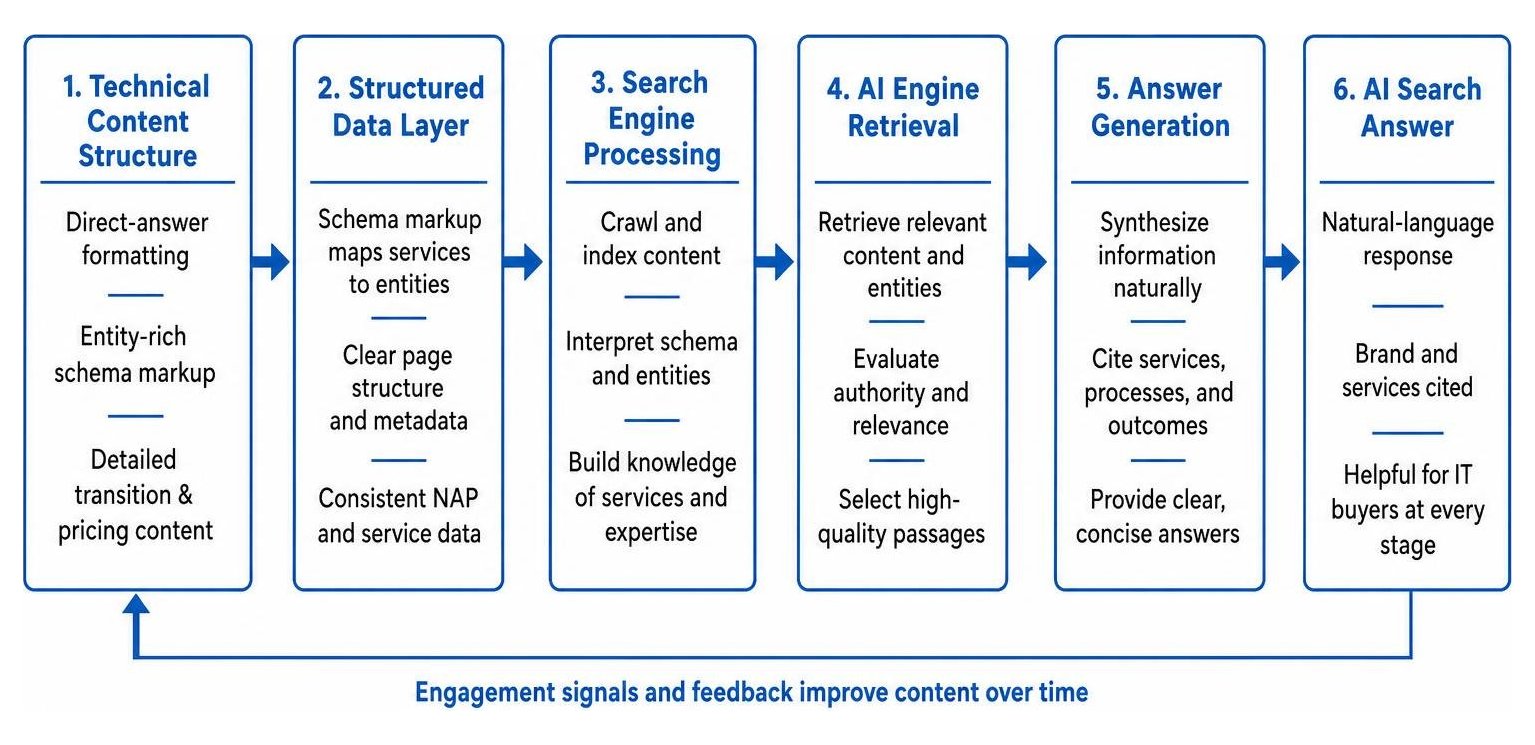
AI Search Optimization, or Generative Engine Optimization (GEO), ensures your managed services brand is directly cited in natural-language responses produced by conversational answer engines. When decision-makers query tools like ChatGPT, Perplexity, or Google's AI Overviews for vendor recommendations, these engines pull from pages with clear, authoritative entity data.
To maximize visibility across AI platforms:
- Adopt Direct-Answer Formatting: Begin key sections with concise, factual answers that explain exactly how your IT support works, what it costs, and who it serves.
- Utilize Entity-Rich Schema: Help search algorithms map your services directly to recognized concepts by implementing structured schema markup across all core offerings.
- Publish Detailed Transition and Pricing Content: AI models favor pages that clearly answer complex questions regarding onboarding phases, credential handover security, and pricing drivers.
Structuring your technical service pages for both human readers and search algorithms ensures maximum search visibility and qualified engagement.
How to Execute, Measure, and Scale Your Search Pipeline

Executing an SEO strategy requires a structured, phased rollout. Jumping straight into content creation without resolving underlying crawlability problems wastes budget and stalls organic traction. By systematically fixing technical SEO issues, you ensure every article, case study, and service page gains indexation quickly.
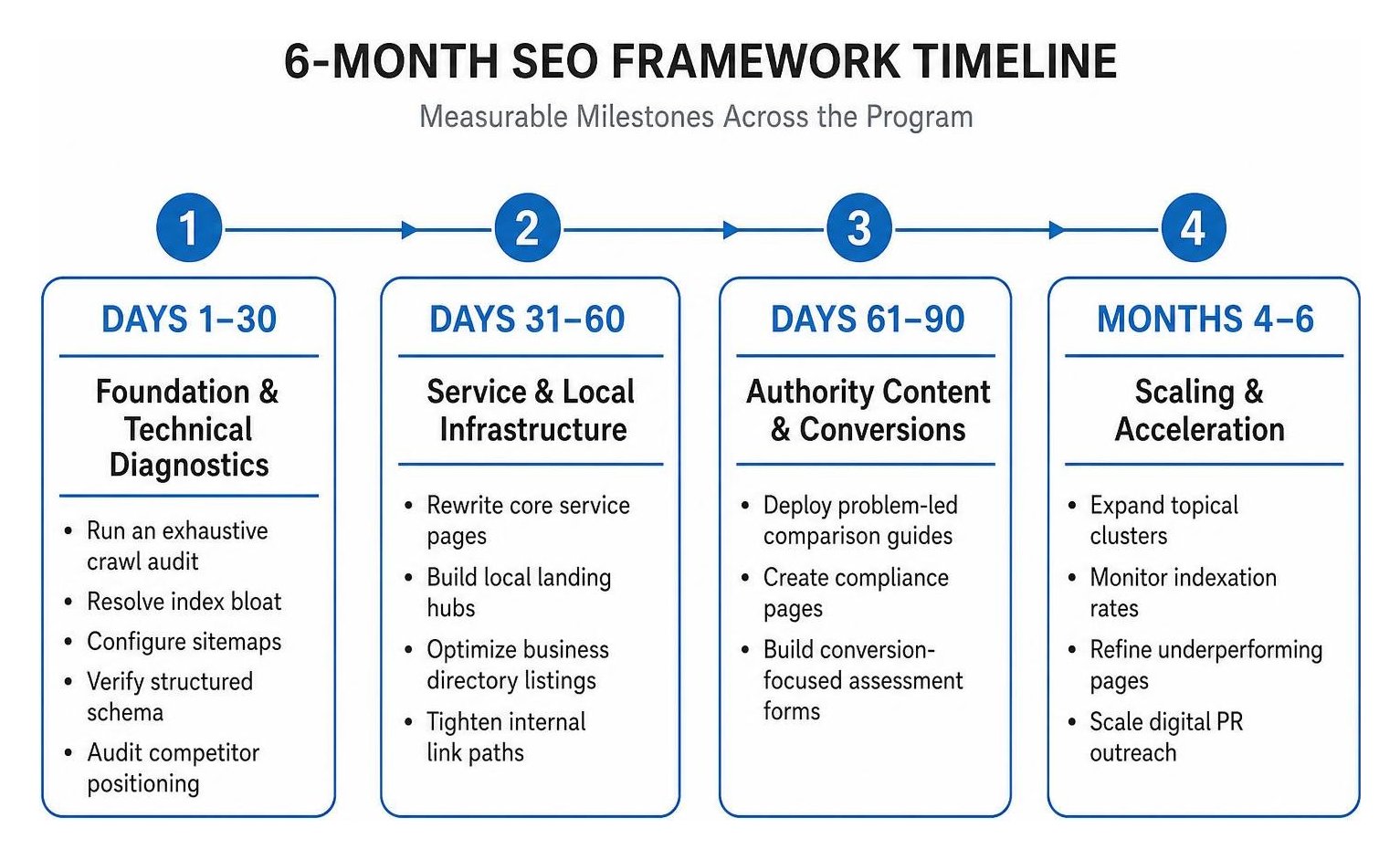
Our phased execution model keeps the program structured and on track:
- Days 1–30 (Foundation & Technical Diagnostics): Run an exhaustive crawl audit, resolve index bloat, configure sitemaps, verify structured schema, and audit competitor positioning.
- Days 31–60 (Service & Local Infrastructure): Rewrite core service pages, build local landing hubs, optimize business directory listings, and tighten internal link paths.
- Days 61–90 (Authority Content & Conversions): Deploy problem-led comparison guides, compliance pages, and conversion-focused assessment forms.
- Months 4–6 (Scaling & Acceleration): Expand topical clusters, monitor indexation rates, refine underperforming pages, and scale digital PR outreach.
What Are the Essential Technical SEO and Speed Requirements for MSPs?
A high-performing IT website must maintain impeccable technical health, loading rapidly and passing all Core Web Vitals checks to establish immediate credibility. If an IT company's own website is sluggish, broken, or insecure, prospective clients will question their ability to manage a complex corporate network.
Key technical requirements include:
- Core Web Vitals Mastery: Achieve page speed scores above 90 on mobile and desktop by improving Core Web Vitals performance. Optimize render-blocking scripts, compress images, and streamline style sheets.
- Clean Crawl Architecture: Maintain a clean robots.txt file and an organized XML sitemap so search engines do not waste crawl budget on thin search archives or tag pages.
- Strict Security Measures: Enforce HTTPS with up-to-date SSL/TLS configurations, clean redirect chains, and zero mixed-content errors.
- Mobile-First UX: Ensure site menus, contact forms, and pricing calculators work flawlessly across mobile devices.
What Timeline and KPIs Truly Measure Long-Term Search Success?
Measuring search success for IT support providers requires tracking qualified sales pipeline, recurring contract values, and conversion velocity rather than simple keyword impressions. Because a single managed services agreement can generate tens of thousands of dollars in lifetime revenue, vanity metrics do not tell the full story.
Key performance indicators to track in your monthly reporting:
- Sales-Qualified Leads (SQLs): The number of inquiries meeting your endpoint minimums and budget criteria.
- Contract Lifetime Value (LTV): Tracking how organic acquisition lowers overall customer acquisition costs over the lifecycle of a multi-year contract.
- Target Keyword Movement: Monitoring progress of high-intent queries moving from positions 11–30 onto page one.
- Google Search Console Engagement: Tracking increases in qualified clicks on core service and vertical compliance URLs.
Our data-driven "Velocity" framework delivers reliable, compounding growth by aligning strict technical execution with high-intent content strategy. If you are ready to evaluate your site's search health, pinpoint performance bottlenecks, and build an organic customer engine, schedule a comprehensive SEO visibility audit with our team.
Taking Your Next Step Toward Predictable Organic Growth
Building a durable search asset takes your managed services business off the referral rollercoaster and gives you a dependable stream of qualified sales conversations. By pairing rock-solid technical health with local optimization, AI-ready content structures, and clear answers for every member of the B2B buying committee, you position your firm as the trusted technology partner in your market.
Stop losing contracts to competitors simply because they appear first on Google or inside AI search tools. Focus on the core searches that drive real business value, optimize your conversion pathways, and watch your recurring revenue scale month after month.