A Practical Field Guide to Search Intent Matching and Keyword Optimization

How do you match search intent to your content?
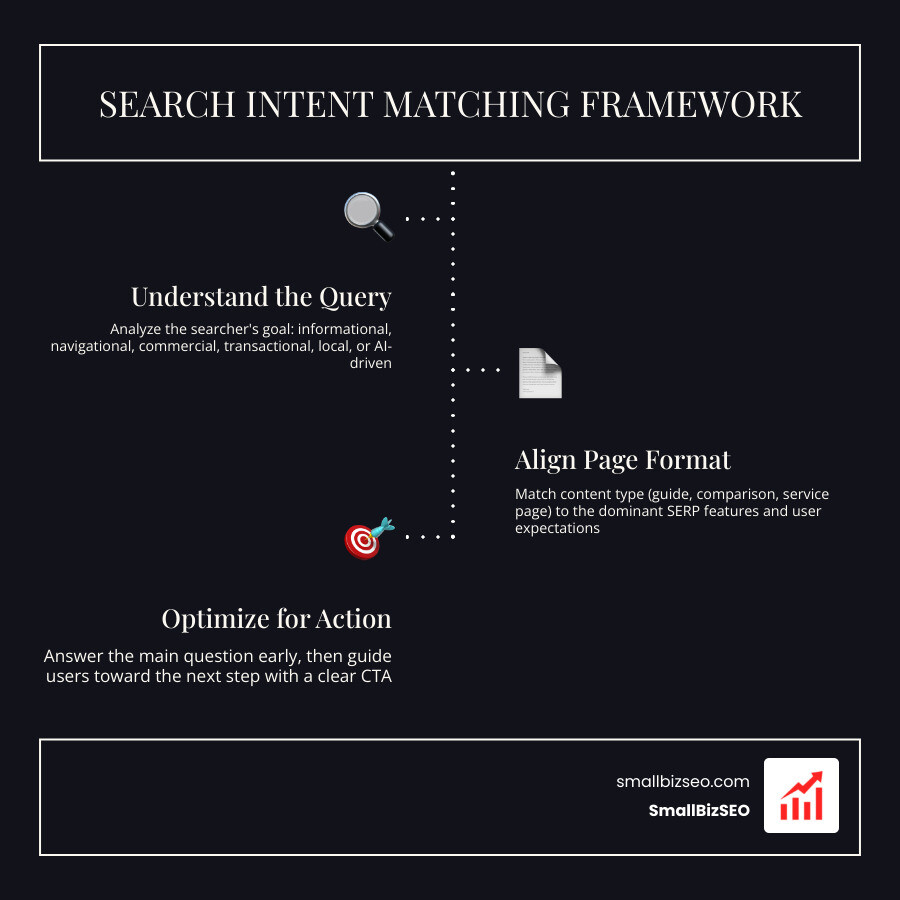
Search intent matching means making a page fit what someone wants to do when they search. To do it, check the top results for your target keyword, note whether searchers expect a guide, comparison, or service page, and build your page around that goal. Answer the main question early, then make the next step clear.
A page can use the right keywords and still miss the mark. Someone looking to compare SEO services needs different information from someone ready to request help. This guide will show you how to spot that difference and use it to plan content for both search results and AI-generated answers.
I'm Clayton Johnson, founder of SmallBizSEO. My work in SEO, content strategy, and AI-driven discovery has made search intent matching central to how I help small businesses turn their expertise into useful pages that attract qualified leads.
Core Frameworks for Search Intent Matching in Modern SEO
Search intent matching requires aligning your page archetype, content depth, and call to action with the underlying goal of the searcher. Modern search engines do not merely calculate raw keyword density; they use semantic models and deep neural networks to evaluate whether a webpage resolves the user's explicit task.
Satisfying modern search algorithms means moving beyond isolated phrase targeting. We must categorize queries into specific behavioral buckets, analyze the underlying mechanics of search algorithms, and format content to satisfy both traditional search result pages and conversational AI engines.
What Are the Primary Types of Search Intent and How Do They Differ?
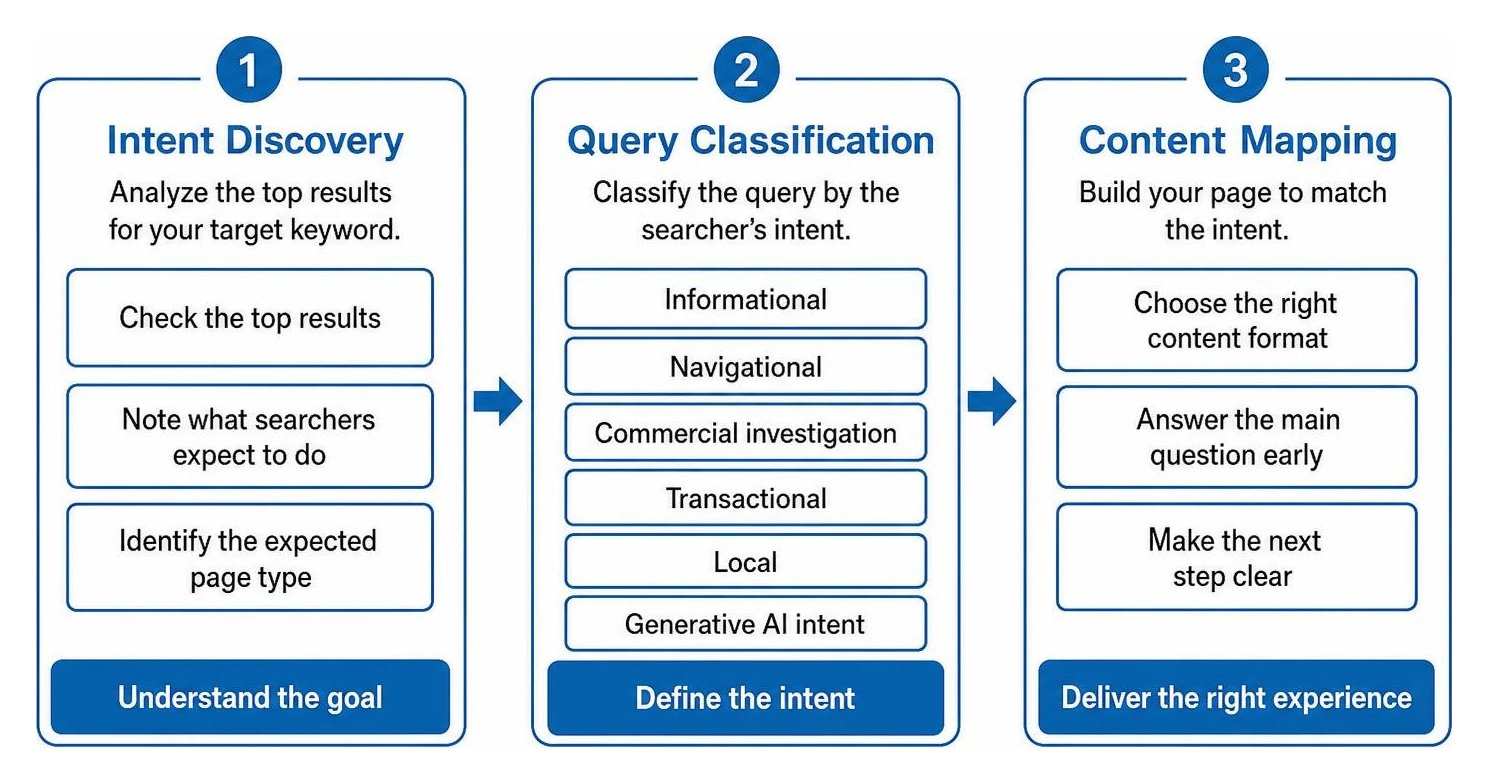
Search queries fall into six distinct categories: informational, navigational, commercial investigation, transactional, local, and generative AI intent. Understanding these variations ensures your content delivers the exact layout and depth users expect.
- Informational Intent: Users seek knowledge or quick answers. These queries account for roughly 70% of standard web searches. Formats include educational blog posts, step-by-step tutorials, and glossary definitions.
- Navigational Intent: The user wants to reach a specific brand, portal, or website. Examples include direct brand lookups or login pages.
- Commercial Investigation: Searchers evaluate potential solutions, services, or products before making a purchase. Targeting a commercial investigation keyword requires structured comparison tables, pros-and-cons lists, and third-party validation.
- Transactional Intent: The user is prepared to make a purchase, schedule a call, or complete a specific conversion. Page archetypes include product detail pages, pricing tables, and streamlined service request forms.
- Local Intent: The searcher needs a physical service or store nearby. These searches frequently feature a regional geo modifier and trigger localized map packs.
- Generative AI Intent: The user asks an artificial intelligence engine to perform a task, synthesize multiple data points, or create a concrete output. In AI platforms like ChatGPT, generative tasks account for 37.5% of all queries.
| Search Intent Type | Primary User Goal | Dominant Page Archetype | Example Query Structure |
|---|---|---|---|
| Informational | Learn or troubleshoot | Comprehensive guide, FAQ | "how does technical SEO work" |
| Navigational | Locate a specific site | Homepage, login portal | "SmallBizSEO client login" |
| Commercial | Compare and evaluate | Comparison post, review hub | "best SEO software for small business" |
| Transactional | Buy or hire directly | Service page, pricing checkout | "hire SEO audit agency" |
| Local | Find nearby providers | Local landing page, map profile | "SEO consultant near me" |
| Generative AI | Generate, draft, or calculate | Structured prompt-ready guide | "draft an SEO content brief outline" |
Academic research on multi-intent attribute-aware text matching shows that user queries contain multiple sub-intents, such as price sensitivity and functional scope. Content must reflect these layered attributes rather than treating every search term as a single, flat keyword string.
How to Execute Search Intent Matching Across SERPs and AI Models
To match intent across both traditional search engine results pages (SERPs) and AI answer engines, you must evaluate live ranking formats and structure your content for rapid entity extraction.
Start by inspecting page-one search results to identify whether Google serves listicles, long-form guides, or direct product landing pages. Note any rich SERP features present, such as People Also Ask accordions, video packs, and zero-click answers that satisfy quick lookups directly in the results.

When optimizing for AI engines like Perplexity, ChatGPT, and Google AI Overviews, apply these practical formatting techniques:
- Front-load direct answers: Place a concise 40-to-60-word summary directly below major headings so language models can easily extract core definitions.
- Build semantic depth: Comprehensive long-form content exceeding 2,300 words is frequently favored by AI synthesis models when handling complex topics.
- Organize with data tables: AI assistants and search bots extract data more accurately from clear HTML tables and bulleted lists.
- Reinforce off-page authority: Large language models heavily prioritize citations from trusted community discussions, authoritative backlink profiles, and industry publications.
A technical study on deep search query intent understanding illustrates how modern search systems process keystrokes and search queries in real time to blend documents, entity cards, and media. Structuring your content with clean subheadings and clear entity definitions ensures algorithms categorize your pages accurately.
Why Relying Solely on Keyword Tools Fails Search Intent Matching
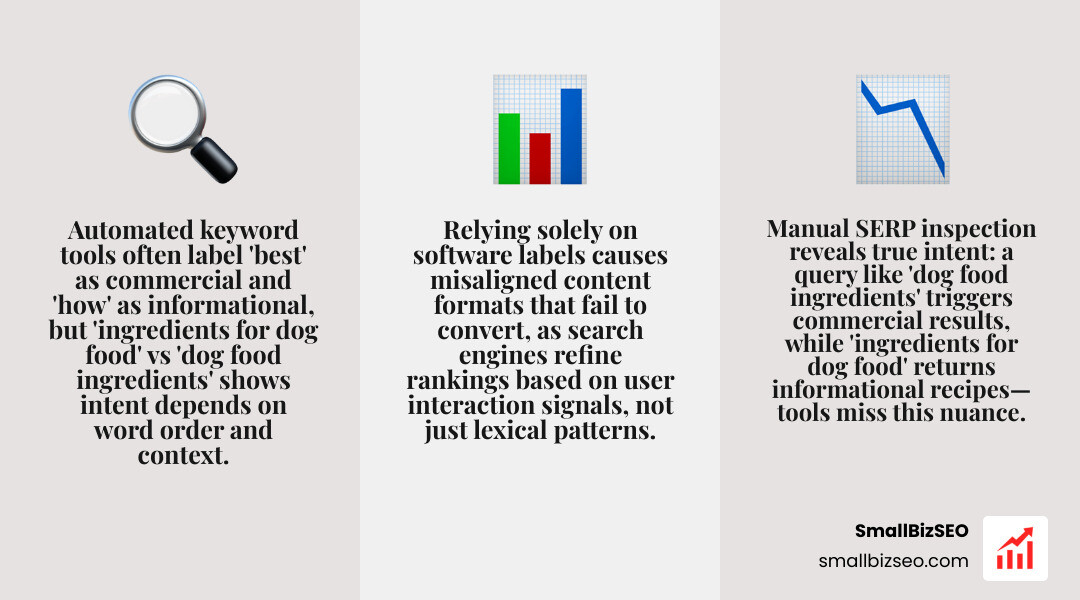
Automated keyword research tools often assign intent labels based on basic lexical patterns. If a keyword contains the word "best," the tool automatically labels it as commercial, while queries containing "how" are tagged as informational. However, human search behavior is far more nuanced.
For instance, the word order in a phrase changes its fundamental meaning. Searching "ingredients for dog food" signals an informational desire for homemade recipes, whereas "dog food ingredients" signals commercial investigation into manufactured pet food additives.
Learning how to analyze user intent behind search queries manually protects your strategy from generic tool classifications. Foundational findings on query-page intention matching demonstrate that search engines continuously refine rankings based on user interaction signals and clicked snippets. Relying purely on software labels causes businesses to produce misaligned content formats that fail to convert visitors.
Optimizing Content and Funnels for Maximum Organic Conversions
High organic traffic provides little business value if visitors immediately bounce back to the search results. Search intent matching serves as the bridge between keyword discovery and bottom-line revenue. By matching each page archetype to the user's specific stage of decision-making, you eliminate friction and guide qualified prospects toward action.
Focusing on bottom-of-funnel commercial and transactional queries delivers exceptional returns. While broad informational searches represent higher monthly search volumes, high-intent transactional pages consistently convert at 20 to 30 times the rate of top-of-funnel informational blog posts.
How Does Intent Evolve Across the Buyer Journey?
Search intent naturally evolves as a prospect moves from initial problem identification to final vendor selection. A small business owner might start with broad definition searches, transition to benefit evaluations, and finish with local provider terms.
Content strategies must accommodate this shift while monitoring for search intent drift, where the dominant SERP format for a specific query changes over time due to shifting user preferences or algorithmic updates.

An empirical analysis of web search intent induction highlights that searchers frequently use brief, two-word queries because they lack the technical vocabulary to describe their problem. By organizing your website into clear topic clusters with distinct sub-intent headings, you help buyers navigate smoothly from exploratory learning to solution evaluation.
How to Prevent Cannibalization and Match Page Archetypes
Targeting similar keywords across multiple pages often causes keyword cannibalization, where two or more URLs on your site compete against each other in the search results. This confuses search algorithms and dilutes your organic visibility.
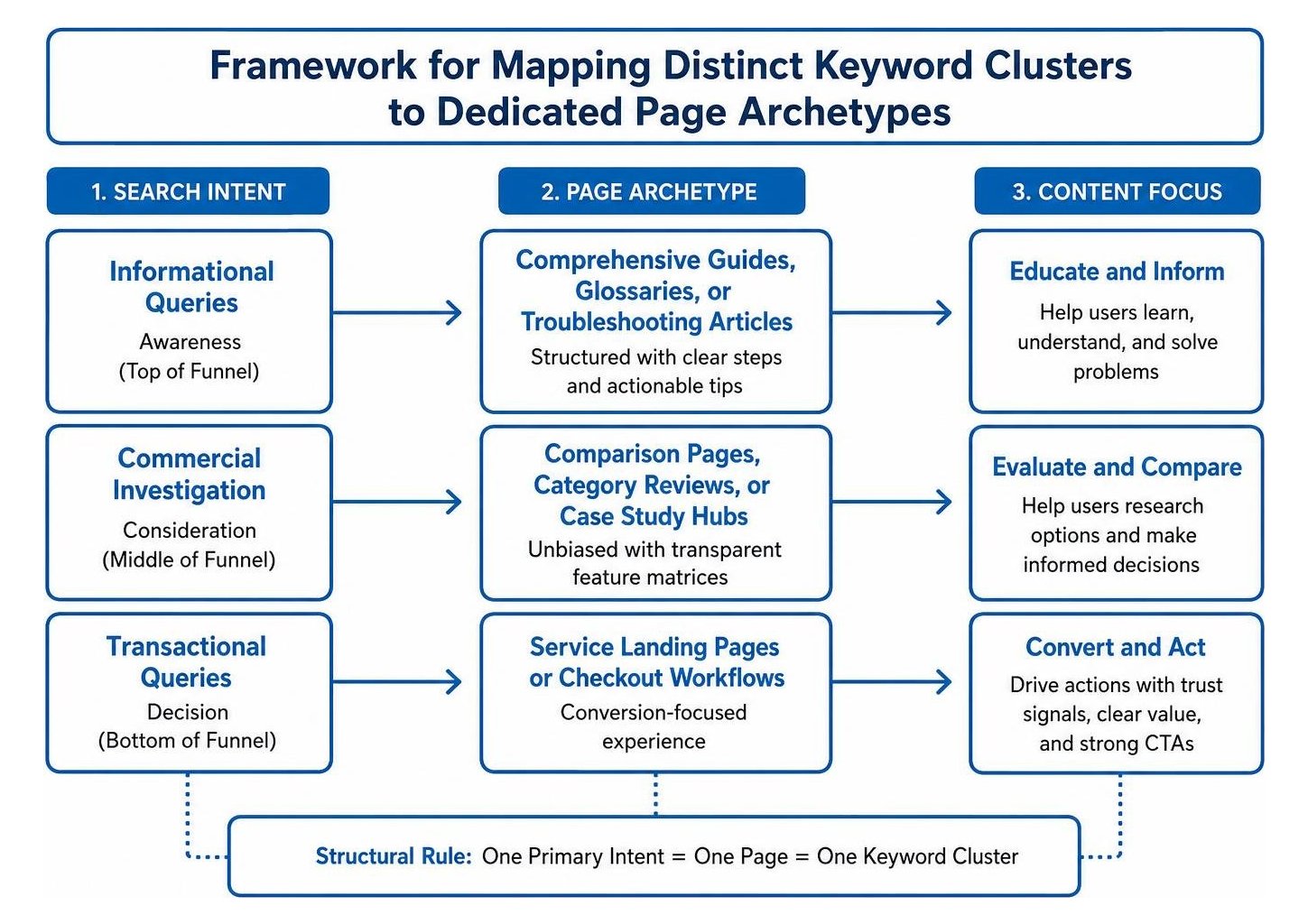
To eliminate cannibalization, follow the strict structural rule: one primary intent = one page = one keyword cluster.
Standardize your content creation process using structured briefs:
- Informational Queries: Assign to comprehensive guides, glossaries, or troubleshooting articles. Structure with clear steps and actionable tips.
- Commercial Investigation: Assign to unbiased comparison pages, category reviews, or case study hubs. Include transparent feature matrices.
- Transactional Queries: Assign to dedicated service landing pages or checkout workflows. Implement conversion-focused copywriting frameworks like Problem-Solution-Proof, display trust badges, and offer clear contact forms.
Our team at SmallBizSEO uses our proprietary "Velocity" framework to audit query clusters, eliminate page overlap, and deploy an exact search intent match strategy tailored to high-converting small business niches.
Putting Search Intent into Action for Predictable Growth
Mastering search intent is the single most reliable way to build organic search visibility that drives real business revenue. When you align your content formats with what searchers and modern AI engines actually demand, you stop wasting resources on low-impact content and start capturing qualified leads ready to buy.
Evaluate your target keyword clusters, inspect the live search results, format your pages with Answer-Ready SEO, and ensure every page on your website fulfills a clear, dedicated user goal.