15 AI-Powered Customer Service Statistics on Response Times and ROI

15 AI-Powered Customer Service Statistics on Response Times and ROI
What Do AI Customer Support Metrics Actually Show?
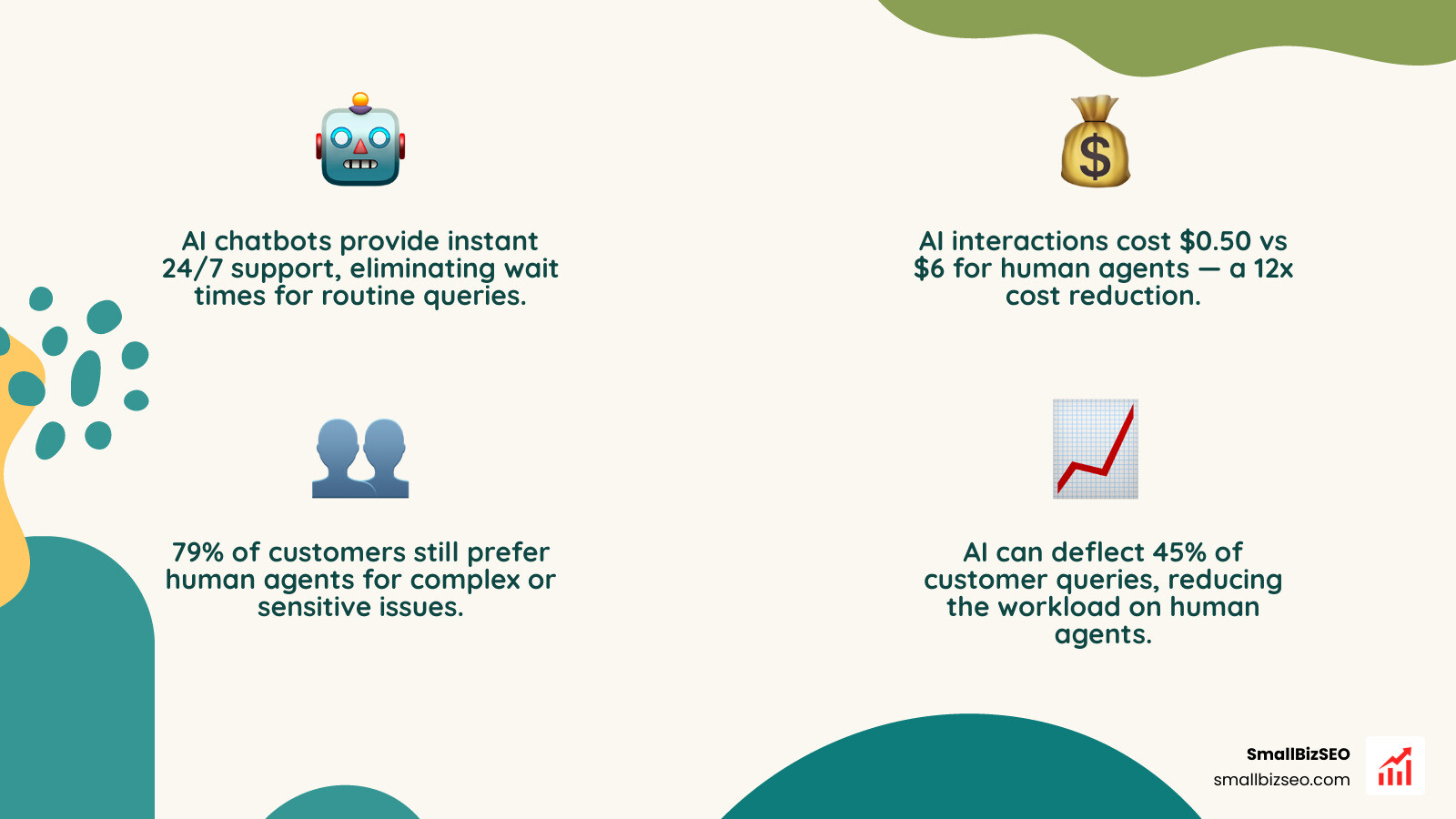
AI-powered customer service statistics on response times, satisfaction, and cost savings point to a clear trade-off: bots can answer routine questions in seconds, around the clock, at a lower cost per interaction. Reported benchmarks put a bot chat at about $0.50 versus $6 for a human-handled chat. But speed alone does not prove better service. Customers still need accurate answers and an easy path to a person when an issue is complex.
I'm Clayton Johnson, founder of SmallBizSEO. My work turns research on AI and customer journeys into practical guidance for small businesses; in this guide to AI-Powered Customer Service Statistics: Response Times, Satisfaction, and Cost Savings, I'll separate useful benchmarks from claims that need more context.
AI-Powered Customer Service Statistics: Response Times, Satisfaction, and Cost Savings definitions:
- AI Chatbot Statistics: Customer Engagement, Lead Generation, and Sales Conversions
- Consumer Trust in Artificial Intelligence: Survey Statistics and Buying Behavior
- AI Training Statistics: How Businesses Are Preparing Employees for Artificial Intelligence
How Do AI Customer Service Statistics Compare Response Times, Satisfaction, and Cost Savings Across Support Channels?
AI customer service handles frontline inquiries across digital channels instantly at a fraction of the expense of live agents, while traditional phone and email channels deliver deeper human empathy at substantially higher operational costs.
Evaluating support channels requires balancing speed, operational containment, and customer sentiment. While phone support delivers high touch for delicate escalations, it carries severe cost and queue penalties. Conversely, automated self-service and conversational virtual assistants resolve routine inquiries instantly, deflecting substantial volume away from overloaded agents.

Across typical service ecosystems, channel economics diverge dramatically:
- Phone Support: Costs $17 to $25 per resolution, with average call handling times exceeding several minutes.
- Email Support: Averages $8 to $15 per ticket, often requiring hours or days for multi-turn resolutions.
- Live Chat: Runs between $10 and $16 per human-assisted interaction, though it achieves strong satisfaction ratings.
- AI Chatbots & Self-Service: Operates between $0.50 and $4.00 per interaction, handling tier-one requests autonomously.
How Much Faster Can AI Customer Service Be at Responding and Resolving Issues?
AI tools cut first response times by 37% to 97%, frequently dropping initial customer wait times from over 15 minutes down to under 30 seconds.
In customer support, speed directly influences retention. Industry benchmarks show that 60% of customers define an immediate response as 10 minutes or less, yet traditional SaaS email queues have a median resolution time of 82 hours.

Automated models eliminate triage delays entirely:
- First Response Acceleration: Implementations routinely slash initial reply times from over 6 hours down to under 4 minutes, with specialized chatbots achieving responses in 1 to 3 seconds.
- Resolution Velocity: End-to-end ticket resolution drops significantly. Academic and industry benchmarks document resolution timelines plummeting from 32 hours down to 32 minutes—a 98% efficiency gain.
- Handling Time Drops: Major financial and e-commerce platforms report cutting average handling times from 11 minutes down to 2 minutes, an 82% reduction.
- Empirical Research: As noted in scientific research on automated chatbot efficiency, conversational bots resolve high-volume inquiries rapidly, allowing human operators to focus on specialized workflows.
How Much Can AI Customer Service Save Through Deflection and ROI?
AI customer service delivers an average return of $3.50 for every $1 invested by deflecting over 45% of incoming ticket volume and reducing per-interaction costs by up to 90%.
Because labor represents up to 95% of contact center operational budgets, automating routine tasks creates immediate bottom-line relief. Conversational AI is projected to eliminate $80 billion in global contact center labor expenses.
| Performance Metric | AI-Powered Chatbots | Human-Handled Support | Operational Impact |
|---|---|---|---|
| Cost per Interaction | $0.50 – $0.70 | $6.00 – $8.00 | ~12x Cost Advantage |
| Average Deflection Rate | 45% – 80% | 0% (Assisted) | Cuts tier-one volume in half |
| First Response Time | Instant (< 30 seconds) | Minutes to hours | 55% average reduction |
| Year 1 to Year 3 ROI | 41% (Y1) to 124%+ (Y3) | Baseline operational cost | Compounding financial return |
Analyzing the productivity and financial ROI from business AI demonstrates that automated triage scales without proportional hiring costs. Evaluating enterprise AI software spending benchmarks helps companies balance upfront tooling costs against long-term operational savings, as detailed in recent Chatbot vs Human Agent performance metrics.
Do Customers Prefer AI Bots or Human Support?
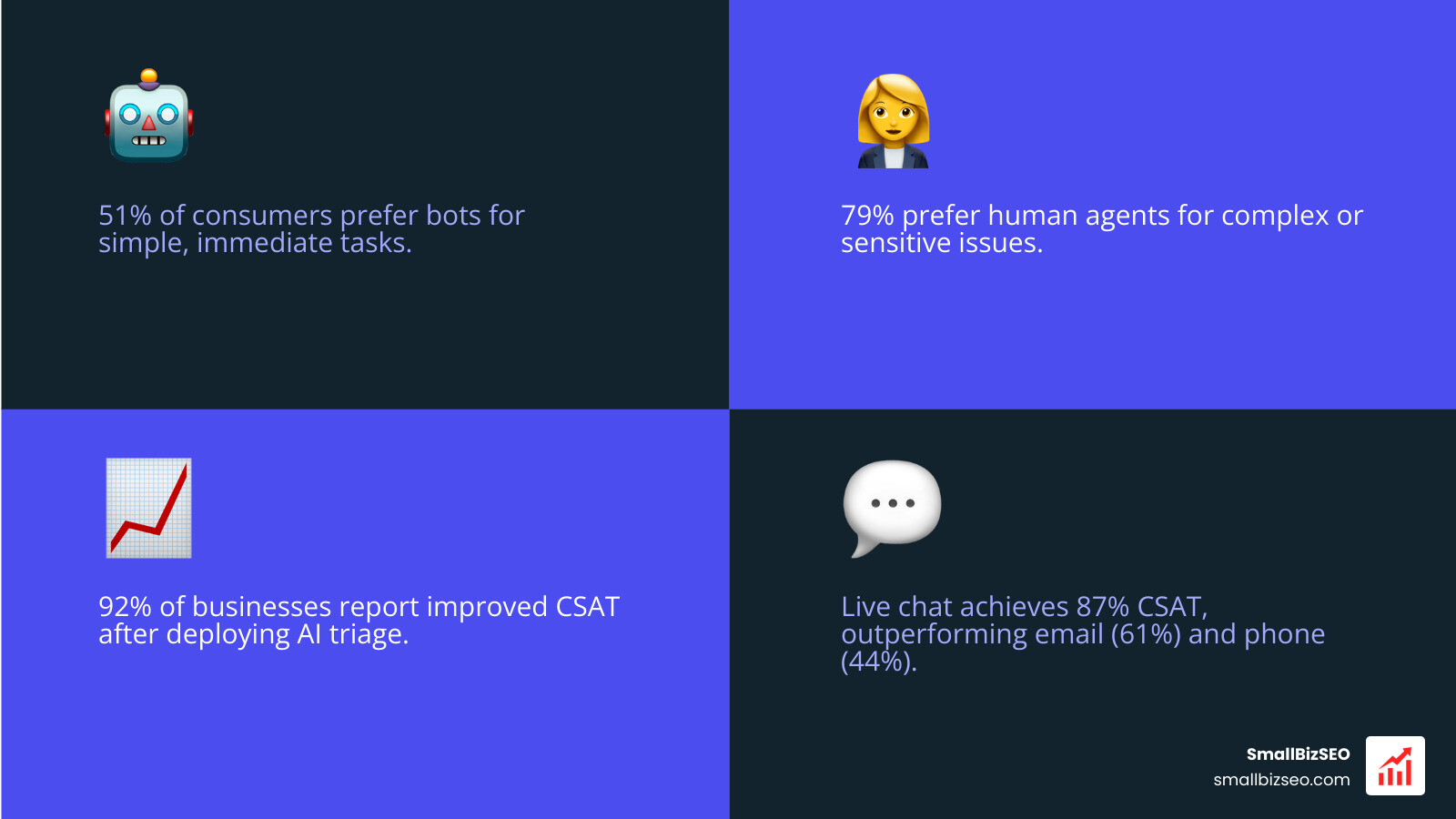
Customer preferences depend heavily on task complexity: 51% of consumers prefer bots for immediate, simple tasks, while 79% still prefer human agents for complex, emotionally sensitive, or high-stakes inquiries.
Speed and accuracy drive customer sentiment:
- CSAT Gains: 92% of businesses report measurable customer satisfaction improvements after deploying AI triage tools.
- The Channel Factor: Live digital chat achieves an 87% CSAT rating, outperforming traditional email (61%) and phone channels (44%).
- The Human Preference: 84% of consumers perceive human agents as more accurate during complex edge cases, and 85% note that multi-layered problems still require human intervention.
- Friction Points: 74% of consumers find repeating their issue across multiple agents or channels frustrating. AI bridges this gap by summarizing chat history for seamless handoffs.
Reviewing vital statistics on consumer trust in AI shows that users embrace automated tools when expectations are clear. Recent findings in the Agentic AI containment and CSAT boost report demonstrate that modern autonomous agents can reach 80% containment while lifting CSAT by 20%.
Where Are AI Customer Service Cost Reductions Happening in Telecom, Banking, and Retail?
Telecommunications, banking, and retail lead AI adoption, achieving double-digit cost reductions by automating high-frequency transactions like order tracking, balance checks, and network troubleshooting.
- Telecommunications: Telecom leads enterprise adoption with over 95% implementation rates. Large operators report up to 70% cost-per-chat reductions and double-digit Net Promoter Score (NPS) increases by routing routine billing and device activation tasks to conversational bots.
- Retail and E-Commerce: Global digital storefronts save upwards of $150 million annually by automating up to 75% of routine order tracking and return inquiries. Exploring the shocking AI shopping metrics in modern retail highlights how smart automation drives direct conversions alongside support deflection.
- Banking & Financial Services: Banking virtual assistants handle billions of routine balance inquiries, card activations, and fraud alerts. Automated IVR and chat integrations consistently yield 60% to 80% operational cost savings compared to legacy call routing.
How Can Businesses Close the CX Implementation Gap and Achieve Sustainable ROI?
Businesses achieve sustainable customer service ROI by integrating AI directly into core business databases, establishing clear escalation rules to live agents, and tracking cost per resolved ticket rather than raw deflection.

What Operational Hurdles Can Reduce AI Customer Service ROI?
The primary operational hurdles limiting support ROI include disconnected data silos, poor agent context during handoffs, high staff turnover, and strict regulatory compliance mandates.
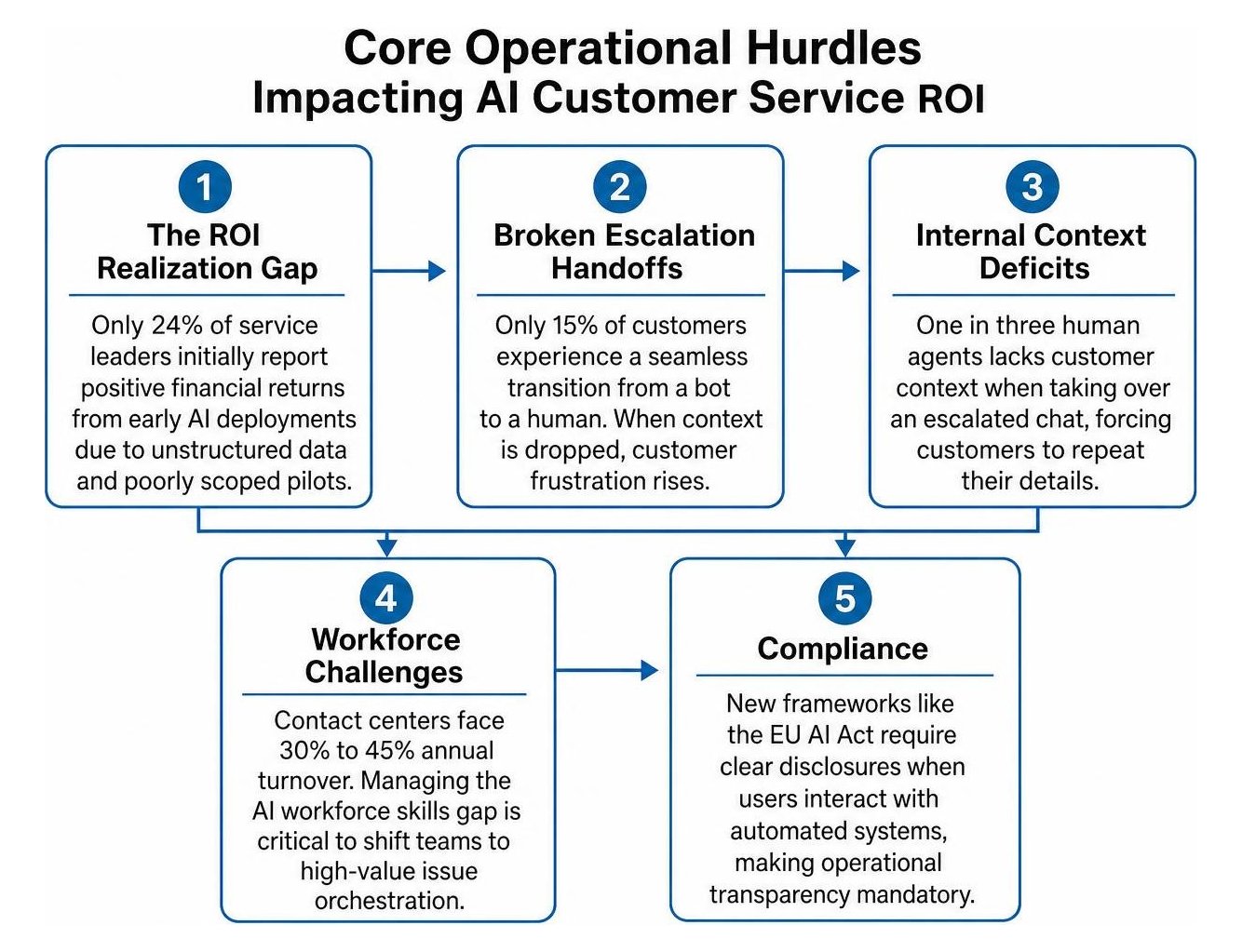
- The ROI Realization Gap: Only 24% of service leaders initially report positive financial returns from early AI deployments, primarily due to unstructured data and poorly scoped pilots.
- Broken Escalation Handoffs: Only 15% of customers experience a seamless transition from a bot to a human. When context is dropped, customer frustration rises.
- Internal Context Deficits: One in three human agents lacks customer context when taking over an escalated chat, forcing customers to repeat their details.
- Workforce Challenges: Contact centers face 30% to 45% annual turnover. Managing the corporate AI workforce skills gap is critical to help support teams transition from repetitive tier-one tasks to high-value issue orchestration.
- Compliance: New frameworks like the EU AI Act require clear disclosures when users interact with automated systems, making operational transparency mandatory.
How Can a Hybrid Support Model Improve Customer Service ROI?
A hybrid support model routes routine tier-one tickets to automated AI agents while reserving experienced human staff for complex escalations, maximizing efficiency without sacrificing customer loyalty.
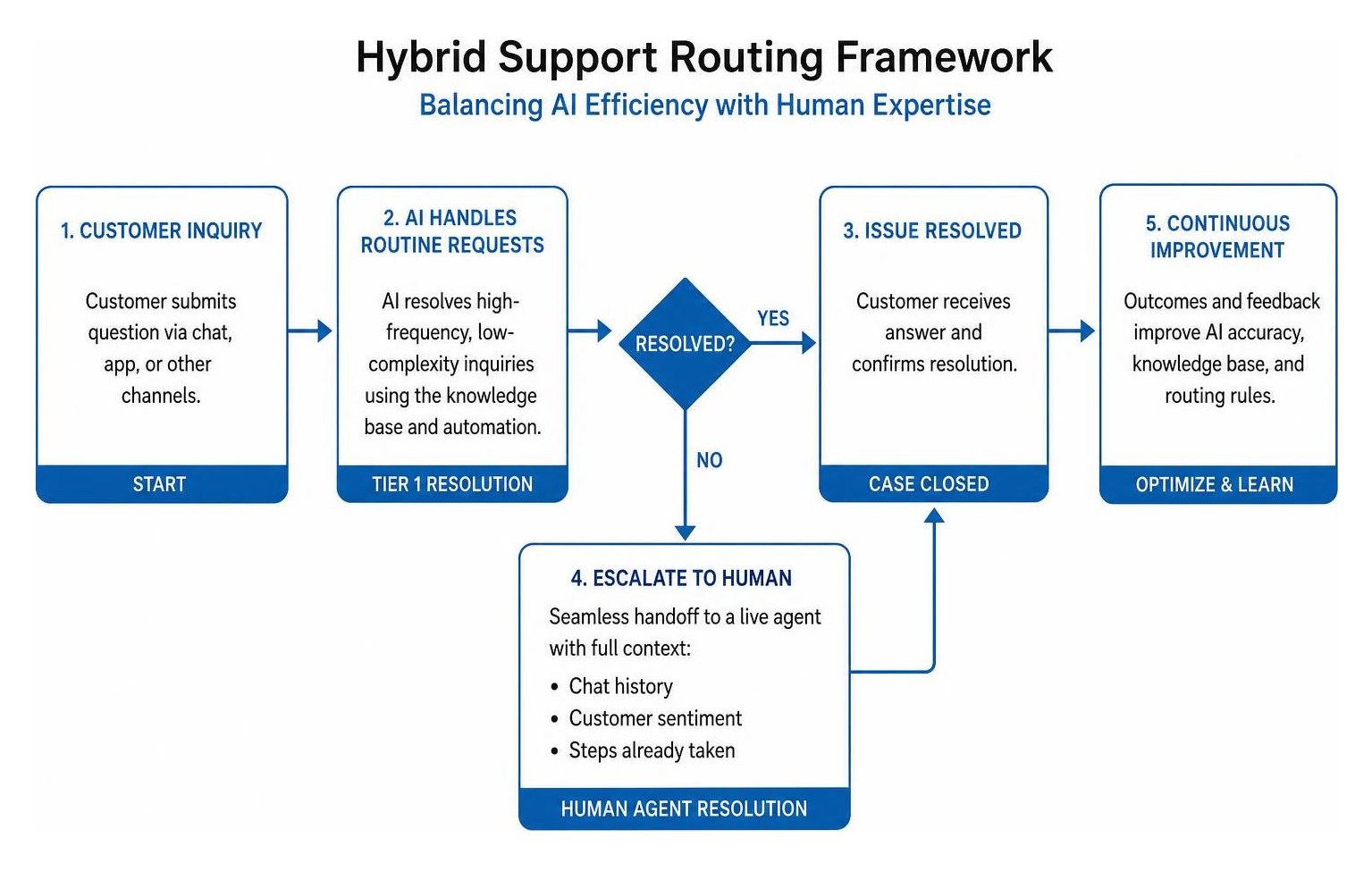
To build an efficient hybrid support model:
- Automate High-Frequency Inquiries First: Direct low-complexity workflows—such as password resets, order updates, and basic FAQs—to conversational agents.
- Maintain a Self-Learning Knowledge Base: Ensure your AI surfaces answers directly from updated help documentation, dynamically updating content as new resolutions occur.
- Preserve Context on Escalation: Ensure that chat history, user sentiment, and attempted troubleshooting steps automatically populate inside the human agent's helpdesk view.
- Track Resolution-Based KPIs: Evaluate cost per resolved ticket and First Contact Resolution (FCR) rather than simple bot deflection metrics.
Examining broader generative AI statistics for business strategy shows that organizations pairing automated workflows with human expertise consistently outperform fully automated or fully manual setups.
Maximizing Your Support Efficiency With Smarter Search and CX Automation
Modern customer support requires balancing speed, containment, and customer trust. Deploying conversational bots for routine inquiries cuts queue times and operating costs, while human agents provide the empathy required for complex cases.
At SmallBizSEO, our data-driven Velocity framework helps small businesses turn customer search intent and content optimization into measurable operational growth. When you align your technical SEO, customer knowledge bases, and automation strategy, your business captures search demand while delivering fast, accurate support experiences. Contact our team today to strengthen your digital presence and scale your support efficiency.