An Essential Guide to Comparing SEO Services for Fashion Brands
An Essential Guide to Comparing SEO Services for Fashion Brands
Which SEO Services Matter Most for a Fashion Company?
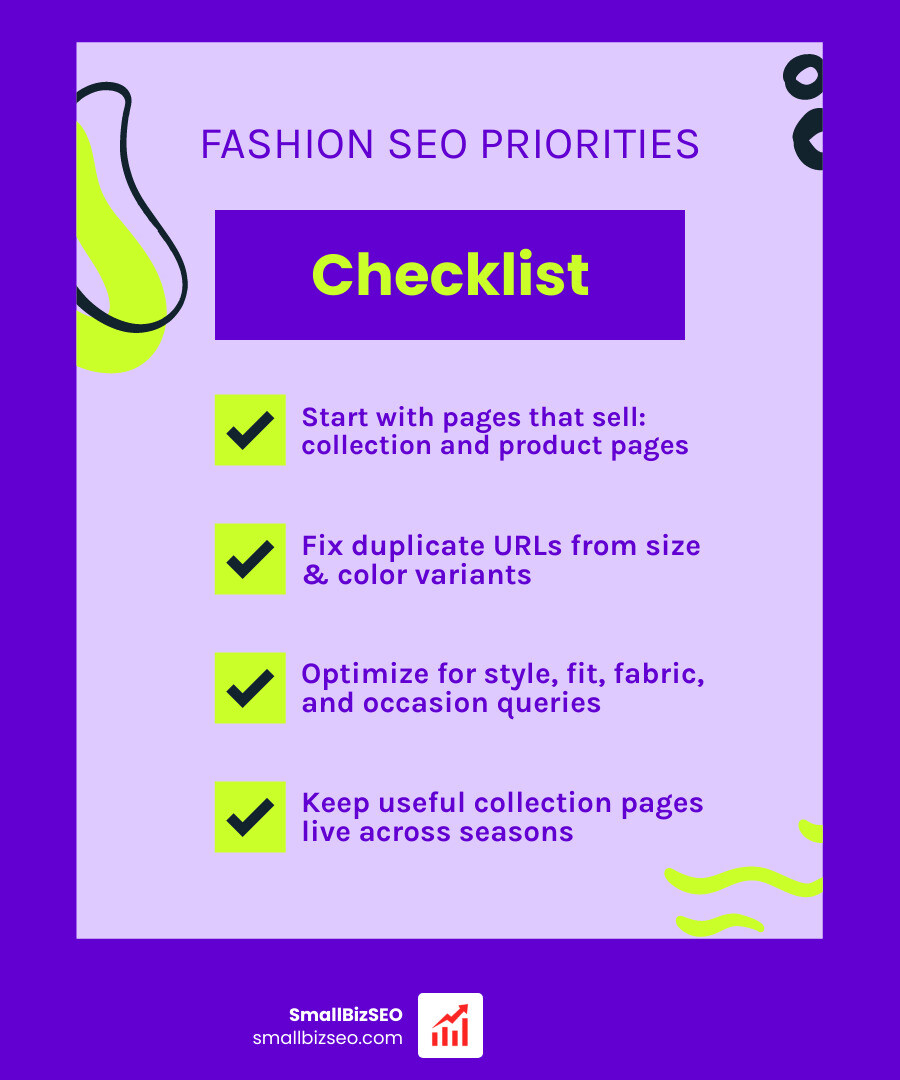
Start with the pages that sell. Effective fashion SEO services improve collection and product pages, fix duplicate URLs caused by size and color options, and make image-heavy pages fast on mobile. They also help shoppers find products by style, fit, fabric, and occasion. If you are comparing providers, ask how they will handle seasonal collections, measure organic sales, and report what they changed.
Fashion adds a challenge that many stores do not face as often: products change quickly, but search visibility takes time to build. A good plan keeps useful collection pages live across seasons and supports them with guides that answer shoppers' questions.
I'm Clayton Johnson, founder of SmallBizSEO, where I connect SEO, content, and digital PR to help businesses attract qualified customers. My work on answer-ready search shapes how I evaluate SEO services for fashion company websites, including visibility in both search results and AI-generated answers.
SEO services for fashion company terms at a glance:
- enterprise local SEO
- SEO for enterprise companies
- local SEO map
Core Solutions Included in Comprehensive SEO Services for Fashion Company Websites
Comprehensive SEO services for a fashion company focus on technical site health, rich collection page architecture, and high-intent product optimization. Because online apparel stores rely heavily on visual appeal and fast seasonal turnover, SEO must do more than just drive traffic. It needs to bring ready-to-buy shoppers directly to the right sizes, cuts, and fabrics.
When exploring ecommerce SEO services, fashion brands need strategies tailored specifically to apparel catalogs. Standard digital marketing advice often ignores the complexity of inventory shifts, seasonal lines, and visual search discovery. Industry specialists highlight how nuanced modern apparel optimization has become when aligning catalog data with Google Search Central standards.
How do technical SEO services for fashion company catalogs resolve variant duplication and crawl budget?
Technical SEO solves catalog bloat by establishing clear canonical rules for color and size variations, managing crawl budgets, and setting up permanent URLs for recurring seasons.
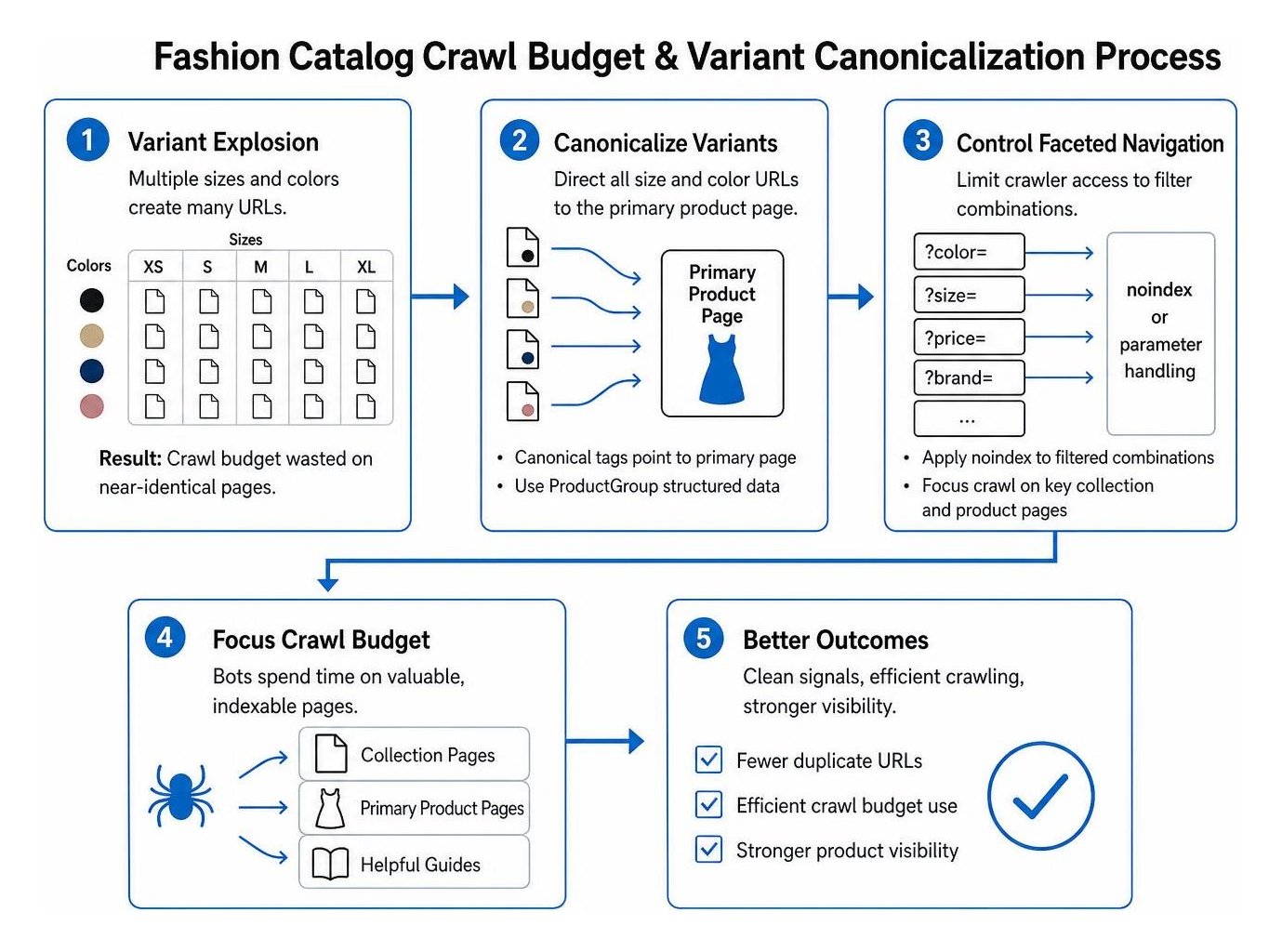
In fashion ecommerce platforms like Shopify and WooCommerce, a single dress available in five sizes and four colors can easily spawn twenty separate URLs. Without proper management, search engine bots waste time crawling thousands of near-identical pages.
Key technical fixes include:
- Variant Canonicalization: Directing color and size parameters back to the primary product page using clean canonical tags and
ProductGroupstructured data. - Faceted Navigation Control: Applying
noindexrules or URL parameter controls to filter combinations (such as price, brand, and size) so search crawlers focus on top-level collection pages. - Seasonal URL Preservation: Reusing evergreen URLs (such as
/collections/summer-dresses) across seasons rather than creating brand-new URLs every year, preventing the typical 40% to 70% loss of accumulated page authority. - Mobile Speed and Core Web Vitals: Compressing high-resolution lookbook images and streamlining JavaScript rendering to ensure mobile pages load in under two seconds.
- Product Feed Health: Mapping complete Global Trade Item Numbers (GTINs), fabric materials, and color attributes to avoid merchant feed disapprovals.
What makes content marketing and category optimization essential in SEO services for fashion company brands?
Category optimization captures broad, commercial-intent searches, while strategic content builds trust, lowers product return rates, and guides shoppers toward purchasing decisions.
Search queries in the apparel industry are rarely limited to simple brand names. Buyers search using style aesthetics, fit preferences, and specific occasions—such as "breathable linen wedding guest dress" or "high-waisted wide-leg trousers."
Optimizing collection pages requires more than just listing product grids. Adding concise, informative copy detailing fabric blends, styling recommendations, and size charts directly addresses customer intent. Pairing these collections with specialized SEO content creation—including interactive lookbooks, seasonal trend reports, and fit guides—creates a natural internal linking structure that channels search authority straight to key product pages. Brands that invest in these foundations position themselves among the stores getting the most value from SEO services for a fashion company, since well-structured content and clean catalogs reinforce each other.
How does AI search optimization (AEO) improve brand visibility in ChatGPT and Google AI Overviews?
AI Search Optimization ensures large language models (LLMs) and answer engines can accurately read, extract, and recommend your apparel products in conversational search queries.
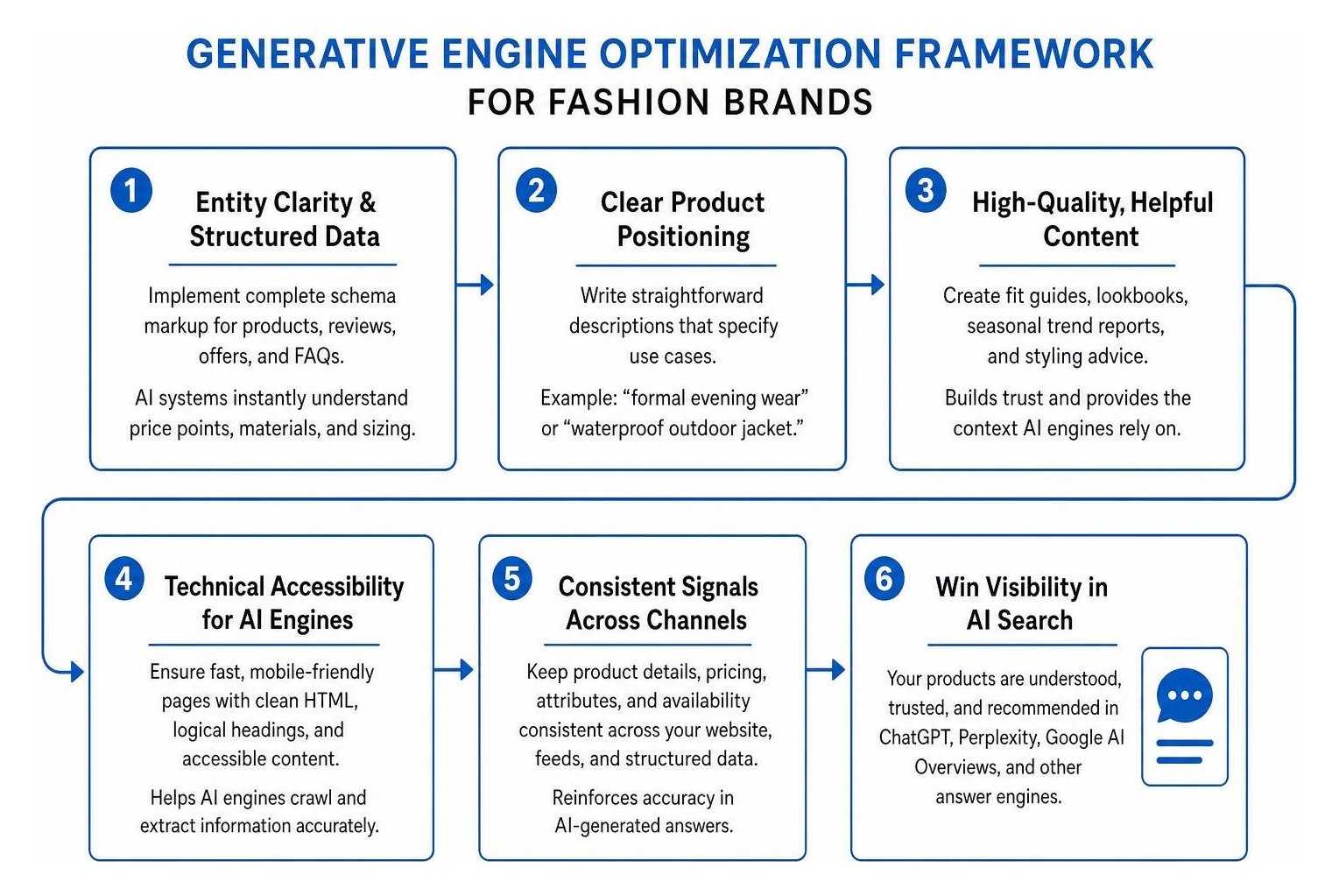
Shoppers frequently turn to tools like ChatGPT, Perplexity, and Google AI Overviews for personalized outfit advice, style comparisons, and budget-friendly wardrobe recommendations. To appear in these conversational results, fashion stores must adopt Generative Engine Optimization (GEO) practices, as detailed in our generative AI search optimization guide.
Winning recommendations in AI search requires:
- Entity Clarity and Structured Data: Implementing complete schema markup for products, reviews, offers, and FAQs so AI systems instantly grasp your price points, materials, and sizing.
- Clear Product Positioning: Writing straightforward descriptions that clearly specify use cases, such as "formal evening wear" or "waterproof outdoor jacket."
- Third-Party Citations: Building genuine mentions and brand features across reputable style publications and independent review sites, which AI models use to verify brand credibility.
Evaluating Agency Performance, Costs, and AI Search Readiness
Choosing the right partner means finding a team that evaluates performance through real ecommerce revenue and transaction data rather than superficial keyword rankings alone.
At SmallBizSEO, we implement our data-driven Velocity framework to combine technical catalog maintenance with E-E-A-T-compliant content growth. Before committing to a long-term contract, we recommend brands schedule a comprehensive fashion SEO visibility audit to evaluate their site architecture, indexation health, and backlink profile.
What are the standard pricing models and ROI timelines for fashion ecommerce SEO?
Fashion SEO pricing generally ranges from entry-level foundational retainers for small boutiques to custom programs for multi-brand apparel catalogs.
| Service Tier | Typical Monthly Investment | Best Suited For | Expected Deliverables |
|---|---|---|---|
| Foundation | $1,500 – $3,000 | Boutique brands (<500 SKUs) | Core technical fixes, metadata templates, key collection optimization |
| Growth | $3,000 – $6,000 | Scaling DTC brands (500–5,000 SKUs) | Faceted navigation cleanup, ongoing content production, digital PR |
| Scale / Enterprise | $7,000 – $10,000+ | Large apparel retailers (5,000+ SKUs) | Advanced programmatic schema, AI citation tracking, international SEO |
Finding budget-friendly SEO service options allows smaller apparel stores to fix technical hurdles without overextending their marketing budgets.
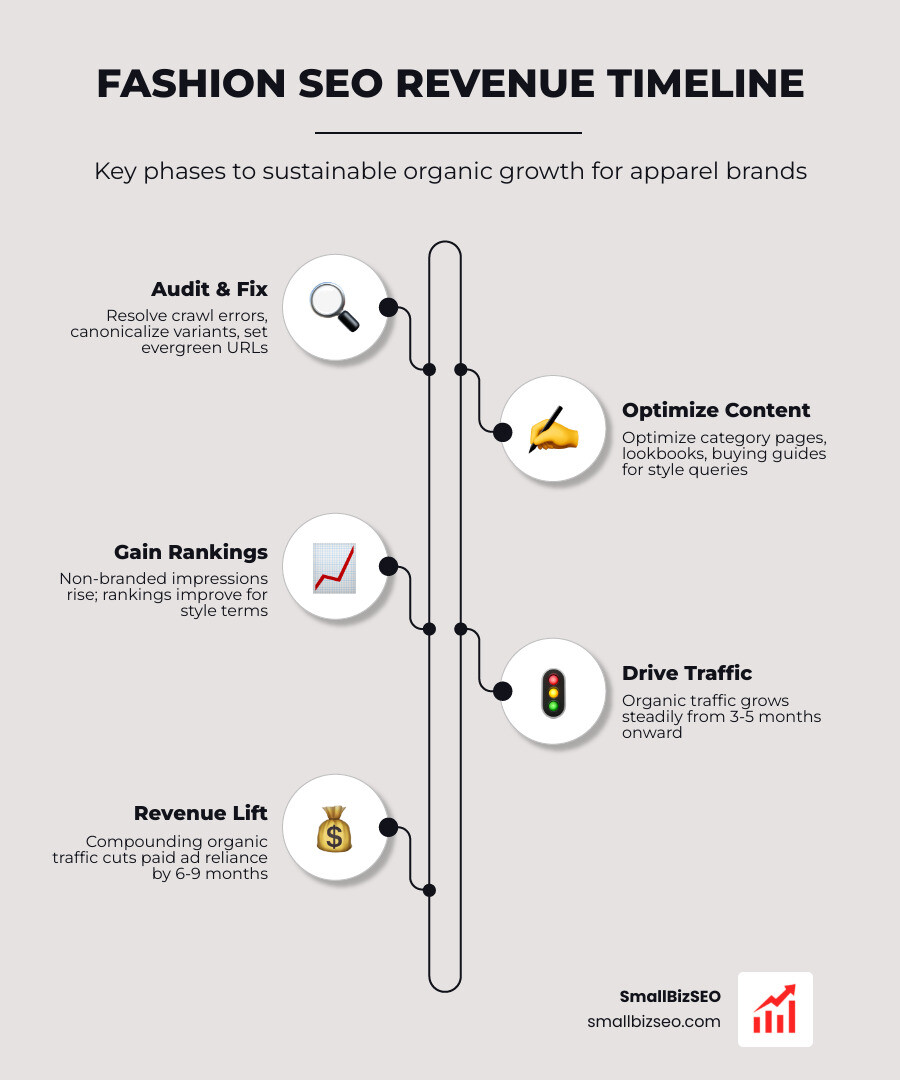
A realistic SEO timeline unfolds in distinct phases:
- Months 1 to 2: Audit completion, resolving crawl errors, variant canonicalization, and setting up evergreen URL architecture.
- Months 3 to 5: Growth in non-branded impressions and improved rankings for style- and category-specific terms.
- Months 6 to 9 and beyond: Compounding organic traffic gains that drive sustainable revenue growth and decrease overall reliance on paid ads.
How should apparel brands evaluate agency track records and avoid red flags?
Apparel brands must vet prospective agencies on their direct experience with fashion-specific platforms, catalog scale, and commercial transparency.
When evaluating agencies, look for experienced teams that understand platform architecture and fashion buyer journeys.
Key questions to ask during your vetting process:
- How do you handle color and size variations on our platform? Ensure they have direct experience handling parameter indexing and
ProductGroupstructured data. - Can you share revenue-focused case studies from fashion stores with similar catalog sizes? Look for verified improvements in organic transactions, not just blog impressions.
- What is your approach to seasonal collection changes? The agency should focus on maintaining evergreen category URLs rather than constantly creating temporary pages.
- Do you track visibility across AI answer engines? They should monitor how your brand appears in conversational AI tools alongside traditional search engine result pages.
- What are your contract terms? Avoid agencies requiring rigid multi-year agreements without clear sprint deliverables or transparent monthly progress reports.
Taking the Next Step in Your Fashion Brand’s Search Growth
Succeeding in fashion ecommerce search requires a balance between creative brand expression and rigorous technical catalog architecture. By fixing variant duplication, keeping collection URLs active across seasons, creating helpful styling content, and optimizing for AI answer engines, your apparel brand can turn regular search demand into predictable, organic sales.
If you are ready to expand your online store's visibility, review your current site architecture, address existing technical hurdles, and build a search strategy that supports your brand every season.