B2B SEO Playbook for Companies Tired of Irrelevant Clicks

How Can SEO for B2B Bring in Better Leads?
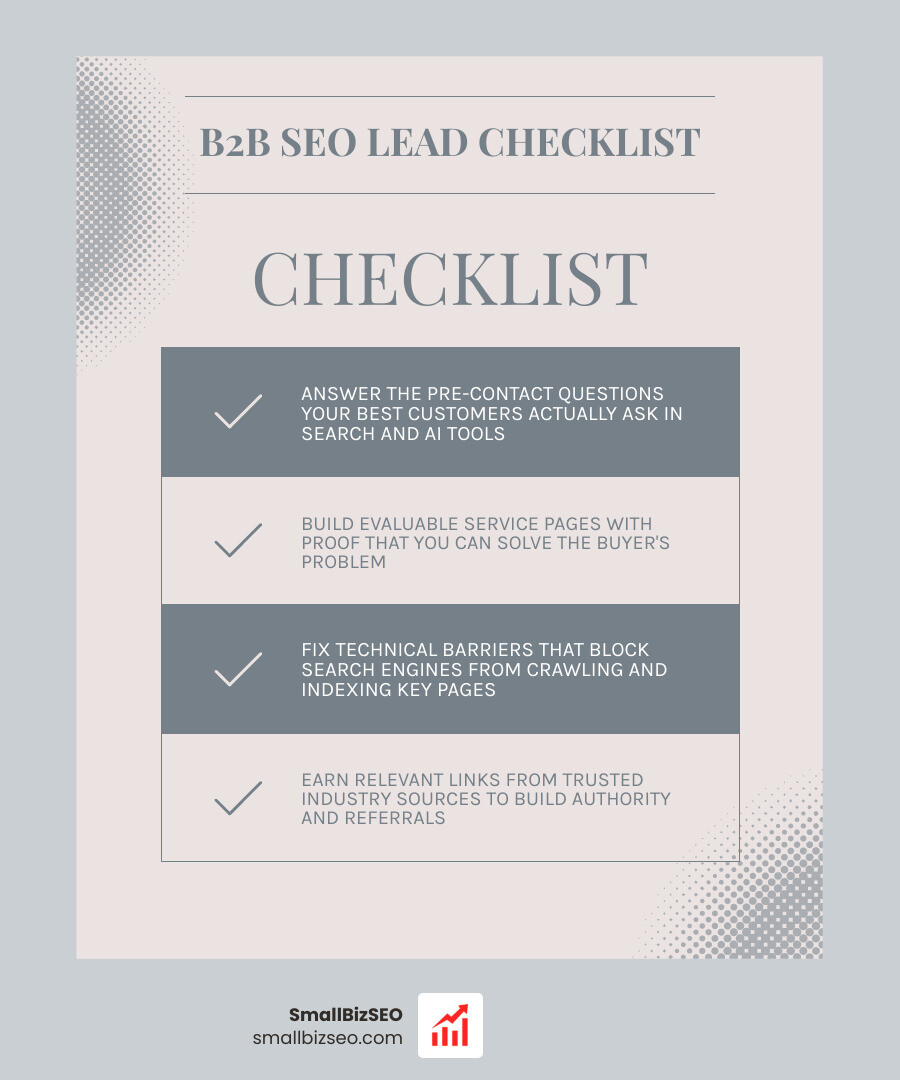
Start with the questions your best customers ask before they contact a vendor. Build pages that answer those questions, make your services easy to evaluate, and show proof that you can solve the problem. Fix pages search engines cannot access, then earn relevant links from trusted industry sources.
A busy page is not always a useful page. In B2B, a few visits from the right buyers can matter more than thousands of clicks from people who will never need your service. This playbook shows how to focus your SEO work on qualified leads, not traffic alone.
I'm Clayton Johnson, founder of SmallBizSEO. My work in SEO for B2B connects technical SEO, content strategy, and link building with the questions buyers ask in search and AI-generated answers.
Introduction to the Modern B2B Search Landscape

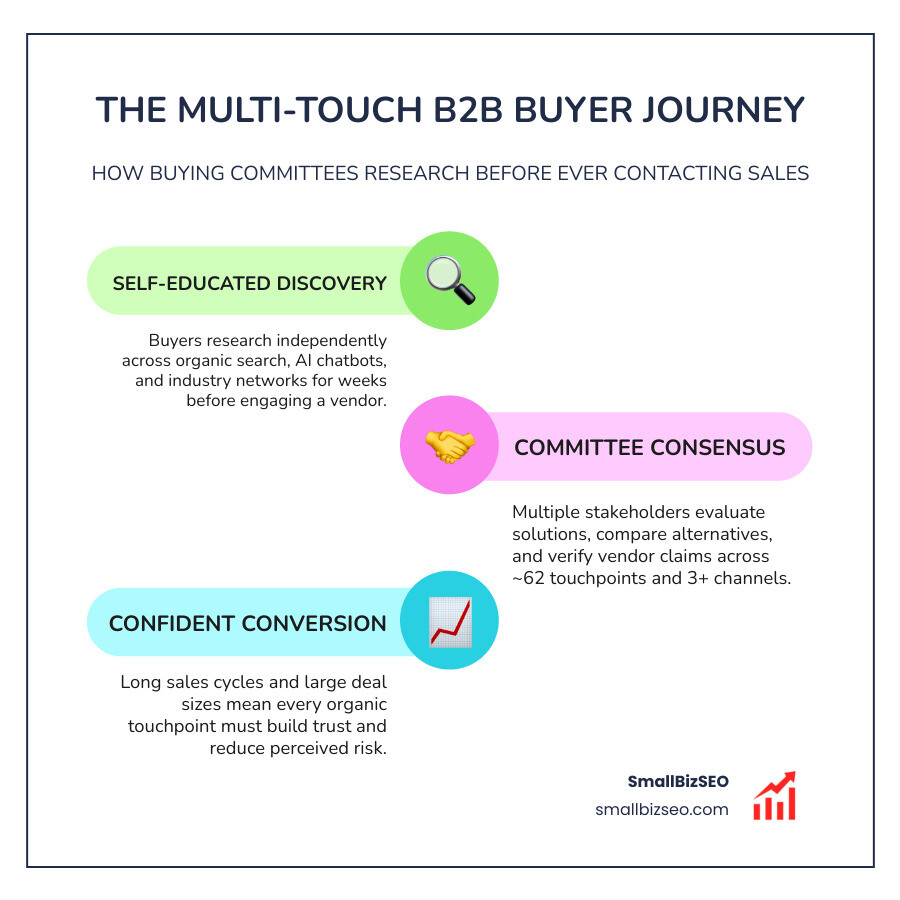
Modern business buyers no longer jump straight from a Google search bar to a contact form. Instead, buying committees spend weeks self-educating across organic search, generative AI tools, and niche industry networks before they ever speak with a sales representative.
If your organic strategy focuses only on broad vanity keywords, you end up with high visitor counts, zero pipeline revenue, and frustrated sales teams. Industry data reveals that the average B2B deal requires 62 touchpoints across three channels before closing. Because sales cycles are long and deal sizes are substantial, every touchpoint must build confidence.
What Is SEO for B2B and How Does It Differ From B2C Search?
SEO for B2B is the practice of optimizing your digital presence to attract, educate, and convert business decision-makers rather than individual retail consumers. While search engine algorithms use similar ranking signals across both models, the underlying search behavior, commercial intent, and conversion paths are completely different.
| Strategy Dimension | B2C SEO | B2B SEO |
|---|---|---|
| Target Audience | Individual end-consumers | Buying committees (5 to 10 stakeholders) |
| Search Volume | High to very high volume | Low to moderate volume, highly specific |
| Sales Velocity | Minutes to days (impulse-driven) | Months to over a year (consensus-driven) |
| Primary Intent | Immediate purchase or quick comparison | Problem evaluation, technical validation, ROI |
| Primary Conversion Goal | Direct online sale or cart checkout | Qualified leads, RFP requests, scheduled demos |
| Deal Value | Low to moderate | High to enterprise-scale contract values |
In consumer search, a buyer might look for running shoes and make a purchase in five minutes. In contrast, B2B procurement involves department heads, finance leads, and IT security teams evaluating risk. You can study a complete B2B SEO strategy to see how targeting high-intent decision queries differs from chasing consumer trends. If your operations depend on high-volume supply relationships, using a wholesale search engine strategy ensures you capture institutional buyers searching for verified partners rather than retail shoppers.
How Have AI Chatbots and Generative Answers Changed Buyer Research Habits?
AI chatbots and AI Overviews have shifted business research into a zero-click discovery environment where buyers form shortlists before visiting a vendor website. Research shows that 94 percent of business buyers used AI in their buying process, and 71 percent of B2B software buyers rely directly on AI chatbots for vendor research.
This trend creates three major shifts in search behavior:
- Shortlists Form Earlier: About 54 percent of software buyers state that AI chatbots influenced which vendors made their shortlist, and 95 percent end up purchasing from a vendor on their day-one list.
- Alternative Discovery: Chatbot findings led 69 percent of buyers to a different vendor than they originally planned to evaluate, and 33 percent bought from a company they had never heard of before.
- Verification Loops: While generative engines deliver quick answers, 64 percent of buyers report encountering AI inaccuracies monthly, leading 63 percent of AI searchers back to standard Google Search to verify claims.
With top-ranking page click-through rates dropping by 58 percent when an AI Overview is present, businesses must adapt through Generative Engine Optimization (GEO). By structuring content as direct answers backed by verifiable data, your brand becomes the cited authority that AI models recommend. You can explore a B2B content strategy for long sales cycles to see how deep technical answers keep you visible across both conversational tools and search engines.
The Actionable Playbook: Executing SEO for B2B to Drive Revenue

To transform organic search into a reliable revenue engine, you need a structured framework that targets intent over raw traffic. We developed our proprietary data-driven "Velocity" framework at SmallBizSEO to help businesses build strong technical foundations, target high-intent decision-makers, and secure E-E-A-T-compliant growth without unnecessary complexity.
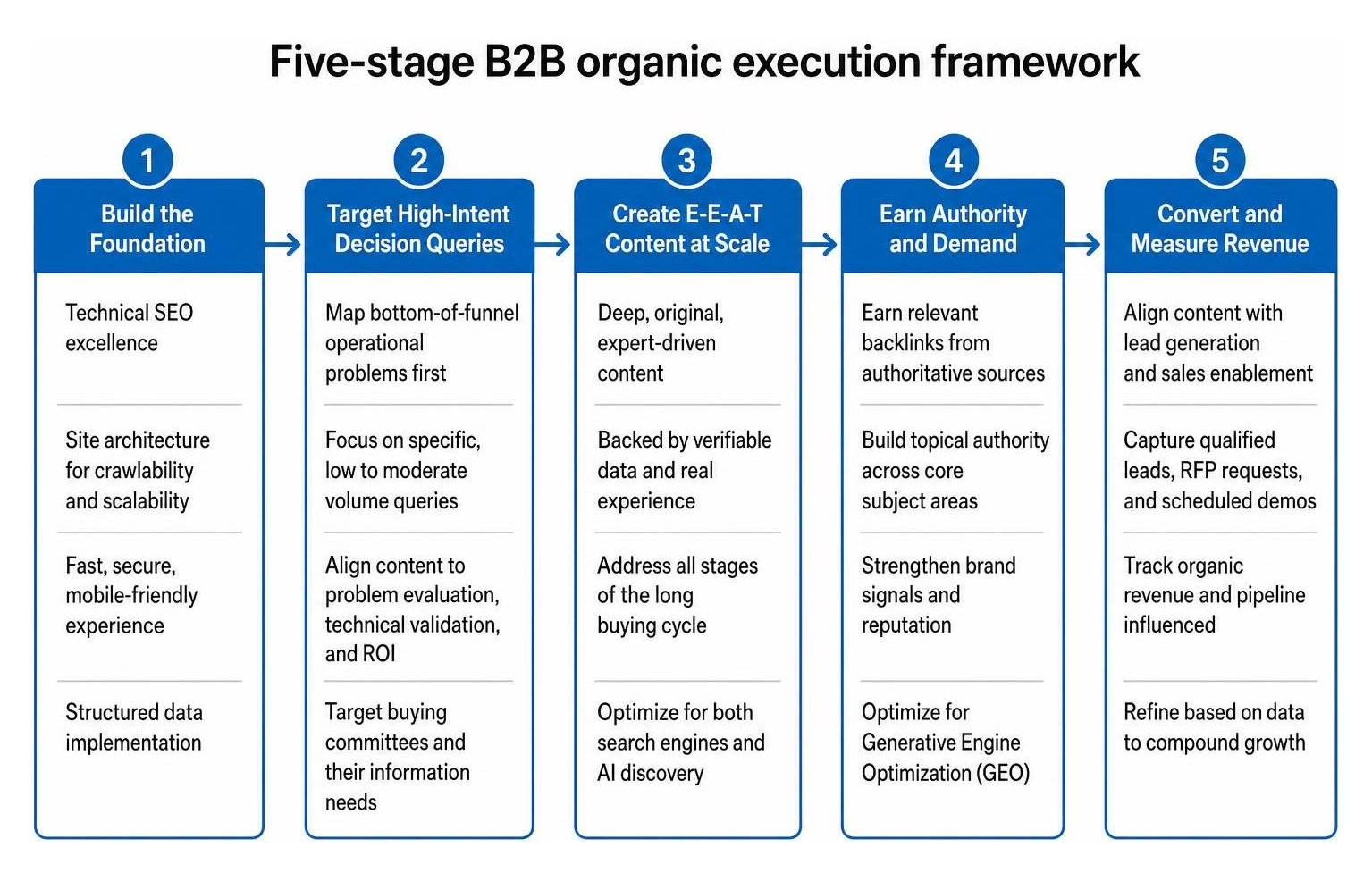
Implementing a high-converting B2B SEO strategy requires aligning your technical structure, content production, and sales enablement into an integrated motion.
How to Structure High-Converting Keyword Strategy and Content in SEO for B2B
Structure your keyword strategy by mapping bottom-of-funnel operational problems first, then organizing your content into clear pillar-and-cluster hubs. A keyword with only 20 searches per month can generate millions in closed-won revenue if those searches come from corporate buyers with an urgent business need.
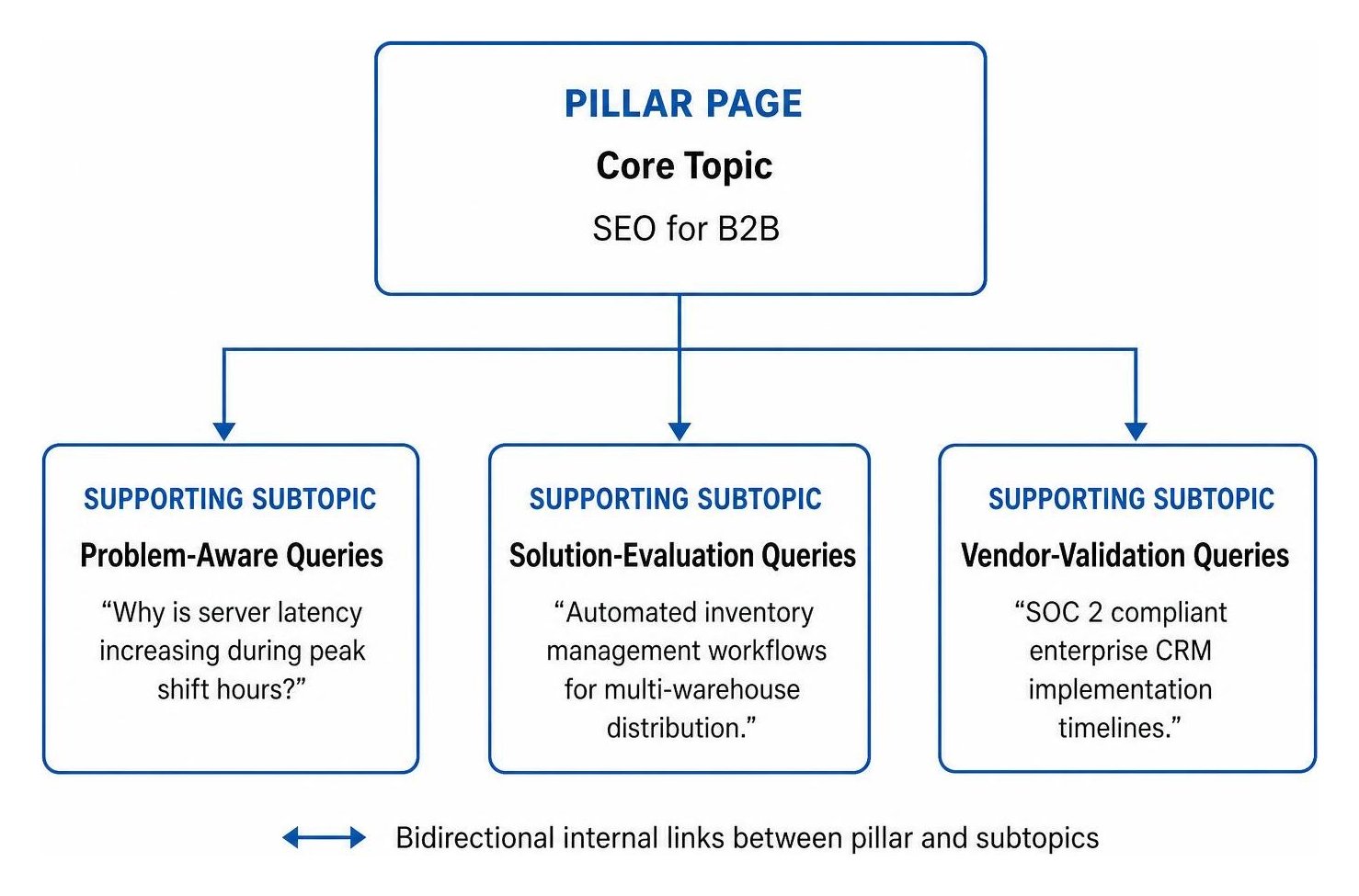
When mapping keywords, organize them by the real questions asked across the buying journey:
- Problem-Aware Queries: "Why is server latency increasing during peak shift hours?"
- Solution-Evaluation Queries: "Automated inventory management workflows for multi-warehouse distribution."
- Vendor-Validation Queries: "SOC 2 compliant enterprise CRM implementation timelines."
To establish authority, build comprehensive pillar pages that solve core challenges, then publish supporting cluster articles that link back to the central hub. For international operations, research localized terminology rather than using machine translation, as regional procurement teams use distinct professional jargon. Establishing topical authority in your niche signals to search engines and AI models that your company possesses genuine subject-matter expertise.
How to Optimize Bottom-of-Funnel Solution, Comparison, and Pricing Pages
Optimize bottom-of-the-funnel (BOFU) pages by providing transparent pricing frameworks, side-by-side feature comparisons, and concrete proof assets. While top-of-funnel blog posts often convert below 1 percent, well-crafted BOFU pages routinely achieve 5 to 15 percent conversion rates because the visitor is already preparing to buy.

To maximize conversions on commercial landing pages, include these essential elements:
- Direct Competitor Comparisons: Build objective "[Your Brand] vs. [Competitor]" tables highlighting specific use cases, integration strengths, and service limits.
- Alternative Solution Hubs: Create dedicated pages targeting "[Competitor] alternatives" designed for dissatisfied customers looking for better reliability or support.
- Transparent Pricing Architecture: Even if enterprise pricing requires custom scoping, outline starting tiers, variables that influence cost, and return-on-investment calculators.
- Embedded Trust Signals: Place client logos, industry compliance badges, customer testimonials, and short case study excerpts directly adjacent to your lead capture forms.
How to Build Authority, Specialized Backlinks, and Social Search Visibility
Build authority by distributing proprietary research, creating practical industry tools, and maintaining active discovery channels across professional networks. Standard outreach templates rarely work in specialized industries; enterprise decision-makers respond to verifiable data and recognized expertise.

Use these three proven channels to build lasting organic visibility:
- Digital PR and Data Assets: Publish original industry surveys and benchmark reports. When you provide unique statistics, trade publications and industry blogs will naturally cite your pages as primary sources.
- Interactive Tools: Develop free web-based calculators, assessment tools, or workflow templates. High-utility assets earn high-quality editorial links over time with minimal ongoing promotion.
- Social Search Integration: Decision-makers increasingly search LinkedIn for peer recommendations, YouTube for technical product walkthroughs, and Reddit for unbiased software feedback. Repurpose your core SEO content across these platforms to capture demand across every touchpoint.
Measuring Pipeline Success and Selecting an Implementation Model
Measure your organic search program using closed-loop pipeline metrics and CRM revenue attribution rather than relying on keyword rank trackers. Tracking organic traffic in isolation hides the true return on investment of your marketing spend.
Connect your analytics platform directly with your CRM to track these primary performance indicators:
- Marketing Qualified Leads (MQLs) and Sales Qualified Leads (SQLs) sourced directly from organic landing pages.
- Pipeline Velocity and Deal Size of accounts that engaged with organic comparison and solution assets during their sales cycle.
- AI Citation Visibility across conversational engines to ensure your brand appears on day-one buyer shortlists.
- Closed-Won Revenue Contribution attributed via multi-touch tracking models across the entire buyer journey.
In-House Team vs. Agency: How to Choose the Right B2B Partner
Building an internal team gives you direct company immersion, but assembling in-house technical specialists, content strategists, data analysts, and link builders requires significant payroll and time. Working with a dedicated agency provides immediate access to seasoned experts, specialized tooling, and established execution frameworks.
When evaluating potential growth partners, look for teams that prioritize pipeline impact over surface-level metrics. You can evaluate top lead-focused B2B SEO agencies to see how modern service providers align organic strategy with pipeline generation. For a complete evaluation framework, review our guide to B2B SEO companies to identify the capabilities needed for sustainable growth.
Ready to Turn Organic Search Into Closed Pipeline?
If your business is ready to stop chasing irrelevant clicks and start capturing high-value accounts, our team is here to help. SmallBizSEO delivers full-service technical SEO, content strategy, and high-authority link building built around our data-driven "Velocity" framework.
Explore our dedicated SmallBizSEO B2B SEO services to learn how we help growing businesses dominate competitive search landscapes, secure AI citations, and build predictable inbound sales pipelines.