Blog Post vs. Service Page: How to Choose the Right Page Type

Should This Keyword Target a Blog Post or a Service Page?
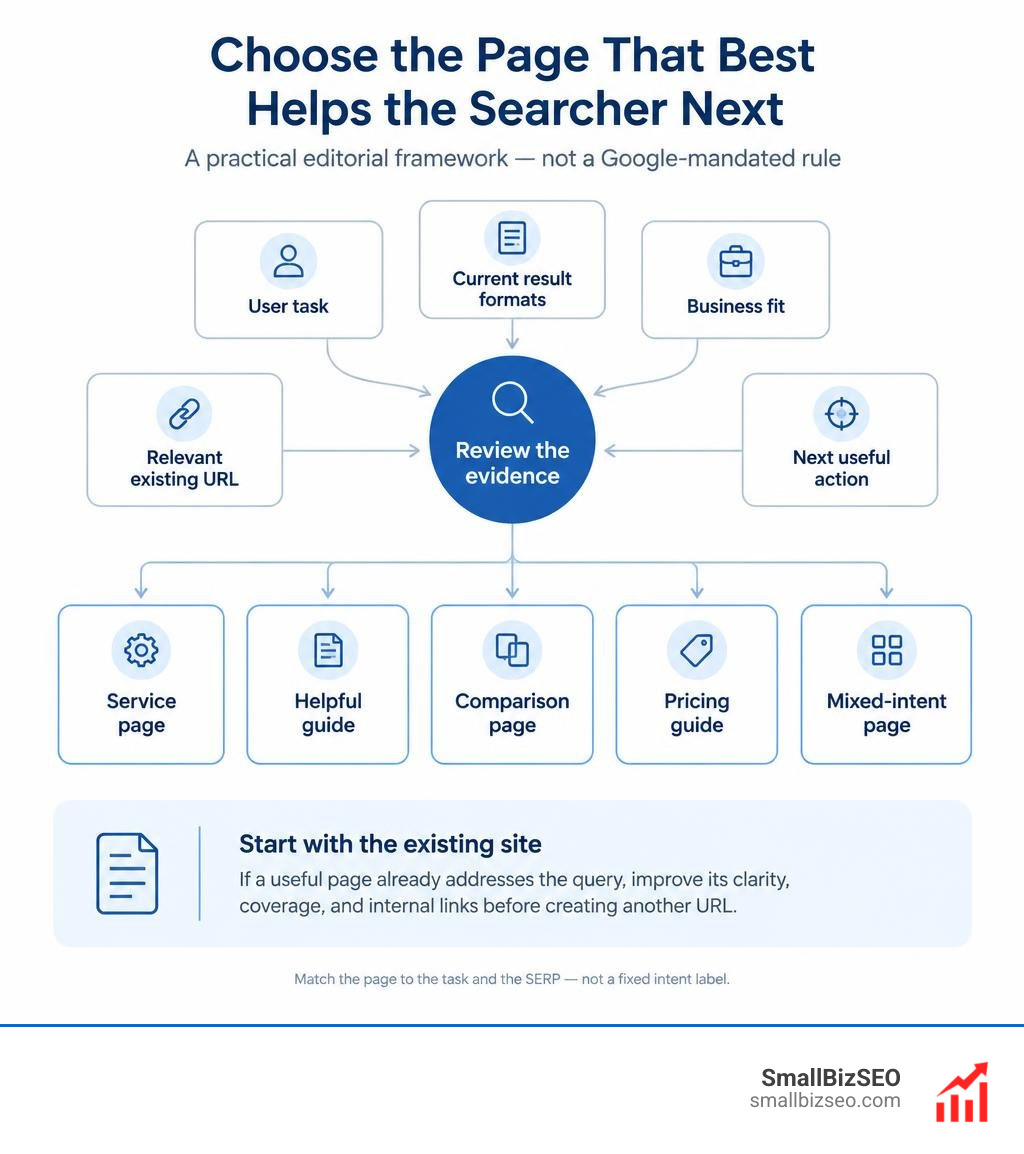
Choose the page type that best helps the searcher take their next useful step. Review the task behind the query, the formats already ranking, the offer you can genuinely support, any relevant page already on your site, and the action you want the visitor to take. A service page, blog post, comparison, pricing guide, or mixed page can each be the right answer.
This is a practical editorial framework, not a Google-mandated rule. Google's guidance on creating helpful, reliable, people-first content and crawlable links supports clear answers, useful detail, and descriptive links.
Start with the existing site before creating something new. If a useful page already addresses the query, improve its clarity, coverage, and internal links before splitting the topic across another URL.
How to Choose Between a Blog Post and a Service Page for a Keyword
Do not assign a keyword to a page type from a modifier alone. Instead, match the page to the searcher's likely task and the evidence in the results page. A comparison can be commercially useful while still working best as an editorial article, and a service page can answer common questions when those answers help a prospective customer evaluate the service.
Google's guidance emphasizes people-first, useful content and crawlable, descriptive links. Use search intent and keyword mapping as planning tools, then validate the decision against the real query and the page you can make genuinely useful.
| Decision question | Evidence to review | Likely page type | Example | Next action |
|---|---|---|---|---|
| What is the searcher trying to accomplish? | The query wording, related questions, and the stage of the decision | Service page, article, or comparison | "Emergency plumbing repair" usually needs immediate service details | Make contacting the business easy when the results support urgent hiring intent |
| Which formats satisfy the query now? | Result types, headings, rich features, and the problems each page solves | Match the dominant useful format without copying it blindly | "How to prevent frozen pipes" often calls for a practical guide | Cover the task clearly and link to relevant help when appropriate |
| Is the intent mixed? | Results that include both editorial and commercial pages | Pricing guide, comparison, FAQ-led service page, or hybrid page | "Plumbing repair cost" may require pricing context, service scope, or both | Give users the information they need before asking them to contact you |
| Do you already have a relevant page? | Existing URL, content quality, search-query overlap, conversions, and internal links | Update the existing page before creating another | A service page already answers the core hiring question | Improve the page or add a supporting article only when it adds distinct value |
Analyzing Intent: How to Choose Between a Blog Post and a Service Page for a Keyword
Begin by naming the task in plain language. Is the person trying to get help now, understand a problem, compare options, estimate cost, or decide whether a solution fits? A buyer intent keyword can be a useful signal, but it does not decide the format by itself. The answer can change by industry, query wording, and the information available in the search results.
- Direct service need: A query such as "emergency plumbing repair" often calls for a service page with availability, service scope, trust information, and a clear way to get help.
- Problem-prevention question: A query such as "how to prevent frozen pipes" often suits a guide that answers the question safely and links to relevant professional help where appropriate.
- Decision-stage question: A query such as "plumbing repair cost" may call for a pricing guide, a detailed service-scope page, or a combination, depending on the results and what your business can support accurately.
SERP Analysis: What the Results Reveal About the Needed Page
Review the live top organic listings in the location and on the device that matter to your audience. Record the page formats, repeated subtopics, and the tasks each ranking result helps users complete. Incognito mode can reduce some personalization, but it does not create a universal or fully unpersonalized view of the results.
Look for patterns rather than applying a fixed result-count rule. If the results repeatedly provide cost explanations, comparisons, troubleshooting steps, local availability, or service details, those patterns show the questions your page needs to address. The goal is not to imitate every ranking page. It is to create a page that is accurate, useful, and aligned with a real business outcome.
When Should You Build a Hybrid Page for Mixed-Intent Queries?
A mixed-intent query can deserve a page that answers the research question and supports a commercial decision. The right structure depends on what the results show and what the visitor needs next. For example, a repair-cost page can explain the factors that affect pricing, clarify service scope, and offer a next step for someone who wants a quote.
Before building a new mixed-intent page, check whether an existing service page, article, or local landing page can be expanded without creating overlap. Add only the information that helps users make progress, rather than adding copy merely to avoid a thin content label, and keep the primary purpose of each URL clear.
Preventing Cannibalization and Optimizing Internal Content Architecture
Multiple pages can appear for the same query without creating a problem. Review the query sets, page purpose, conversions, internal links, and unique value before deciding that two URLs compete. A service page and a supporting article can work together when each answers a distinct need and gives users a sensible next step.
Potential keyword cannibalization deserves investigation, not an automatic penalty diagnosis. Compare what each URL covers, which queries bring visitors to each page, and whether users can move naturally from research content to a relevant service or decision page. A topic cluster can help clarify page roles, but preserve useful URLs when they serve distinct audiences or tasks.
What Should You Check When a Blog Ranks for a Service Term?
If a blog post ranks for a service-related query, first determine why. It may be the more helpful format for that query, or the service page may need clearer scope, better supporting information, or stronger internal connections. Do not assume that the blog post is a mistake simply because it ranks.
- Review the evidence: Use a content audit to compare query groups, page purpose, conversions, and the unique value of each URL.
- Clarify page roles: Give each page a distinct job, such as answering a research question, explaining pricing factors, or describing a service and its scope.
- Use descriptive internal links: Link when it helps the reader move to the next relevant page. Google recommends links that are crawlable and use descriptive anchor text rather than a blanket exact-match policy.
- Consolidate carefully: Use a Content Refresh to improve genuinely redundant content first. Merge or redirect only when the destination can preserve the useful information, and plan redirects and internal-link updates before making the change.
How Should You Choose Supporting Content for a Service Page?
There is no fixed number of supporting blog posts that every service page needs. Choose topics from real unanswered questions, sales conversations, Search Console data, customer research, and the capacity you have to maintain the content.
Build supporting content only when it adds a distinct answer, example, comparison, or decision aid. Use each content brief to define the searcher's task and the page's unique value. Maintain the system over time through thoughtful content creation, content refreshes, relevant internal links, and earned outreach that brings attention to genuinely useful resources.
Building a Unified Content Strategy for Sustainable Growth
The best page type is the one that gives the searcher the clearest useful next step while fitting your business and existing content. Use the results page as evidence, improve strong URLs before duplicating them, and create new pages only when they add a distinct purpose.
SmallBizSEO helps businesses plan and improve content systems with SEO content services that connect useful pages, practical internal linking, and ongoing maintenance. For help evaluating a specific keyword or content overlap, book an SEO consultation.