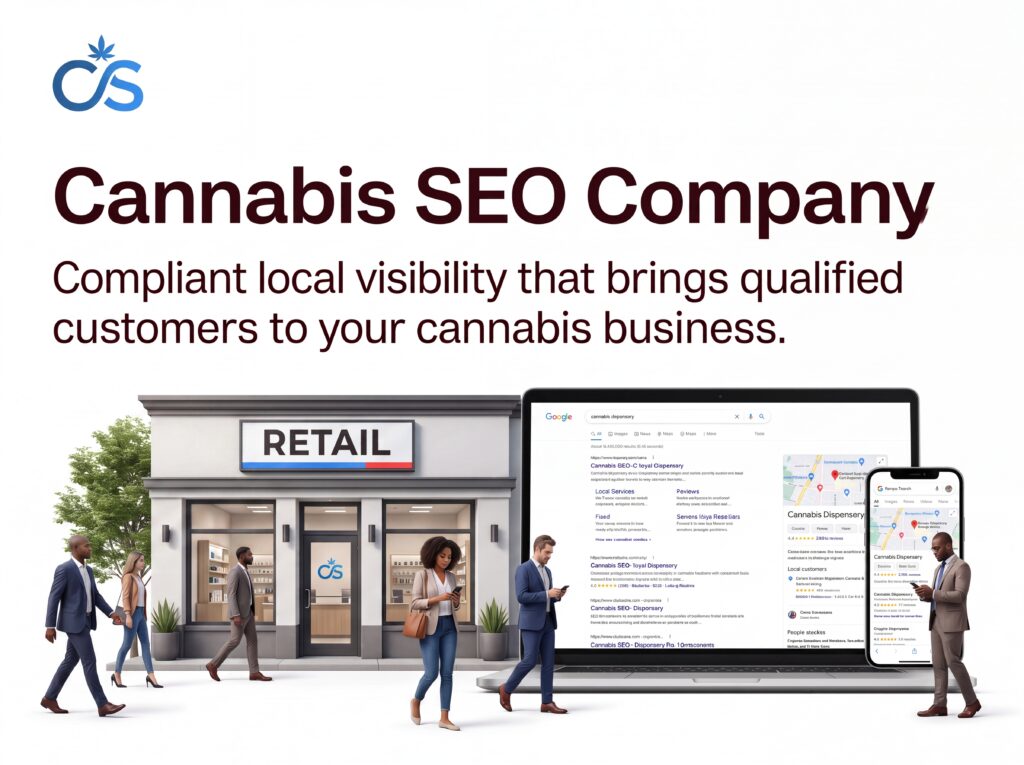
Make public business information and catalog structure clearer while preserving the business’s required access arrangements.
A cannabis brand, a dispensary and another authorized industry business have different websites and discovery needs. Even a retail site may divide its information between location pages and an embedded menu. We begin with that real structure, clarifying what the business publishes and how it is maintained rather than treating every industry keyword as a reason to create a new page.
Search intent & content
Separate business discovery from catalog organization
Connect accurate public location information with the cannabis business’s actual brand, retail or supplier role. We organize catalog navigation and approved range descriptions around that structure, keeping the website’s established access arrangements part of the customer journey.
Location and business discovery
Give actual locations accurate names, addresses and operating information, distinguishing individual sites from the parent brand and keeping public details aligned with the business’s maintained listings.
Example searchcannabis business location information
Menu and catalog architecture
Review how the actual menu system presents public category and item information, identifying duplication or navigation gaps without assuming that every embedded interface is inaccessible to search engines.
Example searchcannabis catalog category information
Brand and product-range explanation
Organize factual descriptions of the business’s real range and brand relationships, using approved attributes without turning product copy into health, safety or therapeutic claims.
Example searchcannabis brand product range
Business-model clarification
Explain whether the organization operates retail locations, supplies other businesses or represents a brand, giving each audience an appropriate information route rather than mixing incompatible commercial tasks.
Example searchcannabis supplier business information
Website priorities
Build useful pages around real customer decisions
Inspect the actual menu integration
Check rendered pages, URLs and navigation in the deployed system before proposing native category pages, so technical recommendations address observed behavior rather than blanket iframe assumptions.
Keep location facts distinct
Use real differences in store details and public information rather than duplicating one location page across every market the brand mentions.
Preserve access requirements
Treat age and geographic controls as business requirements to retain, planning content and navigation around them instead of creating alternate paths that bypass restrictions.
Give claims a clear owner
Keep product descriptions and business-status information within the organization’s review process, while SEO work addresses structure, discoverability and accurate public presentation.
Our approach
A practical plan for your website
We first confirm the business model, actual locations and catalog system. The SEO plan then addresses concrete information gaps and technical behavior within the business’s existing publishing and access boundaries.
Review the foundations
Check crawlability, existing pages, customer needs, and the services your business actually offers.
Map services to demand
Connect customer questions to useful service pages and supporting content without duplicating search intent.
Build, measure, improve
Publish useful pages and refine them using search visibility and separately configured inquiry analytics.
- Accurate public business and location information.
- Product descriptions limited to approved, supportable attributes.
- Existing age and geographic access controls preserved.
- Search work distinguished from legal authorization or health-claim certification.
Frequently asked questions
Questions about your industry SEO strategy
Are embedded cannabis menus always invisible to search engines?
No blanket assumption is appropriate. The actual integration needs inspection, including rendered content, links and URLs. Recommendations should follow observed technical behavior rather than the presence of an embed alone.
Should a brand and a dispensary use the same SEO structure?
Not necessarily. A brand may need range and business information, while a location-based retailer also needs accurate local details. The structure should follow the actual organization and its authorized activities.
Can SEO changes bypass an age or location gate?
The strategy should preserve the business’s access requirements. Technical visibility work is not a reason to create unrestricted alternate routes or misrepresent content to visitors and search engines.
How do we measure whether SEO is helping?
Use Google Search Console for search visibility and page performance. Measure calls, inquiries, and lead quality separately through analytics and intake tracking where configured.
Can you guarantee rankings or new customers?
No. We focus on the work within our control: technical foundations, useful content, clear navigation, and measurement. Search outcomes depend on competition and other factors.
Build a clearer path from search to inquiry
Discuss your cannabis business model and public website structure with SmallBizSEO to identify accurate, bounded improvements in discovery and navigation.
Search rankings & AI visibility — AI SEO / AEO
- Google AI Mode
- ChatGPT
- Claude
- Gemini
- Perplexity


Related services & strategies