Tracking Permitted Uses in Content Licensing Agreements

How do you track permitted uses in a content licensing agreement?
For tracking permitted uses in a content licensing agreement, create a rights register for every asset and check it before each new use. Record what the agreement allows, who approved it, the evidence supporting that decision, and the actual places where the asset appears.
A register helps teams turn contract language into a repeatable workflow, but it is not legal clearance. The signed agreement and applicable law control. When rights, exceptions, or related permissions are unclear, pause the proposed use and obtain qualified advice.
The same asset can have different permissions for an organic webpage, a paid campaign, a newsletter, or a printed piece. A prior use does not automatically authorize a new channel, format, audience, or edit.
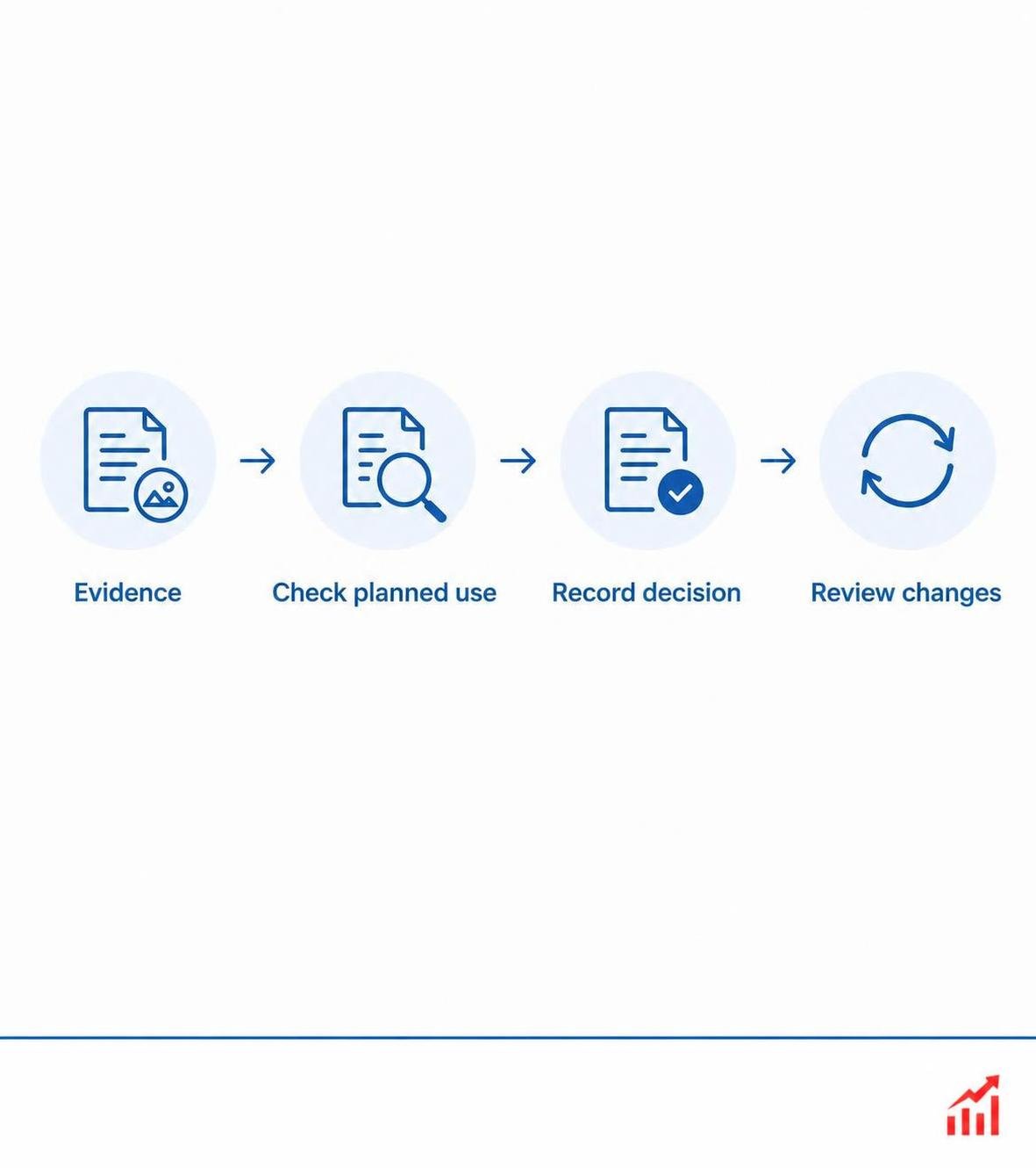
Build a rights register for each licensed asset
A rights register gives a content team one working record for each asset version. It should capture the permission actually granted by the agreement, not assumptions based on a license label. The U.S. Copyright Office explains that copyright owners control several exclusive rights and may authorize others to use them; the scope of a license matters. See the U.S. Copyright Office's licensing guidance for background.
Which fields belong in a content rights register?
Use one row or record for each asset version, then include the fields a reviewer needs to make a use decision:
| Register field | What to record |
|---|---|
| Asset and version | File name, asset ID, version, creator, and a link to the approved file. |
| Rights holder and evidence | Licensor or rights holder, the signed agreement or order record, and any approval emails or platform terms. |
| Allowed purpose and channel | The specific purpose and channel, such as an organic blog post, email, paid placement, print, or internal use. |
| Modifications and territory | Whether cropping, resizing, translation, adaptation, or other changes are allowed, plus any territorial scope. |
| Term and renewal terms | Start and end conditions, renewal options, notices, and any contract-specific review point. A perpetual grant is not necessarily unrestricted. |
| Seats, sublicensing, and attribution | Authorized users, transfer or sublicensing limits, required credit, and placement instructions when the agreement requires them. |
| Limits, approval owner, and use instances | Quantity or placement limits, the person responsible for approval, and each live or planned use of the asset. |
Missing information is not permission. If the record does not show that a use is allowed, route it for review rather than treating the absence of a restriction as approval.
How should a team decide whether a proposed use is permitted?
Compare the proposed use with the register and the underlying agreement. The examples below are hypothetical. They show how a team might classify a request, not a legal determination.
| Decision | Hypothetical example | Next step |
|---|---|---|
| Allowed | The agreement expressly permits the existing image in an organic article, the term is active, and required credit is included. | Record the use instance and publish through the normal workflow. |
| Requires approval | The image is approved for an organic article, but the team wants to use it in a paid campaign or crop it differently. | Ask the designated approval owner or rights holder before use. |
| Prohibited | The agreement expressly bars sublicensing, but a partner asks for the source file. | Decline the request and retain the decision record. |
| Unknown | The contract is silent or the signed evidence cannot be found. | Do not use the asset until the rights are clarified. |
Some agreements provide broad rights, while others narrowly define channels, formats, quantities, or audiences. The Canadian sample licensing clauses are useful illustrations of how terms can be expressed, not universal requirements.
What related rights should the register flag?
A copyright license may not resolve every permission connected to an asset. Depending on the asset and planned use, the team may also need to consider privacy, publicity, trademark, model-release, music, or other rights. For material released under CC BY 4.0, record the required attribution, license link, and change notice where that license actually applies. Do not treat a Creative Commons rule as a default for unrelated assets.
Review uses, approvals, and evidence before reuse
A reliable review process checks a planned use against the register before the asset goes live or is reused. It should also capture what changed, who decided, and where the final asset appears. That makes the record useful for routine content operations without presenting it as a legal guarantee.
How do you review an asset before publishing or reusing it?
Use a short, repeatable review:
- Confirm the asset version. Make sure the file matches the version linked in the register.
- Match the proposed use. Check purpose, channel, audience, modifications, territory, term, attribution, and stated limits against the signed evidence.
- Record the decision. Save the reviewer, decision, conditions, and location of the use instance.
- Escalate uncertainty. If the agreement, approval, or related rights are unclear, do not treat the use as cleared. Obtain qualified advice or written clarification.
- Review changes and expiry conditions. Track contract-specific notices, renewals, amendments, and revisions. Retain the evidence for the period required by the agreement or applicable obligations rather than applying a blanket deletion rule.
Teams can incorporate this review into a content planning process, a routine content audit, and a content refresh. Those workflows support organized content operations; they do not replace legal review.
What should happen when a license changes or ends?
First, read the agreement and any amendment to determine the required action. Some terms may require removal, replacement, a notice, a renewal, or a record of continued use; others may have different instructions. Update the register, identify affected use instances, assign an owner, and document the steps taken. Avoid assumptions about automatic removal, deletion, or ongoing rights.
SmallBizSEO provides SEO content services and workflow support for content operations. It does not provide legal services or legal clearance for content rights decisions.
Put the rights register into everyday content operations
A practical rights register makes it easier to see what evidence supports each content use and where an asset is being reused. Keep the agreement, approvals, asset version, and use instances together, then review them before a new channel, paid placement, edit, or renewal decision.
For help organizing the content workflow around that register, explore SmallBizSEO's SEO content services or book a conversation. For ambiguous rights or legal questions, seek qualified advice before using the asset.