Detailed Guide to Measure Digital PR Beyond Backlinks

How Do You Measure Digital PR Beyond Backlink Totals?
To measure digital PR beyond backlink totals, check what each placement achieves. Record whether it reaches the right audience and covers a topic your business wants to be known for. Then track brand mentions, referral visits, search visibility, and leads. A smaller set of relevant placements may do more for your business than a long list of links that bring no interested visitors.
I'm Clayton Johnson, founder of SmallBizSEO. My work connecting SEO, digital PR, and content has shaped how I measure digital PR beyond backlink totals: by looking at whether coverage builds trust and helps small businesses attract qualified leads.
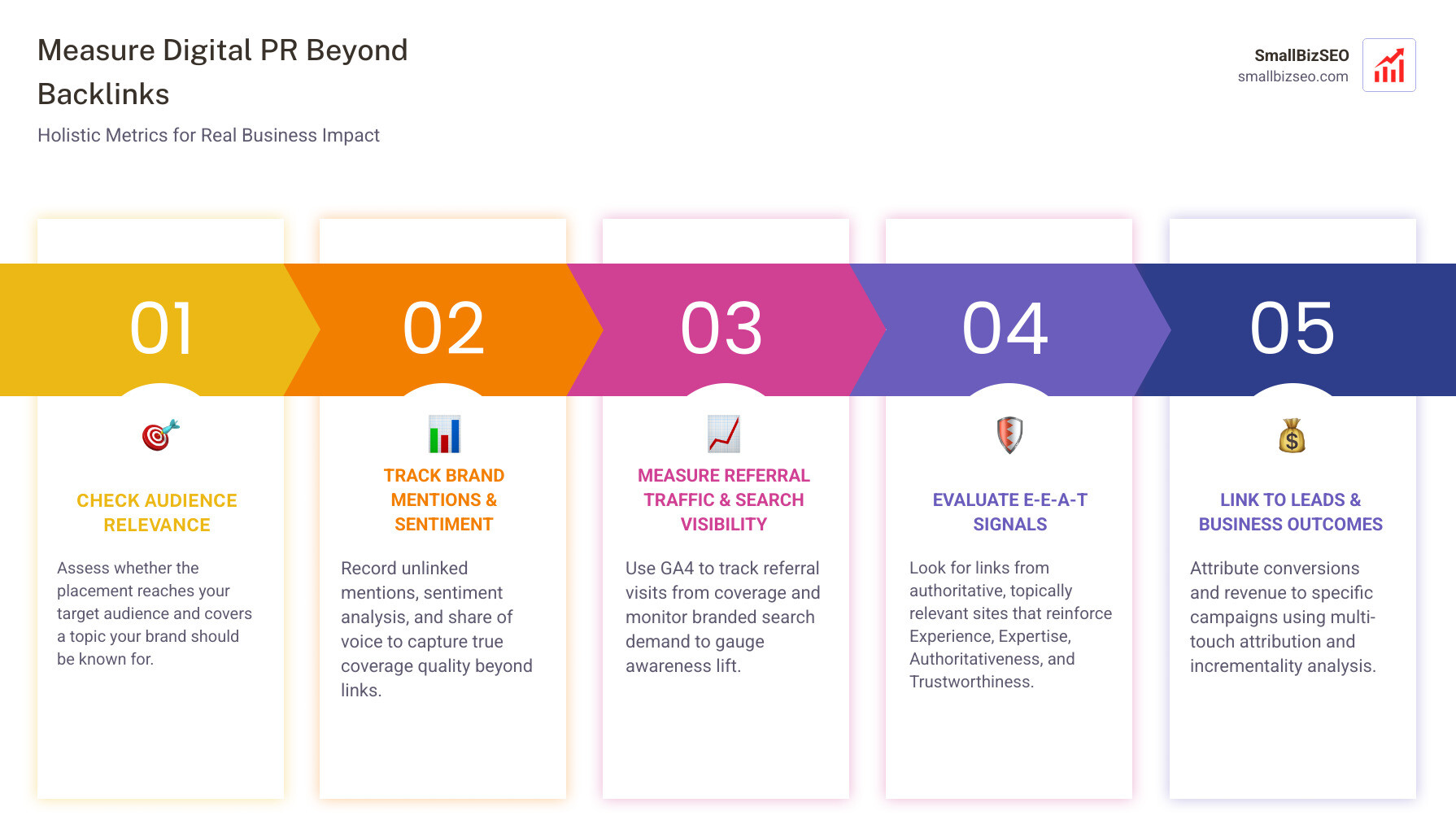
Why and How to Measure Digital PR Beyond Backlink Totals
Counting total links does not show whether a campaign helped your business grow. Raw backlink totals fail to capture audience relevance, brand positioning, or conversion value. Search engines do not treat all links equally, prioritizing contextual relevance, domain trustworthiness, and verifiable Experience, Expertise, Authoritativeness, and Trustworthiness (E-E-A-T) signals over sheer quantity.
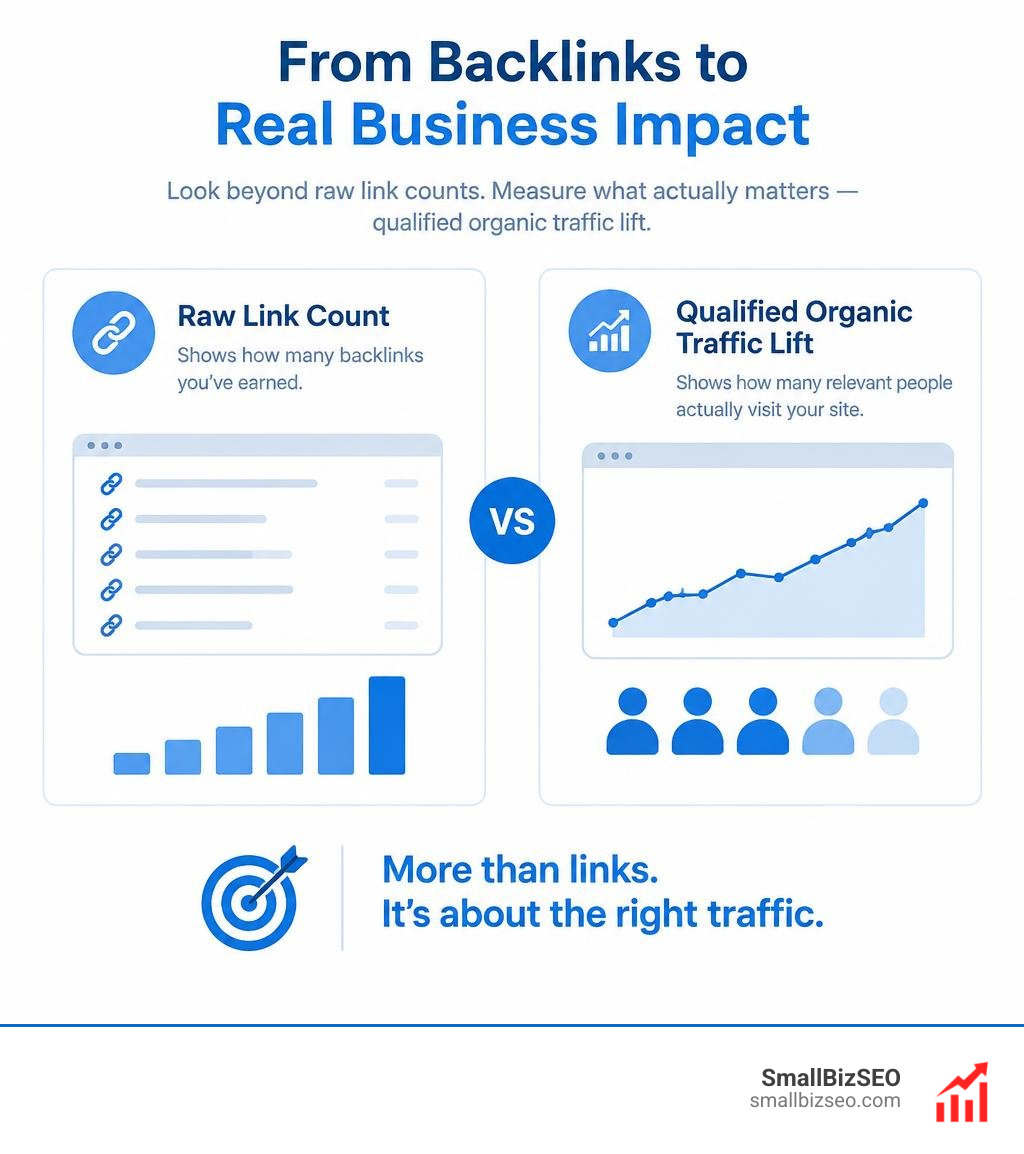
Industry studies demonstrate that only 10.5% of specialists consider total links their primary key performance indicator (KPI). Instead, the most popular metrics are overall organic traffic growth (22.5%) and ranking improvements (19%), with referral traffic and sales conversions each accounting for 13%. To evaluate real performance, practitioners use standardized frameworks like the communication measurement standards developed by AMEC alongside authoritative digital PR performance data.
What Core Metrics Explain How to Measure Digital PR Beyond Backlink Totals?
Evaluating a campaign requires looking past superficial volume to assess authority, trust, and topical alignment. While 91.3% of digital PR specialists use third-party authority metrics such as Domain Rating (DR) to judge link quality, only 13.5% factor in topical relevance.
To determine true value, assess three core dimensions:
- Authority Metrics: Evaluate domain strength using metrics like Ahrefs Domain Rating or Moz Domain Authority. Digital PR coverage achieves an average DR of 61, with over 20% of secured links landing on DR 70 to 79 publications.
- Trust Metrics: Measure link trustworthiness using indicators like Majestic Trust Flow, which calculates proximity to known, curated seed sites to filter out spam.
- Topical Relevance: Check if the placement sits within a dedicated industry category or section directly tied to your product or service offering. Securing an editorial link in a tightly focused niche vertical delivers stronger search equity than an off-topic mention on a generic news site.
| Measurement Dimension | Vanity Metrics to Avoid | High-Impact Metrics to Track |
|---|---|---|
| Link Acquisition | Total raw link count | Topical relevance score, DR 70+ ratio, followed link rate |
| Search Visibility | Overall site impressions | Target keyword movements, ranking velocity within 60–90 days |
| Audience Engagement | Potential media reach / impressions | Referral traffic volume, average engagement time, bounce rate |
| Commercial Value | Arbitrary Earned Media Value (EMV) | Direct referral revenue, assisted conversions, pipeline value |
How Do Brand Mentions, Sentiment, and Share of Voice Reveal True Coverage Quality?
Not every impactful piece of earned media contains a physical hyperlink. In fact, research shows that up to 62% of earned editorial coverage mentions a brand without adding an active link. Modern search engines evaluate an unlinked mention as an implied citation, validating entity trust and topical authority across the web.
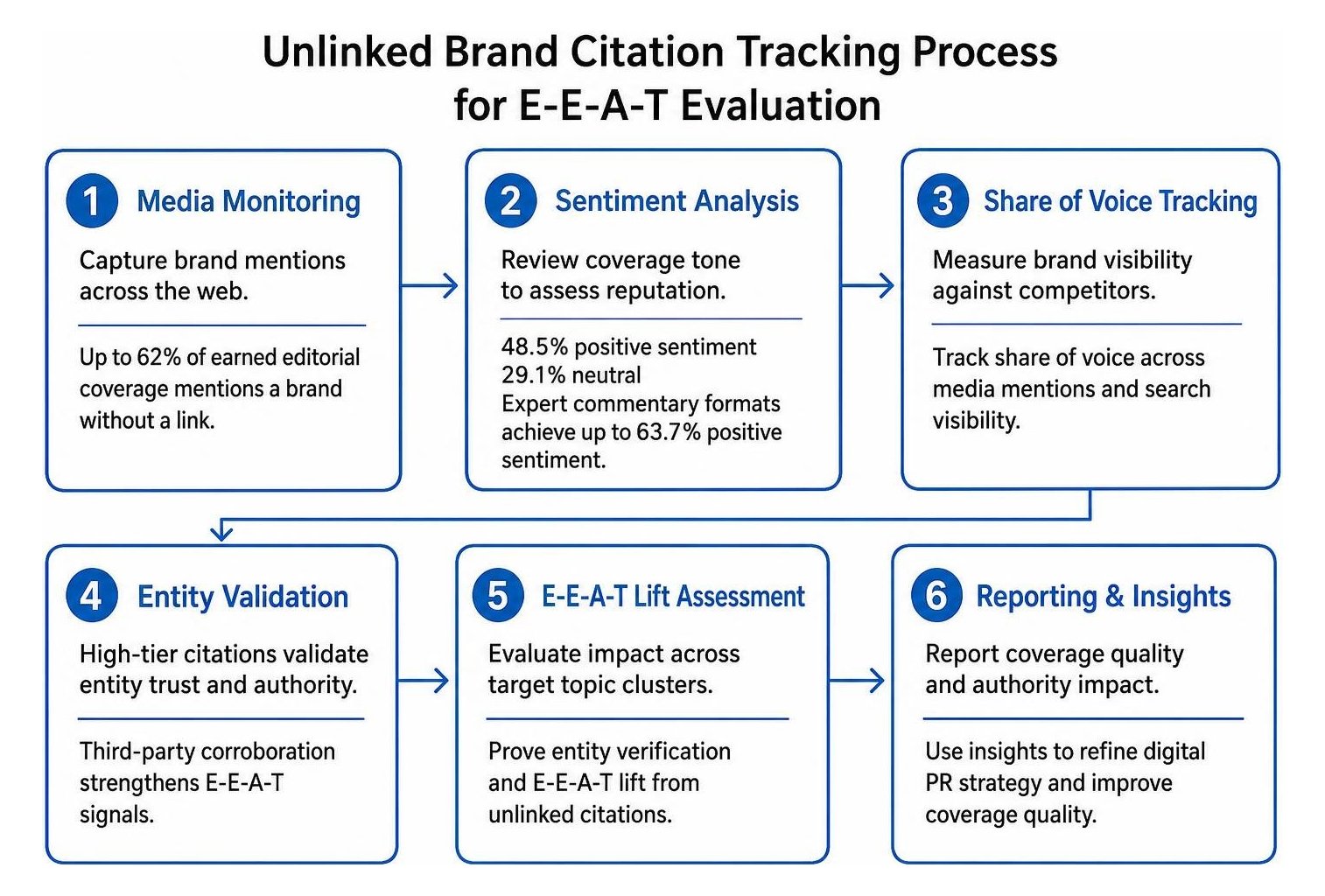
Tracking qualitative brand metrics provides a complete picture of coverage impact:
- Media Monitoring & Sentiment Analysis: Reviewing coverage tone ensures placements support brand reputation. Industry data indicates 48.5% of earned digital PR coverage carries positive sentiment, 29.1% is neutral, and expert commentary formats secure positive sentiment rates as high as 63.7%.
- Tracking Share of Voice: Measure your brand's percentage of total media mentions and search visibility relative to top market competitors.
- Entity Validation: High-tier brand citations provide search engines with third-party corroboration. Setting up an analytics framework for unlinked mentions helps prove entity verification and E-E-A-T lift across target topic clusters.
Step-by-Step Instructions: How Can You Measure Digital PR’s Impact on Revenue and Traffic?
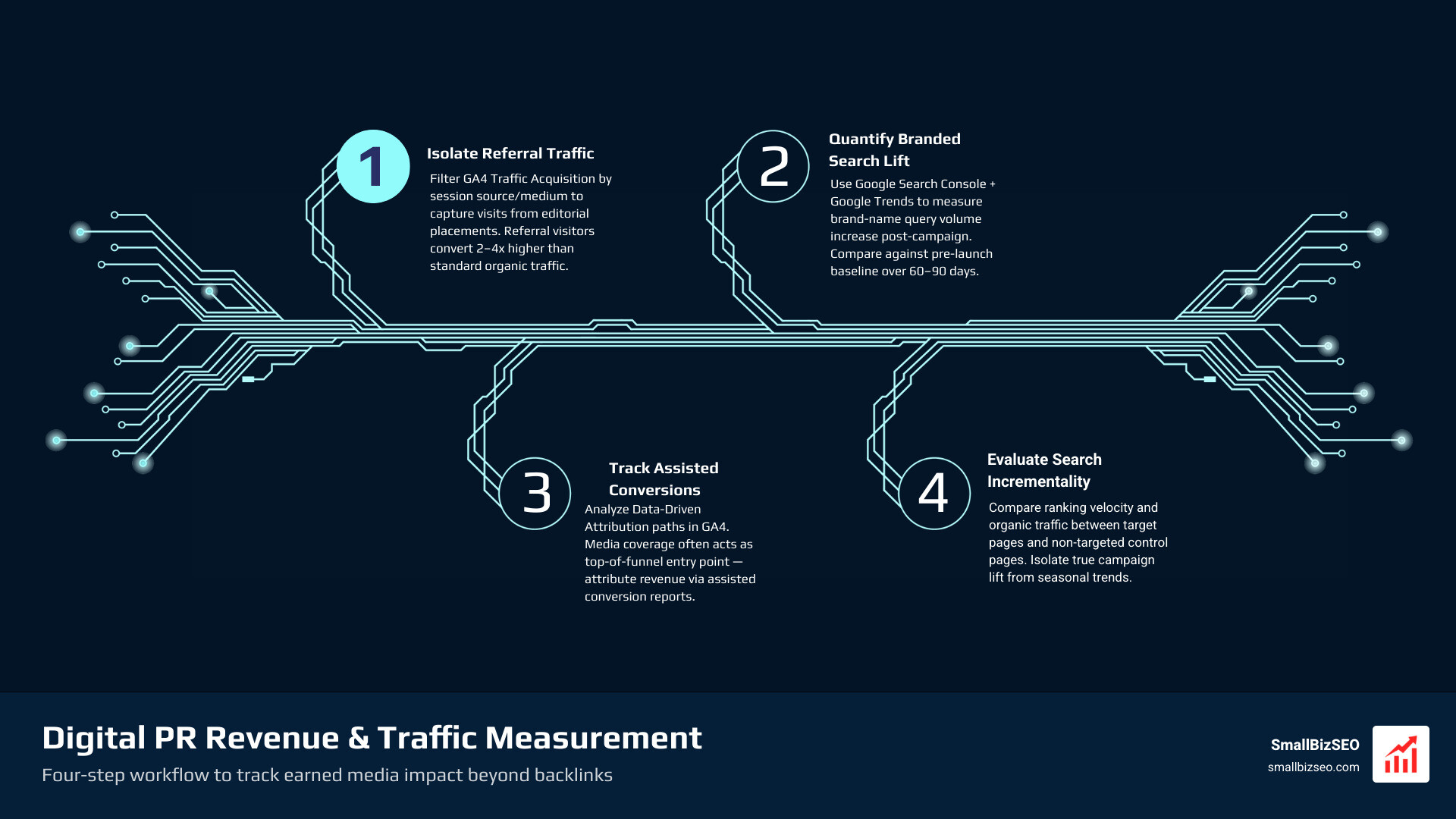
Connecting earned media coverage to bottom-line business metrics requires a structured tracking workflow in Google Analytics 4 (GA4) and Google Search Console:
- Isolate Referral Traffic in GA4: Navigate to the Traffic Acquisition report and filter by Session Source/Medium to monitor visits originating directly from published articles. Referral visitors from trusted editorial sources often convert at two to four times the rate of standard organic search traffic.
- Quantify Branded Search Growth: Check Google Search Console and Google Trends for increases in brand name search queries during and after a campaign launch by measuring post-launch branded search demand.
- Track Assisted Conversions: In GA4, analyze Data-Driven Attribution (DDA) paths. Media coverage frequently serves as an introductory top-of-funnel touchpoint, making it essential to capture revenue value by reporting organic search assisted conversions.
- Evaluate Search Incrementality: Compare target page keyword ranking velocity and organic traffic trends against non-targeted control pages to determine campaign incrementality over a 60- to 90-day window.
How Can You Prove Digital PR’s Business Impact and ROI?
To prove business impact, present executive stakeholders with a clear narrative that connects campaign investment to qualified traffic, lead pipelines, and lasting search equity rather than vanity metrics like estimated impressions.

What Should a Four-Pillar Reporting Framework Measure?
A structured four-pillar reporting framework ensures campaigns are evaluated on both operational success and tangible commercial return:
- Output: Quantify the assets produced and placements secured, tracking live URLs, publication tier, and followed link status.
- Quality: Score each placement based on audience alignment, publication authority, on-page topical relevance, and brand message pull-through.
- Impact: Measure downstream business results, including referral revenue, ranking movements on commercial landing pages, and multi-touch source attribution models.
- Learning: Document actionable takeaways regarding pitch angles, journalist response rates, and data formats to refine future outreach efforts.
To calculate Link Replacement Value, assign standard commercial acquisition costs based on Domain Rating tiers (such as valuing DR 70+ placements at $400 to $800 each). Add directly attributable referral sales and the estimated monetary value of organic ranking improvements to present an executive-ready return on investment figure.
How Can You Track Long-Term E-E-A-T, Knowledge Graph Authority, and AI Citations?
Modern search experiences increasingly pull answers directly from large language models and generative search platforms. Earned media coverage represents approximately 84% of all third-party citations used by major AI answer engines to answer non-branded commercial queries.

Track these advanced authority indicators to protect your long-term search presence:
- AI Engine Citation Tracking: Monitor how often your brand, proprietary research data, and executive commentary are cited across tools like ChatGPT, Claude, and Perplexity when users search for solutions in your sector, applying strategies designed for earning AI citations.
- Knowledge Graph Consistency: Use Organization and Person Schema markup on your canonical site assets to reinforce entity connections established by third-party press coverage.
- Organic Compounding Loops: High-performing data campaigns create recurring SEO value. Achieving top search positions for primary research assets generates continuous, passive editorial links long after active media outreach concludes.
Transforming Digital PR Reporting into Measurable Business Growth
Evaluating digital PR through the single lens of backlink totals hides the true commercial and strategic value of earned media. By shifting your measurement strategy toward topical relevance, brand search lift, multi-touch conversion attribution, and AI search presence, you can clearly demonstrate bottom-line impact to stakeholders.
At SmallBizSEO, our data-driven Velocity framework combines technical SEO precision with high-impact outreach to help businesses secure lasting organic visibility and qualified leads. When you are ready to move past vanity metrics, explore our dedicated digital PR services to build sustainable authority that fuels measurable revenue.