Diagnosing Sudden Google Discover Traffic Shifts and Traffic Drops

Start with the traffic source, not a presumed penalty
A sudden Google Discover decline calls for an investigation, not an automatic rewrite of every article. First establish what changed in the Discover report, which pages account for the change, and whether those pages still work. Keep confirmed defects separate from plausible explanations that the available data cannot prove.
Google describes Discover as less predictable than keyword-driven Search. Interests, available content and system changes can alter distribution even when a publisher has not changed its publishing frequency or quality. Treat that traffic as supplemental rather than a guaranteed baseline. See Google's Discover guidance.
1. Preserve a comparable reporting snapshot
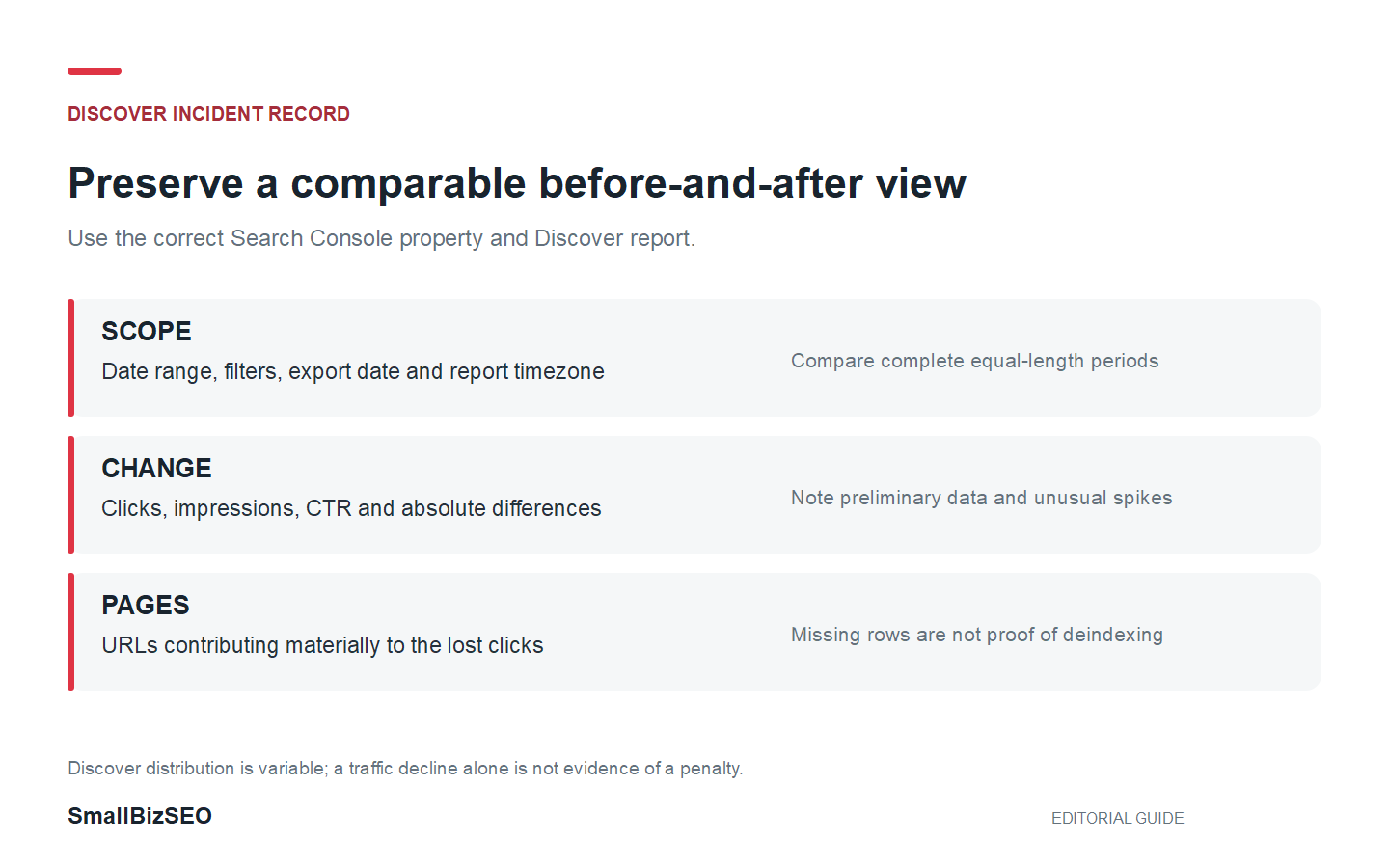
Open the Discover performance report for the correct Search Console property. Record the date range, filters and export date before making changes. Compare complete periods of equal length; do not compare a partial day with a completed day. The newest data can be preliminary. Note whether the comparison crosses a weekend, holiday or publication burst.
The report has an impressions threshold, and page rows can be omitted below their threshold even while their data contributes to totals. Metrics are assigned to canonical URLs. A missing row is therefore not proof that a page was removed from Google. Google documents these limits in its Discover performance report reference.
Save three figures for each period: clicks, impressions and click-through rate. Add the absolute difference, not only the percentage. A fall from a small base and a loss across a major traffic source require different business responses. Note the report timezone when matching changes to deployment logs.
2. Find the pages responsible for the difference
Sort the page comparison by lost clicks. Build a short incident sheet with one row for each material contributor: URL, publication or substantive update date, topic, before-and-after clicks, impressions, observed change and next check.
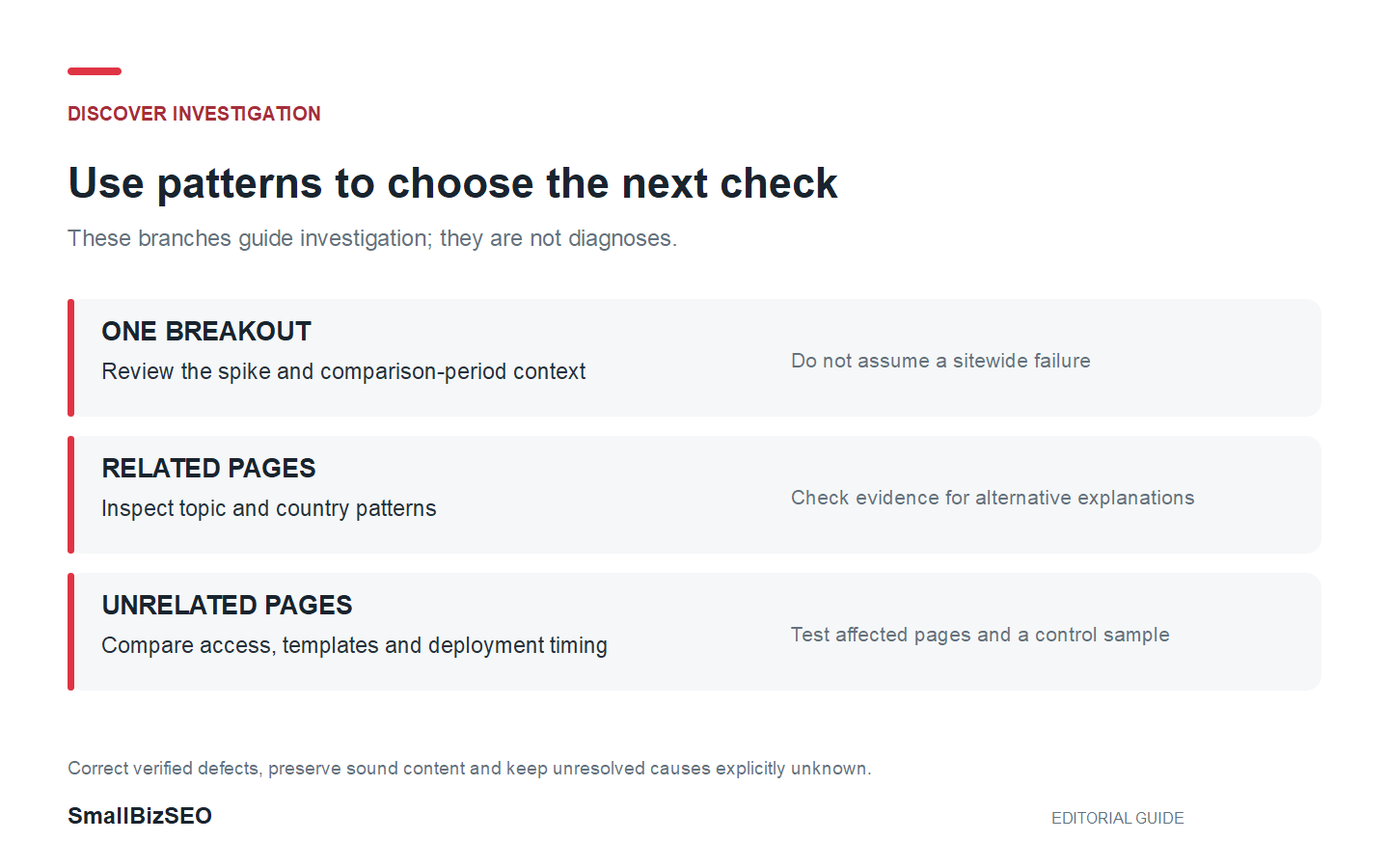
- One former breakout article dominates the decline: investigate whether the initial comparison period was an unusual spike rather than the site's normal level.
- Several related articles decline together: examine topic and country patterns before assuming a whole-site problem.
- Many unrelated pages change at once: compare the timing with template releases, outages, access rules and confirmed Search announcements.
- Impressions remain similar while clicks fall: review how the article is presented and whether audience composition changed. CTR alone does not reveal the cause.
These are investigation branches, not diagnoses. Write down what evidence would support or contradict each explanation.
3. Check affected URLs and a control sample
Select a few affected pages and a few comparable pages without the same decline. Check that each loads for ordinary visitors, displays its main content and image, and has the intended canonical and indexing directives. Review recent deployment changes and Search Console indexing, security and manual-action reports.
If a defect is confirmed, record the exact URL or shared template, the evidence, an owner and a reversible fix. A broken image path needs a different response from an accidental noindex directive. Google's traffic-drop troubleshooting guide covers technical, security, policy and demand-related causes. Avoid deleting sound articles merely because a graph fell.
4. Do not substitute analytics referrers for Discover evidence
Google explains that Discover can use the same referrer values as the surface where it was viewed, such as the Google app or web Search. A generic Google referral segment is not a clean Discover-only dataset. Use Search Console to establish the Discover pattern, then use on-site analytics to examine relevant landing-page behavior without claiming exact source equivalence. See Google's traffic identification documentation.
5. Choose a proportionate response
Correct verified access or presentation defects. Improve misleading headlines, weak sourcing or outdated information because readers need the correction, not because a particular edit promises renewed distribution. If no defect is found, keep the incident open with an explicit uncertainty statement rather than inventing an algorithm explanation.
For example, a hypothetical publisher finds that one seasonal article produced most of last week's clicks and the rest of its pages are broadly unchanged. Its first action is to review the spike and audience context, not rebuild the entire website. Another publisher finds the same incorrect indexing directive across affected pages after a release; that evidence supports a targeted technical fix.
Close the review with what changed, what was verified, what remains unknown, what action was taken and when the next comparison will occur. Recovery is not guaranteed. A documented decision is more useful than a confident but untested story about the algorithm.