A Competitor-Based Domain Authority Baseline for a New Website
What Is a Realistic Domain Authority Benchmark for a New Website?
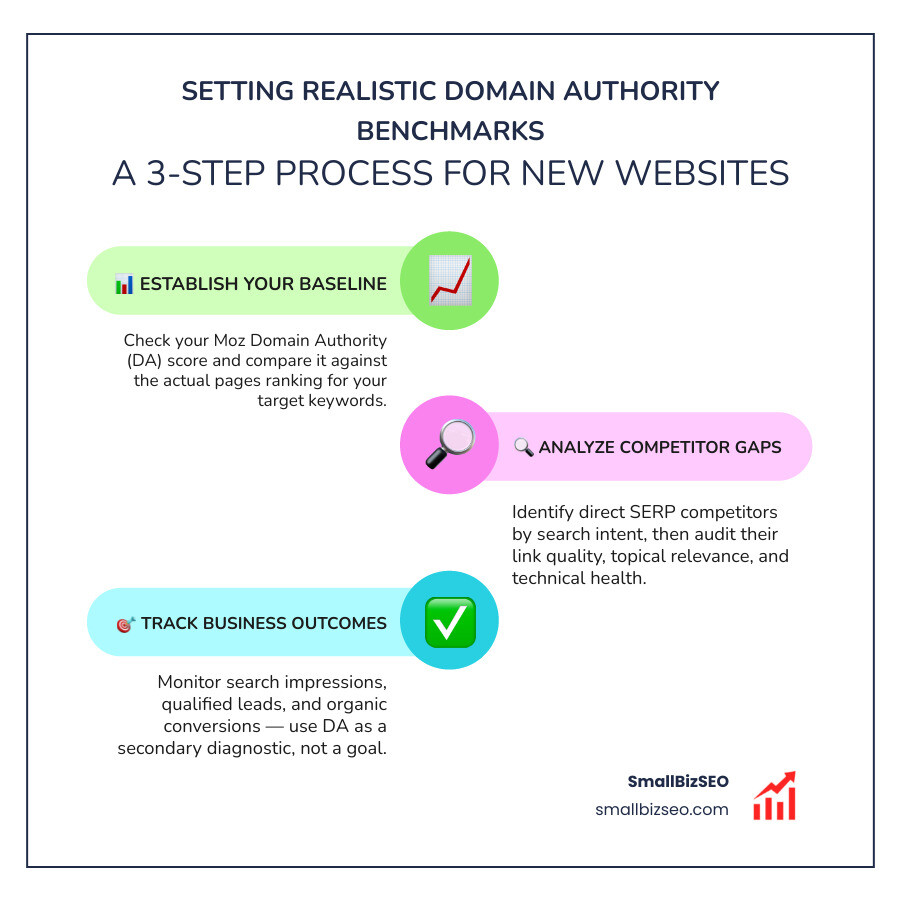
Setting realistic domain authority benchmarks for a new website starts with a baseline, not a target score. Check your site's Moz Domain Authority (DA), then compare it with the pages ranking for searches your customers actually make. Review the relevance and quality of earned links, and track search impressions, qualified organic leads, and sales opportunities as your content and technical SEO improve.
Moz DA is a third-party comparison metric, not a Google ranking factor. A higher score cannot guarantee rankings or protect a site from search changes.
How Can You Set Realistic Domain Authority Benchmarks for a New Website?
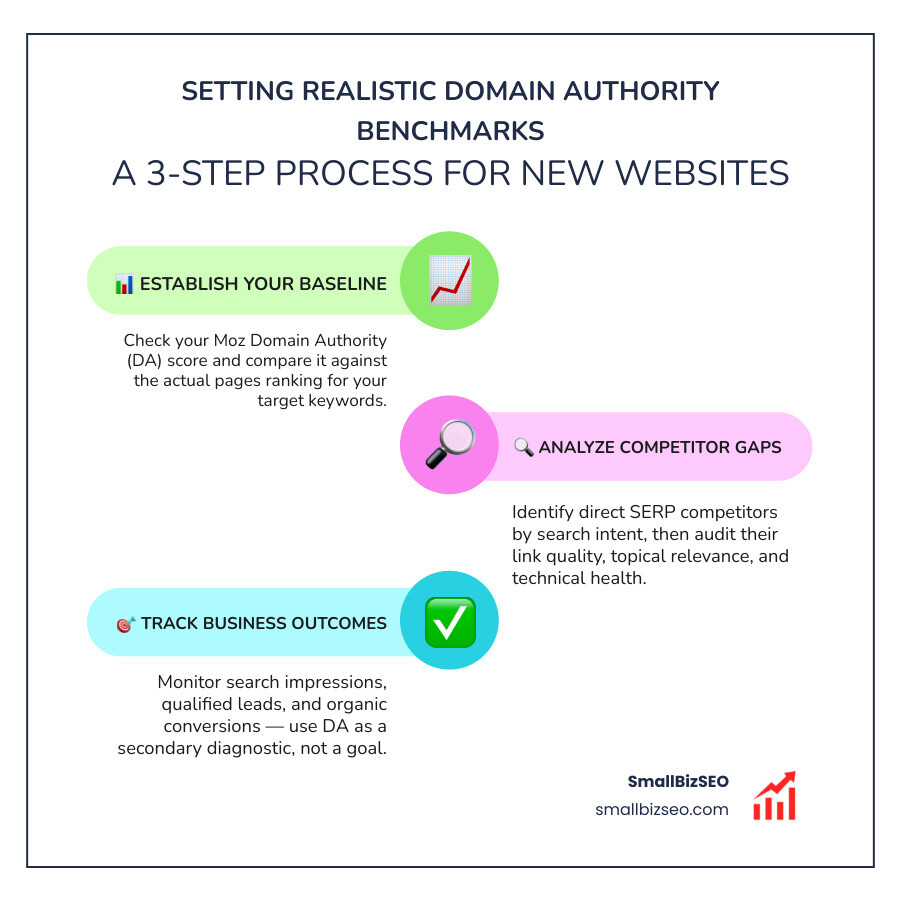
To set meaningful benchmarks, establish your starting baseline, audit the specific search competitors targeting your keywords, and address content, link quality, and technical health gaps. Treat third-party authority scores strictly as comparative diagnostics rather than direct search engine ranking criteria.
When launching a new domain, an arbitrary authority score can distract from the evidence available in the search results. Website authority metrics provide comparative context, but Moz Domain Authority, Ahrefs Domain Rating, and Semrush Authority Score are separate proprietary measures. They are not interchangeable, and none is Google PageRank or a direct measure of link equity. Use a third-party authority metric only to compare the same vendor, measurement date, and scope, such as domain-level figures with other domain-level figures or page-level figures with other page-level figures.
Step 1: Why DA Is Context, Not a Ranking Target
Domain Authority operates on a logarithmic scale from 1 to 100, meaning that growing a score from 10 to 20 requires significantly less effort than advancing from 50 to 60. Because of this structure, score changes do not scale linearly with organic search visibility.
Search engines do not use proprietary third-party metrics to rank web pages. Google’s historical PageRank concept is not the same as any modern third-party authority score. These tools use their own data and modeling to provide comparative context, so a change in a score should be treated as a prompt to investigate the underlying links, pages, and search results rather than proof that rankings will rise or fall. Moz describes Domain Authority as a relative model of ranking potential in its Authority Scoring guide; score movement can reflect changes in its index and the wider web as well as changes to your site.
Step 2: How Do You Identify Real SERP Competitors Instead of Chasing Arbitrary Scores?
Identify real competitors by examining the specific web pages ranking for your target keywords rather than looking at high-profile industry brands. Search query intent dictates which pages Google rewards, and localized or niche queries often surface specialized sites with modest domain metrics.
Instead of trying to match the authority of national aggregator directories, focus on building specialized depth. Applying a comprehensive topical authority strategy allows a newer website to outrank larger competitors for specific queries by delivering thorough, tightly interlinked content clusters. Following established methods on how to benchmark domain authority for SEO ensures you compare your domain against peers fighting for the same real estate.
Step 3: How Can SERP Analysis Help Set Realistic Domain Authority Benchmarks for a New Website?
Analyzing search results helps you observe the mix of pages currently competing for an individual query; it does not reveal a minimum authority score required to rank. Record the page-level evidence you can see, including intent match, content format, internal support, relevant links, and gaps the ranking page leaves unanswered. Those observations support better content and SEO decisions, but they cannot isolate a single reason why any page ranks.
Use a small, repeatable sample for SERP analysis. Reviewing the first 10 organic results can be a useful illustrative starting point, not a ranking rule or a complete explanation of the results. It also cannot directly measure link equity or explain why a page ranks.
| Field | What to Record |
|---|---|
| Query | The search query being reviewed. |
| Location | The search location used for the check. |
| Device | The device used for the search. |
| Date Checked | When the results were reviewed. |
| Ranking URL | The page that appears in the results. |
| Intent / Content Type | The apparent search intent and format of the ranking page. |
| Moz DA (Optional) | A same-date Moz Domain Authority comparison, if useful. |
| Page-Level Evidence / Content Gaps | Observable strengths, missing details, and unanswered questions. |
| Earned-Link Relevance | Whether visible referring links appear relevant and editorial. |
| Next Action | The specific content, technical SEO, or outreach follow-up to consider. |
Use the worksheet to compare observable patterns across pages, not to set a numeric DA target or assign one cause to a ranking outcome.
Step 4: Why Does Backlink Relevance Matter More Than Raw Volume?
Backlink relevance and usefulness matter more than raw link counts. Prioritize editorially earned links from sources that genuinely serve the same topic or audience, and avoid disconnected or manipulative link patterns.
When reviewing your backlink acquisition strategy, focus on relevance, editorial judgment, and the usefulness of the linked resource:
- Relevant Referring Domains: Prioritize links from publications and sites that are genuinely connected to the topic or audience.
- Natural Editorial Anchors: Use descriptive anchor text that reads naturally in the surrounding editorial content. Do not manage anchor text by a prescribed ratio.
- Editorial Integration: Pursue contextual links earned through original research, industry commentary, or valuable assets.
- Profile Quality Review: Look for patterns that may be irrelevant, manipulative, or disconnected from the site’s audience.
For young websites starting without an established reputation, earning high-quality backlinks should be supported by useful, linkable assets, original research, and credible editorial relationships. SmallBizSEO’s link-building services focus on earned outreach rather than manufactured authority signals.
How Can You Track SEO Growth Beyond Third-Party Authority Scores?
Evaluate your SEO growth by tracking search impressions, organic clicks, target keyword positions, and qualified leads. Keep third-party authority metrics in your secondary diagnostic toolkit while measuring primary business performance through organic conversions and pipeline value.
Relying exclusively on domain metrics can create a false sense of security or unnecessary discouragement. A site's score might rise due to passive directory scraping without driving a single qualified buyer, while a focused domain might generate steady revenue with a modest score.
Which Metrics Show Business Outcomes, and Which Are Diagnostic Indicators?
Separating business outcomes from diagnostic metrics keeps your marketing focused on measurable returns:
| Metric Category | Specific Metrics | Strategic Purpose |
|---|---|---|
| Business Outcomes | Qualified Organic Leads, Form Inquiries, Direct Phone Calls, Pipeline Revenue | Measures actual commercial return and customer acquisition generated through search channels. |
| Primary SEO Indicators | Search Impressions, Non-Branded Organic Clicks, Average Keyword Position | Tracks visibility trends, keyword indexing depth, and user interaction within search engine results. |
| Diagnostic Authority Metrics | Moz Domain Authority, Unique Referring Domains, Page-Level Equity | Provides comparative context for backlink growth and competitive gaps; it does not set a ranking target. |
| Technical Health Metrics | Core Web Vitals, Crawl Error Frequency, Indexing Coverage | Helps identify technical barriers that can make it harder for search engines to discover, render, or index pages; it does not guarantee indexing or rankings. |
How Often Should You Review Search Indicators and Update Your Benchmarks?
Review query performance, qualified leads, content changes, and earned-link activity monthly so you can spot developing issues and opportunities. Use quarterly comparisons for broader strategic decisions, such as whether the competitor set, content priorities, or technical roadmap has changed. Address urgent technical issues, indexing problems, or major traffic changes as soon as they are identified rather than waiting for a scheduled review.
Use this systematic review workflow:
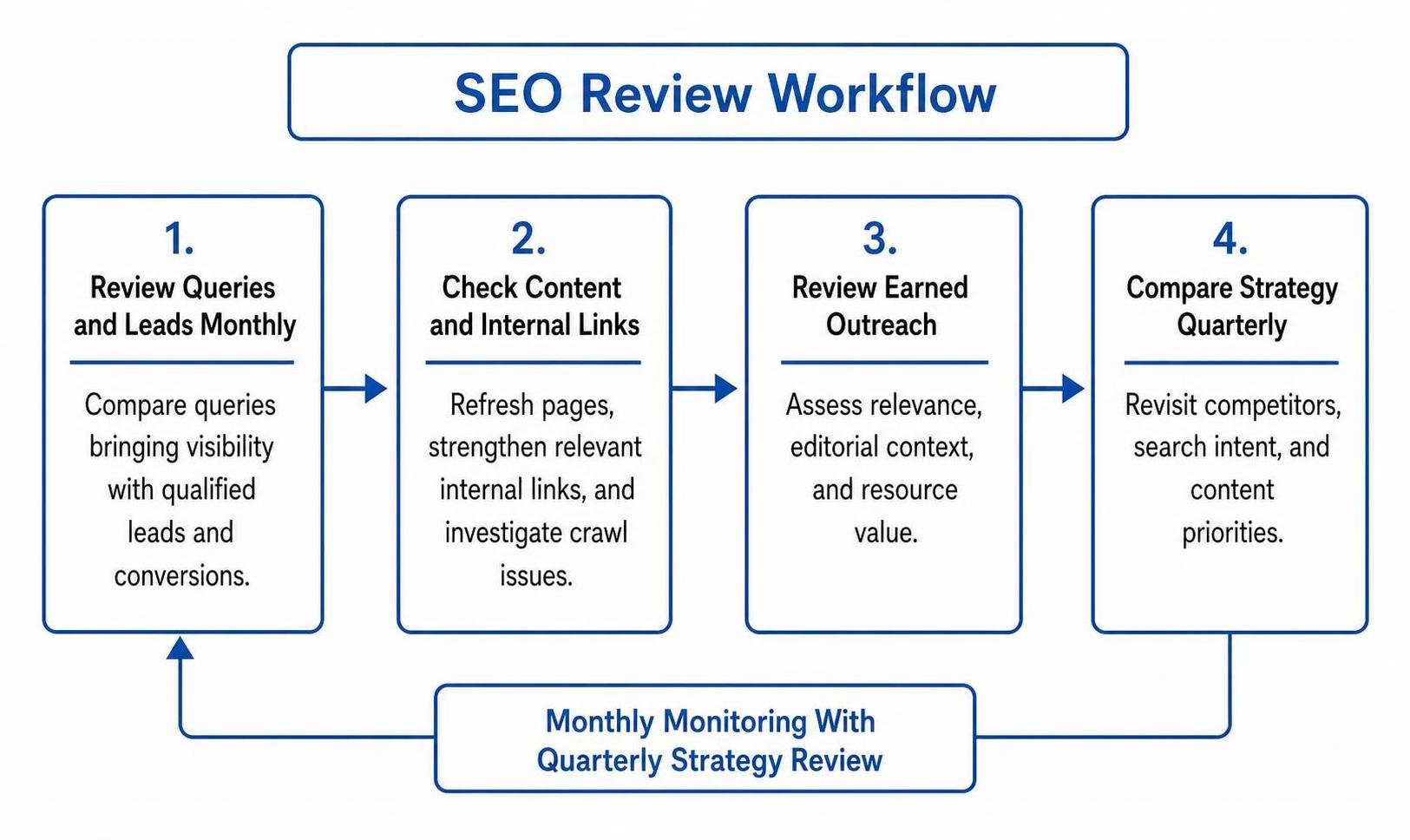
- Review Queries and Leads Monthly: Compare the queries bringing visibility with the leads and conversions they support.
- Check Content and Internal Links: Refresh pages that no longer match intent, improve coverage where evidence shows a gap, and strengthen relevant internal links. For ongoing help, explore SmallBizSEO’s SEO content services.
- Review Earned Outreach: Assess whether recently earned links are relevant, editorial, and connected to useful resources rather than treating them as a guaranteed ranking lever.
- Compare Strategy Quarterly: Revisit the competitor worksheet, search intent, and content priorities to identify material changes.
- Act on Urgent Issues Immediately: Investigate sharp visibility losses, crawl problems, or broken critical pages when they appear.
For informational guidance on interpreting authority metrics alongside real search performance, visit our domain authority resource. To discuss ongoing SEO support, content refresh work, internal linking, or earned outreach, book a consultation.
Practical Steps for Building Search Authority
Calibrating domain expectations requires shifting attention from arbitrary scores toward meaningful search performance. By establishing competitor baselines, building relevant topical coverage, securing quality editorial links, and maintaining technical site health, you establish an effective foundation for tracking organic search visibility and qualified pipeline.