Local SEO for Garage Door Repair: Terms Demystified

How can garage door repair companies get found in local search?
SEO for garage door repair starts with the searches that lead to calls. Set up a complete Google Business Profile, create a page for each major repair service, and make it easy to call from a phone. Add useful pages for the cities you serve, keep your business details consistent, and ask customers for honest reviews after each job.
These steps help customers find and choose you when a broken spring or stuck door needs prompt attention. This guide explains the local search terms behind those steps, including the Google Map Pack, service pages, and reviews.
I’m Clayton Johnson, founder of SmallBizSEO. My work in content strategy, technical SEO, and link building for small businesses shapes this practical guide to SEO for garage door repair.
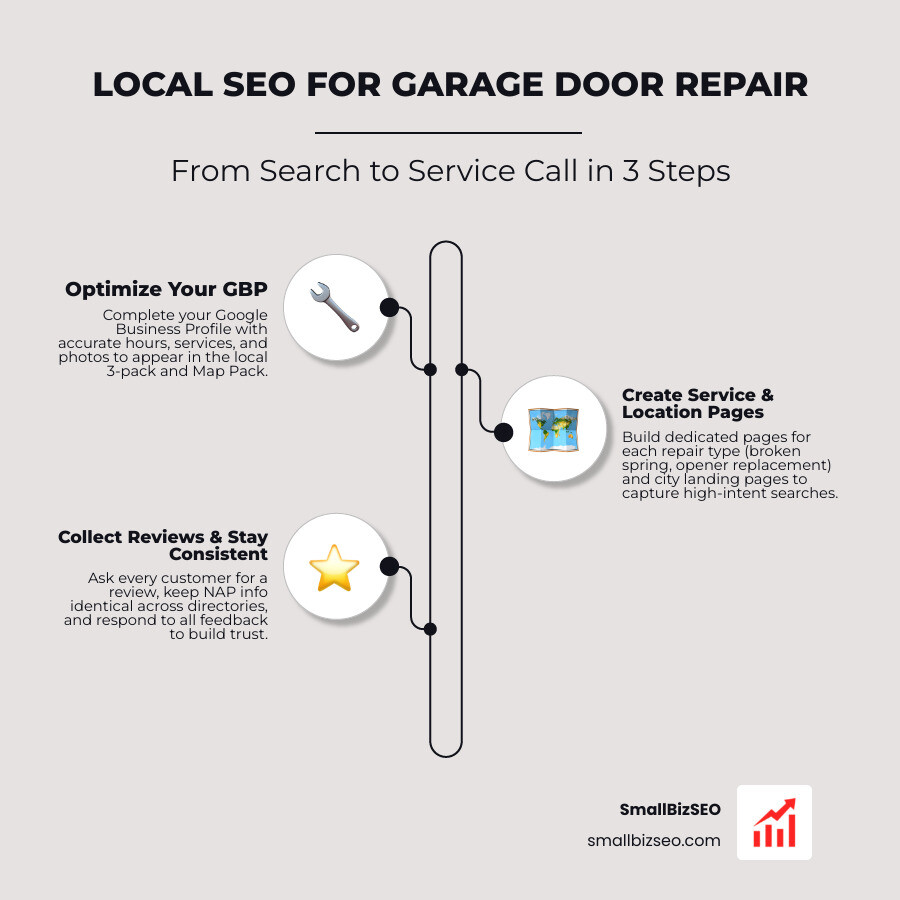
SEO for garage door repair terms to learn:
Why SEO for Garage Door Repair Drives Urgent Phone Calls
Local SEO is the fastest way to turn immediate garage door malfunctions into confirmed service bookings. Roughly 46% of all Google queries carry local intent, and for home trades, the Google Map Pack appears in approximately 98% of search engine results pages. When a homeowner discovers a broken torsion spring at 7:00 AM, they do not browse dozens of websites. Instead, 72% of consumers evaluate three or fewer businesses before deciding, and 75% finalize their selection within 30 minutes.

Dominating the local 3-pack ensures your business captures these urgent searches right when intent is highest. Implementing strategic local SEO company tactics and studying a practical guide to local SEO map visibility bridges the gap between passive online impressions and high-value inbound calls.
What Makes SEO for Garage Door Repair Uniquely Urgent?
Garage door repairs are primarily distress purchases triggered by unexpected mechanical failures. Queries like "open now near me" have surged by 400%, while "near me" problem phrases have increased 900%. When a vehicle is trapped behind a jammed overhead door, homeowners perform rapid "driveway searches" prioritizing immediate availability and proximity over lengthy price shopping.
Understanding how user intent differs between emergency repairs and planned door installations helps you craft the right pages for each search type.
| Search Dimension | Emergency Repair Searches | Planned Installation Searches |
|---|---|---|
| Typical User Search | "broken garage door spring repair near me" | "custom insulated carriage garage doors" |
| Decision Window | Under 30 minutes | 2 to 6 weeks |
| Primary Device | Mobile smartphone | Desktop / Tablet |
| Primary Conversion Driver | Map Pack position, reviews, 24/7 badge | Style galleries, brand options, financing |
| Key Landing Page | Dedicated repair page with click-to-call | Installation gallery with material specifications |
Targeting transactional keywords ensures emergency searchers reach your dispatch team immediately. As an experienced contractor SEO company, we build streamlined conversion pathways that turn these high-stress situations into immediate service calls.
How to Master High-Intent Keyword Targeting and Google Business Profile Optimization
To capture high-intent repair queries, your Google Business Profile (GBP) must be complete, active, and precisely categorized. Up to 56% of local businesses leave their profiles incomplete, yet fully optimized profiles receive 70% more location visits and 50% more purchase consideration.
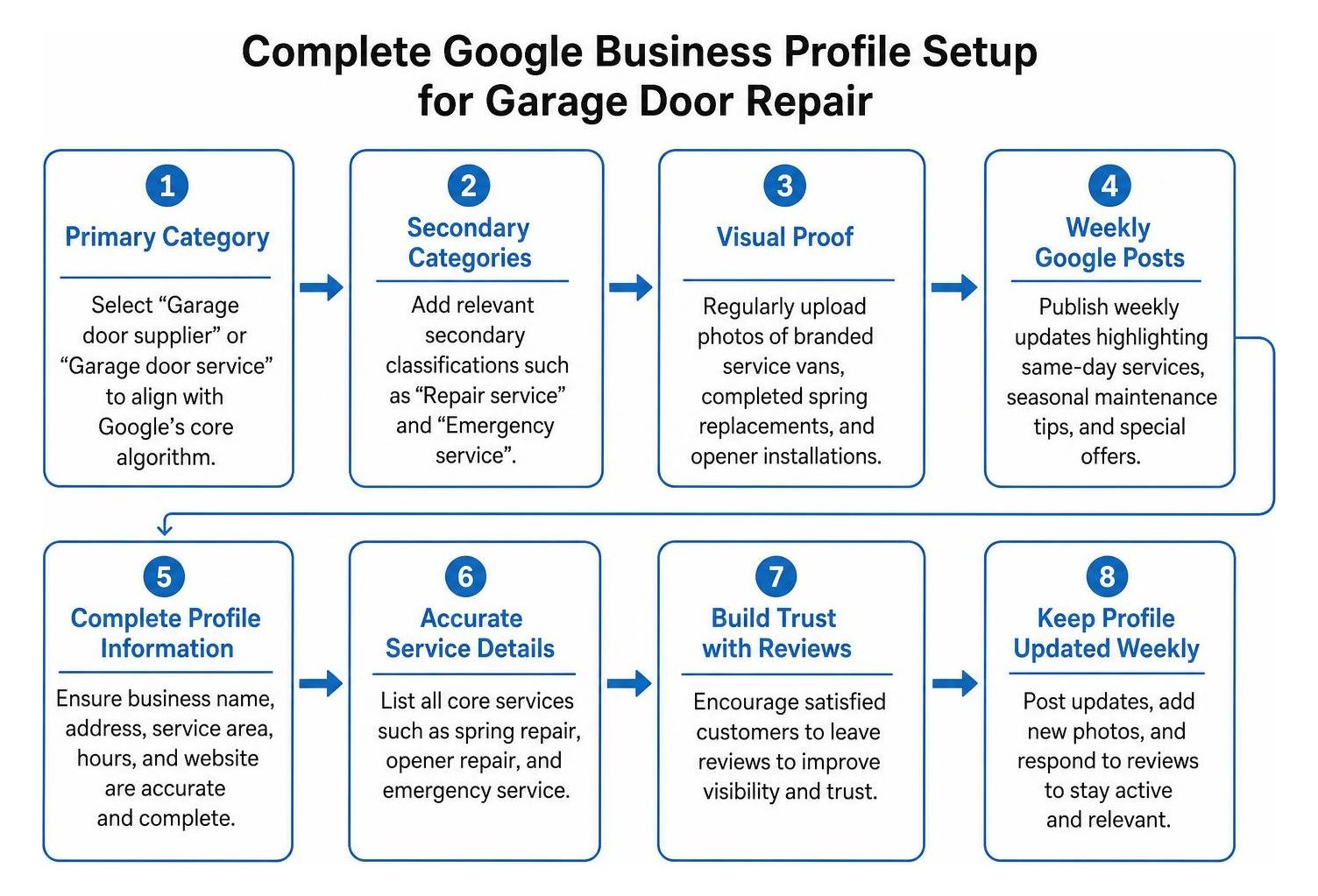
Start by refining your core GBP settings:
- Primary Category: Select "Garage door supplier" or "Garage door service" to align with Google's core algorithm.
- Secondary Categories: Add relevant secondary classifications such as "Repair service" and "Emergency service".
- Visual Proof: Regularly upload photos of branded service vans, completed spring replacements, and opener installations to build trust without showing faces.
- Weekly Google Posts: Publish weekly updates highlighting same-day services, seasonal maintenance tips, and special offers.
- GBP Q&A: Seed common questions addressing warranty terms, service call fees, and average arrival windows.
Following established industry frameworks strengthens geographic prominence and ensures search engines understand your specific service offerings.
How to Structure Service and Location Pages for Maximum Reach
A single homepage cannot rank for every individual repair service and outlying neighborhood. You need an organized website architecture that uses content silos to separate repair services from planned installations, supported by unique city landing pages.
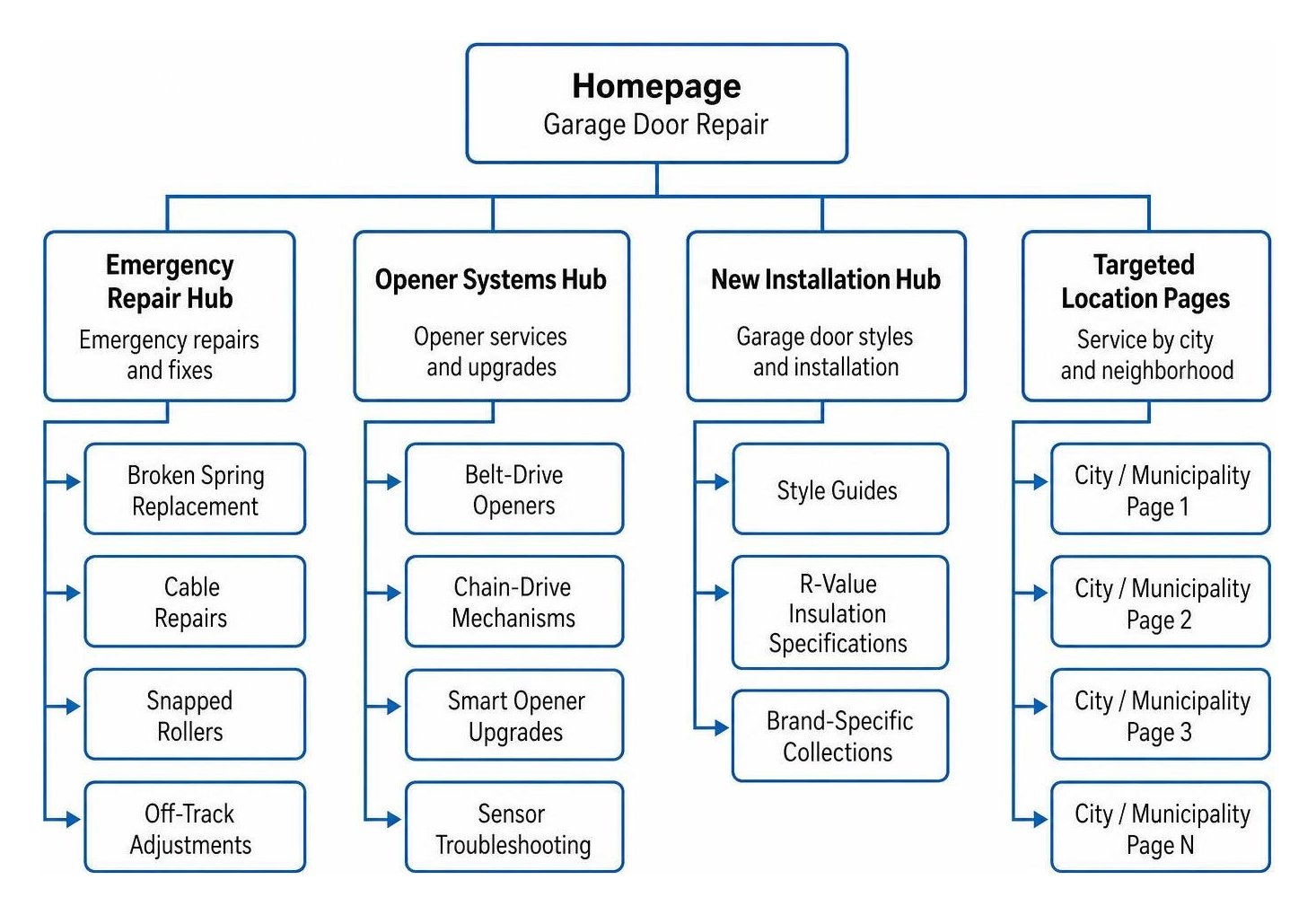
Structure your content into distinct thematic silos:
- Emergency Repair Hub: Houses child pages dedicated to broken spring replacement, cable repairs, snapped rollers, and off-track adjustments.
- Opener Systems Hub: Covers belt-drive openers, chain-drive mechanisms, smart opener upgrades, and sensor troubleshooting.
- New Installation Hub: Features style guides, R-value insulation specifications, and brand-specific collections.
- Targeted Location Pages: Provide unique information for each surrounding municipality, embedding customer reviews and specific neighborhood service details.
Following the ultimate guide to improve company website SEO ensures your internal links pass authority effectively from core service pages down to localized neighborhood URLs.
How to Scale Your Local Search Engine Visibility
Scaling local visibility requires combining technical website health, steady customer review generation, and trusted directory citations. Google relies on three core factors—relevance, distance, and prominence—to calculate local rankings.

Expanding your visibility radius means proving that your business is reliable and verified across the web. Following proven local SEO map services what you need to know helps protect your brand against aggressive local competitors.
What Technical Factors Dominate SEO for Garage Door Repair?
Mobile users needing urgent repairs will leave a slow website immediately. Google evaluates Core Web Vitals and site speed as critical ranking factors, with pages loading under three seconds achieving substantially higher conversion rates.
To ensure search engines can properly read and index your site, add structured schema markup to your code:
- LocalBusiness Schema: Specifies your exact business name, logo, operational hours, accepted payment methods, and geographic coordinates.
- Service Schema: Explicitly details individual offerings, such as "Torsion Spring Replacement" or "Overhead Door Sensor Repair."
- FAQPage Schema: Formats common questions directly in search results, answering pricing and emergency response queries before the user even clicks.
Implementing these code standards aligns your site with recommendations found in industry guides to garage door local optimization, ensuring search bots understand your services instantly.
How Review Velocity and Local Citations Protect Map Rankings
Review velocity—the consistency with which your business earns new customer feedback—is one of the strongest ranking signals for the Google Map Pack. A business adding five to ten genuine reviews each month will consistently outrank competitors with static review profiles.
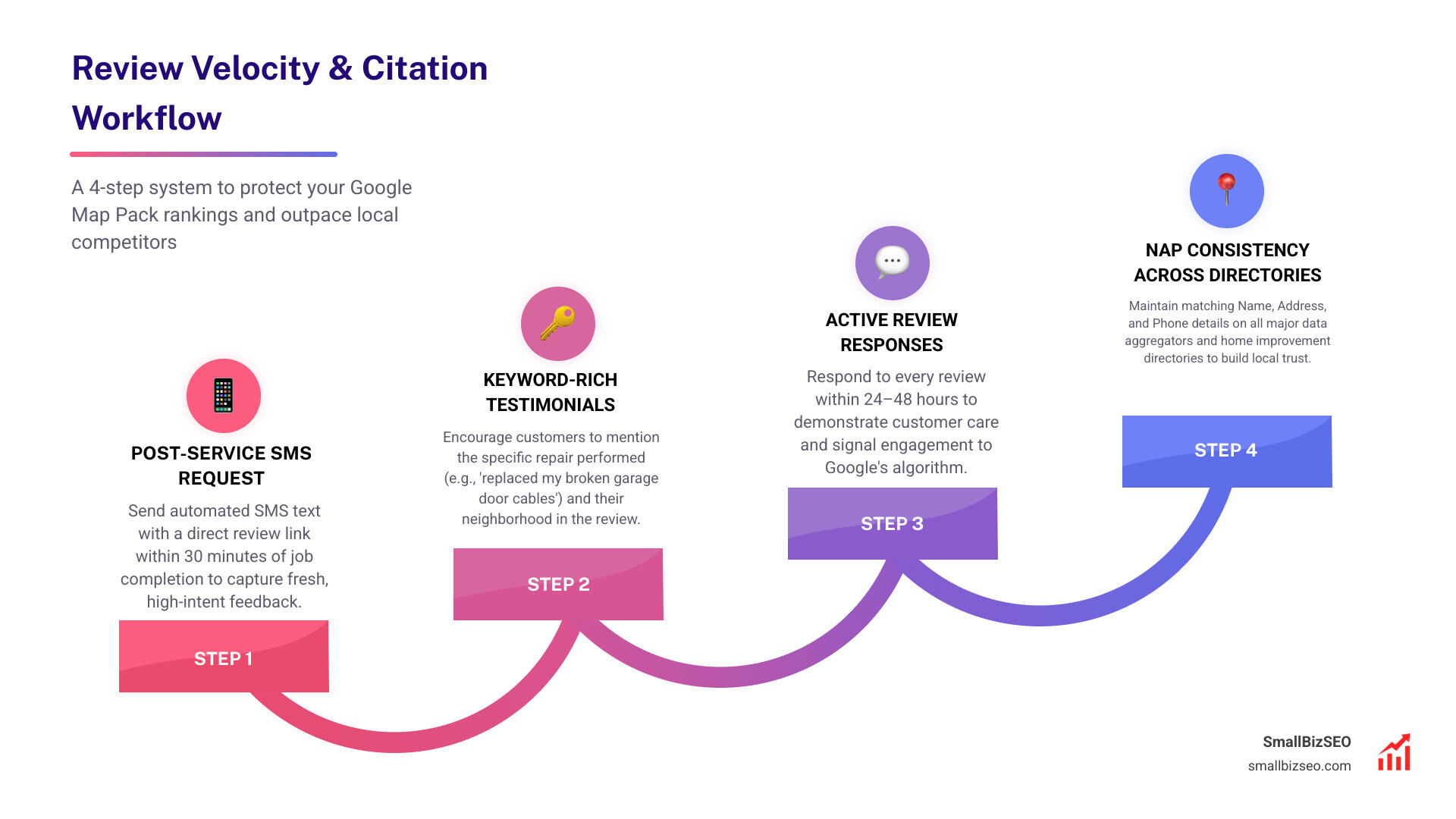
Build an automated post-service review workflow:
- Prompt Timing: Send an automated SMS text message with a direct review link within thirty minutes of job completion.
- Keyword Mentions: Encourage customers to mention the specific repair performed (e.g., "replaced my broken garage door cables") and their neighborhood.
- Prompt Responses: Respond to every review within 24 to 48 hours to demonstrate active customer care.
- Citation Consistency: Maintain matching Name, Address, and Phone (NAP) details across major data aggregators and home improvement directories.
How to Measure SEO Performance and Prepare for AI Search
Modern search increasingly includes generative AI Overviews and natural language tools. Approximately 45% of users now ask conversational platforms for local trade recommendations. Adapting requires clear, direct answers to common troubleshooting questions, structured data, and consistent web mentions.
Track these core metrics to measure real business growth:
- Dynamic Call Tracking: Track organic and map-driven phone calls directly in your analytics platform.
- GBP Interaction Metrics: Monitor direction requests, website clicks, and direct click-to-call actions inside your Google dashboard.
- Conversion Rate by Service: Measure which individual repair pages generate the highest volume of booked service appointments.
To evaluate your current search footprint and uncover hidden ranking opportunities across your service area, request a free SEO visibility audit from our technical team.
Taking Action to Dominate Your Local Repair Market
Winning top local rankings requires clear service pages, an active Google Business Profile, fast mobile page speeds, and consistent customer reviews. By organizing your website around high-intent repair queries and maintaining technical SEO standards, you make it easy for homeowners to choose your team when their garage doors fail.
SmallBizSEO is an SEO company that provides technical SEO, content strategy, and link-building services for small businesses. Our data-driven "Velocity" framework delivers fast rankings and E-E-A-T-compliant growth through transparent, automated reporting. We help trade contractors build reliable, scalable organic search pipelines that turn online searches into confirmed service appointments.