18 Eye-Opening AI Workforce Statistics on Automation and Productivity

18 Eye-Opening AI Workforce Statistics on Automation and Productivity
How Is AI Changing Work Around the World?
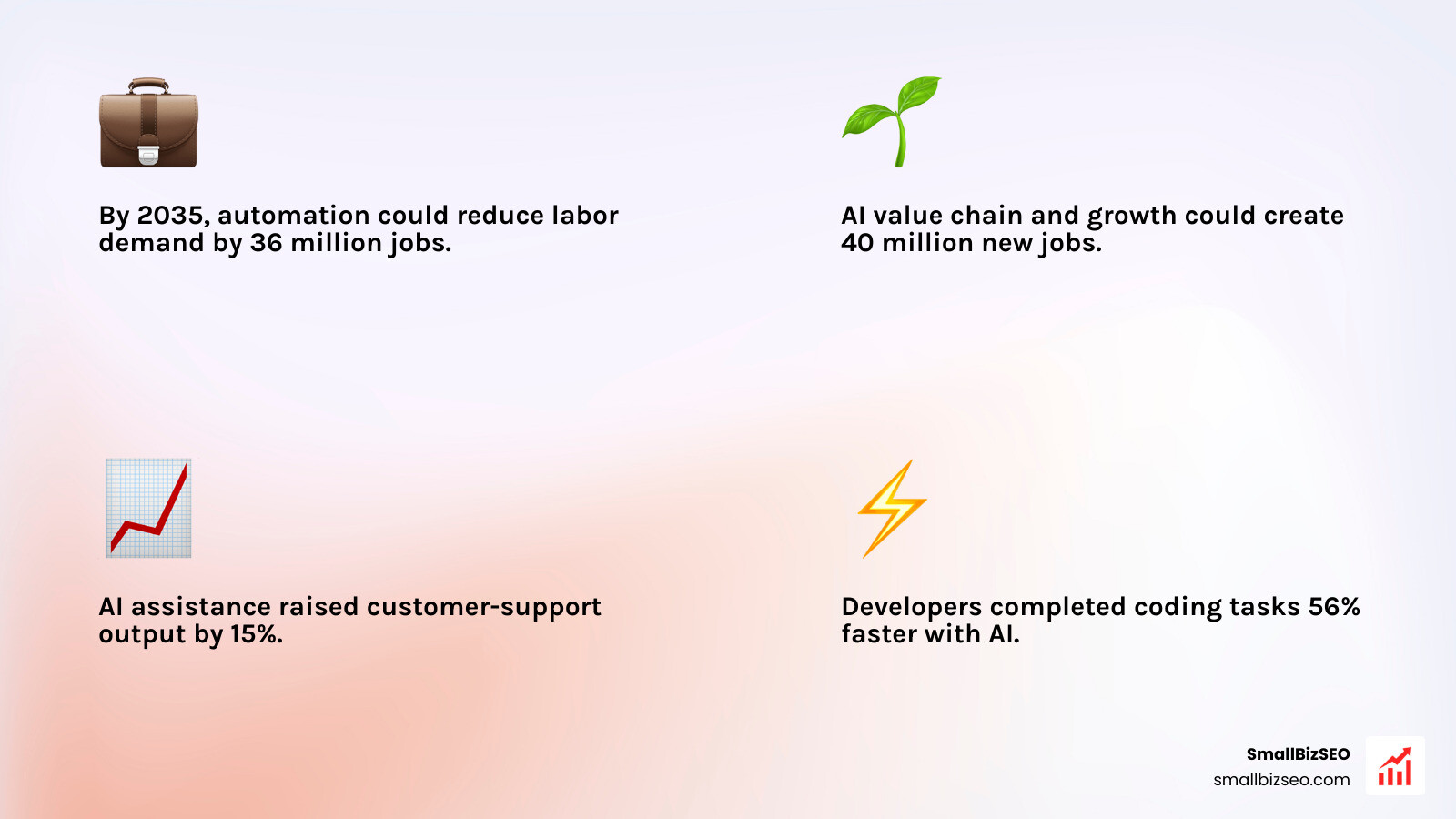
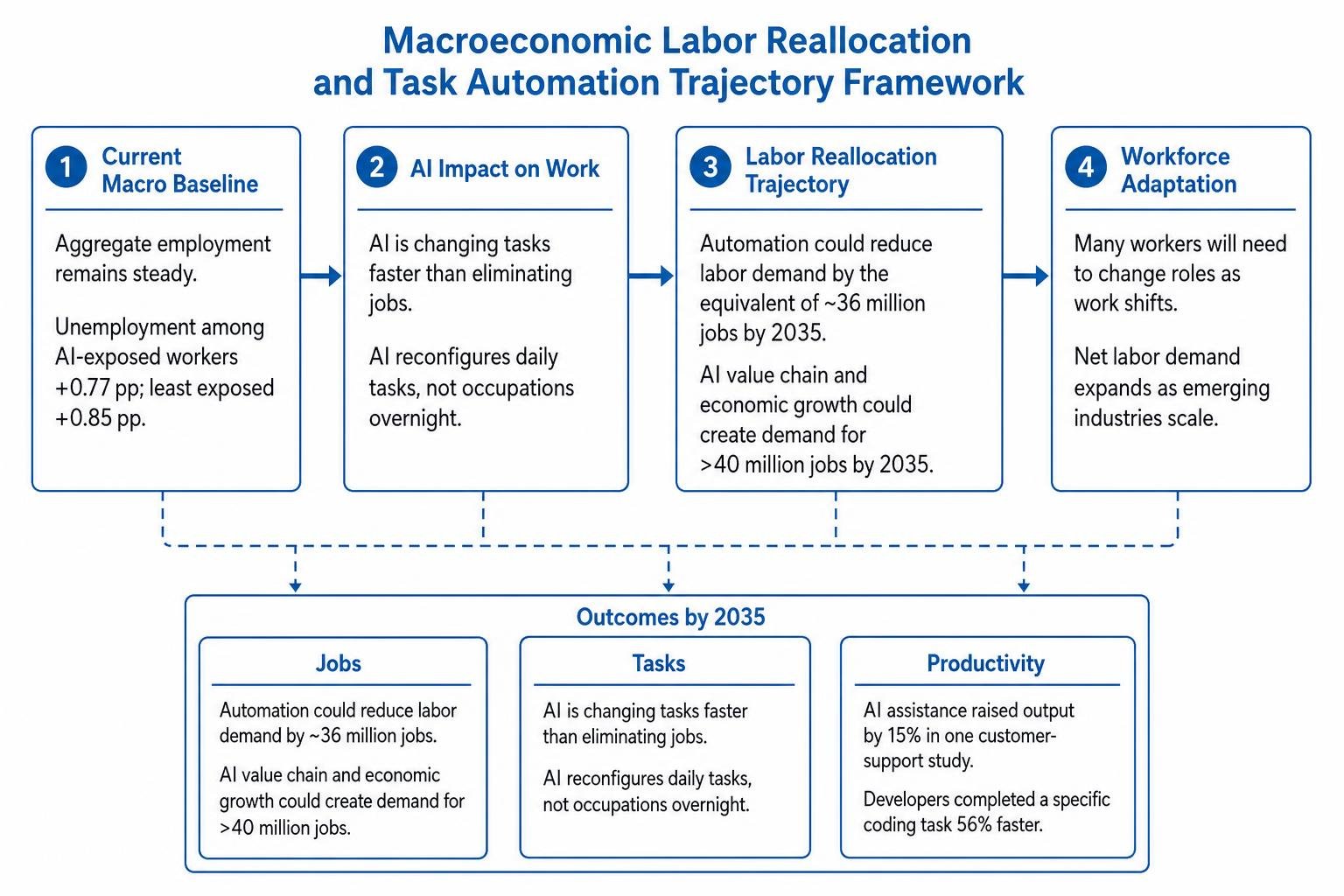
AI is changing tasks faster than it is eliminating jobs. One US forecast estimates that automation could reduce labor demand by the equivalent of about 36 million jobs over the coming decade, while the AI value chain and broader economic growth could create demand for more than 40 million. Those are projections, not a count of jobs lost or created by AI alone. Research on US workforce pathways also suggests that many workers will need to change roles as work shifts.
The productivity gains are easier to measure today: AI assistance raised output by 15% in one customer-support study, while developers completed a specific coding task 56% faster in another. These results show what AI can do in particular settings, not what every worker should expect.
I’m Clayton Johnson, founder of SmallBizSEO, and I use research on AI workforce statistics on jobs created, tasks automated, and productivity gains to make changes like these easier for small business owners to understand. My work in SEO, content strategy, and AI-driven discovery focuses on turning complex trends into practical guidance.
Simple guide to AI workforce statistics on jobs created, tasks automated, and productivity gains:
- AI Training Statistics: How Businesses Are Preparing Employees for Artificial Intelligence
- AI Tools Market Share: The Most Popular Artificial Intelligence Platforms for Businesses
- Human vs. AI-Generated Content: Traffic, Engagement, and Conversion Statistics
Understanding global labor trends requires separating immediate macroeconomic baselines from long-term projections. Despite rapid algorithmic advancement, broad aggregate employment remains steady. Data indicates that unemployment rates among workers highly exposed to AI increased by 0.77 percentage points, which aligns closely with the 0.85 percentage point rise observed among workers in the least exposed sectors. Rather than wiping out occupations overnight, intelligent software systems are fundamentally reconfiguring daily tasks.
How Many Jobs Could AI Create, Which Tasks Could It Automate, and How Much Could It Boost Productivity?
The empirical data highlights a dynamic shift: while millions of routine roles face technological displacement, net labor demand expands as emerging industries scale and productivity accelerates across the board.

When organizations introduce automated systems, lower unit costs frequently trigger the Jevons paradox—where increased efficiency lowers the cost of a service, causing consumer demand to surge and spurring overall economic growth.
| Economic Sector | Task Automation Potential | Net Job Growth Outlook | Average Measured Productivity Lift |
|---|---|---|---|
| Office & Administrative Support | High (Up to 80% of hours) | Contraction (-12% to -15%) | +15% to +25% across routine operations |
| Technology & Software Engineering | Moderate-High (70% of hours) | Strong Expansion (+10% to +18%) | +56% faster task completion time |
| Retail, Sales & Customer Care | Moderate (68% of hours) | Rebalancing (-5% to +4%) | +14% to +30% resolution speed |
| Healthcare & Clinical Operations | Low-Moderate (26% of hours) | Strong Expansion (+15% to +22%) | +20% administrative time savings |
How Many Jobs Could AI Create, and Where Could Labor Demand Grow?
Projections indicate that the expansion of the AI value chain and complementary economic activities could generate demand for more than 40 million new jobs. Additionally, between 500,000 and 2 million positions will emerge in entirely new occupational categories that do not exist today.
According to a Stanford SIEPR policy analysis on AI labor market realities, early-adopting enterprises experienced a 10% net employment expansion within two years of deploying enterprise AI platforms. Growth is heavily concentrated in organizations making substantial per capita enterprise AI adoption spending. Notably, roughly 60% of projected employment growth is concentrated in the top two wage quintiles, signaling a significant shift toward high-value, specialized roles.
Which Jobs and Tasks Are Most Exposed to Automation?
Automation potential is unevenly distributed across the economy, with approximately 36 million full-time equivalent roles facing structural displacement or heavy task reorganization.
More than 75% of workers who may need to switch occupations come from administrative support, retail sales, and logistics. Rather than substituting entire positions, organizations increasingly turn to autonomous agent workflow integration to absorb non-routine cognitive subtasks, including document parsing, meeting summarization, and data validation.
How Much Can AI Improve Productivity and Revenue?
AI integration produces tangible output gains across diverse corporate functions, driving a 3x higher growth rate in revenue per employee in exposed sectors compared to non-exposed peers.

Real-world operational benchmarks demonstrate significant workflow acceleration:
- Contact Center Operations: A generative assistant lifted overall resolution output by 15%, with novice and less-skilled workers seeing an immediate 30% improvement in issues resolved per hour.
- Software Development: Programmers utilizing tools like GitHub Copilot completed coding tasks 56% faster, as documented in the PwC Global AI Jobs Barometer report.
- Knowledge Worker Efficiency: Compounding measurable productivity and cost savings data shows that standard office workers reclaim an average of 68 minutes per working day by automating routine drafting and research.
How Are AI Skills Affecting Wages and Hiring?
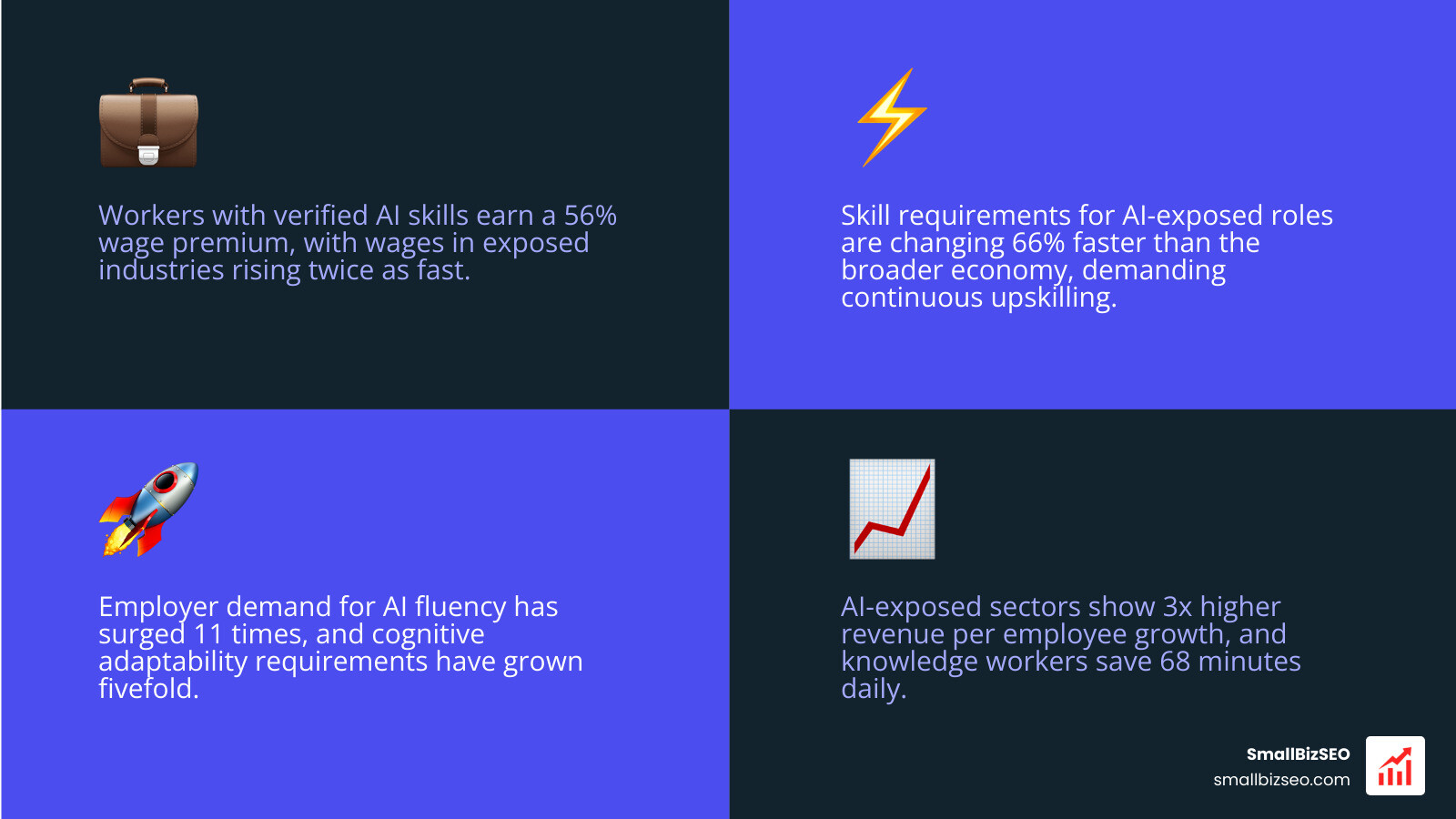
Specialized technical fluency commands an immediate financial return: workers possessing verified AI competencies command a 56% wage premium.
Wages in highly exposed industries are rising twice as fast as those in lagging sectors. However, this premium comes with intense volatility. Skill requirements for AI-exposed roles are changing 66% faster than across the broader economy. Employer demand for AI fluency has surged 11 times, adaptability requirements have grown fivefold, and cognitive traits like curiosity and resilience have tripled. Reviewing corporate AI skills gap benchmarks confirms that continuous upskilling is now essential to avoid wage stagnation across lower-tier earnings brackets.
How Can Businesses and Workers Prepare for AI-Driven Labor Changes Over the Coming Decade?
Proactive adaptation requires structured reskilling pipelines, updated organizational workflows, and clear talent pathways to prevent structural labor bottlenecks.

How Can 11 Million Workers Overcome Barriers to Changing Careers?
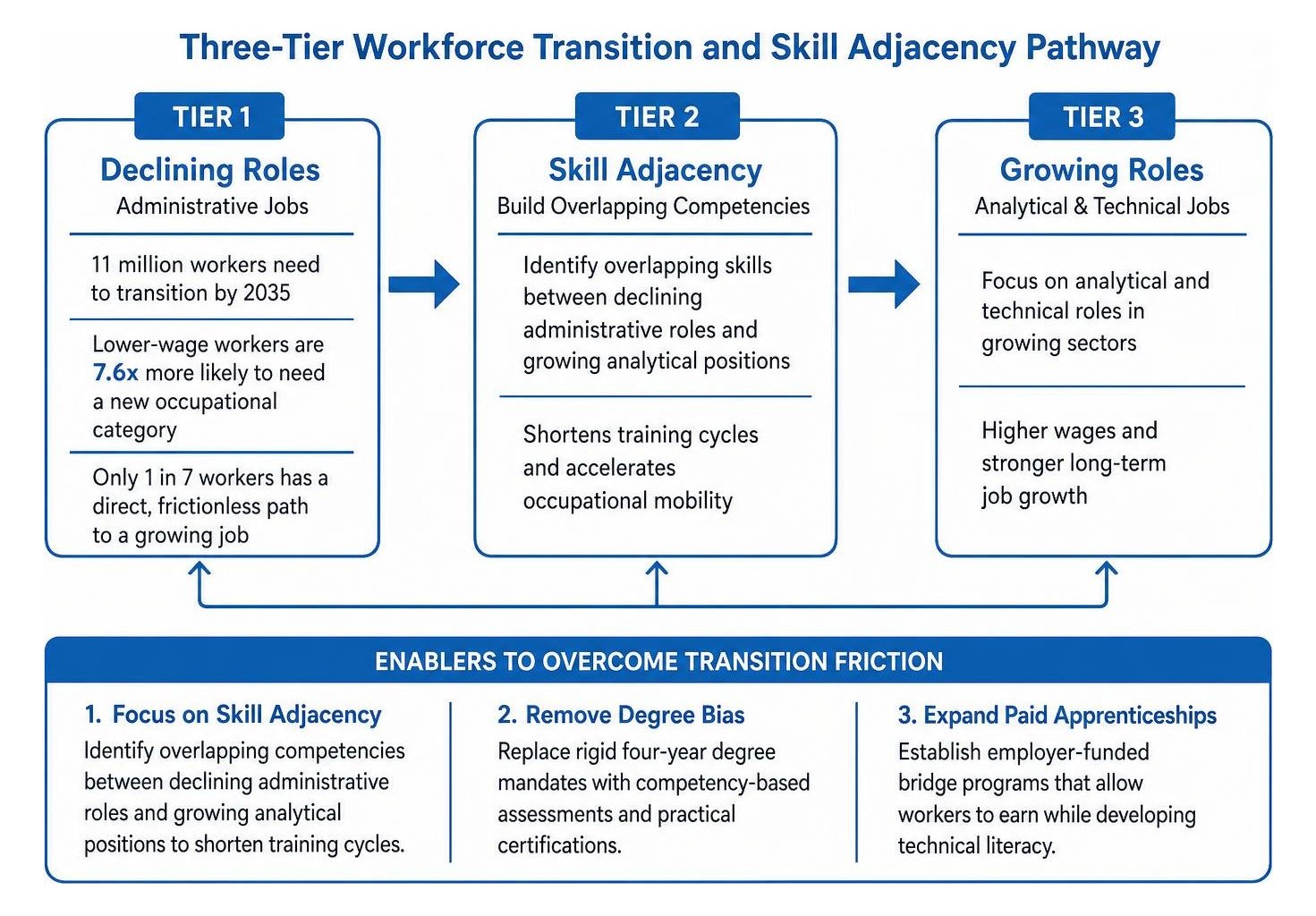
An estimated 11 million workers in declining occupations will need to transition into growing sectors over the coming decade.
The friction involved in occupational mobility is substantial. Lower-wage workers are 7.6 times more likely to require a transition to an entirely new occupational category than high-wage earners. Currently, only one in seven workers enjoys a direct, frictionless path into an expanding job family without major retraining.
To navigate this hurdle:
- Focus on Skill Adjacency: Identify overlapping competencies between declining administrative roles and growing analytical positions to shorten training cycles.
- Remove Degree Bias: Replace rigid four-year degree mandates with competency-based assessments and practical certifications.
- Expand Paid Apprenticeships: Establish employer-funded bridge programs that allow workers to earn while developing technical literacy.
How Can Businesses Scale Human-AI Collaboration and Get Lasting Results?
Sustainable transformation requires leaders to pair automated systems with human oversight rather than simply cutting headcount.
As highlighted in our review of 50 generative AI statistics every business owner should know, successful organizations adopt an augmentation-first model. Small businesses should conduct task-level audits across every department to identify repetitive operational drag. By reallocating human capacity toward high-touch client advisory, strategic optimization, and creative execution, organizations unlock sustainable margins and build resilient teams prepared for long-term growth.
Navigating the Next Era of Workplace Transformation
The data confirms that artificial intelligence is reorganizing the nature of work rather than initiating an unrecoverable collapse in labor demand. While millions of routine tasks will be absorbed by software algorithms, expanding digital ecosystems continue to create higher-value roles, increase worker productivity, and reward adaptive skills.
Organizations that audit internal workflows, invest heavily in workforce upskilling, and build human-centered operational models will secure the greatest productivity gains and establish lasting competitive advantages.