How Gen Z and Millennials Are Redefining Internet Search Habits

How Gen Z and Millennials Are Redefining Internet Search Habits
Which generations are replacing Google with AI search?
Gen Z leads in AI search adoption, while Millennials stand out for frequent AI use. But replacing Google is not an all-or-nothing choice. People often use AI for quick answers and comparisons, then turn to traditional search to check sources or explore further. That is the key finding behind AI Search Demographics: Which Generations Are Replacing Google With AI?
For small businesses, the shift means customers may find answers without visiting a search results page. It also means Google still matters. Your content needs to be useful and easy to find in both places.
I'm Clayton Johnson, founder of SmallBizSEO. My work in SEO and AI-driven discovery informs how I examine AI Search Demographics: Which Generations Are Replacing Google With AI? and help businesses adapt.
Basic AI Search Demographics: Which Generations Are Replacing Google With AI? glossary:
- ChatGPT Usage Statistics: Demographics, Popular Tasks, and Business Applications
- Consumer Trust in Artificial Intelligence: Survey Statistics and Buying Behavior
- How Frequently Do AI Search Engines Change Their Recommendations? Citation Consistency Statistics
AI Search Demographics: Which Generations Are Replacing Google With AI?
Direct answer: Gen Z and Millennials lead in AI search adoption, but the extent to which each generation is replacing Google varies by task and usage habits.
The way people look up information online is undergoing a major structural transformation. While traditional search engines once held a near-monopoly on digital exploration, conversational answer engines have carved out a substantial share of query volume. Broad industry data highlighted in the Adobe Survey Says It’s ON : Google vs ChatGPT analysis reveals that 77% of surveyed Americans now utilize conversational models like ChatGPT as a search engine, with roughly 24% defaulting to conversational assistants over legacy search engines.
To understand this shift, we must review the core adoption metrics across age cohorts:
| Generation | AI Tool Adoption Rate | Daily or Weekly Regularity | Primary Search Preference | Key Motivators |
|---|---|---|---|---|
| Gen Z (18–26) | 82% occasional use | 70% weekly usage | Conversational AI & Social Media | Speed, direct answers, summarization |
| Millennials (27–42) | 75% adoption | 43% daily usage | Hybrid (AI for work, Google for navigation) | Workplace efficiency, task automation |
| Gen X (43–58) | 65%–80% trial | Moderate / situational | Traditional search engines | Practical comparisons, quick facts |
| Baby Boomers (59–77) | 45% trial | Low / embedded tools only | Traditional search engines | Established habits, trust in source links |
Understanding these ChatGPT usage statistics and demographics allows us to see how query habits diverge depending on the user's stage of life.
AI Search Demographics: Which Generations Are Replacing Google With AI in Daily Workflows?
Direct answer: Gen Z and Millennials are most likely to use AI tools in everyday and workplace tasks, with younger adults increasingly forming an AI-first search habit.
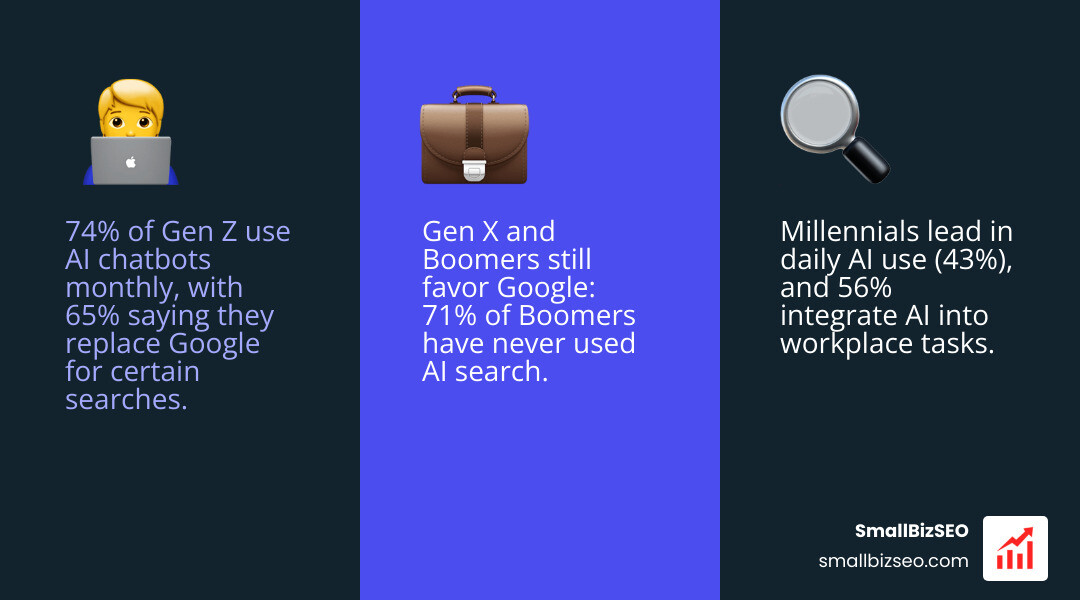
Younger adults treat conversational interfaces as interactive thinking partners rather than simple index lookups. Approximately 74% of young adults report using an AI chatbot in the last month, and 65% state they have actively used an AI assistant as a direct replacement for traditional search queries. Furthermore, research featured in the Shift Browser report on generational AI usage indicates that 47% of 18- to 24-year-olds reach for an AI interface first when looking up information, edging out the 42% who still instinctively start with a traditional search bar.
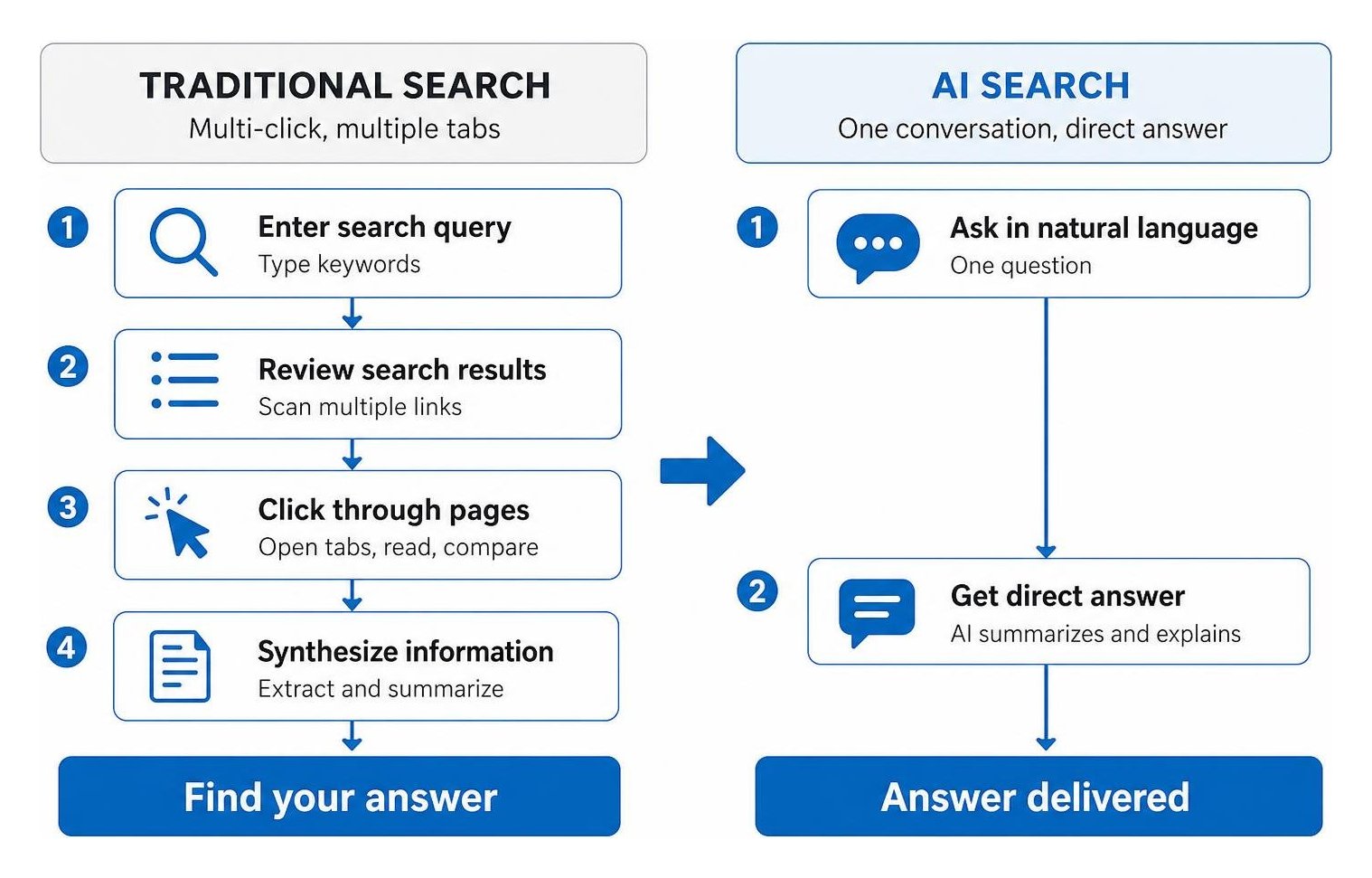
Millennials, meanwhile, represent the true power users of digital automation. About 43% of Millennials use AI tools every single day, and 56% actively integrate them into workplace tasks to draft communications, parse datasets, and organize complex projects. Our collection of generative AI statistics every business owner should know shows that 62% of Millennials believe conversational tools genuinely improve their day-to-day productivity. Rather than sorting through ten blue links, these cohorts prioritize immediate synthesis.
AI Search Demographics: Which Generations Are Replacing Google With AI for Shopping and Product Discovery?
Direct answer: AI tools are quickly becoming a core part of product discovery and comparison, with conversational recommendations directly driving retail purchases.
Commercial search queries are shifting from manual browsing to AI-guided curation. Instead of typing fragmented keywords into Google to find buying guides, shoppers frequently ask language models to compare product specifications, weigh pros and cons, and summarize buyer feedback. Findings on AI search utilization and consumer shifts reveal that 47.5% of AI search users have completed a purchase based on a direct conversational recommendation.
This evolution in consumer behavior highlights several distinct buying patterns:
- Product Comparisons: Shoppers paste two or three items into a prompt to evaluate differences instantly.
- Tailored Recommendations: Users describe their exact lifestyle constraints to receive custom product picks.
- Discovery Across Generations: While Gen Z frequently discovers items on social apps, Gen X displays up to 80% search adoption when researching practical purchases.
To learn more about how conversational tools impact merchant sales, explore our breakdown of AI shopping statistics redefining digital retail.
Why Are Gen X and Baby Boomers Slower to Abandon Google?
Direct answer: Established habits, privacy concerns, and a strong preference for original source links make older generations slower to leave traditional search engines.
While younger users embrace conversational assistants for speed, older generations often maintain strict search fidelity toward legacy engines. About 65% of Gen X adults use AI tools occasionally, yet they still overwhelmingly default to traditional search engines for critical information. Among Baby Boomers, 71% have never used standalone tools like ChatGPT, and 40% of adults over 65 state they never interact with generative interfaces intentionally.
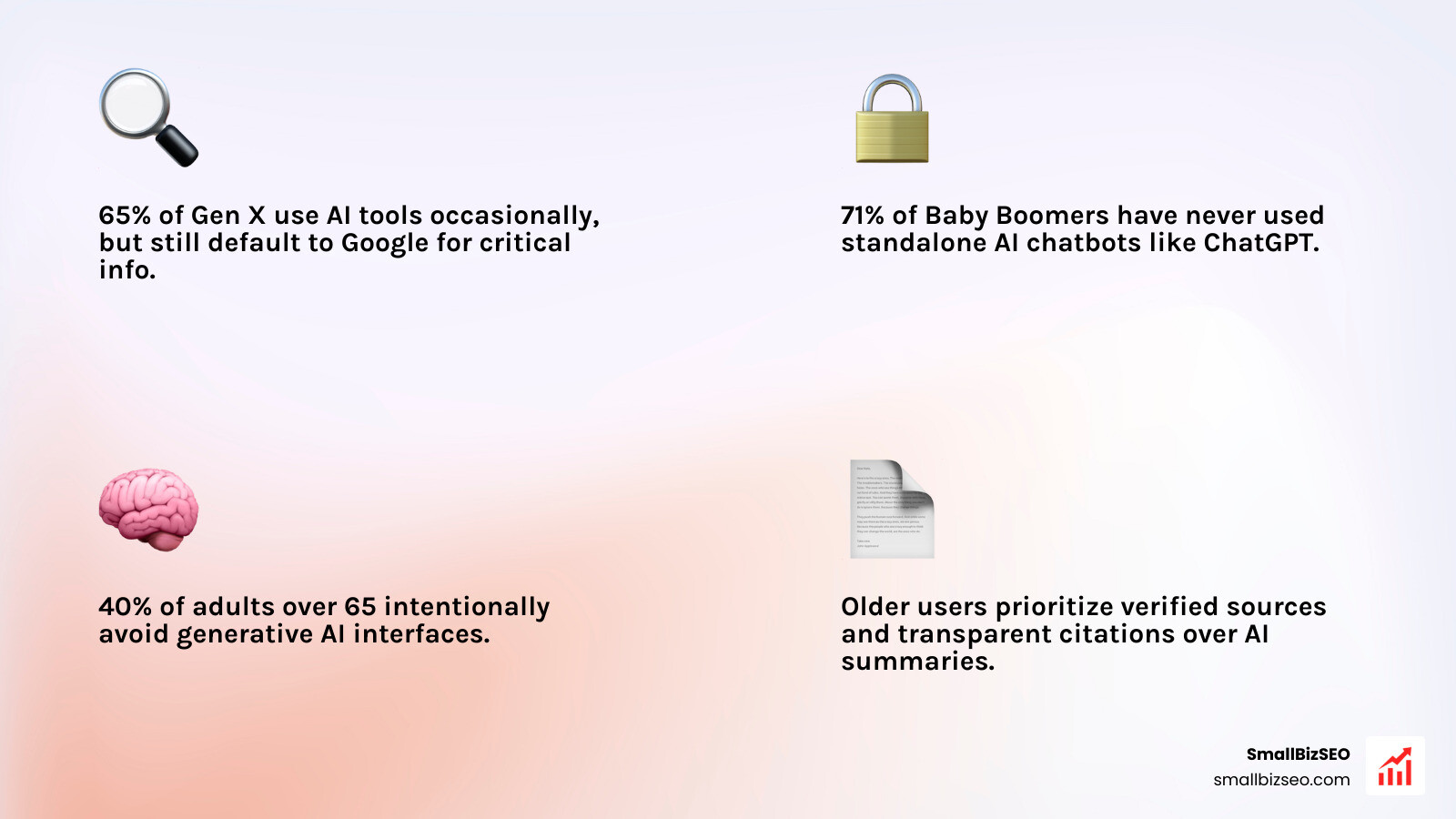
Much of this hesitation stems from cognitive trust barriers. Older searchers prefer clicking directly through to verified publisher websites where they can assess the author's credibility firsthand. Examining consumer trust in artificial intelligence clarifies why: older users place significant value on transparent citations, clear source attribution, and strict data privacy, viewing unverified algorithmic summaries with healthy skepticism.
Which AI Search Platforms Are Capturing Market Share Across Age Groups?
Direct answer: The conversational search landscape has fragmented into a multi-platform environment led by ChatGPT, Gemini, and Claude alongside specialized answer engines.
The market for generative answers is no longer dominated by a single player. As detailed in McKinsey's analysis on the new front door to the internet, audience traffic is expanding across diverse ecosystems. ChatGPT’s overall share of web traffic among generative tools has normalized toward 53%, while Google’s Gemini has captured roughly 28% and Anthropic’s Claude has grown toward 9%.
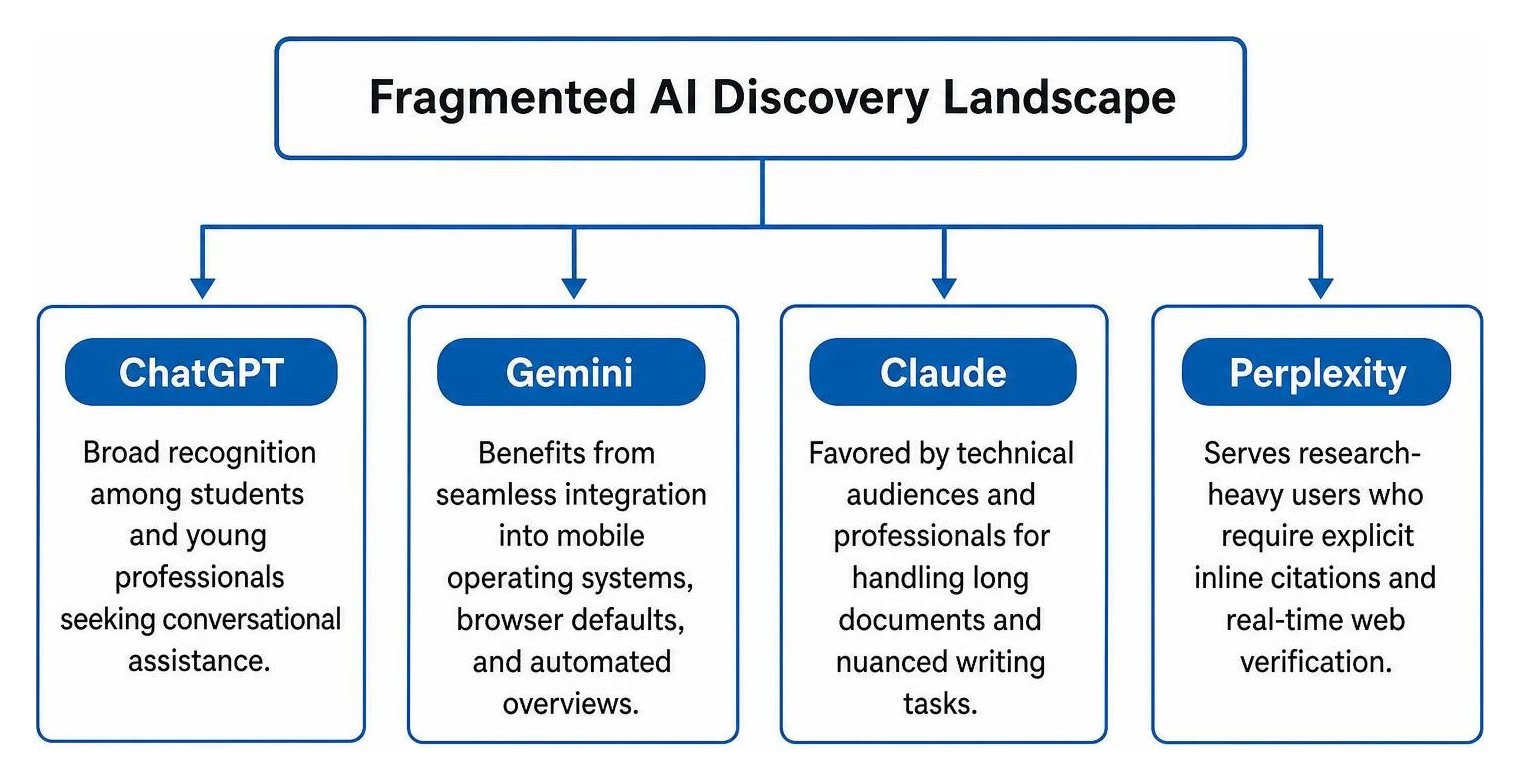
Platform preferences often align with user interfaces and mobile accessibility:
- ChatGPT: Retains broad recognition among students and young professionals seeking conversational assistance.
- Google Gemini: Benefits from seamless integration into mobile operating systems, browser defaults, and automated overviews.
- Claude: Favored by technical audiences and professionals for handling long documents and nuanced writing tasks.
- Perplexity: Serves research-heavy users who require explicit inline citations and real-time web verification.
Because models frequently refresh their information sources, monitoring why generative search engines change their brand picks is crucial for tracking online visibility.
Navigating the Future of Multi-Platform Search
Direct answer: Businesses should optimize their content for both traditional search rankings and conversational AI citations using structured data, authoritative brand mentions, and clear factual answers.
Adapting to generational shifts requires an expanded digital marketing strategy. While traditional SEO remains vital for capturing high-intent navigational queries and local searches, small businesses must also embrace Generative Engine Optimization (GEO). At SmallBizSEO, our data-driven Velocity framework helps companies build strong search visibility and E-E-A-T authority across every major search interface.
To maintain visibility across all demographic groups, implement these core practices:
- Structure Clear Factual Answers: Add concise definitions, summary bullets, and structured schema so language models can easily parse and cite your pages.
- Publish Deep Original Research: Large language models reference unique data points, statistics, and industry benchmarks when building user answers.
- Build Unlinked Brand Authority: Generative engines evaluate industry mentions, press coverage, and reviews across the web to gauge credibility.
- Balance Speed with Depth: Satisfy younger searchers seeking immediate takeaways while providing the comprehensive sourcing that older buyers expect.
To ensure your digital assets stay competitive across both Google and generative engines, discover our specialized AI SEO services and our complete guide to updating your search engine optimization for the AI era.