How Much Money Are Businesses Spending on AI? Investment Statistics and Projections

AI has moved beyond a small experimental budget and become a major enterprise infrastructure commitment. For businesses evaluating how much money companies are spending on AI, investment statistics and projections estimate global annual spending of $2.5 trillion to $2.6 trillion, with yearly growth of roughly 44% to 47%. That total spans data-center construction, computing hardware, cloud capacity, and enterprise software subscriptions.
To put current enterprise spending into perspective, consider how modern AI capital allocation compares to historical mega-projects:
- The Manhattan Project: Cost approximately $36 billion in inflation-adjusted terms—a fraction of modern annual hardware capex.
- The Apollo Program: Totaled roughly $257 billion across its entire multi-year lifecycle, an amount now eclipsed by single-year private capital deployment in computing clusters.
- The US Interstate Highway System: Cost roughly $500 billion across several decades of nationwide construction.
Artificial intelligence spending now accounts for approximately 2% of overall gross domestic product in major technology-driven economies, matching the peak investment phases of the railroad boom and the early commercial internet expansion.
How Are Hyperscaler Capex and Venture Capital Mega-Rounds Shaping AI Investment?
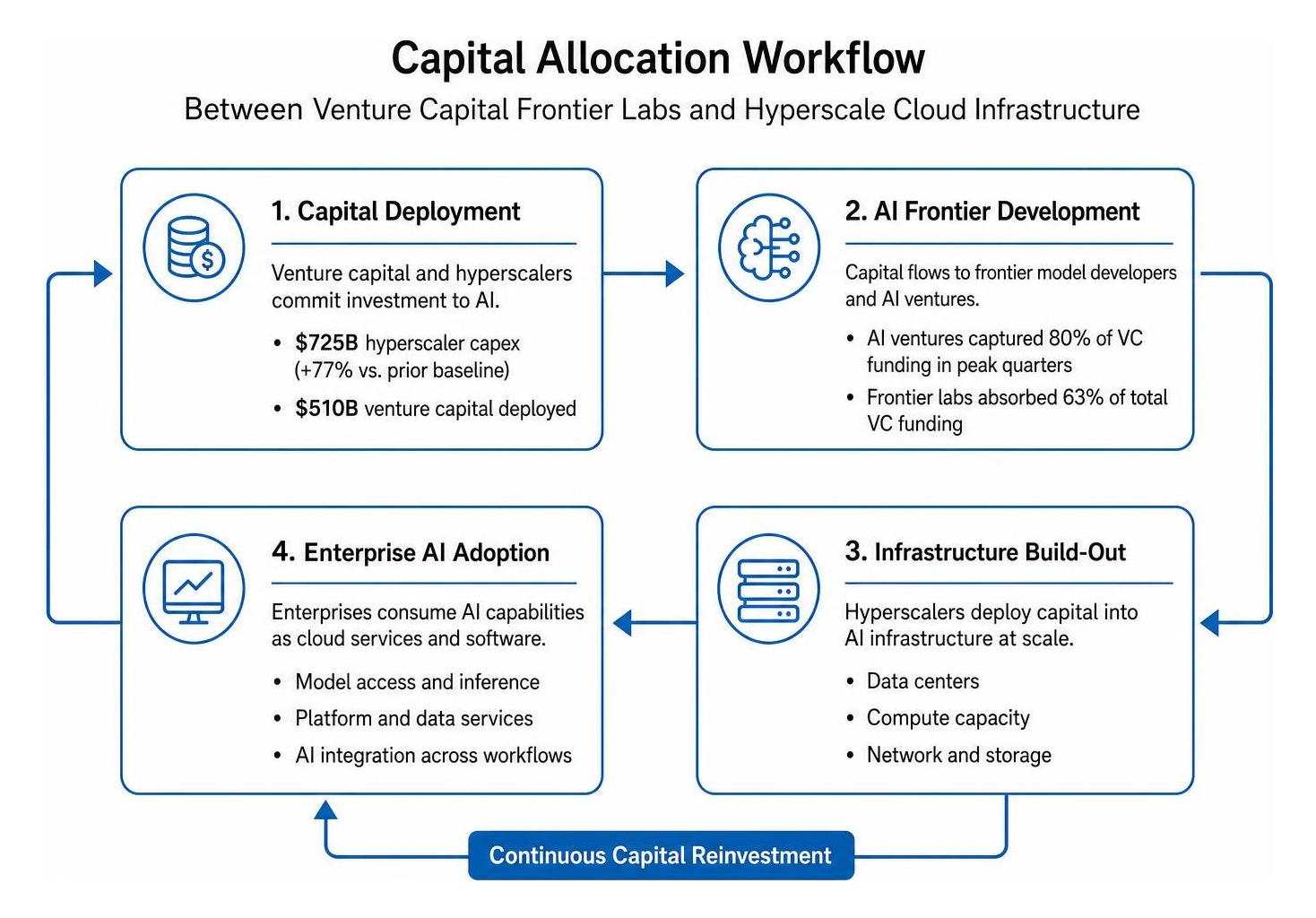
Hyperscalers and venture capital firms represent the two largest engines funding the artificial intelligence expansion. Hyperscale cloud providers—primarily Amazon, Microsoft, Alphabet (Google), and Meta—have collectively guided to $725 billion in combined capital expenditure, representing a 77% increase over prior baseline levels.
According to the Goldman Sachs AI Investment Forecast, global AI investment continues to accelerate across both public and private markets, driven by aggressive infrastructure build-outs.
In private equity and venture markets, capital concentration has reached historic highs:
- Venture capital deployment reached $510 billion in the first half of a single fiscal cycle.
- AI ventures captured 80% of all venture funding during peak quarters.
- Frontier model developers, including OpenAI, Anthropic, xAI, and autonomous systems providers like Waymo, absorbed 63% of total venture capital funding.
Where Is AI Investment Concentrated?
Private artificial intelligence capital is heavily concentrated in North America, while international competitors rely on diverse public-private funding vehicles.
| Region | Primary Funding Channels | Notable Characteristics |
|---|---|---|
| United States | Private Venture Capital, Corporate Capex ($285.9B+ private total) | Dominates frontier model training, custom silicon design, and cloud host infrastructure. |
| China | State Guidance Funds ($184B) & Private Venture ($12.4B) | Focuses on open-weight foundation models (e.g., DeepSeek), robotics, and public infrastructure. |
| European Union & UK | National AI Innovation Plans (€109B) & Private Tech Hubs | Emphasizes industrial compliance, enterprise software integration, and regional research institutes. |
| Asia-Pacific | Public-Private Infrastructure Alliances | Rapid enterprise adoption with software market share projected to reach 47%. |
Where Is Business AI Spending Going?
Hardware and physical compute infrastructure claim the vast majority of enterprise AI budgets, followed by software integration, cloud access tiers, and specialized consulting.
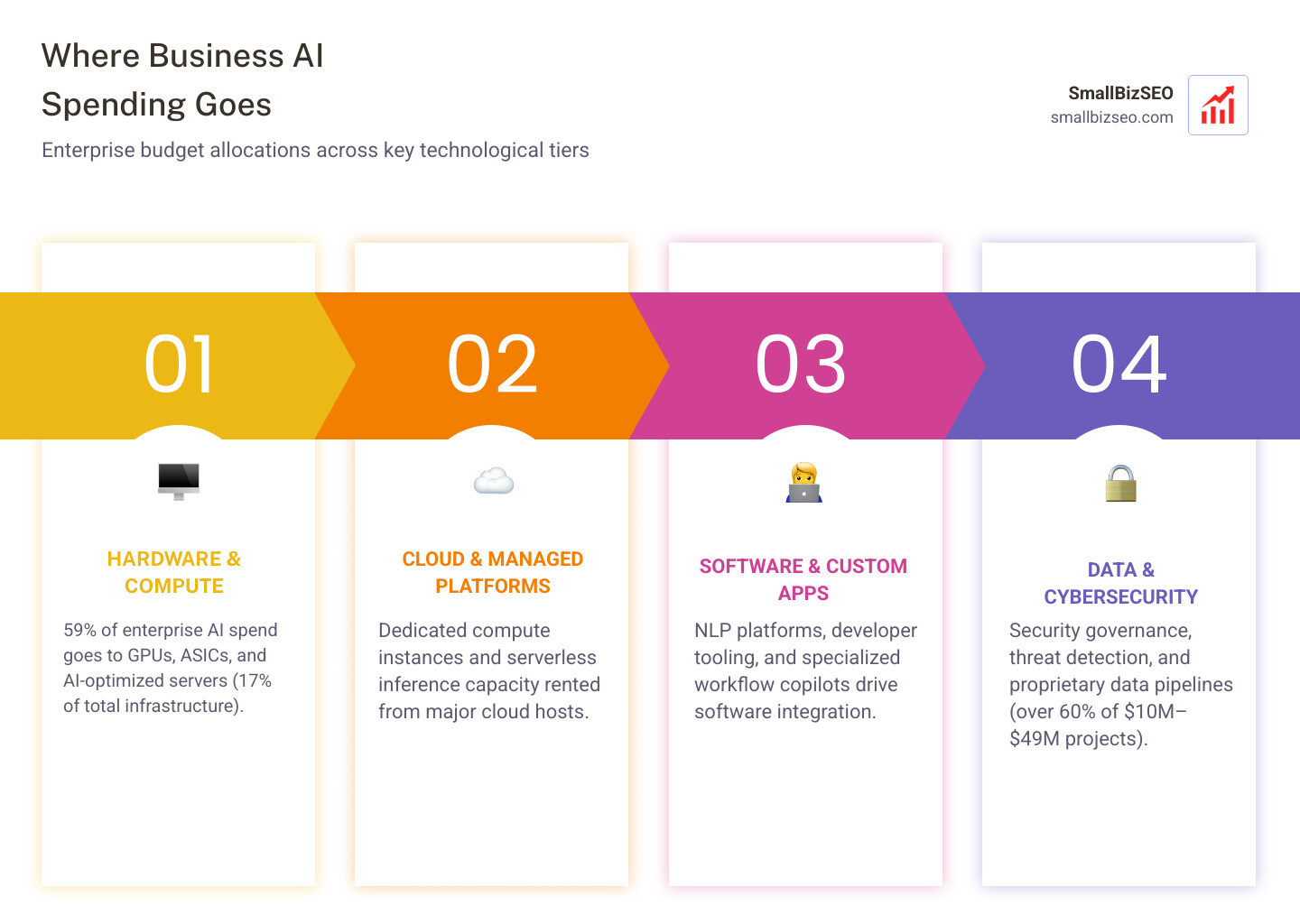
Enterprise budget allocations are distributed across key technological tiers:
- Hardware & Compute Infrastructure (59%): High-performance graphics processing units (GPUs), custom application-specific integrated circuits (ASICs), and AI-optimized enterprise servers (accounting for 17% of total infrastructure spend).
- Cloud Capacity & Managed Platforms: Dedicated compute instances and serverless inference capacity rented from major cloud hosts.
- Enterprise Software & Custom Applications: Natural language processing platforms, developer tooling, and specialized workflow copilots.
- Data Architecture & Cybersecurity: Enterprise security governance tools, threat detection, and proprietary data pipeline structuring (representing over 60% of enterprise projects in the $10M–$49M range).
How Does AI Investment Vary by Industry?
Enterprise artificial intelligence adoption varies by vertical, depending on direct return on investment opportunities and workflow compatibility:
- Financial & Insurance Services: Represents the largest absolute spending sector. Financial institutions deploy models for automated fraud analysis, algorithmic underwriting, and customer support routing.
- Healthcare & Life Sciences: Allocates substantial budgets toward accelerated molecule discovery, predictive diagnostic imaging, and clinical administrative automation.
- Manufacturing & Logistics: Invests heavily in industrial robotics and predictive maintenance systems, where single enterprise deployments average up to $20 million per program.
- Professional Services & IT: Directs capital toward generative coding assistants, automated drafting platforms, and updating your search engine optimization for the AI era.
According to research from the Oxford Economics AI Projections, artificial intelligence is projected to grow from 7% to roughly 22% of all enterprise technology expenditures over the coming decade.
How Are Businesses Investing in Agentic AI and Cross-Functional Automation?
Organizations are shifting capital away from simple conversational chatbots toward agentic AI systems that execute complex, multi-step operations without continuous human prompting.
Findings from the KPMG AI Pulse Survey reveal that 62% of enterprises have deployed autonomous AI agents, with 73% of those businesses using them to automate multi-functional operational workflows.
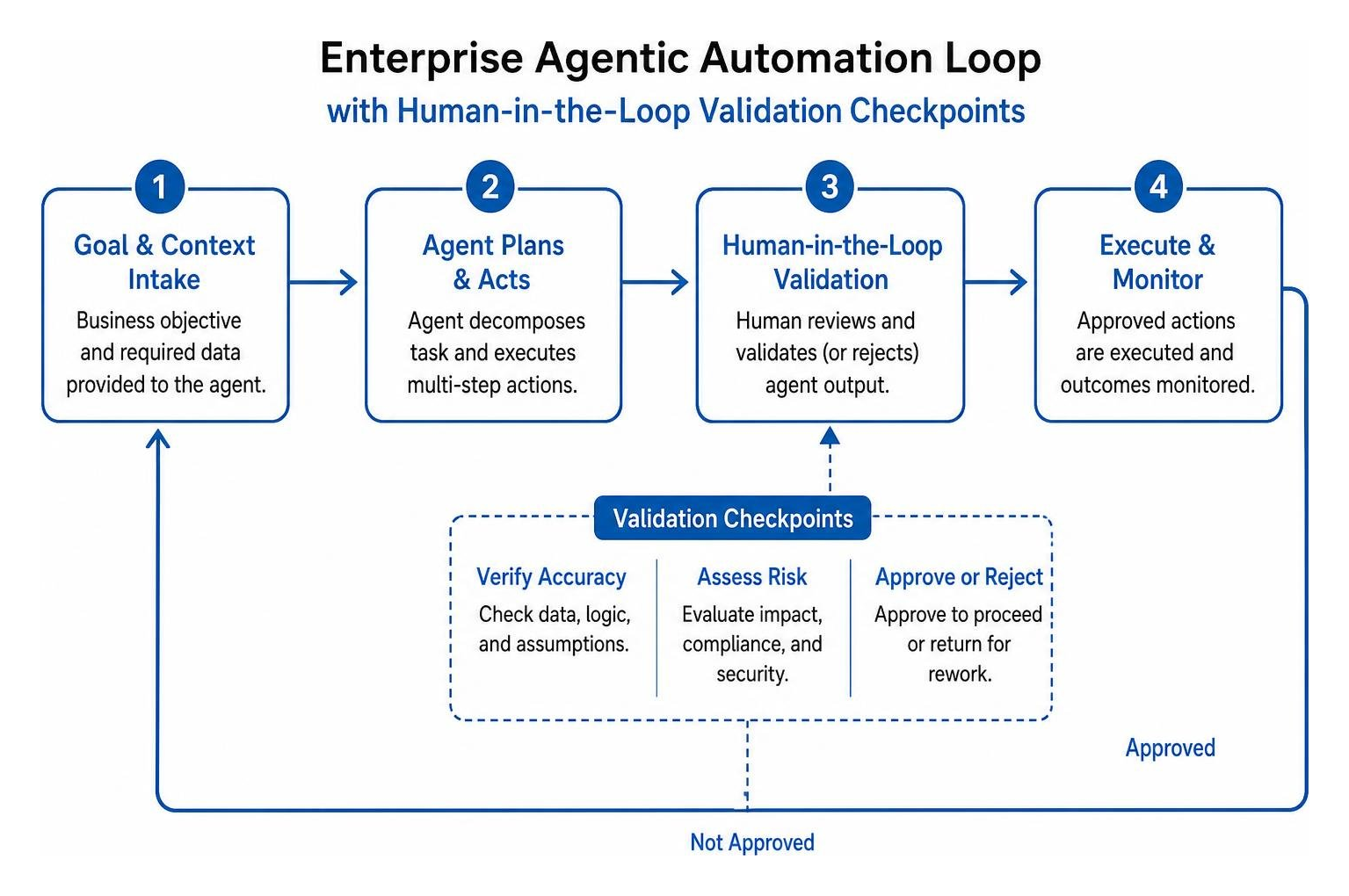
Deploying agentic systems requires balanced spending across several organizational priorities:
- Governance Frameworks: 91% of executives cite data privacy and cybersecurity controls as decisive factors in their automation rollout strategy.
- Human-in-the-Loop Safeguards: Implementing verification checkpoints to validate agent decisions before execution.
- Workforce Reskilling: 87% of enterprises are actively upskilling staff to operate alongside autonomous systems, with 71% of leaders offering salary premiums for verified AI management skills.
Is AI Adoption Delivering a Return on Investment?
While enterprise adoption rates have climbed to 88%, realized financial returns remain unevenly distributed across organizations.

This disconnect between deployment and financial return is characterized by several core market metrics:
- The Adoption-Impact Gap: Despite 88% of businesses using artificial intelligence tools, only 6% qualify as high-performing organizations that achieve greater than a 5% positive impact on earnings before interest and taxes (EBIT).
- Executive Return Metrics: 56% of enterprise chief executive officers report negligible short-term net financial return on their AI investments.
- Task Efficiency vs. P&L Growth: Task-level productivity gains (such as developers writing code 55% faster) often fail to produce bottom-line earnings growth without complete workflow redesign.
- End-User Value Capture: Significant value generated by generative tools currently accrues as consumer surplus—estimated at $172 billion annually in major economies—rather than direct corporate profits.
Is the Current AI Build-Out Sustainable or a Bubble?
The sustainability of ongoing capital deployment depends on closing the gap between infrastructure costs and software application revenue.
Market analysts debate whether current capital intensity represents an unsustainable bubble or a necessary infrastructure build-out. Moving beyond the hype unlocking the true AI SEO advantage requires organizations to evaluate whether infrastructure utilization matches enterprise demand.
Unlike the dot-com era, current hyperscaler capital expenditure is funded by profitable technology corporations with substantial cash reserves. However, high computing costs, long integration timelines, and model commoditization could cause a temporary correction in enterprise hardware spending.
How Much Could Businesses Spend on AI Over the Next Decade?
Long-term economic projections indicate sustained spending growth throughout the next decade, with corporate investments expanding into every major industry vertical:
- Long-Term Enterprise Run Rates: Global technology spending is projected to hit $3.3 trillion, with national corporate spend in leading economies rising toward $1.75 trillion over a ten-year horizon.
- Macroeconomic Value: Artificial intelligence is projected to contribute substantially to global economic output through automated labor support and accelerated scientific development.
- Physical Scaling Bottlenecks: Future spending trajectories face physical constraints, including electrical grid capacity, power transformer lead times, and advanced semiconductor fabrication limits.
Frequently Asked Questions About Enterprise AI Investment
What Is the Total Global Business Spending on AI Annually?
Total worldwide full-stack business spending on artificial intelligence—including hardware, cloud computing, enterprise software, and professional implementation services—is forecast between $2.5 trillion and $2.6 trillion, representing an annual growth rate of roughly 44% to 47%.
Which Industries Are Investing the Most Capital in Artificial Intelligence?
Financial and insurance services lead total enterprise capital allocation, followed closely by technology services, professional consulting, advanced manufacturing, and healthcare life sciences.
What Percentage of Companies Are Achieving a Positive ROI From Their AI Investments?
Approximately 79% of organizations report achieving measurable financial returns or expect to realize positive ROI within a twelve-month operational window. However, only 6% of enterprises currently achieve substantial EBIT improvements exceeding 5%.
Turning AI Capital Investment Into Measurable Business Growth
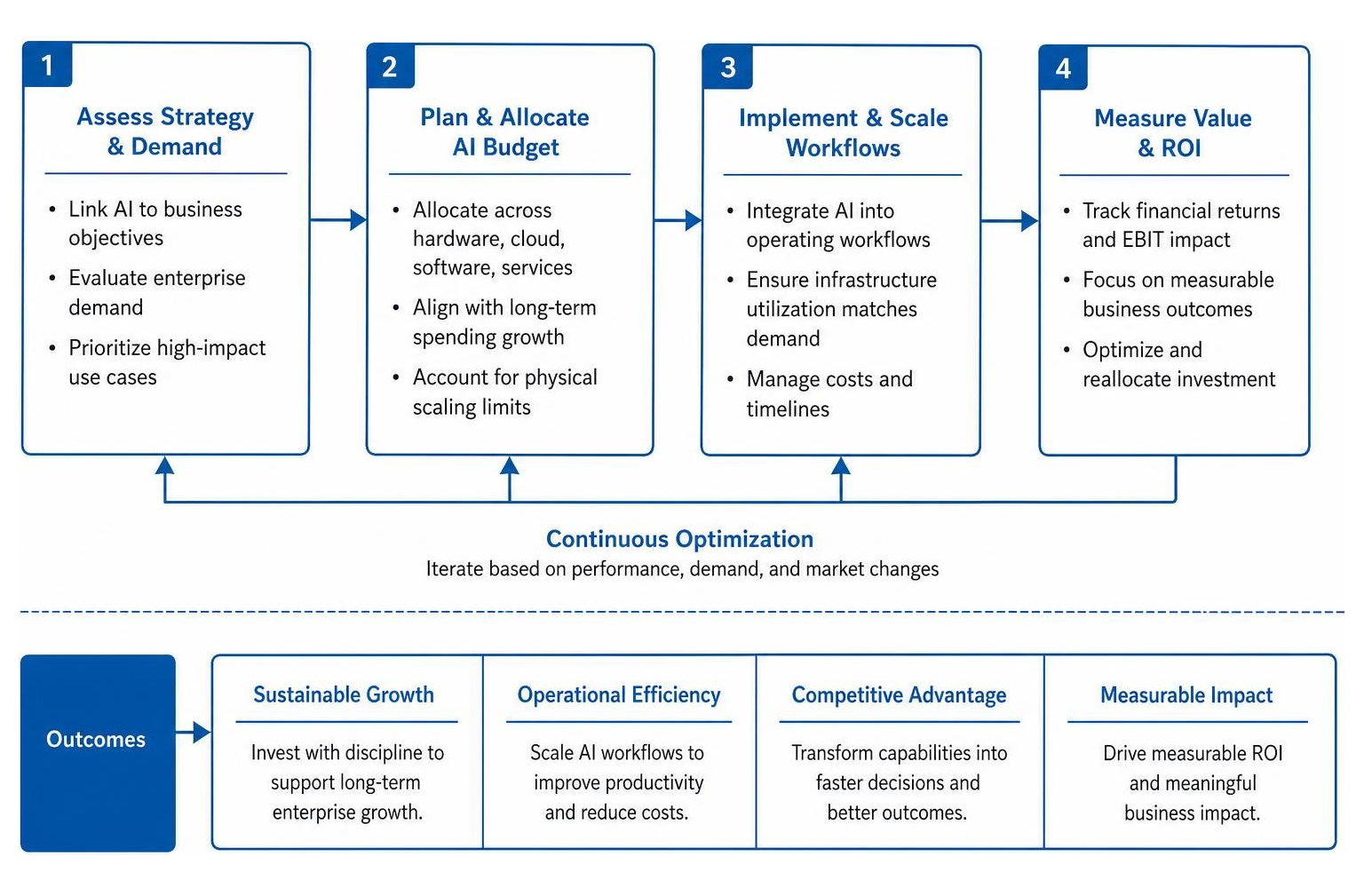
Navigating modern technology budgets requires discipline, clear business metrics, and workflow redesign. Rather than spending capital on unproven software platforms, sustainable growth comes from connecting AI capabilities directly to customer acquisition and organic search visibility.
At SmallBizSEO, we help businesses capture measurable returns from digital search disruption. Through our proprietary, data-driven Velocity framework, we deliver transparent technical SEO, content strategy, and digital authority building that translates organic discovery into bottom-line revenue. Explore our full suite of AI SEO services to align your marketing budget with proven, revenue-generating search performance.