How Much Money Does AI Actually Save Businesses? Productivity and ROI Statistics!

How Much Money Does AI Actually Save Businesses? Productivity and ROI Statistics
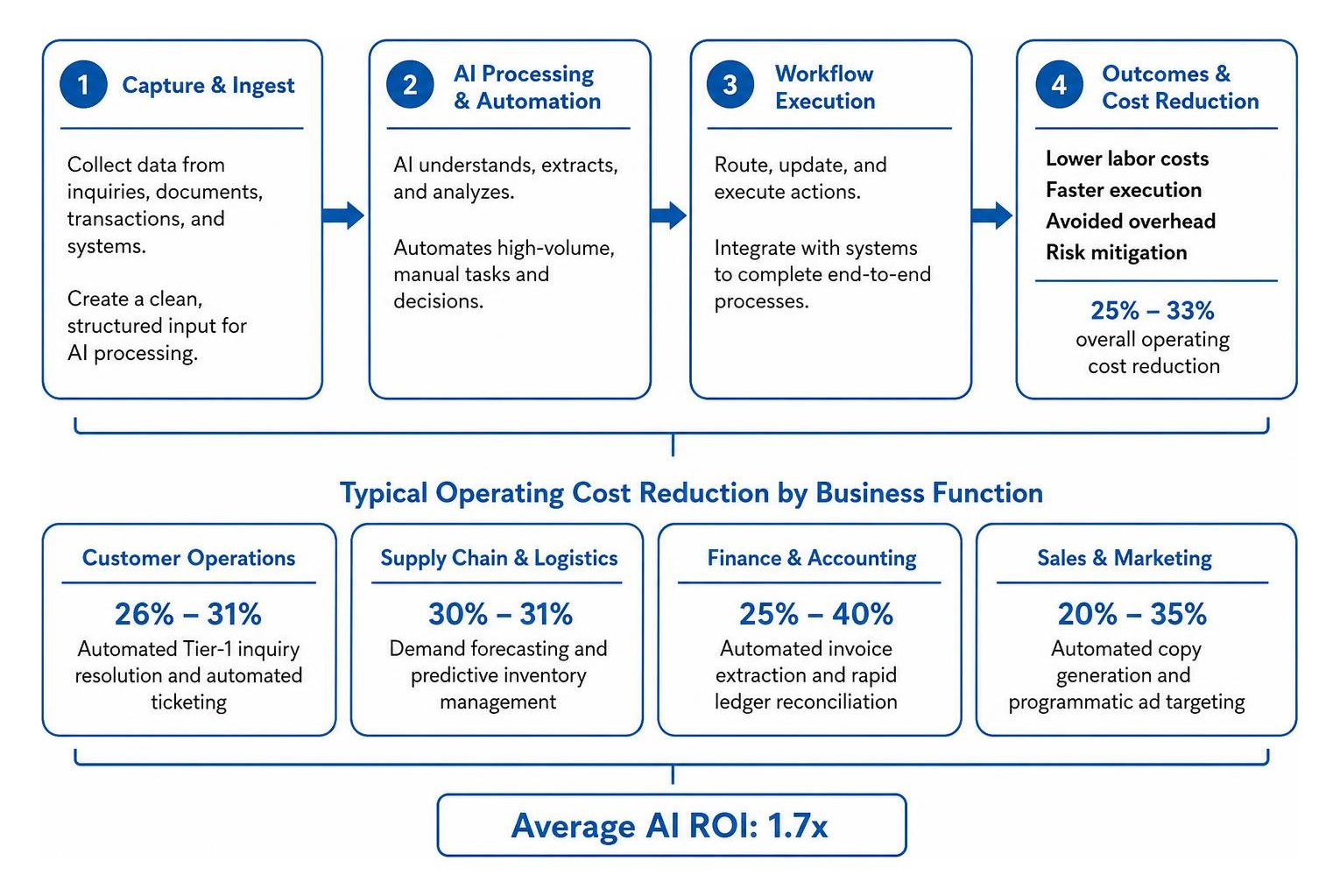
Businesses integrating artificial intelligence typically see measurable returns through reduced labor costs, faster execution, and avoided operational overhead. Comprehensive studies show average returns hovering around 1.7x across enterprise rollouts, with specific high-volume cloud deployments yielding returns up to 284%.
The exact dollar amount saved depends heavily on operational scale, labor intensity, and initial process efficiency. While enterprise organizations report multi-million-dollar bottom-line impacts, smaller operations capture proportional savings by reclaiming valuable labor hours. For leaders evaluating practical adoption, this analysis, “How Much Money Does AI Actually Save Businesses? Productivity and ROI Statistics,” shows that returns accelerate when tools are embedded directly into day-to-day operational workflows.
| Business Function | Typical Operating Cost Reduction | Primary Mechanism of Savings |
|---|---|---|
| Customer Operations | 26% – 31% | Automated Tier-1 inquiry resolution and automated ticketing |
| Supply Chain & Logistics | 30% – 31% | Demand forecasting and predictive inventory management |
| Finance & Accounting | 25% – 40% | Automated invoice extraction and rapid ledger reconciliation |
| Sales & Marketing | 20% – 35% | Automated copy generation and programmatic ad targeting |
How Does AI Reduce Enterprise Costs in Practice?
Enterprise cost reduction occurs primarily through a combination of direct labor substitution, process acceleration, and risk mitigation. When analyzing comprehensive corporate budgets across core operational functions, artificial intelligence has demonstrated the potential to reduce overall operating expenditures by 25% to 33%, through careful budget mapping that identifies which functions benefit most from automation.
According to McKinsey generative AI productivity research, the economic potential of generative automation centers on its ability to unlock billions in productivity across customer operations, software engineering, and marketing. Rather than replacing entire departments, software handles high-volume, manual tasks such as data entry, policy checking, and document routing.
For instance, processing complex invoices often shifts from days of manual data extraction to minutes of automated parsing. As highlighted in a Capgemini study on AI-driven business operations, organizations are averaging a 1.7x return on their AI investments by embedding intelligent automation directly into daily workflows. By systematically targeting bottlenecks, finance and administration teams eliminate processing backlogs, lower error rates, and avoid expensive compliance audits.
How Much Can AI Save Small Businesses Across Core Operations?
For small businesses, the primary financial return comes from eliminating repetitive administrative overhead without hiring additional full-time staff. By implementing focused AI tools for customer inquiry handling, scheduling, and local marketing, smaller enterprises can significantly expand their operating margins and overall margin expansion over time.
A practical Forbes guide on measuring AI returns points out that tracking granular metrics—such as customer acquisition cost, conversion rate, and recovered hours—proves the financial value of modest software subscriptions. For example, a small e-commerce retailer using intelligent demand forecasting can avoid thousands of dollars in monthly inventory waste, while service businesses streamline acquisition by measuring AI SEO returns to capture qualified search demand efficiently.
Furthermore, small teams reduce software bloat by unifying customer communication and automated appointment booking into centralized intelligent platforms, preventing lost sales leads and lowering client acquisition overhead. These cumulative gains illustrate, in concrete terms, how much money AI actually saves businesses when applied consistently to everyday operations, and the productivity and ROI statistics bear this out across industries.
How Does AI Improve Productivity and Workforce Efficiency Across Industries?
AI drives productivity by compressing the time required to complete cognitive and manual tasks, allowing existing teams to deliver higher output without proportional headcount expansion. Across knowledge-work domains, automated systems handle data collection and initial drafting, freeing human professionals to focus on strategic execution.

What Productivity Gains Does the Maven Smart System Case Study Report?
The defense sector provides some of the most striking empirical evidence of AI-driven productivity. The Maven Smart System (MSS) was designed to solve severe analytical bottlenecks where staff spent 97% of their time gathering data and only 3% analyzing it.
By integrating computer vision and natural-language large language models, MSS revolutionized operations:
- Computer vision delivered an initial tenfold increase in battlefield visualization and targeting efficiency.
- Integrating large language models added an additional fivefold speed boost in operational analysis.
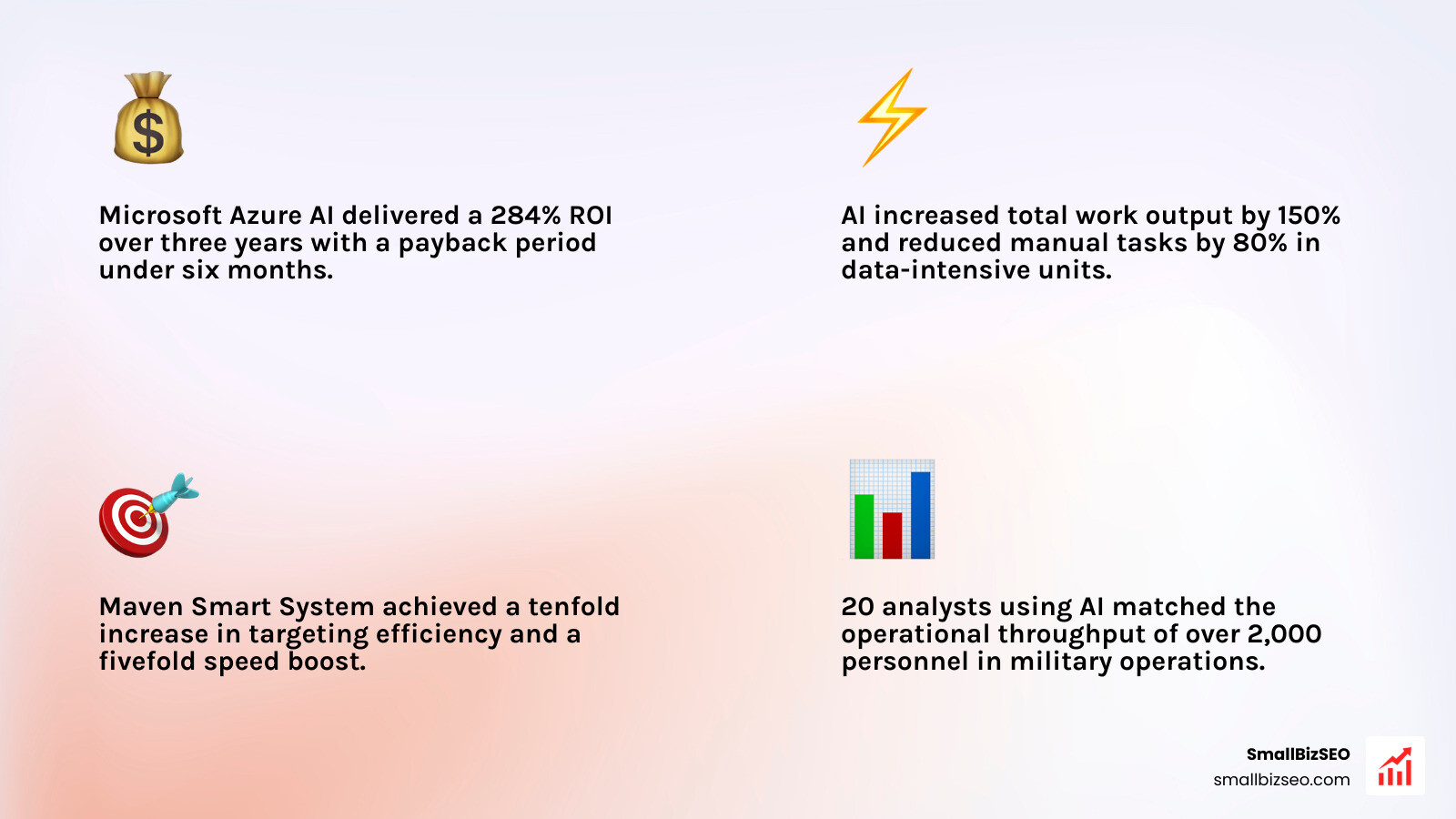
- During high-tempo operations, a dedicated unit of roughly 20 analysts using MSS matched the operational throughput of historic military operations that previously required more than 2,000 personnel.
- The system's active user base scaled rapidly to approximately 80,000 users, demonstrating how centralized, model-driven intelligence eliminates manual data consolidation.
This dramatic acceleration in cognitive processing highlights how automated data synthesis allows skilled personnel to bypass low-level extraction and focus exclusively on high-stakes decision-making and operational execution.
What ROI and Productivity Gains Does Microsoft Azure AI Report?
In enterprise computing, cloud-based machine learning systems provide consistent financial and operational benchmarks. A comprehensive Total Economic Impact analysis of enterprise AI conducted by Forrester on Microsoft Azure AI revealed significant returns:
- An overall return on investment of 284% over a three-year evaluation cycle.
- A complete financial payback period achieved in less than six months.
- A 150% increase in total work output across data-intensive business units.
- An 80% reduction in manual, repetitive tasks, producing over $1.6 million in direct labor savings.
- A 7% reduction in total operating costs, equating to $16 million in enterprise savings.
These efficiency gains mirror the financial benefits achieved by automating tedious SEO tasks in everyday business operations, where reducing manual data gathering directly boosts bottom-line profitability. When teams replace spreadsheet maintenance and routine technical auditing with automated data collection, they deliver higher strategic output with consistent quality.
What Challenges Affect AI ROI and Financial Payback Timelines?
Achieving a positive return on AI investments requires navigating implementation barriers, hidden integration costs, and operational friction. Simply buying an AI license does not guarantee financial returns if the organization lacks the infrastructure to use it effectively.
What Hidden Costs and Data Challenges Can Affect AI ROI?
The most common reason AI initiatives fail to deliver expected financial returns is inadequate data infrastructure. AI models require clean, accessible, and structured data to generate accurate results. When businesses deploy software without addressing underlying data silos, staff spend billable hours fixing erroneous outputs.
Key challenges impacting returns include:
- Data Cleansing and Integration: Connecting modern models to legacy internal databases often requires upfront technical consulting.
- Employee Training and Change Management: If employees do not adopt new systems, software subscription costs continue without delivering efficiency gains.
- Model Maintenance and Governance: Ensuring ongoing accuracy requires active supervision to prevent drift and compliance issues.
- Strategic Selection: Deploying comprehensive AI SEO services delivers higher returns than purchasing disconnected single-use tools without a clear business objective.
- Workflow Alignment: Introducing intelligent software into fragmented processes without clear standard operating procedures often leads to workflow bottlenecks and inconsistent adoption across teams.
How Long Does AI Take to Pay Back, and What Long-Term Value Can It Create?
Most structured AI deployments follow a predictable breakeven curve. While out-of-the-box productivity tools can provide immediate labor savings within days, broader functional automation typically delivers full payback within six months to two years.
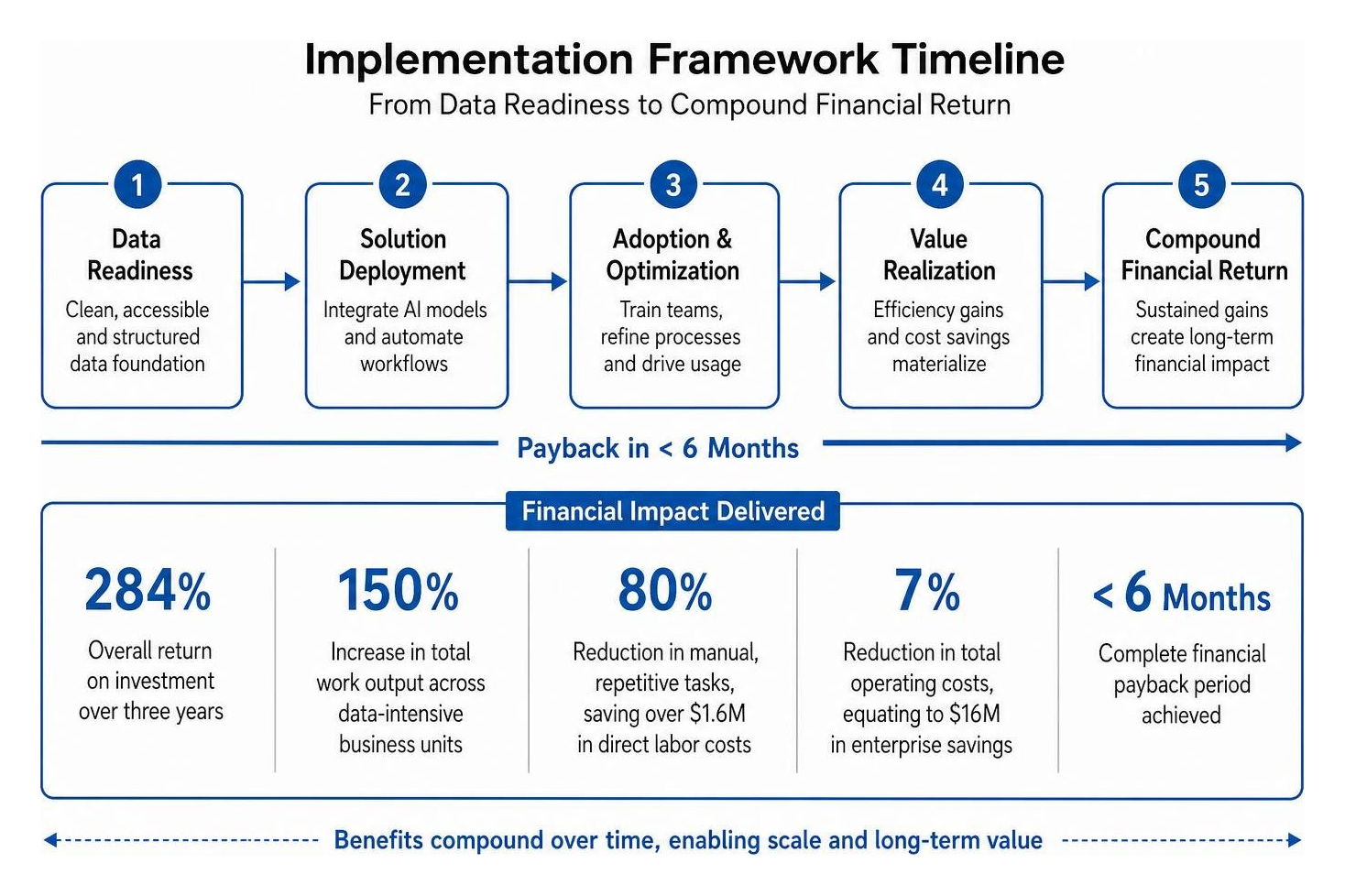
Once initial deployment costs are amortized, the financial benefits compound. Businesses achieve continuous scale economies, enabling them to expand transaction volumes and serve larger customer bases without adding proportional operational overhead. This compounding operational leverage strengthens gross margins and frees up capital for strategic expansion.
Frequently Asked Questions About Business AI Savings and ROI
What Is the Average ROI Businesses Achieve From AI Investments?
Cross-industry surveys show businesses achieve an average ROI of 1.7x on generative AI projects, with specialized enterprise cloud implementations reporting returns exceeding 280% when deployed across mature digital processes.
Which Business Departments Experience the Fastest Cost Savings From AI?
Customer service and marketing departments generally realize the quickest savings. Automated Tier-1 support chatbots cut query-handling costs by up to 30%, while automated content workflows reduce external agency expenditures immediately.
How Long Does It Typically Take for an AI Deployment to Break Even?
Targeted software applications frequently achieve financial breakeven in less than six months. Larger enterprise implementations involving custom data integration generally project positive returns within a one-to-three-year window.
Building Sustainable Value Through Intelligent Automation
Maximizing the financial return of AI requires treating technology as an operational capability rather than an isolated experiment. To capture tangible cost savings and long-term margin growth, businesses must establish clear baseline metrics, prioritize high-volume bottlenecks, and ensure data integrity before scaling tools.
At SmallBizSEO, we implement a data-driven framework designed to help businesses capture real visibility and operational efficiency. Choosing to partner with a dedicated AI SEO company ensures that your business leverages automated workflows that drive qualified traffic, convert prospects, and maximize bottom-line ROI.