How Smart Chunking Preserves Document Meaning in Large Context Windows

How Should You Split a Long Source Document Without Losing Important Context?
To split a document effectively, choose chunk boundaries based on the natural structure and meaning of the text, then tune chunk size and overlap to match your specific retrieval requirements. Knowing how to split a long source document without losing important context is essential because dumping hundreds of pages of raw text into a single prompt often degrades performance. Large language models frequently struggle with the "lost-in-the-middle" problem, where critical details buried deep inside extensive prompts receive less attention than information placed at the immediate beginning or end. Splitting source documents—commonly known as chunking—remains essential for Retrieval-Augmented Generation (RAG), automated extraction, and document synthesis.
When documents are chopped arbitrarily, context breaks down. Key definitions become separated from their clauses, tables lose their column headers, and pronouns lose their referents. Smart chunking solves this by establishing clean boundaries, retaining structural hierarchies, and ensuring that every indexed segment carries the semantic baggage it needs to stand on its own.
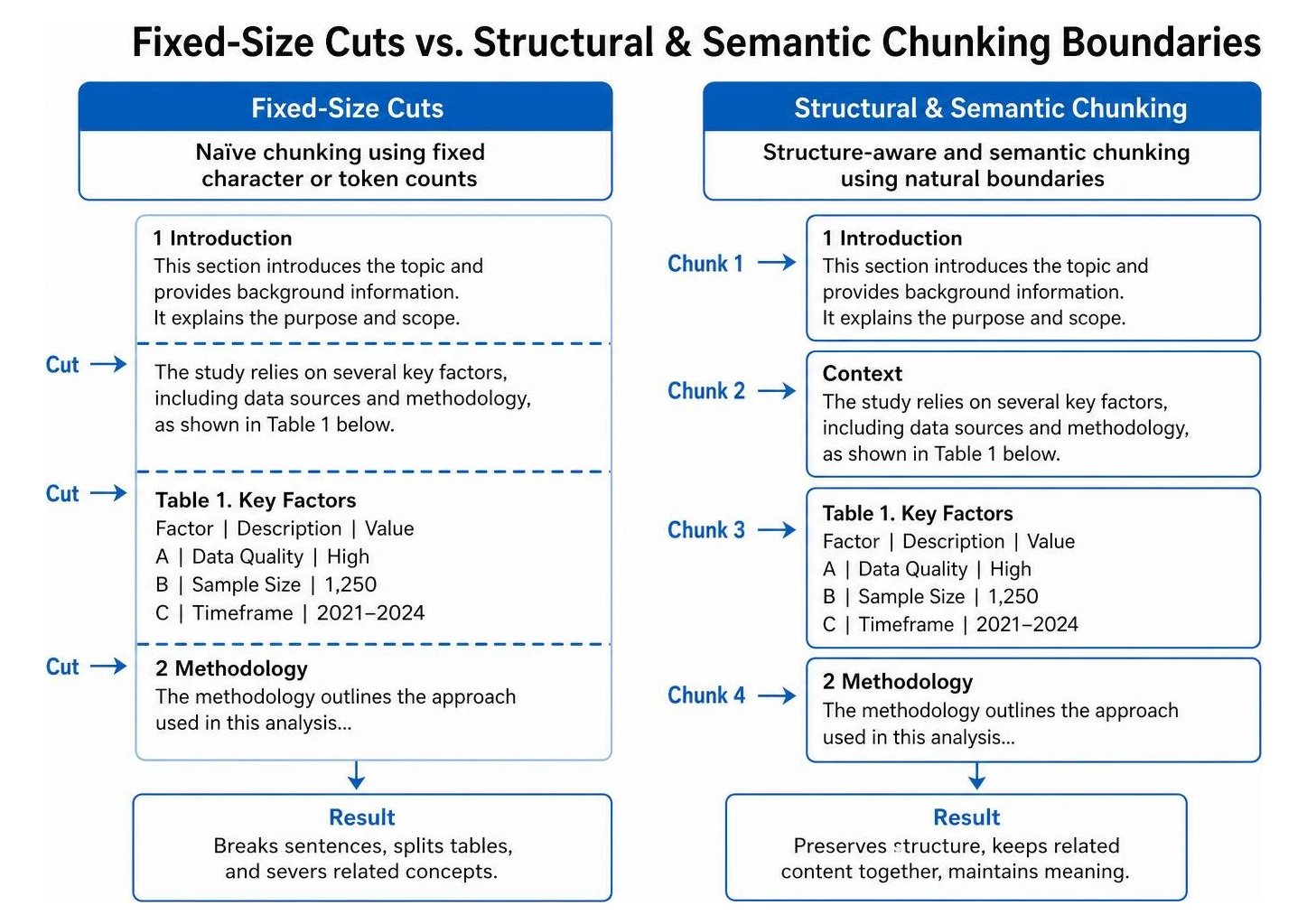
Naïve chunking relies entirely on fixed character or token counts. For example, slicing text every 500 characters indiscriminately cuts through sentences, splits numerical figures, and severs related concepts. In contrast, structure-aware and semantic chunking strategies look at formatting, headings, and topical continuity before creating a partition.
| Chunking Strategy | Primary Boundary Mechanism | Context Preservation Level | Computational Overhead | Best Use Case |
|---|---|---|---|---|
| Fixed-Size Chunking | Character or token counts | Low to Moderate | Very Low | Uniform plain text without headings |
| Recursive Chunking | Multi-level separator lists (paragraphs, sentences) | Moderate to High | Low | Standard articles and documentation |
| Semantic Chunking | Embedding similarity shifts | High | High | Unstructured text with subtle topic shifts |
| Structure-Aware Chunking | Markdown/HTML headings, sections, DOM trees | Very High | Moderate | Technical manuals, legal contracts, reports |
Where Should You Place Chunk Boundaries?
Chunk boundaries should always align with natural structural breaks—such as heading levels, major section dividers, and paragraph breaks—falling back to sentence boundaries only when an individual block exceeds the target capacity.
Enterprise documents such as financial filings, policies, and contracts are designed with explicit hierarchies. Slicing through these without understanding the layout causes severe extraction errors. As research into why long documents break extraction systems demonstrates, model accuracy drops significantly when structural cues are discarded during ingestion.
When processing semi-structured or long-form prose, implement recursive splitting:
- Attempt to split at primary section headers (H1, H2).
- If a section is too long, split by double line breaks (paragraphs).
- If a paragraph is too long, split by sentence terminators.
- If a sentence exceeds capacity, split by whitespace.
For unstructured corpora where explicit headings do not exist, semantic boundary detection provides an alternative. This technique generates embeddings for consecutive sentences and measures the cosine similarity between them. When the similarity score drops below a chosen threshold (such as 0.55), a topic shift is detected, and a chunk boundary is placed. This mirrors the principle of maintaining topical clarity, much like writing with clear topical intent when creating content for natural writing for context queries.
How Large Should Chunks Be, and How Much Overlap Should You Use?
Use 256 to 1024 tokens as a standard baseline for chunk size, combined with a 10% to 20% sliding window overlap to protect ideas that span chunk boundaries.
Chunk sizing represents a fundamental trade-off:
- Small Chunks (128–256 tokens): High retrieval precision. Vectors represent highly specific concepts, making them easy to match against targeted queries. However, they lack broad contextual completeness.
- Medium Chunks (512–800 tokens): Balanced performance. Common production defaults, such as standard OpenAI vector store settings (800 tokens with 400-token overlap), provide sufficient breadth for complex explanations while keeping embedding vectors sharp.
- Large Chunks (1024–2000+ tokens): High context retention, but lower vector specificity. Large chunks risk introducing extraneous noise, which can dilute vector search similarity scores.
Overlap serves as an insurance policy. A sliding window of 10% to 20% (for example, 50 to 100 tokens on a 512-token chunk) ensures that an essential statement spanning two chunks appears completely in both. As outlined in documentation on how to chunk documents in Azure AI Search, setting an appropriate overlap prevents mid-sentence fragmentation and preserves context across artificial breaks. However, avoid excessive overlap (greater than 40%), as it inflates index storage, increases API costs, and can return redundant duplicate passages during vector retrieval.
How Can Parent-Child Retrieval Preserve Document Structure?
Parent-child retrieval separates the chunk size used for search matching from the chunk size sent to the language model for generation.
In traditional systems, the exact text block retrieved by a vector query is passed directly into the generation prompt. Parent-child indexing decouples these two requirements:
- Child Chunks (Small): The document is split into granular, highly focused segments (such as 128 to 256 tokens) optimized for crisp vector similarity matching.
- Parent Chunks (Large): Each child chunk is linked via metadata to its encompassing parent section, full paragraph, or entire document chapter (such as 1024 to 2048 tokens).
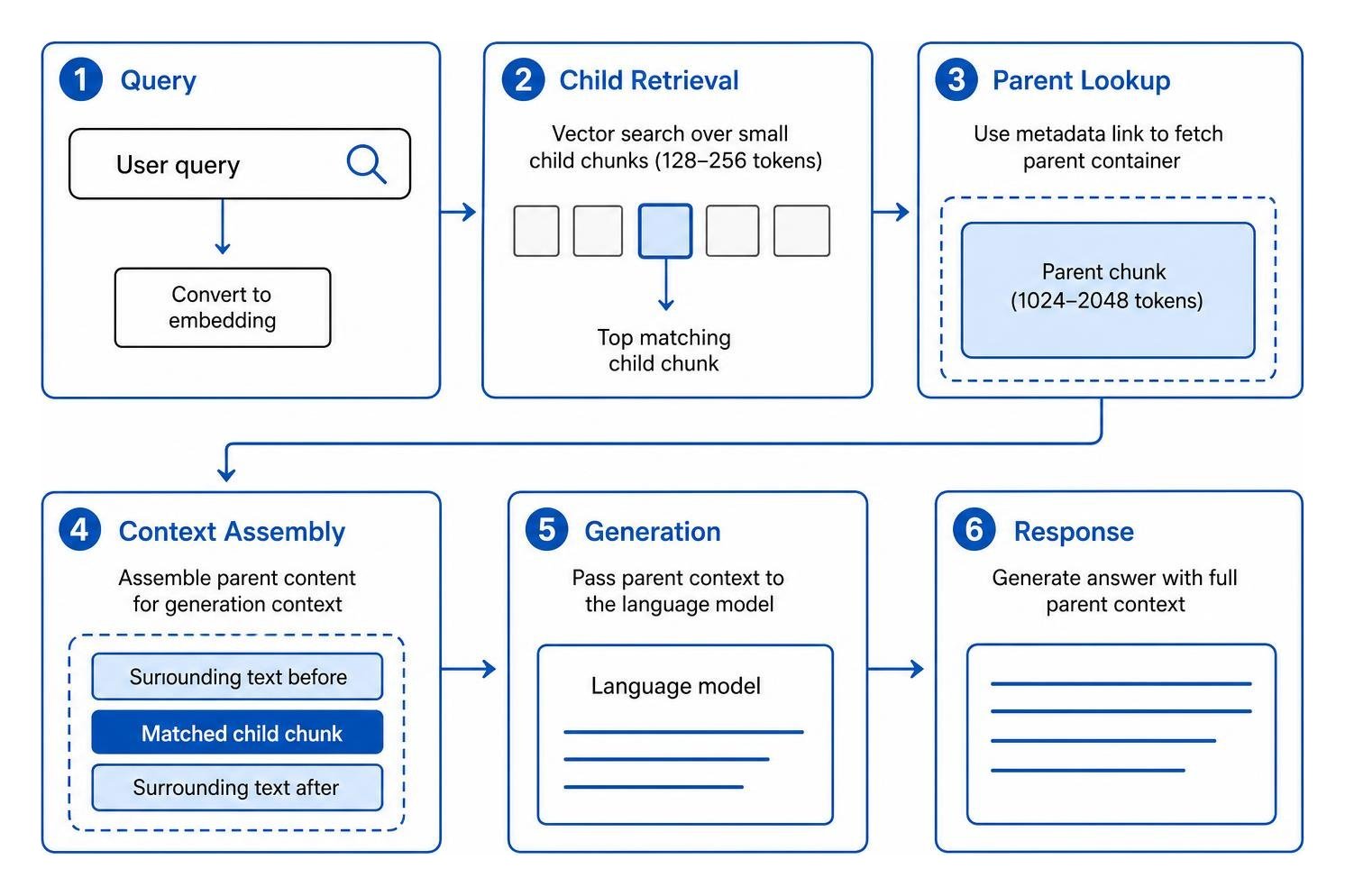
When a search query matches a child chunk, the retrieval engine fetches the larger parent container and passes that surrounding context to the model. This small-to-big retrieval pattern resolves the tension between search precision and contextual depth. Implementing document parsing frameworks, as detailed in the Docling chunking tutorial for RAG, allows you to maintain document outline trees automatically. This hierarchical indexing mirrors how we structure websites to build topical authority, ensuring that every granular point remains anchored to its broader thematic parent.
How Can You Optimize, Evaluate, and Scale Context-Aware Workflows?
Scale your document pipelines by injecting structured metadata into every chunk, isolating specialized elements like tables and code, and validating end-to-end retrieval accuracy.
At SmallBizSEO, our data-driven approach focuses on structural integrity across complex information pipelines. Managing dense source material requires a reliable ingestion architecture, particularly when navigating context window limits across enterprise applications.
What Context and Metadata Should You Add to Each Chunk?
Enrich every chunk with breadcrumb paths, document titles, version numbers, and chunk position indicators directly inside the text payload or metadata envelope.
When text is split, individual chunks frequently become ambiguous. A chunk stating "The deductible is $500 per incident" loses its meaning if the system cannot tell whether it applies to standard auto insurance, comprehensive flood coverage, or a commercial umbrella policy.
Contextual retrieval methods solve this problem by prepending a short summary or breadcrumb trail to the chunk prior to embedding and indexing. As highlighted in guides covering chunking large documents with contextualized retrieval, injecting document-level summaries into individual snippets substantially boosts hybrid search performance combining BM25 keyword matching with dense vector retrieval. Applying this type of structural optimization is a cornerstone of sound content SEO, ensuring search engines and language models interpret information within its intended framework.
How Do You Handle Tables, Code, and Multi-Batch Verification?
Keep complex data structures such as tables and code blocks intact as indivisible units, and verify document coverage across multi-batch processing jobs using strict audit manifests.
Splitting tabular data or programming scripts using prose-based chunking ruins their logic. A table cut in half loses its column relationships, while a code block cut mid-function causes syntax errors.
To preserve these specialized structures:
- Tables: Convert tables into Markdown, CSV, or structured JSON objects. Ensure column headers are preserved, or serialize each row into an explicit sentence (e.g., "For Segment A, Revenue was $12M"). Keep small-to-medium tables entirely within a single chunk.
- Code Blocks: Treat code blocks as atomic units. Split along class or function declarations rather than line counts.
- Batch Verification: When handling large files (such as 100+ page PDFs) in discrete batches, maintain a verification manifest as outlined in guides on splitting long documents for AI without losing context.

Follow these verification steps when running multi-batch document pipelines:
- Generate an initial page manifest recording total page counts, section titles, and SHA-256 document hashes.
- Track batch execution to verify 100% page coverage with zero skipped sections.
- Extract source citations alongside every data extraction point.
- Perform an automated reconciliation pass to identify conflicting values, amendments, or superseded policy terms found in later pages.
- Validate that all extracted metrics match their cited original page numbers before committing results to production storage.
Maintaining Document Context Across Production Systems
Dividing large documents does not have to mean sacrificing their underlying meaning. By prioritizing structure-aware boundaries, establishing balanced chunk sizes with moderate overlap, leveraging parent-child indexing, and enriching segments with metadata, you ensure that language models receive complete, accurate, and easily verifiable context.
Evaluate your retrieval pipeline regularly against real user queries. Track whether downstream answers cite accurate sections, measure where boundary failures occur, and refine your chunking configuration to maintain data fidelity at scale.