How to Check Search Volume for Keywords Without Expensive Subscriptions

How can you check search volume for keywords without a paid subscription?
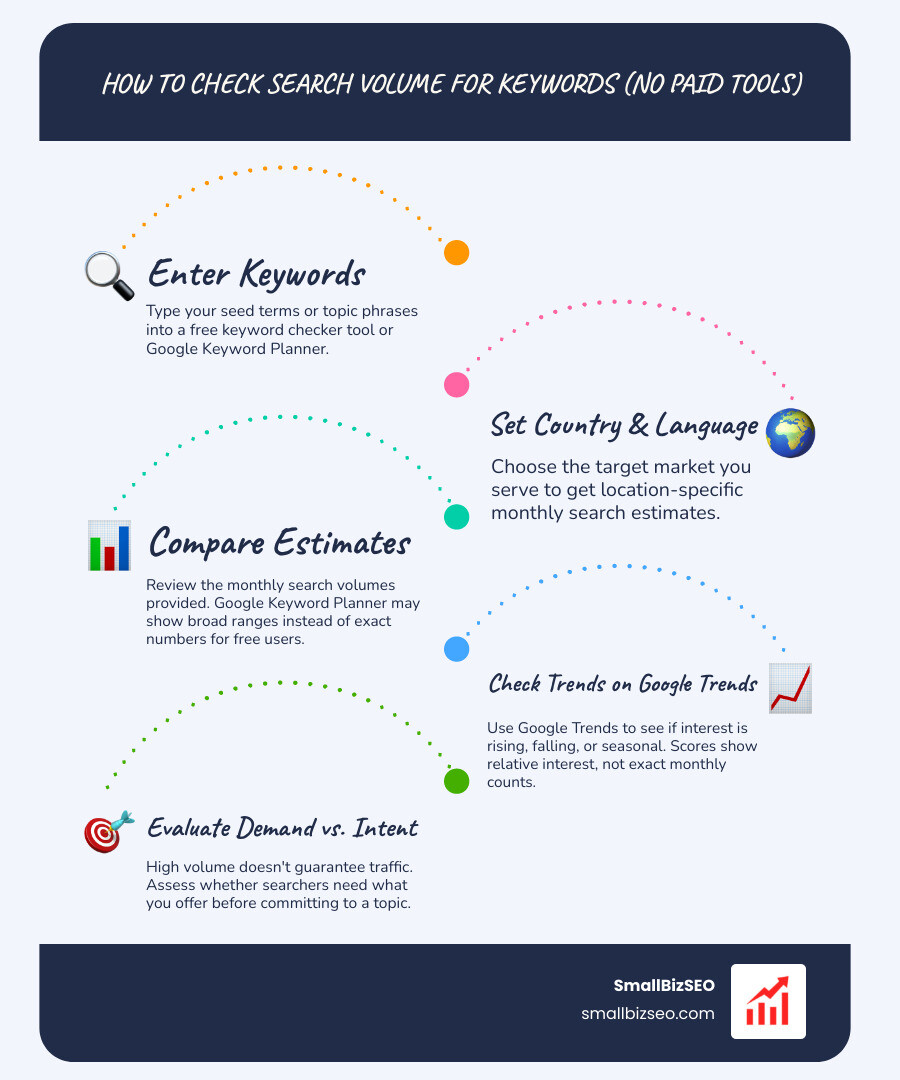
To check search volume for keywords, enter your terms in a free keyword checker, choose the country you serve, and compare the estimated monthly searches. If you have a Google Ads account, Google Keyword Planner is another free option, though it may show broad ranges. Use Google Trends to see whether interest is rising or seasonal; its scores show relative interest, not monthly search counts.
Search volume helps you spot demand, but it does not promise website visits. Before choosing a topic, check whether the people searching are likely to need what your business offers.
I’m Clayton Johnson, founder of SmallBizSEO, where I use keyword research to connect content plans with the questions potential customers ask. I’ll show you how to check search volume for keywords and use the results without treating estimates as guarantees.
How to Check Search Volume for Keywords Using Free and Native Tools
You can check search demand by using native search engine utilities and free tier lookup tools that query actual search engine indexes. These tools provide monthly query averages, seasonal shifts, and commercial competition levels without requiring enterprise software subscriptions.
How to Check Search Volume for Keywords with Google Keyword Planner
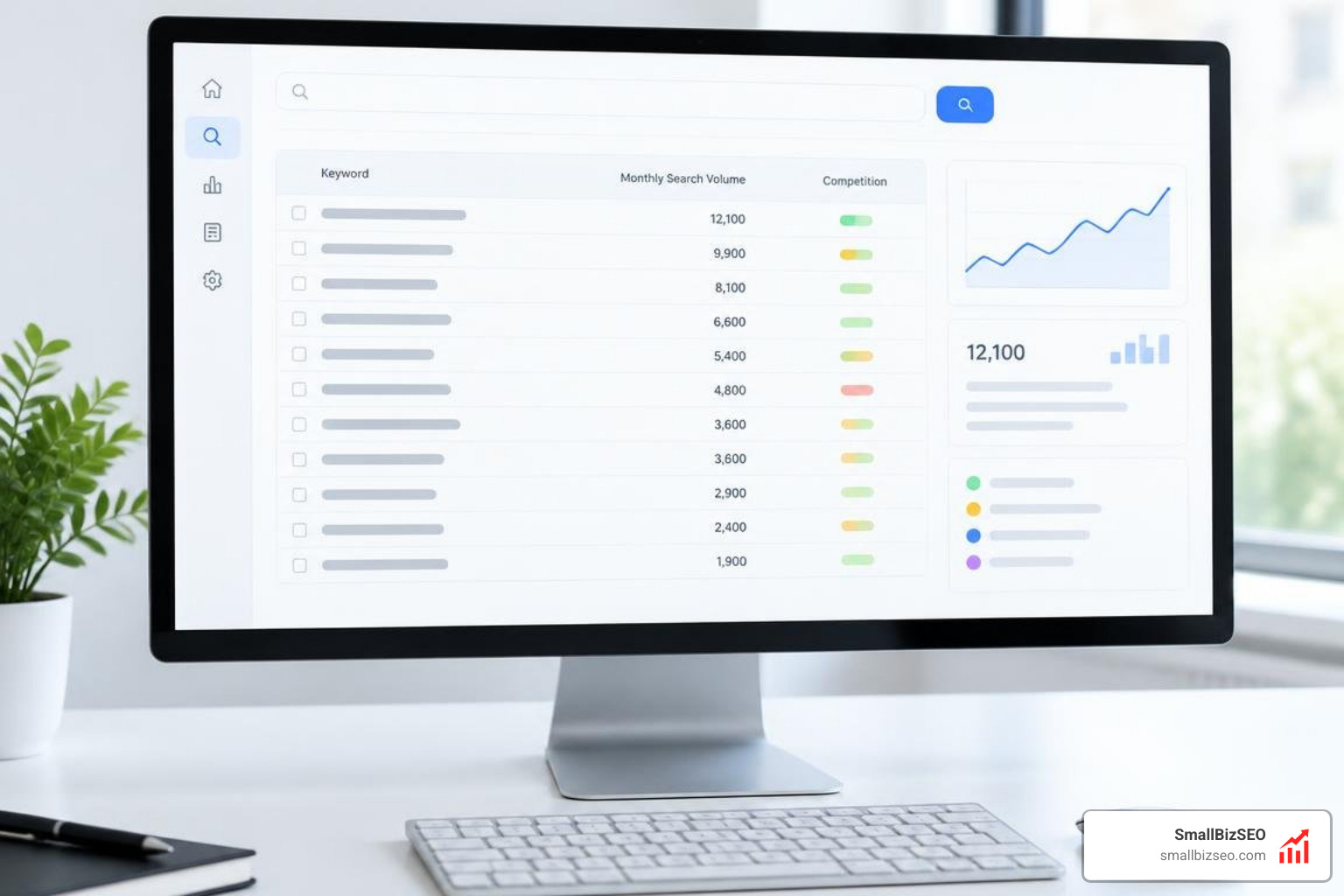
Google Keyword Planner provides direct search query data from Google's advertising network. While primarily built for pay-per-click advertisers, it serves as an excellent foundational tool for organic SEO research.
To extract keyword metrics using this native platform:
- Create a free Google Ads account and switch the view from Smart Mode to Expert Mode.
- Navigate to the top navigation bar, click Tools and Settings, select Planning, and open Get Campaign Keyword Suggestions with Keyword Planner.
- Choose Discover new keywords to generate term ideas from seed phrases or website URLs, or select Get search volume and forecasts to paste an existing list.
- Set your target geographic location and language to ensure data accuracy.
- Review the average monthly searches, three-month change percentages, and top-of-page bid estimates.
Accounts without active ad spend will see wide search volume metrics (such as 1K–10K or 10K–100K) rather than precise numbers. To uncover more specific figures, create a draft forecast plan inside the tool. The impressions forecast models anticipated ad views based on your maximum bid ceiling, providing a closer approximation of monthly query demand. For a deeper step-by-step walkthrough, check our Google Keyword Planner guide.
How to Check Search Volume for Keywords and Historical Trends with Google Trends
Google Trends visualizes relative search interest on a normalized scale from 0 to 100 rather than providing absolute search counts. A score of 100 represents peak popularity for a given term in your selected region and timeframe.
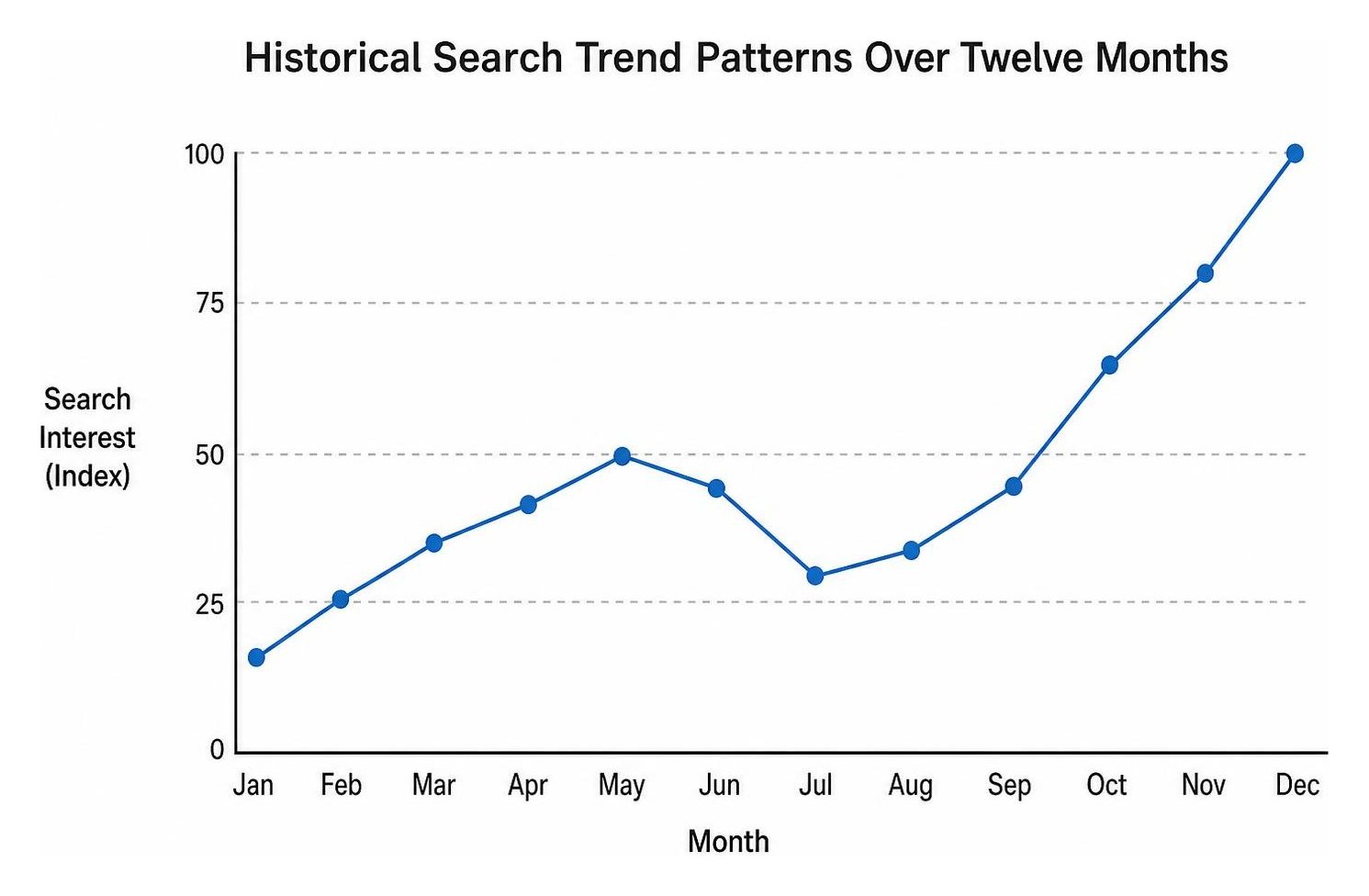
Using trend analysis protects your strategy from misleading 12-month rolling averages. Standard search volume tools average monthly demand over an entire trailing year. If a seasonal query spikes to 12,000 searches in December but drops to zero for the remaining eleven months, standard tools report an average monthly volume of 1,000. Google Trends uncovers these sharp seasonal spikes, helping you plan content publication dates before demand peaks.
Trend analysis also highlights search volatility and breakout queries. Evaluating regional breakdowns helps local businesses verify whether customer interest is concentrated in specific target service locations.
What Is the Difference Between Exact Match and Broad Match Search Volume?
Exact match volume measures queries for that precise term, while broad match volume measures total searches across all related variations, synonyms, and phrase expansions.
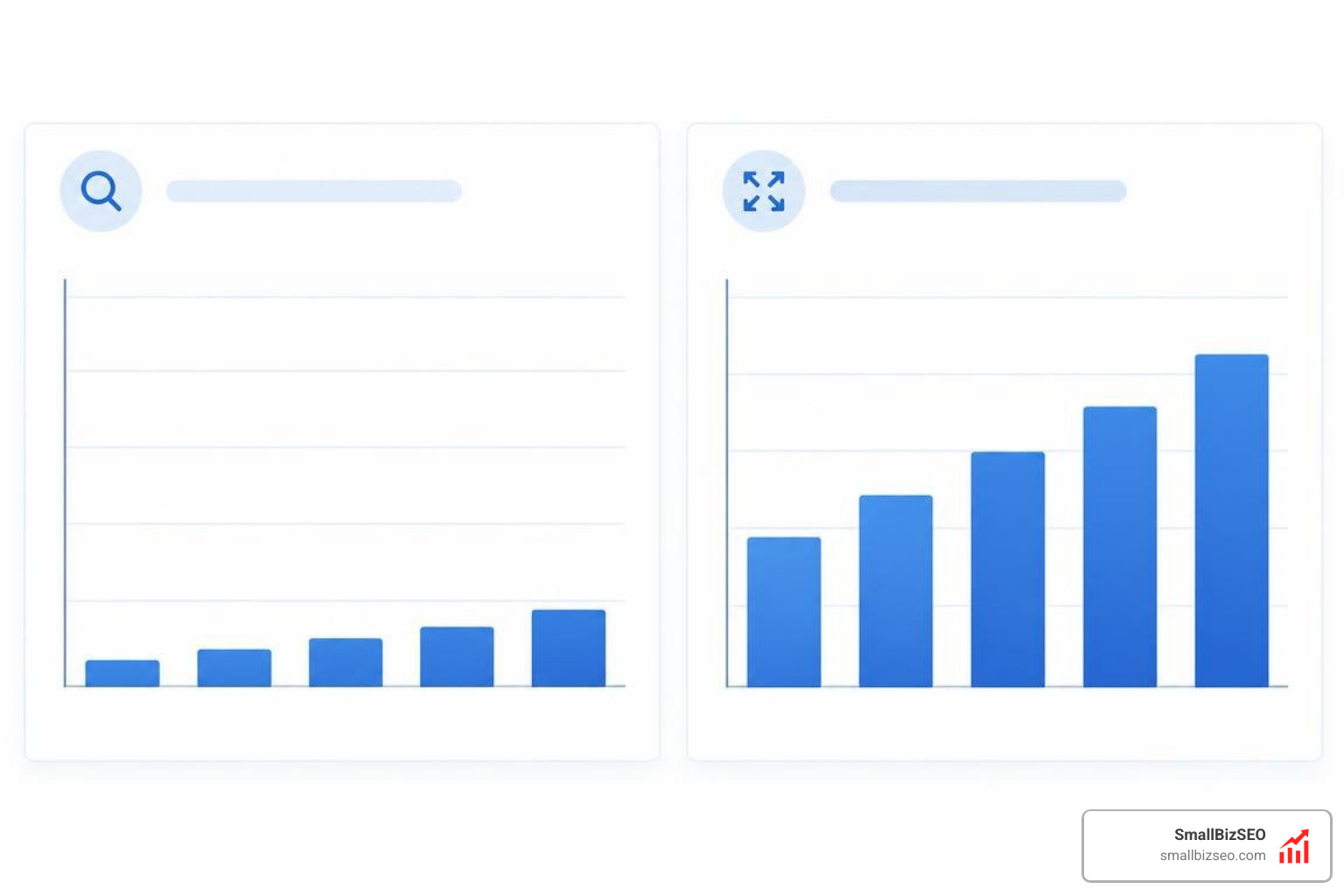
Think of exact match as your demand floor and broad match as your traffic ceiling:
- Demand Floor (Exact Match): The baseline audience searching for the specific phrase.
- Traffic Ceiling (Broad Match): The maximum total audience searching for the overarching topic across all grammatical variations.
When a query has low exact match volume but high broad match volume, it indicates strong long-tail demand. You can address multiple variations on a single comprehensive page rather than creating thin, isolated posts.
| Metric Attribute | Exact Match Search Volume | Broad Match Search Volume |
|---|---|---|
| Definition | Searches for the exact phrase without modifications | Searches including the term, synonyms, misspellings, and related variations |
| Strategic Role | Establishes the baseline minimum demand floor | Establishes the total topical traffic ceiling |
| Keyword Type | Typically describes competitive head terms | Naturally encompasses targeted long-tail keywords |
| Content Application | Target as primary page headings and titles | Incorporate naturally as supporting subtopics |
How to Evaluate and Prioritize Keyword Volume for Content Strategy
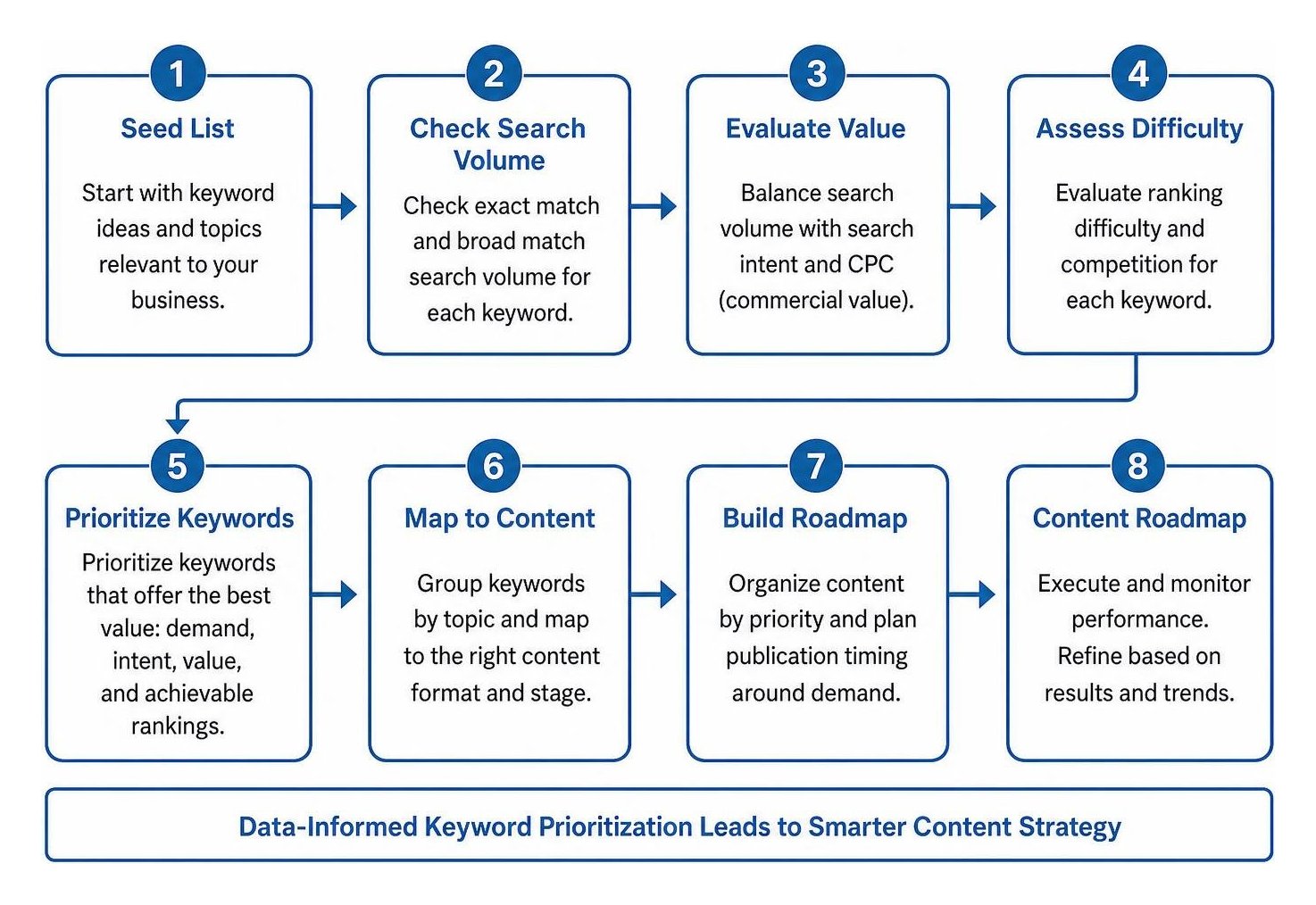
Raw volume alone does not determine keyword value. Prioritizing terms requires balancing search demand with search intent, commercial value, and ranking difficulty.
How Do Search Intent and CPC Impact the True Value of Search Volume?
Search volume tells you how many people search, but intent and Cost Per Click (CPC) tell you whether those searchers will convert into paying customers.
Search intent represents the underlying objective of the user's query:
- Informational: Users seeking answers or tutorials (for example, "how to fix a leaky pipe").
- Commercial Investigation: Users evaluating competing solutions (for example, "best plumbing services review").
- Transactional: Users prepared to make a purchase or hire a provider (for example, "emergency plumber near me").
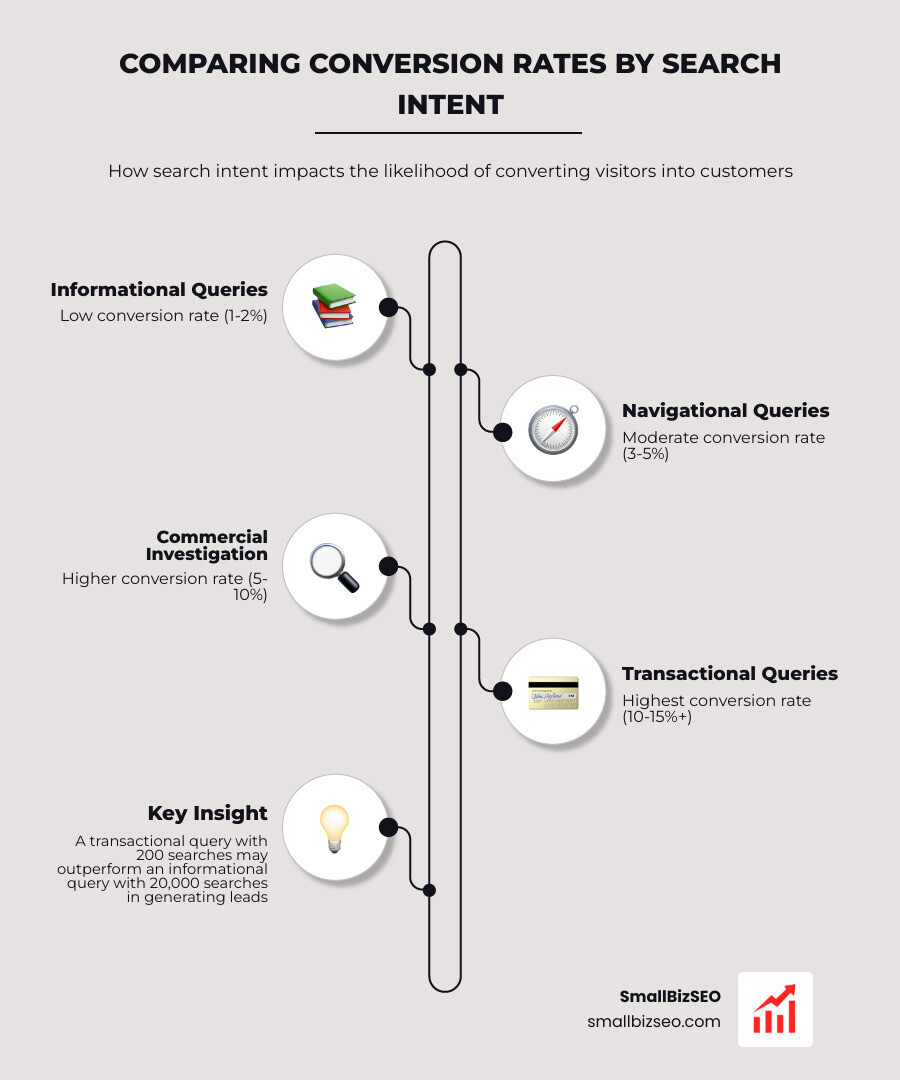
A query with 200 monthly searches categorized under transactional keywords frequently generates more qualified business leads than an informational head term with 20,000 monthly searches.
Evaluating average CPC and advertiser competition scores provides an organic value signal. High CPC bids indicate that paid advertisers achieve positive returns on those clicks. Targeting high-intent terms and commercial investigation keywords allows small businesses to capture high-value organic traffic even with modest search volumes.
What Is Keyword Difficulty and How Does It Relate to Search Volume?
Keyword difficulty measures how challenging it is to earn a first-page ranking for a specific term, evaluated on a scale from 0 to 100. It is calculated primarily by analyzing the backlink profiles, domain authority, and content depth of the current top-ranking URLs.
High search volume terms usually carry high difficulty scores because established websites with significant backlink equity dominate those search engine results pages (SERPs). Attempting to rank a new or growing website for highly competitive terms leads to stalled organic visibility.
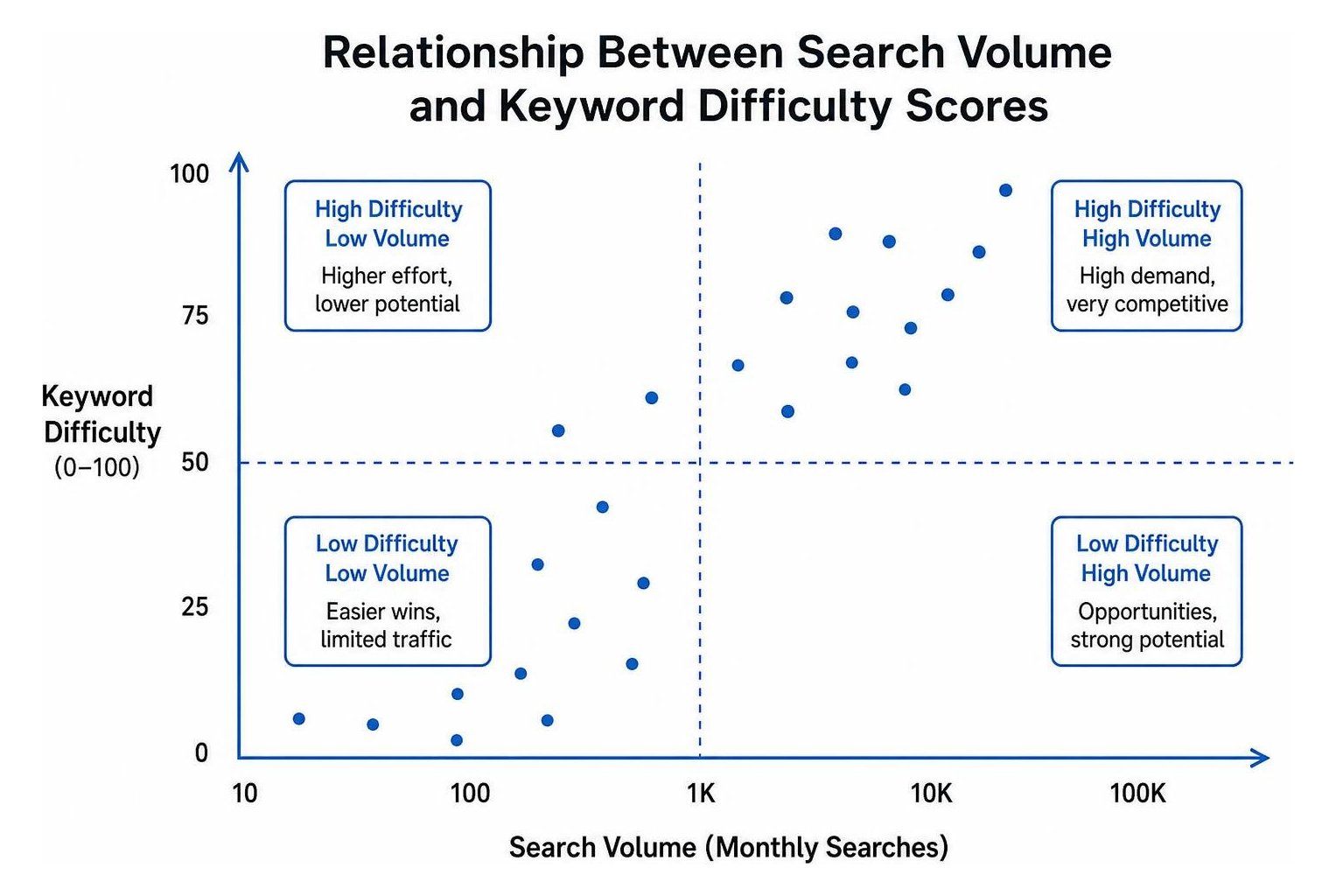
Conducting a competitor gap analysis reveals lower-competition opportunities where competing sites have weak page authority or thin content. Targeting these gaps gives you a faster path to meaningful search traffic.
How to Turn Search Volume Data into an Actionable Content Plan
To turn raw search volume data into measurable organic growth, organize your keywords into structured topic clusters and build an execution roadmap:
- Group by Parent Topics: Map related low-volume long-tail terms to a high-volume primary topic to create structured content hubs.
- Execute Systematic Keyword Mapping: Assign one primary keyword and supporting variations to each URL to maintain clean topical focus.
- Prevent Keyword Cannibalization: Ensure distinct pages do not target identical search intent, which divides your ranking authority.
- Develop an SEO Forecast: Estimate organic traffic yields by applying realistic click-through rates (CTR) to your target keyword volume across projected ranking positions.
At SmallBizSEO, our Velocity framework uses data-driven content planning and transparent reporting to help small businesses capture search demand and turn visibility into steady revenue. If you want to identify high-value keyword opportunities and fix technical roadblocks across your site, request a data-driven SEO visibility audit from our team.
Moving from Search Volume Data to Real Business Results
Keyword search volume is a foundational planning metric, but sustainable organic growth comes from targeting the right audience. By using free tools like Google Keyword Planner and Google Trends, evaluating exact versus broad match reach, and filtering for commercial intent, you can build an effective content strategy without expensive subscriptions. Focus on high-intent topics that solve customer problems, build supporting content clusters, and turn search demand into consistent business growth.