How to Evaluate and Compare SEO Agencies

How to Evaluate and Compare SEO Agencies
When Is It Time to Hire an SEO Agency?
Consider hiring an SEO agency when search traffic has stalled, leads are inconsistent, or your team lacks time to handle technical fixes and content. Bring an agency in early if you are redesigning your website so search visibility is part of the plan, not an afterthought.
Before you compare agencies, set a business goal, decide what work you need done, and ask each firm to explain its approach, costs, and reporting. Check recent client work and references. Avoid anyone who guarantees rankings.
I'm Clayton Johnson, founder of SmallBizSEO. My work connecting SEO, content, and digital PR to qualified leads shapes how I approach hiring an SEO agency: choose a partner who understands your business goals and can show you what they are doing.
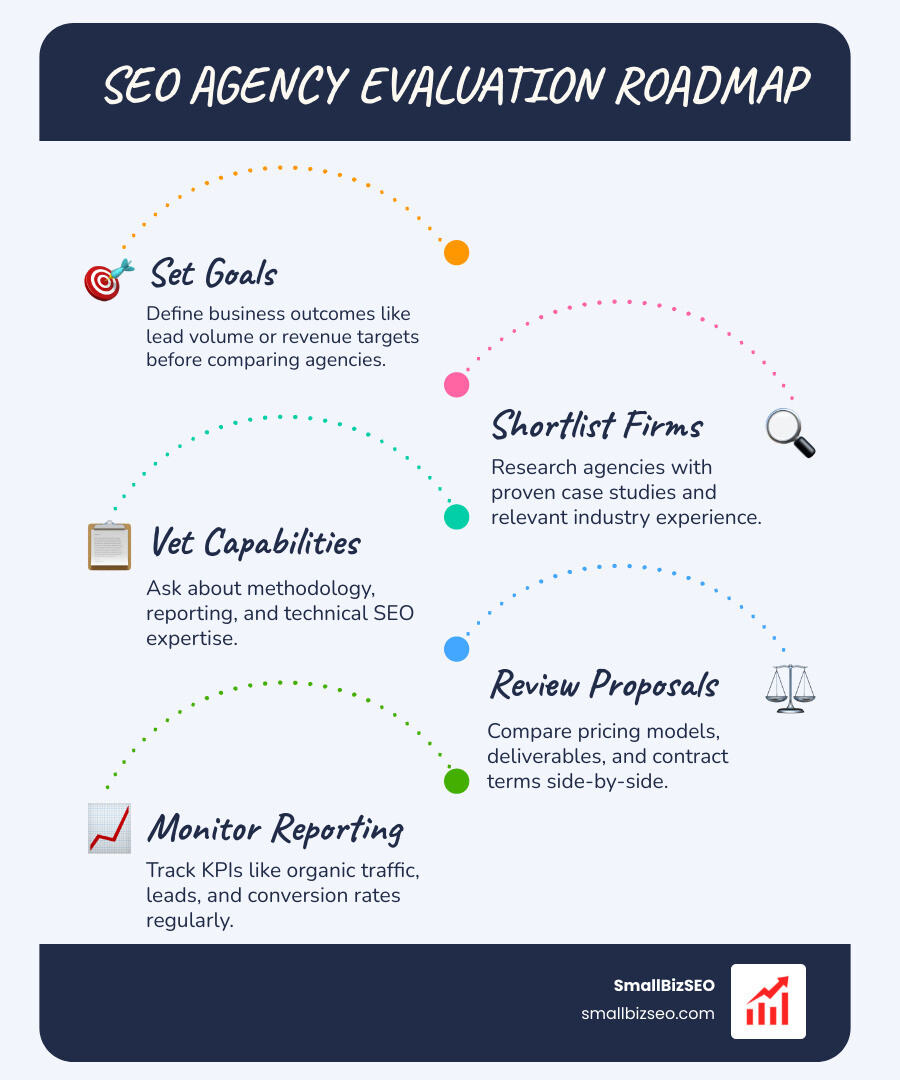
Hiring an SEO agency terms simplified:
Search engine optimization is complex, with more than 200 ranking factors influencing where your website appears in search engine result pages. When internal marketing teams are stretched thin, or when search algorithms roll out unannounced updates that cause impressions to plummet, keeping up in-house becomes difficult. Bringing in specialized support prevents costly missteps and restores organic momentum.
What Should You Define Before Hiring an SEO Agency?
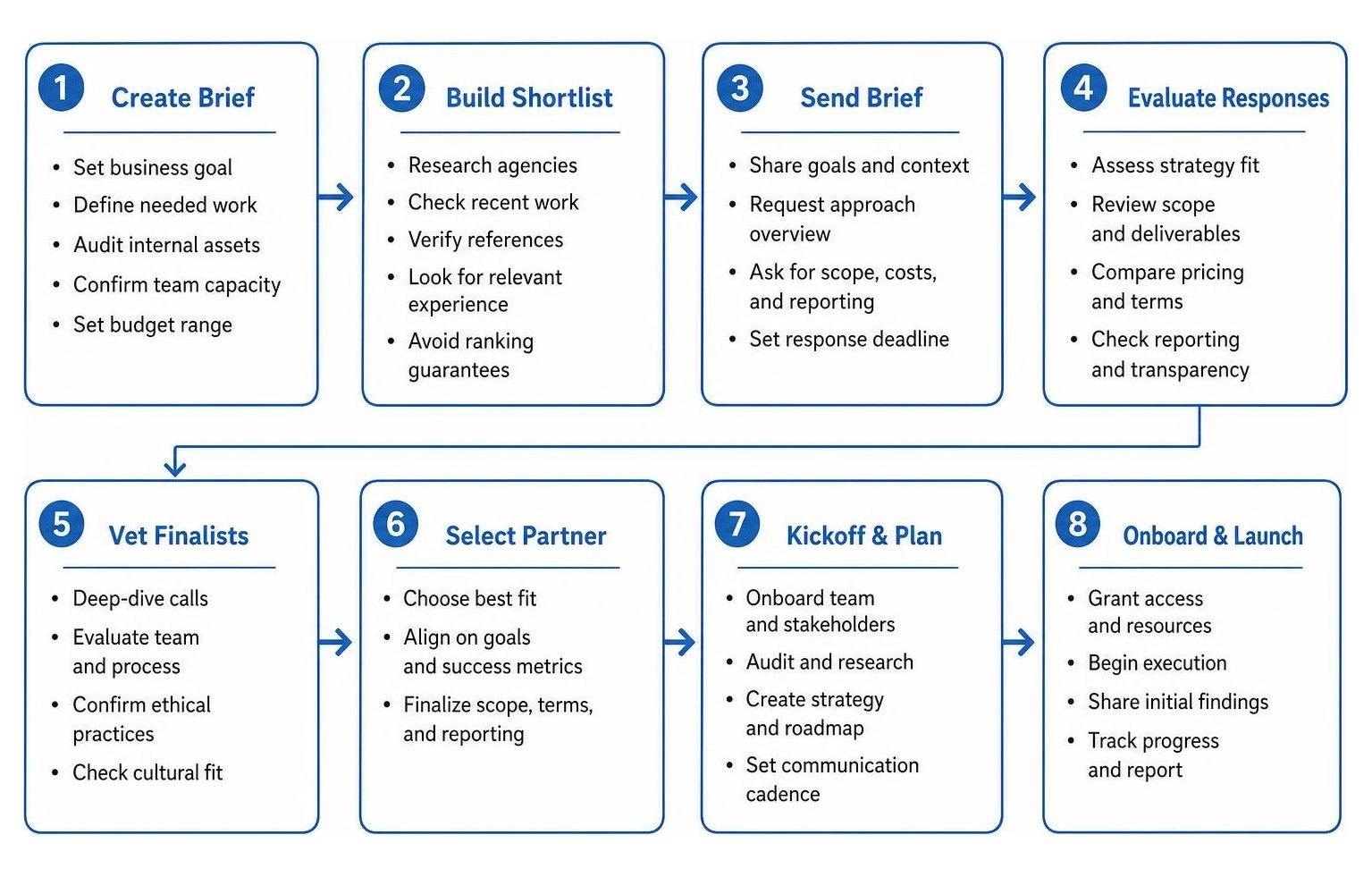
Before reaching out to prospective vendors, define your target business outcomes, required deliverables, budget parameters, and internal capacity. Starting conversations with a clear brief prevents vendors from pitching generic packages that fail to move the needle.
We recommend preparing a concise project overview that outlines:
- Commercial Goal Setting: Establish precise metrics such as generating 30 new sales-qualified leads per month or expanding organic revenue by 25%.
- Pipeline Contribution Targets: Clarify how organic search integrates with your sales funnel, customer acquisition cost goals, and customer lifetime value.
- Core Deliverables Needed: Identify whether you need an end-to-end strategy, deep technical remediation, authority building, content creation, or generative search optimization.
- Internal Asset Audit: Detail your current content library, CMS platform, developer bandwidth, and access to internal subject-matter experts.
- Development Team Capacity: Determine who will execute recommended changes on your site to prevent bottlenecks.
Reviewing the ultimate guide to choosing a trusted SEO agency provides additional clarity when framing these initial requirements.
How to Evaluate and Vet Agency Capabilities, Pricing, and Ethics
To evaluate an SEO agency effectively, assess their verified track record, transparency regarding deliverables, ethical alignment with search engine guidelines, and cultural fit with your team. Following a structured vetting process ensures you choose a partner that operates with full integrity.
When comparing your hiring options, evaluate how an agency stacks up against alternative staffing structures:
| Factor | Full-Service SEO Agency | Freelancer / Consultant | In-House SEO Specialist |
|---|---|---|---|
| Primary Strength | Multi-disciplinary team (technical, content, PR) | Cost-effective for specific tasks | Deep, exclusive focus on your brand |
| Average Monthly Cost | $1,000 – $10,000+ | $500 – $3,000 | $6,000 – $12,000+ (salary + tools) |
| Ramp-Up Speed | Rapid onboarding with proven processes | Fast start on defined scopes | Slow (recruiting, hiring, and tooling) |
| Tool Stack Included | Yes (enterprise tool suites included) | Limited to individual subscriptions | No (requires separate software budget) |
| Execution Bandwidth | High cross-functional support | Limited to individual hours | Limited to single employee capacity |
Following our step by step guide to choosing a reliable SEO company will help your team conduct systematic due diligence and weed out underperforming candidates.
What Essential Questions and Vetting Criteria Separate Top Agencies?
Top-tier agencies separate themselves through transparent methodologies, detailed case studies, adherence to Google Search Essentials, and clear communication standards. They explain the mechanics behind their strategies rather than hiding behind buzzwords.
During discovery calls, ask these critical vetting questions:
- "What specific technical or content bottlenecks do you see on our site?" A capable partner should identify foundational opportunities rather than making vague promises.
- "Can you walk us through a recent campaign where results stalled and how you adapted?" Look for strategic problem-solving and honest diagnostics.
- "Who is doing the daily execution on our account?" Confirm whether work is completed by dedicated in-house strategists or outsourced to third parties.
- "How do you handle links and digital PR?" Ensure they use editorial, white-hat outreach rather than paid private blog networks that risk algorithmic penalties.
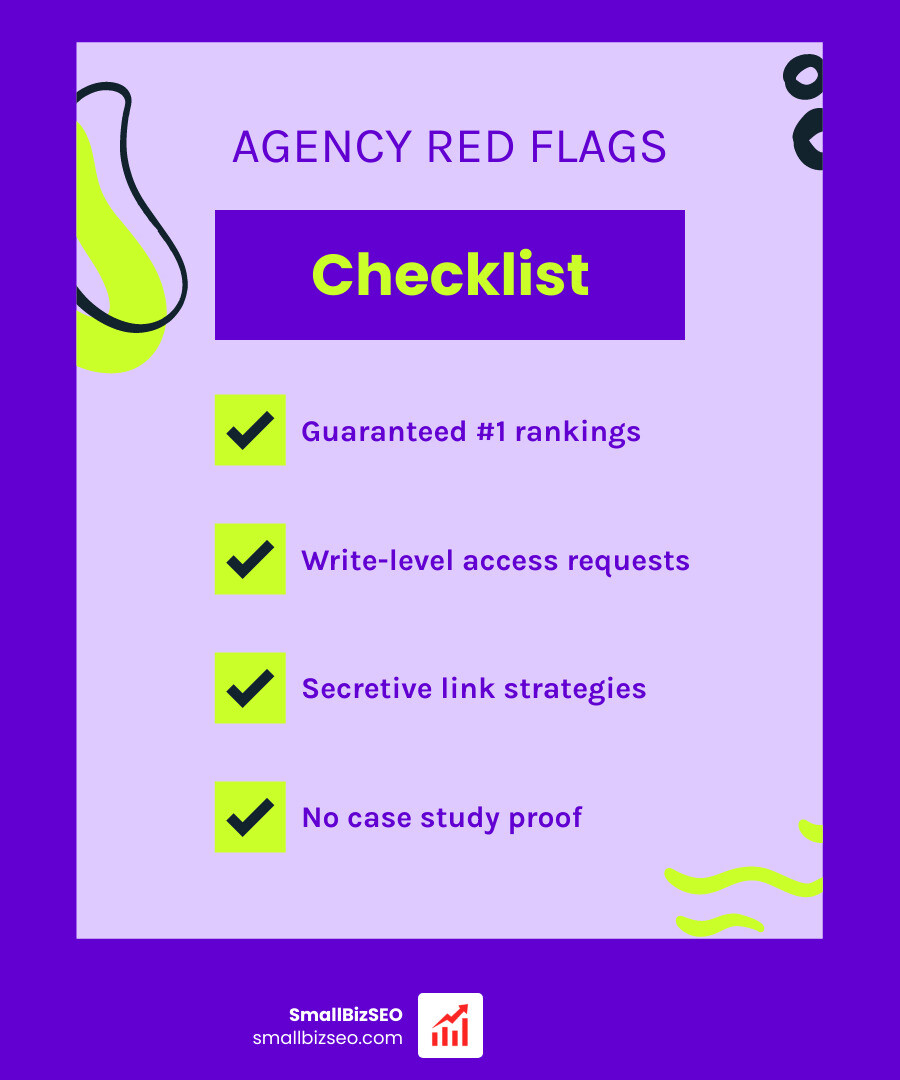
Critical Red Flags to Avoid:
- Guaranteed #1 Rankings: Search algorithms update frequently; no legitimate firm can guarantee a specific ranking position.
- Requests for Write-Level Access During Audits: Initial audits require only read-only access to Google Search Console and analytics tools. Never grant administrative write access before signing a verified agreement.
- Secretive Strategies: If an agency refuses to disclose its link sources or content creation processes, walk away.
What Should You Know About SEO Pricing Models and Budget Benchmarks?
SEO pricing varies based on domain authority, technical debt, and market competition, with reputable agencies typically requiring a four-figure monthly investment. Standard pricing models include monthly retainers, project-based contracts, and hourly consulting.
| Pricing Model | Typical Cost Benchmark | Best Used For |
|---|---|---|
| Monthly Retainer | $500 – $2,500 (Basic) / $3,000 – $10,000+ (Comprehensive) | Ongoing growth, continuous content, and active link acquisition |
| Project-Based Audit | $500 – $2,000 | One-time technical site health remediation and roadmapping |
| Hourly Consulting | $15 – $35 (Entry Freelance) / $100 – $300 (Senior Specialist) | Advisory support, developer guidance, or specific troubleshooting |
Across the wider industry, entry-level basic SEO services average around $497 per month, but comprehensive growth strategies for competitive sectors require deeper investment. In retail, ecommerce brands see an average return of $2.75 for every single dollar invested in organic search optimization. Explore structured SEO packages to see how deliverable tiers align with distinct commercial goals.
How Can You Evaluate Technical and Local SEO Capabilities?
Evaluate technical and local search capabilities by checking an agency's proficiency in crawl architecture, schema markup implementation, Google Business Profile management, and citation consistency. A qualified agency must demonstrate mastery across both technical health and geographic signals.
When vetting a local SEO company, ensure their execution checklist covers:
- Google Business Profile (GBP) Management: Regular profile optimization, review management workflows, and local post scheduling.
- NAP Consistency: Aligning your business name, address, and phone number across authoritative directories to build geo-relevance.
- Structured Data and Entity Optimization: Implementing schema markup to support rich snippets, Answer Engine Optimization (AEO), and Generative Engine Optimization (GEO) across AI-powered search engines.
How Should You Measure Success, Onboarding, and Agency Fit?
Measure success by establishing clear onboarding workflows, collaborative developer handoffs, and attribution reporting tied to qualified pipeline and revenue. Smooth onboarding sets the standard for long-term partnership success.
An effective agency partnership begins with a thorough onboarding questionnaire covering your technical infrastructure, competitive landscape, and brand voice. At SmallBizSEO, we implement our proprietary "Velocity" framework to deliver fast rankings and E-E-A-T-compliant organic growth, backing every campaign with transparent, automated reporting so you always know where your investment goes. Review our published case studies to see how structured optimization frameworks generate reliable outcomes across different business models.
To uncover existing search bottlenecks before hiring, get started with an SEO visibility audit to benchmark your website's baseline performance.
What KPIs and Timelines Should You Use to Measure Organic ROI?
Realistic SEO campaigns take three to six months to produce noticeable improvements in rankings and qualified traffic, with commercial returns compounding significantly between six and twelve months. Set performance milestones that reflect this natural timeline.
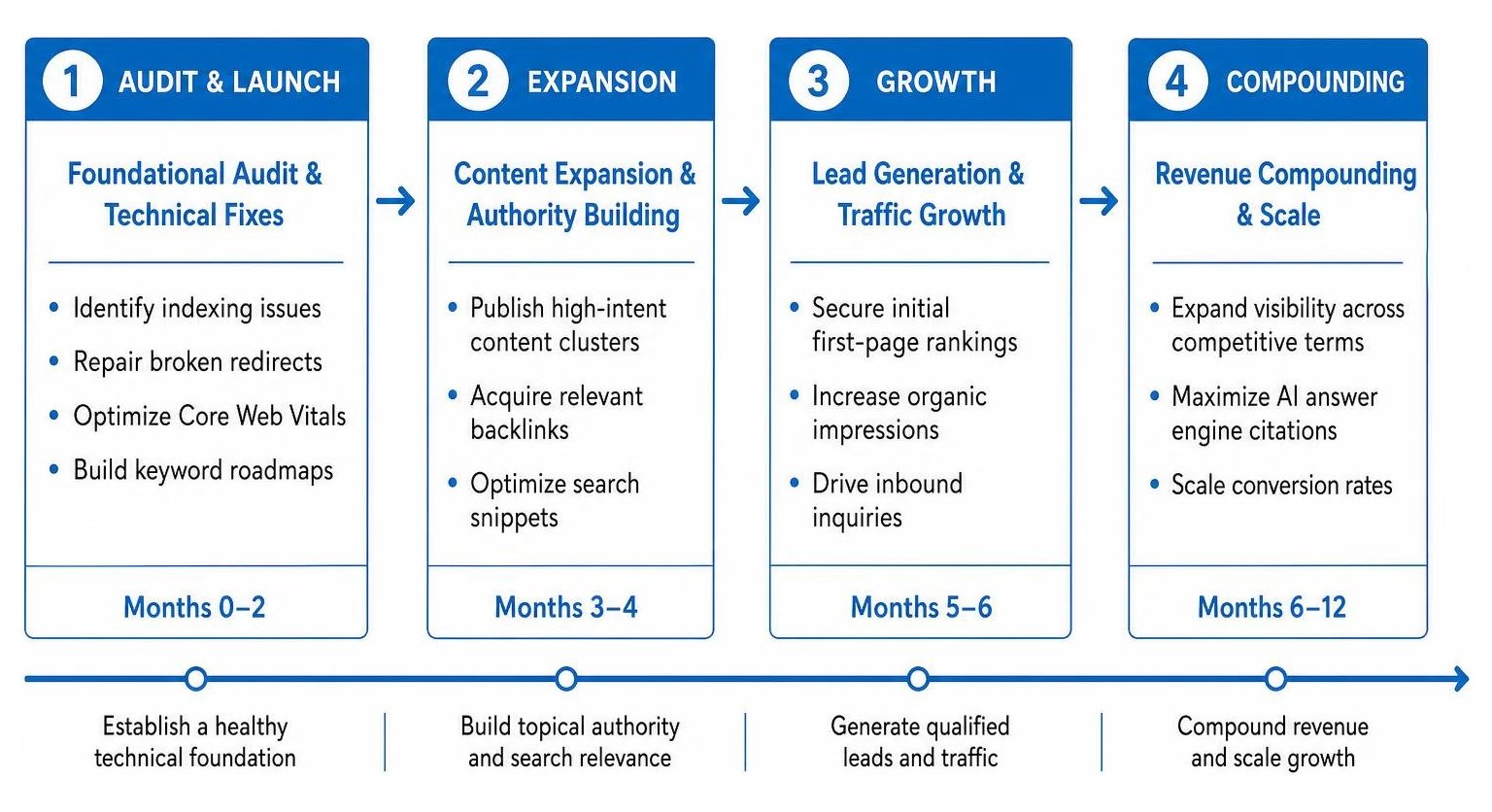
Key stages of an organic growth campaign include:
- Months 0 to 2 (Foundational Audit & Technical Fixes): Identifying indexing issues, repairing broken redirects, optimizing Core Web Vitals, and building keyword roadmaps.
- Months 3 to 4 (Content Expansion & Authority Building): Publishing high-intent content clusters, acquiring relevant backlinks, and optimizing search snippets.
- Months 5 to 6 (Lead Generation & Traffic Growth): Securing initial first-page rankings, increasing organic impressions, and driving inbound inquiries.
- Months 6 to 12 (Revenue Compounding & Scale): Expanding visibility across competitive search terms, maximizing AI answer engine citations, and scaling conversion rates.
Primary KPIs to Track:
- Sales-Qualified Leads (SQLs) & Conversions: The volume of inquiries or transactions driven by organic search.
- Organic Keyword Distribution: The growth of non-branded keywords ranking in positions 1 through 3 and on page one.
- Core Web Vitals & Technical Health: Crawl efficiency, page load speed, and structured data validation.
- Attributed Pipeline Value: Direct revenue and pipeline contribution tracked through analytics attribution.
Ensure your service agreement contains reasonable exit clauses (such as a 30-day notice period after an initial period) and guarantees full client ownership of all content, technical assets, and analytics accounts upon contract completion.
Choosing Your Next Steps for Organic Search Growth
Selecting the right SEO partner is an investment in your company's digital infrastructure. By defining clear business goals, asking probing questions about methodology, demanding transparent reporting, and tracking commercial metrics, you can hire an agency that delivers sustainable organic growth. Focus on partners who prioritize measurable revenue over vanity metrics, maintain ethical standards, and adapt to modern search trends. Take the time to audit your site, compare proposals systematically, and establish a collaborative relationship built on mutual accountability.