How to Optimize Your Content for E-E-A-T and Build Real Search Trust

How to Optimize Your Content for E-E-A-T and Build Real Search Trust
Why E-E-A-T Optimization Is the New Battleground for Search Trust
E-E-A-T optimization is the process of strengthening the signals Google uses to judge whether your content is trustworthy, credible, and worth ranking. Here's what it covers at a glance:
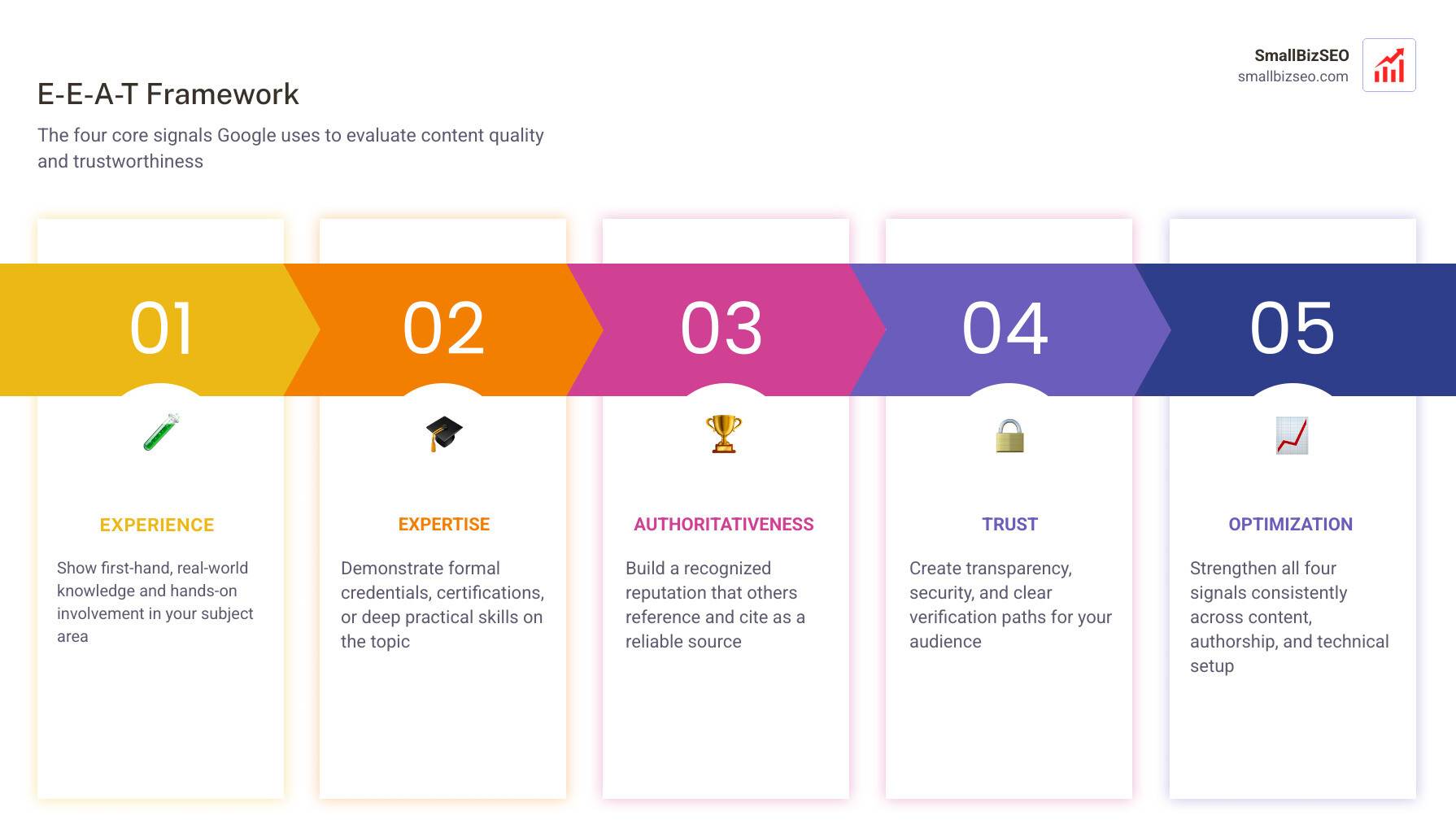
- Experience - Show first-hand, real-world knowledge in your content
- Expertise - Demonstrate formal or practical credentials on your topic
- Authoritativeness - Build a reputation that others recognize and reference
- Trust - Make your site safe, transparent, and easy to verify
There was a time when ranking on Google was mostly about keywords and backlinks. That era isn't entirely gone — but it's been overtaken by something much harder to fake: trust.
Google's automated systems are designed to prioritize helpful, reliable content created to benefit people — not content made to game rankings. With AI-generated content now making up a significant share of what appears in search results, Google leans harder than ever on signals that prove a real, qualified human stands behind the information.
For small business owners, this is actually good news. You have something large content farms don't: genuine experience and real relationships with your customers.
I'm Clayton Johnson, a digital PR and SEO specialist focused on building search visibility through credibility and authority — the core principles behind every e-e-a-t optimization strategy I've worked on. In the sections ahead, I'll walk you through exactly what E-E-A-T means, why it matters for your business, and what you can do about it today.
Demystifying Google's E-E-A-T Framework
Google uses E-E-A-T to evaluate the quality of search results. It is not a direct ranking score, but rather a conceptual framework that guides how Google's automated systems assess content quality. These quality guidelines help search engine algorithms replicate what human evaluators consider helpful and reliable. By focusing on these trust signals, we can align our websites with what Google wants to show its users.

Experience vs. Expertise: The Core Difference
Though they sound similar, Experience and Expertise require different types of proof:
- Experience is all about first-hand, real-world practice. It answers the question: Have you actually done this yourself? For example, a travel blogger sharing original photos and personal challenges from their trip demonstrates Experience.
- Expertise refers to formal credentials, specialized training, or professional status. It answers the question: Are you qualified to teach this? A licensed financial advisor explaining tax codes demonstrates Expertise.
Understanding this distinction is vital for E-E-A-T optimization. Depending on the topic, Google might look for one or both. You can read more about how these signals work in Incremys' Guide to E-E-A-T.
Why Trust is the Ultimate Foundation
According to Google's quality guidelines, Trustworthiness is the most important member of the E-E-A-T family. While Experience, Expertise, and Authoritativeness build up your credibility, they all exist to support Trust. An untrustworthy page cannot achieve a high rating, regardless of how expert the author is.
Building trust requires absolute transparency, secure browsing standards, and factual accuracy. To explore how search engines evaluate these brand signals, check out SynthQuery's E-E-A-T Explanation and this guide on Authority-Driven SEO Trust Services.
The High Stakes of YMYL Content
Your Money or Your Life (YMYL) content refers to topics that could significantly impact a person's health, financial stability, safety, or well-being. This includes medical advice, financial planning, legal guidance, and safety information.
Because the stakes are so high, Google applies much stricter E-E-A-T standards to YMYL pages. If your site offers YMYL advice without verifiable credentials, you risk losing search visibility and facing severe Google Penalties that can decimate your traffic.
Is E-E-A-T a Direct Google Ranking Factor?
No, E-E-A-T is not a direct algorithmic ranking factor. Google does not assign a numeric E-E-A-T score to your website. Instead, it is a framework that helps Google design and refine its ranking systems to identify helpful, high-quality content.

How Quality Raters Influence the Algorithm
Google employs thousands of human Search Quality Raters globally to evaluate the quality of search results. These raters use Google's Search Quality Rater Guidelines to grade websites.
While their individual feedback does not directly change your page's ranking, Google uses their aggregated assessments to train and fine-tune its automated ranking algorithms. If you have noticed sudden traffic drops after a system update, learning How to Recover from a Google Algorithm Penalty can help you rebuild your site's trust signals.
The Role of the Helpful Content System
Google's Helpful Content System evaluates websites on a site-wide level. It looks for signals that show a site is focused on creating people-first content rather than search engine-first content.
If a site publishes thin, unhelpful pages just to capture keyword traffic, the entire site's visibility can suffer. Aligning your content with user intent and maintaining strong technical foundations is a critical part of modern On-Page SEO.
Actionable Strategies for E-E-A-T Optimization
To turn E-E-A-T from an abstract concept into a practical strategy, we must translate these quality principles into verifiable on-page and off-page signals.
| Trust Signal Type | On-Page Tactics | Off-Page Tactics |
|---|---|---|
| Experience | Case studies, original photos, step-by-step workflows | User-generated reviews, forum discussions, social proof |
| Expertise | Detailed author bios, credential schema, editorial reviews | Digital PR, academic citations, industry interviews |
| Authoritativeness | Topical clusters, primary research, clear site structure | High-quality backlinks, unlinked brand mentions |
| Trustworthiness | HTTPS, clear contact pages, privacy policies, terms of service | Active review profiles, positive brand sentiment |
Demonstrating First-Hand Experience in Content
The easiest way to show Experience is to stop writing generic summaries and start sharing real-world practice.
- Use original screenshots, photos, and video demonstrations.
- Include case studies that highlight your specific processes, settings, and observed limitations.
- Share personal anecdotes and lessons learned from actual client work.
By integrating these real-life elements into your SEO Content Services, you create content that AI cannot easily replicate. For a deeper look at what search engines look for, check out this guide on E-E-A-T for SEO.
Establishing Author and Brand Credentials
Anonymous content is a major red flag for search engines. Every article should have a named author with verifiable credentials.
- Author Bios: Add a detailed bio to every article, outlining the author's professional background, certifications, and links to their active social media profiles (like LinkedIn).
- About Us Page: Build a comprehensive About page explaining your business's mission, history, and real team members.
- Social Proof: Highlight industry awards, professional affiliations, and client testimonials.
To learn how to integrate these credibility signals into your brand strategy, review the RS Gonzales E-E-A-T SEO Strategies.
Technical Signals for E-E-A-T Optimization
Your technical infrastructure should make it easy for search engine bots to verify your credibility.
- Schema Markup: Implement Author and Organization schema to link your content creators to their official credentials.
- HTTPS Security: Ensure your site is fully secure with an active SSL certificate.
- Contact Information: Provide a clear, easily accessible contact page with a phone number, email address, and physical service locations.
If you are planning to update your site's structure, follow a comprehensive Website Redesign Checklist to avoid breaking these trust signals, and learn about advanced schema setups in the Seeberger Solutions EEAT Guide.
Navigating E-E-A-T in the Era of AI and Generative Search
The rise of generative AI has flooded the web with automated content, making human verification and editorial standards more important than ever.
Balancing AI Content with Human Verification
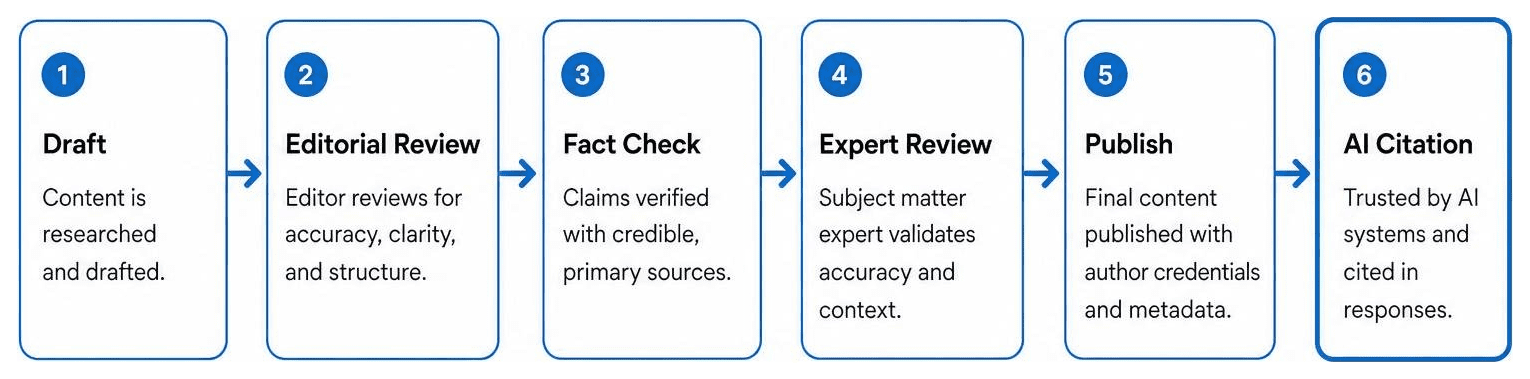
While AI tools can assist with research and outlines, publishing ungoverned AI content can quickly damage your brand's trust. We advocate for a "human-in-the-loop" approach:
- Establish strict editorial standards and style guides.
- Ensure every piece of content is fact-checked and reviewed by a subject-matter expert.
- Disclose your use of AI tools transparently if your audience expects it.
Maintaining this level of content governance is essential for protecting your search visibility. You can read more about structuring these workflows in Epic Visibility's AI SEO Guide.
Optimizing for Citations in AI Overviews
Generative search engines and AI Overviews rely on highly authoritative sources to answer user queries. To become a citable source for AI engines, focus on structured formatting:
- Clear Hierarchy: Use a logical H1-H2-H3 heading structure. Pages with clear heading hierarchies are significantly more likely to be cited in generative search.
- Use Lists and Tables: A vast majority of cited pages in AI Overviews feature structured lists or data tables.
- Primary Sources: Cite reputable data and link out to official government, academic, or industry-standard sites.
Identifying the search queries that trigger these generative answers is a key part of running a modern Keyword Gap Analysis.
Tracking and Measuring Your Trust Signals
Building search trust is a long-term investment, and you need the right metrics to ensure your efforts are paying off.

Measuring the ROI of E-E-A-T Optimization
While E-E-A-T is not a single metric, its impact can be tracked through overall site performance:
- Organic Visibility: Monitor your impressions and rankings for high-intent keywords.
- User Engagement: Watch for improvements in average session duration and lower bounce rates, which indicate that users trust your content.
- Conversion Rates: Trust directly correlates with sales and leads.
To get a clear picture of how your site stands, we recommend scheduling a Detailed SEO Analysis.
Key Performance Indicators for Digital Authority
To measure your off-page reputation, track these authority metrics:
- Backlink Profile: Earn links from topically relevant, high-trust domains in your industry.
- Brand Mentions: Track how often your brand is mentioned across forums, news sites, and social media, even without a direct link.
- Referral Traffic: Monitor traffic coming from authoritative industry publications.
Building these relationships requires a strategic approach to Link Building Services.
Frequently Asked Questions about E-E-A-T
What does E-E-A-T stand for?
E-E-A-T stands for Experience, Expertise, Authoritativeness, and Trustworthiness. It is a quality evaluation framework outlined in Google's Search Quality Rater Guidelines.
How long does it take to see results from E-E-A-T improvements?
On-page changes like adding author bios or securing your site can show immediate improvements in how quality raters perceive your site. However, broader authority-building efforts—such as earning high-quality backlinks and establishing brand mentions—typically take six to twelve months to compound and reflect in search rankings.
Can small businesses compete with large brands using E-E-A-T?
Yes! In fact, small businesses often have a distinct advantage. By focusing on niche expertise, documenting real-world local experience, and creating highly personalized content, small brands can easily outshine generic corporate sites. To learn how to build your local authority, read our comprehensive SEO Services Guide.
Conclusion
In a search landscape increasingly dominated by automated content, digital trust is your most valuable asset. By focusing on E-E-A-T optimization, you ensure that your website remains a reliable, citable resource that both search engines and users can rely on.
At SmallBizSEO, we help small businesses in New York, NY build lasting search authority. Our data-driven "Velocity" framework is designed to deliver fast rankings and E-E-A-T-compliant growth through transparent, automated reporting.
Ready to find out where your website stands? Let us help you identify and fix your weak authority areas today with a comprehensive SEO Visibility Audit.