How to Simplify Technical Service Descriptions in 5 Simple Steps

How Can You Make Technical Service Descriptions Clear to Customers?
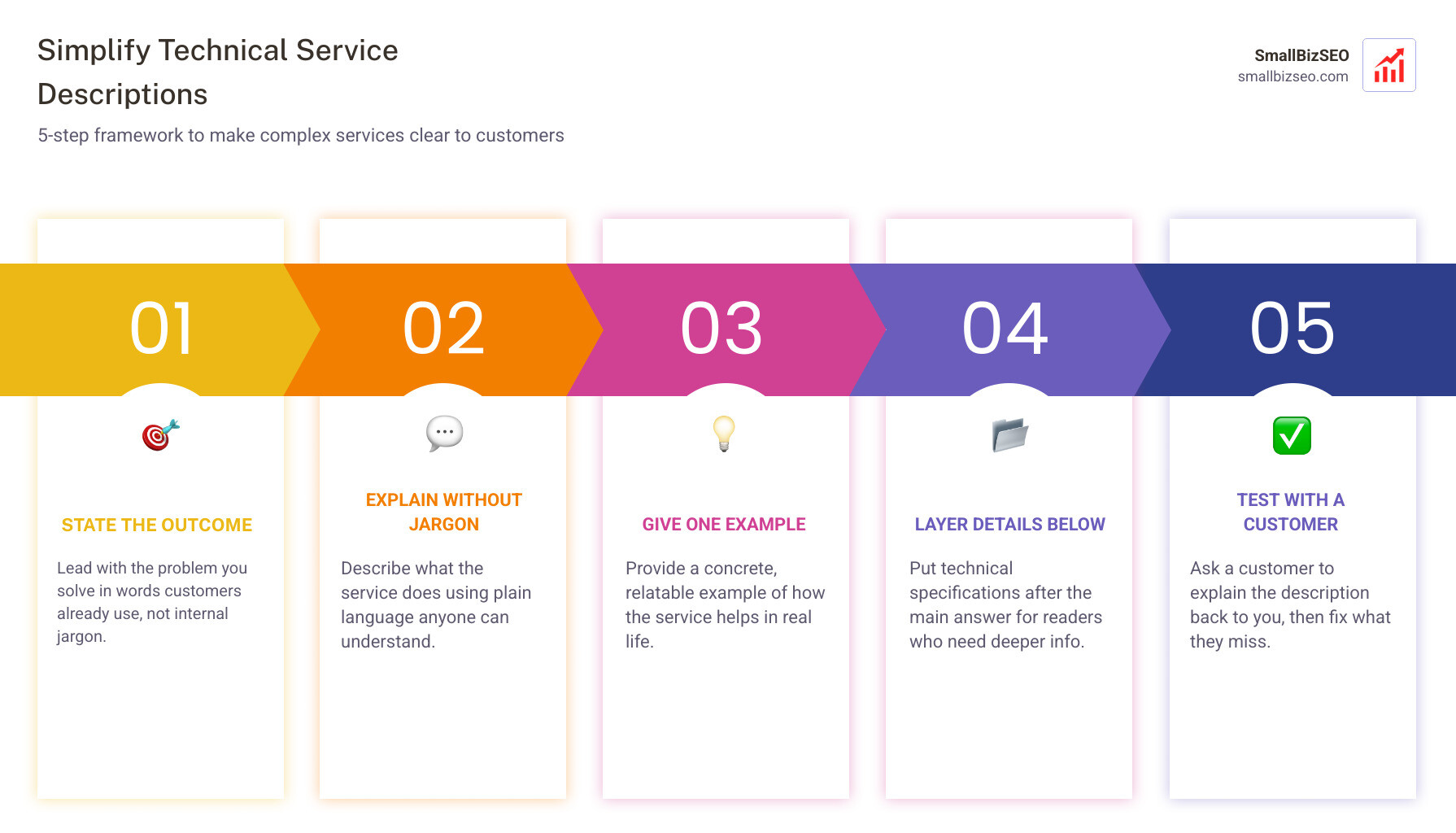
To learn how to simplify technical service descriptions for customers, start with the problem they need solved. Then follow five steps:
- State the outcome in words customers use.
- Explain what the service does without internal jargon.
- Give one concrete example of how it helps.
- Put technical details below the main answer for readers who need them.
- Ask a customer to explain the description back to you, then fix what they miss.
The goal is not to hide how the service works. It is to help someone see its value before asking them to sort through the details.
I’m Clayton Johnson, founder of SmallBizSEO. My work in SEO and content strategy has taught me that how to simplify technical service descriptions for customers starts with answering their questions clearly, then backing up those answers with useful detail.
Why Learning How to Simplify Technical Service Descriptions for Customers Drives Growth
Clear technical descriptions drive business growth by eliminating buyer confusion, shortening sales cycles, and drastically reducing customer support costs. When prospective clients land on a service page, they are trying to answer a simple question: "Can this team solve my specific problem?" If your copy forces them to decode engineering vocabulary, they leave.

Industry data shows that 82% of service professionals say customer expectations are higher than ever, and 61% of customers prefer resolving simple issues using self-service options. When technical service descriptions are straightforward, buyers can self-educate and qualify themselves quickly. Clear descriptions also lower operational overhead; self-service tickets cost an average of $2.37 to resolve, compared to $15.72 for telephone support and $17.10 for walk-ins.
| Metric / Outcome | Jargon-Heavy Service Descriptions | Simplified, Outcome-First Descriptions |
|---|---|---|
| Initial Bounce Rate | High (prospects experience cognitive friction) | Low (prospects grasp relevance in seconds) |
| Average Cost per Support Ticket | $15.72 – $17.10 (requires human explanation) | $2.37 (resolved through self-service clarity) |
| Buyer Trust & Retention | Low (creates distance and confusion) | High (clear communication establishes authority) |
| Sales Cycle Velocity | Slow (extended back-and-forth Q&A) | Fast (stakeholders approve proposals readily) |
Why Is Knowing How to Simplify Technical Service Descriptions for Customers Critical for Conversion?
Knowing how to communicate your technical capabilities directly impacts your bottom line because confused buyers do not buy. When business owners evaluate complex offerings, cognitive overload triggers friction that stalls decision-making.
Adopting understanding IT service catalog presentation principles means presenting services through customer-centric use cases rather than internal department workflows. When you pair this clarity with structured SEO-friendly content writing, you capture search intent while delivering immediate answers that drive inbound conversions.
What Are the Costly Mistakes in Technical Service Messaging?
The most common mistake in technical service messaging is the "curse of knowledge"—assuming your audience shares your specialized vocabulary. Companies often fall into these costly traps:
- Leading with internal acronyms: Using technical shorthand that alienates decision-makers.
- Dumping specifications upfront: Listing server specs, code libraries, or toolsets before defining the business value.
- Overusing passive voice: Writing dense, academic explanations that obscure accountability and action.
- Confusing complexity with prestige: Assuming big words signal deep expertise, when they actually signal poor communication.
As explored in this guide on how to explain complex services without dumbing them down, plain language does not dilute technical sophistication; it translates expertise into commercial value. Engaging audiences through SEO storytelling & evergreen content helps frame complex capabilities as clear, memorable narratives.
5 Actionable Steps to Simplify Complex Technical Services

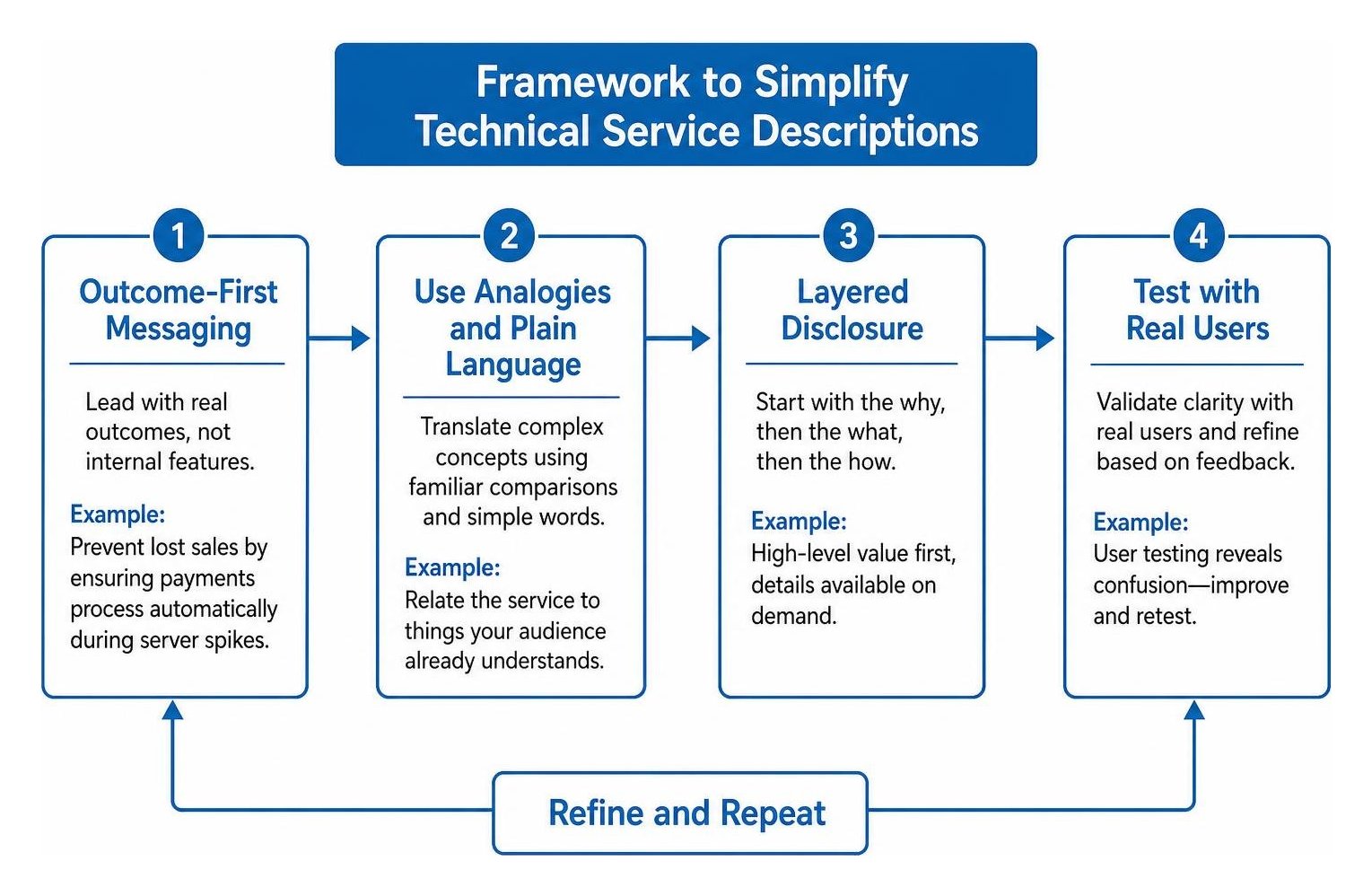
Transforming technical copy into clear, customer-friendly messaging requires a structured framework. Follow these five practical steps to make any technical service understandable and persuasive.
Step 1: Lead with Real Outcomes Instead of Internal Features
Always lead with the measurable result the client receives rather than the mechanism used to achieve it. Technical teams naturally describe what they built, but clients purchase what changes for their business.
For example, instead of stating, "We implement asynchronous webhook retry pipelines," state, "We prevent lost sales by ensuring your checkout system automatically processes payments even during server spikes." As outlined in this guide on translating technical work to non-technical clients, switching the verb to an outcome immediately clarifies value. Integrating these principles into small business content strategies ensures your service pages attract and convert high-intent buyers.
Step 2: Translate Complex Jargon Using Familiar Analogies
Use relatable mental models to ground unfamiliar concepts in everyday experiences. The AWE Formula (Analogy, What It Does, Evidence) provides an effective blueprint:
- Analogy: "Think of our cloud backup service like an automated safety deposit box for your critical data."
- What It Does: "It continuously saves copies of your files off-site so your operations never stop if hardware fails."
- Evidence: "Our clients restore lost files in under five minutes and reduce IT downtime by over 90%."
Applying proven simplifying technical writing techniques allows you to turn abstract technical features into sticky language. This clarity strengthens your overall brand building content, positioning your company as an accessible, trusted authority.
Step 3: Structure Layered Content for Progressive Disclosure
Organize your content in progressive layers so executive buyers get instant answers while technical evaluators can review deep specifications:
- The 5-Second Summary: A single sentence stating who the service is for and the core problem it solves.
- The 30-Second Overview: Three to four bullet points highlighting specific business outcomes and client-facing metrics.
- The Methodology & Proof: A high-level explanation of your process paired with case studies or verifiable results.
- Technical Specifications & FAQs: Deep technical parameters, integration details, and edge cases placed in structured accordion sections or secondary resources.
To help search engines index these clear layers, consider implementing service schema across your digital catalog. Structuring your pages with progressive disclosure mirrors the proven approach of translating complex B2B services into narrative stories, keeping both executives and technical teams engaged.
Step 4: Format Copy for Fast, Frictionless Scanning
Dense blocks of text create immediate cognitive fatigue. Format your service descriptions for effortless readability:
- Keep introductory sections concise (5 to 10 words).
- Limit body paragraphs to 2 or 3 short sentences.
- Maintain an average sentence length of roughly 10 to 15 words.
- Use strong action verbs at the beginning of bullet points.
- Restrict bullet lists to 3 or 4 focused items to prevent cognitive overload.
Step 5: Test Service Descriptions with Practical Validation Methods
Before publishing your technical descriptions, run them through objective clarity tests:
- The Five-Second Rule: Show your service description to someone outside your industry for five seconds. Ask them: "What does this service do, and who is it for?" If they cannot answer accurately, refine your opening hook.
- The Non-Expert Test: Explain your core service offering to a friend or family member without technical background. If they ask for clarification on basic terms, replace those words with everyday equivalents.
- Readability Auditing: Run your text through tools like Hemingway to identify passive voice, overly complex sentences, and unnecessary adverbs.
Refining your text through systematic content readability optimization ensures your technical messaging is accessible, authoritative, and built to convert.
Practical Steps to Transform Your Technical Messaging
Simplifying technical service descriptions is not about dumbing down your expertise—it is about respecting your customer's time and cognitive bandwidth. By leading with clear business outcomes, replacing internal buzzwords with grounded analogies, and structuring pages with progressive disclosure, you create messaging that builds trust and drives measurable business growth.
Review your primary service pages today. Highlight every piece of internal jargon, ask whether each sentence describes a feature or a benefit, and restructure your copy so prospective clients immediately understand the value you deliver.