Small Business Content Strategies That Drive Real Inbound Inquiries

Small Business Content Strategies That Drive Real Inbound Inquiries
How Can Small Business SEO Content Bring In More Inquiries?
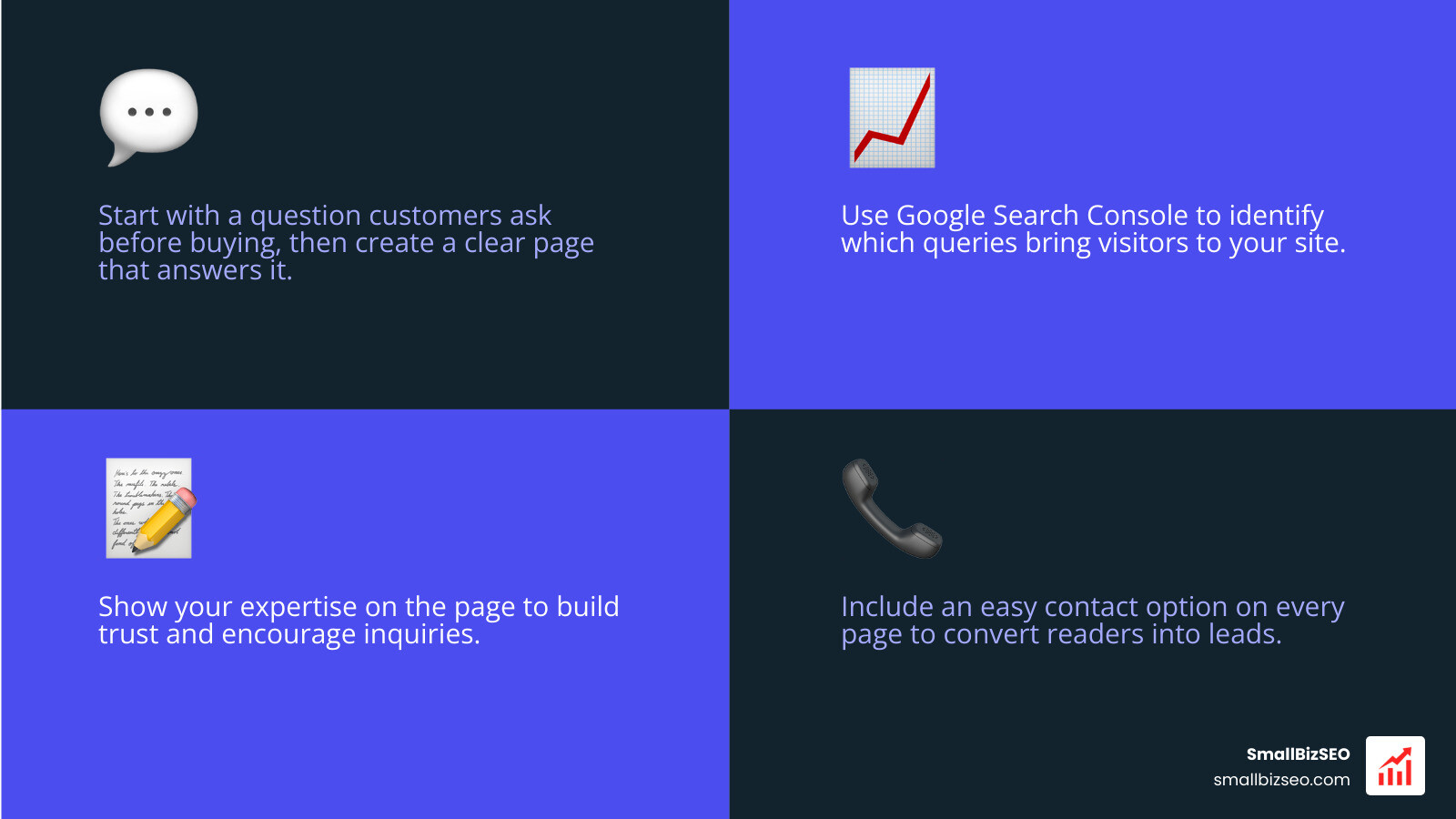
To create small business SEO content that brings in inquiries, start with a question customers ask before buying. Make a page that answers it clearly, shows what your business knows, and gives readers an easy way to contact you. Then use Google Search Console to see which searches bring visitors, and track inquiries alongside clicks.
I'm Clayton Johnson, founder of SmallBizSEO, where I connect SEO, digital PR, and content to help businesses attract qualified leads. My work on small business SEO content and Answer-Ready SEO starts with the buyer's question and ends with a useful next step.
Key small business SEO content vocabulary:
How to Build High-Ranking Small Business SEO Content That Converts
Search engines rank web pages by crawling content, indexing text and media, and ranking documents based on relevance, user intent, and site authority. Ranking at the top of the search engine results page (SERP) requires matching your content directly to what a user wants to accomplish when they type a query.
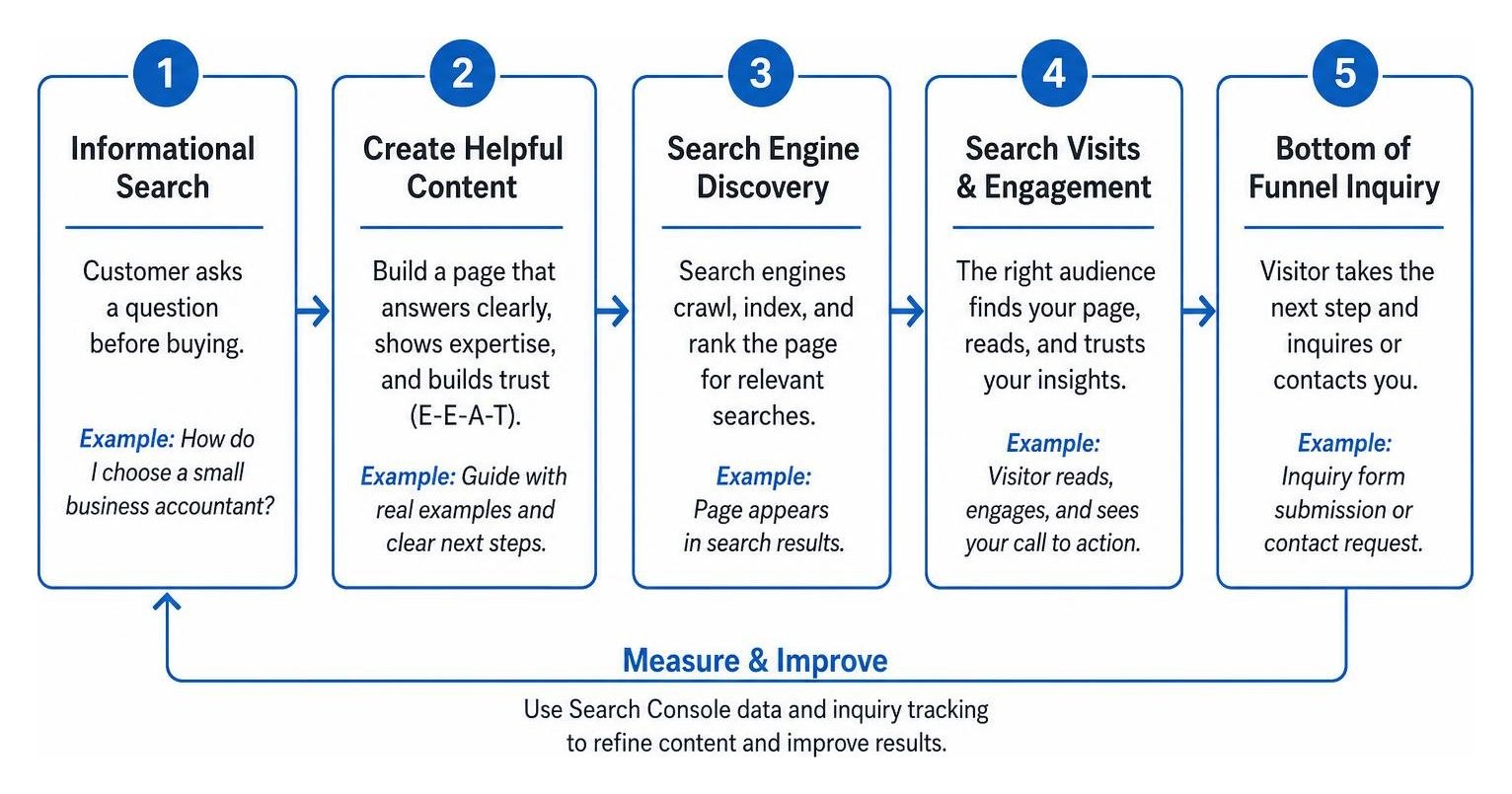
Organic search drives 53.3% of all website traffic across the web, outperforming paid advertisements and social channels as a sustainable source of revenue. While search engines use over 200 signals to evaluate pages, small businesses achieve the best return on investment by focusing on bottom-of-funnel content that solves specific customer problems.
Before drafting an article or service page, perform a SERP competitive analysis to identify what top-ranking pages include. Look at their heading hierarchy, content format, and visual assets. Rather than producing generic overviews, create comprehensive resources that integrate real-world examples, transparent pricing insights, and clear calls to action. For foundational indexing guidance, consult the Search Engine Optimization SEO Starter Guide provided by search engines.
What Is Small Business SEO Content and How Does It Differ from Local SEO?
Small business SEO content targets broader informational and transactional search queries across wider geographic markets, whereas local SEO focuses on location-specific searches, Map Pack rankings, and directory citations.
| Feature | Small Business SEO Content | Local SEO Strategy |
|---|---|---|
| Primary Goal | Nationwide or regional organic rankings for commercial terms | Google Map Pack rankings and local storefront visits |
| Core Asset | Dedicated service pages, guides, and comparison articles | Google Business Profile and local directory citations |
| Search Intent | Educational, solution-focused, and transactional intent | Geographic searches ("near me", neighborhood terms) |
| Conversion Focus | Web forms, schedule links, and consultation calls | Direct phone calls, map directions, and foot traffic |
Both approaches reinforce each other. Research shows that almost half of all searches have local intent, and 72% of consumers who make a local search visit a business within five miles. Businesses with a complete Google Business Profile are 70% more likely to attract visits.
Integrating a guide on using content marketing to boost SEO alongside practical local SEO optimization creates multiple entry points for buyers. Consistent name, address, and phone number (NAP) data combined with in-depth service pages helps search engines verify your business legitimacy and serve your website to high-intent searchers.
How to Research and Map Keywords for Small Business SEO Content
Effective keyword research for small businesses focuses on identifying low-competition, high-intent search terms that reflect specific customer pain points.
Targeting broad, highly competitive keywords often wastes resources for growing sites. Instead, focus on long-tail keywords (search queries containing three or more words). These terms typically carry clear purchase intent and lower difficulty scores. Use keyword research tools to evaluate monthly search volume, keyword difficulty, and intent categories:
- Informational Queries: "how to maintain commercial cooling systems"
- Commercial Investigation: "best concrete sealing options for warehouses"
- Transactional Intent: "affordable dental equipment repair quote"
Analyze your own Google Search Console data to find queries currently ranking on page two (positions 8 to 20). Updating and expanding pages targeting these queries can quickly move them onto page one, where over 99% of user clicks occur.
You can follow a practical guide to keyword content optimization or review a practical guide to writing blog posts for SEO to structure detailed content briefs before writing. Mapping one target keyword and three to five secondary variations to each page prevents keyword cannibalization across your site.
What Are the Essential On-Page and E-E-A-T Signals to Optimize?
On-page SEO requires placing keywords strategically across page elements while demonstrating Experience, Expertise, Authoritativeness, and Trustworthiness (E-E-A-T).
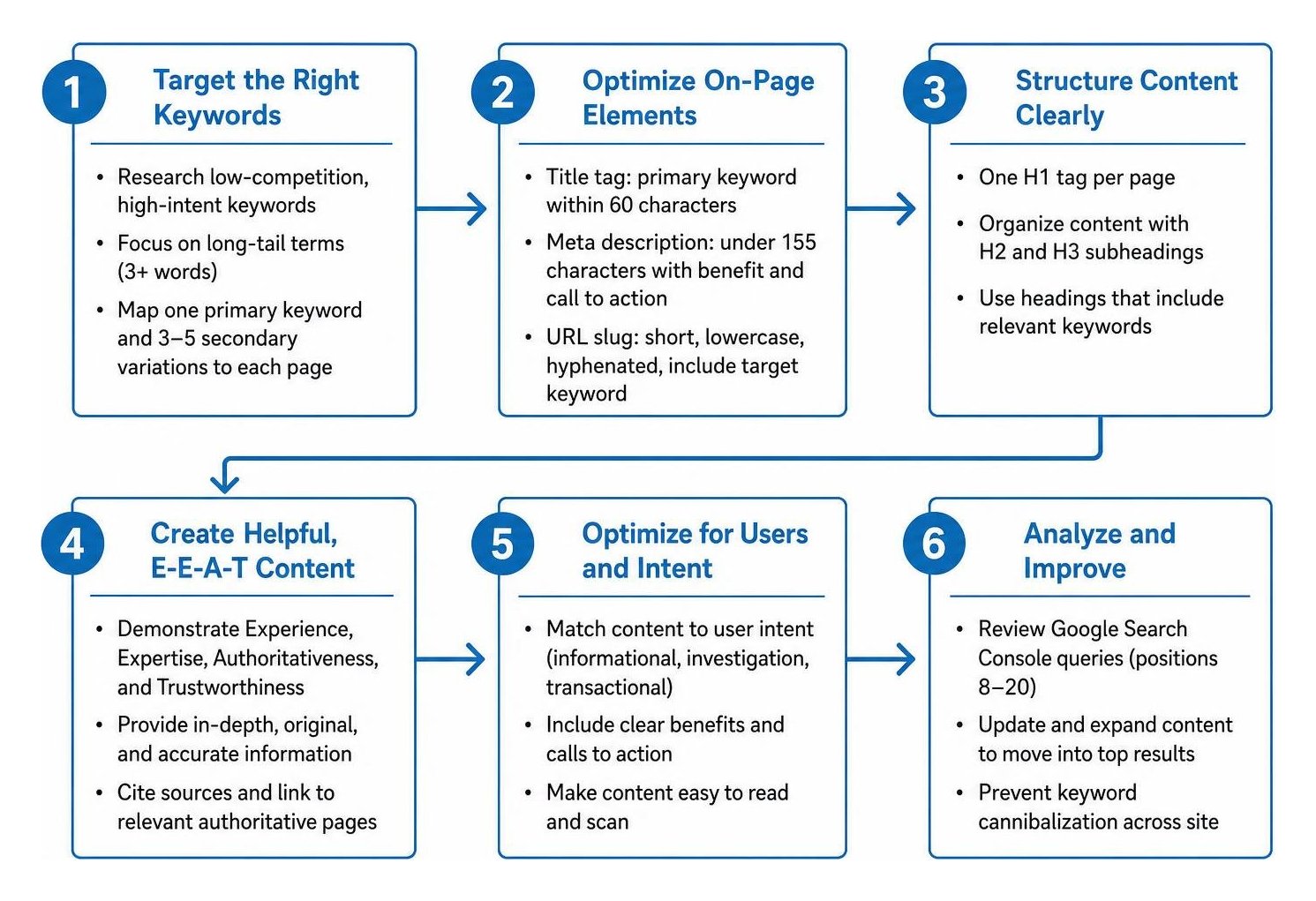
Search crawlers and human visitors rely on consistent structural signals to understand your content. Apply these essential on-page practices across every publication:
- Title Tags and Meta Descriptions: Front-load your primary keyword in the title tag within 60 characters. Write a meta description under 155 characters that includes a benefit and a call to action.
- URL Structure: Use short, lowercase, hyphenated URL slugs that contain only your target keyword.
- Heading Hierarchy: Maintain a strict heading structure (one H1 tag, followed by organized H2 and H3 subheadings).
- Internal Linking: Link each new post to two or three relevant service pages and update older articles to link back to the new content, passing internal link equity. Follow the checklist for WordPress blog SEO to ensure proper technical site structure.
- Image Optimization: Compress images into modern WebP formats and write descriptive alt text that supports screen readers and visual search indexing.
- E-E-A-T Author Profiles: Include author bylines, credentials, client case studies, and transparent sourcing to satisfy search quality evaluation guidelines.
Backlinks also play an essential role in domain trust. In a study conducted by Backlinko, the number one ranking page had nearly four times more backlinks than those ranking below it. Earning high-quality backlinks from niche directories and industry publications validates your authority.
Scaling Content Operations and Measuring Organic Results
Building a sustainable organic lead pipeline requires consistent publishing and regular tracking of business metrics rather than just vanity impressions.
Small business SEO is a cumulative process. Most growing sites observe early indexing and initial movement within 3 to 6 months, while significant inbound lead volume typically matures between 6 and 12 months.
Configure Google Analytics 4 and Google Search Console to monitor key performance indicators:
- Organic Clicks and Impressions: Track total visibility growth across non-branded search terms.
- Average Keyword Position: Monitor movements for target commercial terms toward the top three positions.
- Form Submissions and Call Clicks: Measure actual inbound inquiries generated from organic search landing pages.
- Crawl Health: Ensure no indexation errors or broken links waste search engine crawl efficiency.
Conduct quarterly content audits to review declining pages. Updating statistics, adding new FAQs, and improving page speed ensures your content remains competitive over time.
How Does AI Search Change Optimization for Growing Businesses?
AI-driven search engines and conversational answer engines summarize web content directly in search results, making clear structural formatting vital for visibility.
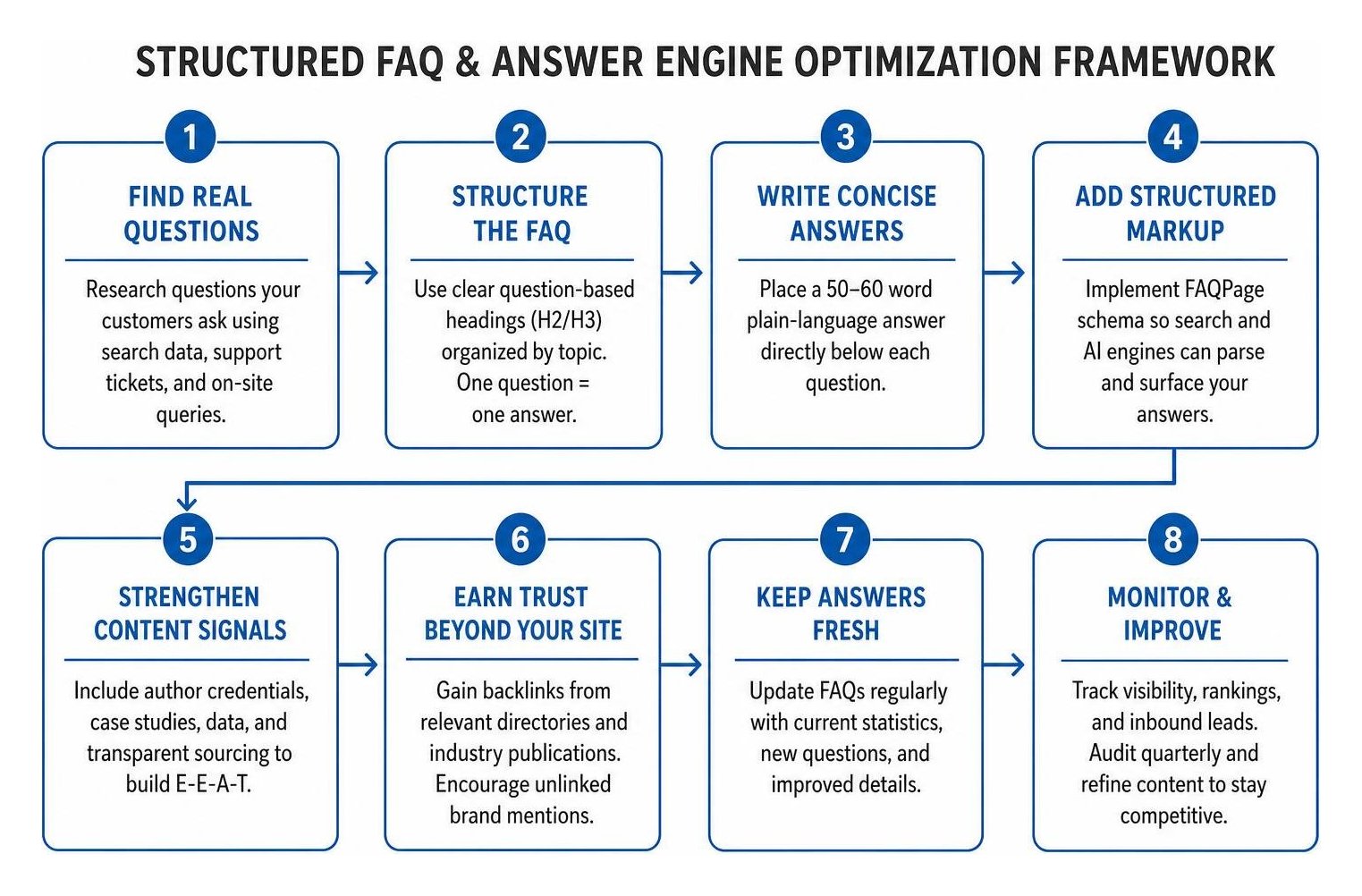
To rank within AI Overviews, Generative Engine Optimization (GEO) and Answer Engine Optimization (AEO) require writing concise 50-to-60-word plain-language answers directly below question-based headings.
Using structured tools like SEO writing prompts for small businesses can accelerate outline creation, but human editorial oversight is necessary to weave in first-hand experience and original data. Unlinked brand mentions across the web also serve as trust signals that AI models evaluate when recommending businesses. Adopting a comprehensive SEO content strategy ensures your site satisfies traditional search algorithms and generative AI summaries simultaneously.
Should You Manage SEO In-House or Hire Professional Services?
Small businesses must decide whether to execute SEO tasks internally or partner with a specialized search marketing agency based on time, budget, and technical skill.
- In-House Management: Best for business owners with available time to research keywords, write articles, and manage basic on-page updates using entry-level software tools.
- Professional Agency Execution: Best for companies wanting rapid organic expansion without diverting internal staff from core operational tasks.
At SmallBizSEO, we implement our data-driven "Velocity" framework to help small businesses achieve rapid search rankings and sustainable inbound inquiries. Our team handles comprehensive technical health audits, high-authority link acquisition, conversion-optimized copywriting, and automated reporting. If you want to scale your inbound inquiries efficiently, explore our comprehensive SEO content services to accelerate your business growth.
Next Steps for Turning Search Visibility into Revenue
To transform your website into an inquiry generation engine, begin by answering the exact questions your ideal clients ask every day. Conduct focused keyword research, structure your pages with clean headings and direct answers, and maintain a consistent publishing schedule. As search technologies evolve, clear, expert-led content that addresses real user intent will continue to win top rankings and deliver qualified inbound leads to your business.