Beginner’s Guide to Choosing an International SEO Company
Beginner's Guide to Choosing an International SEO Company
Domestic vs. Global Search: What Sets International Agencies Apart
Choosing the right international SEO company requires evaluating four core capabilities: technical architecture and hreflang governance, native cultural transcreation, non-Google regional search engine expertise, and isolated cross-border analytics tracking. A qualified global SEO company must engineer an infrastructure capable of handling varied languages, regional user behaviors, and country-specific crawl budgets without diluting the authority your brand has built domestically.
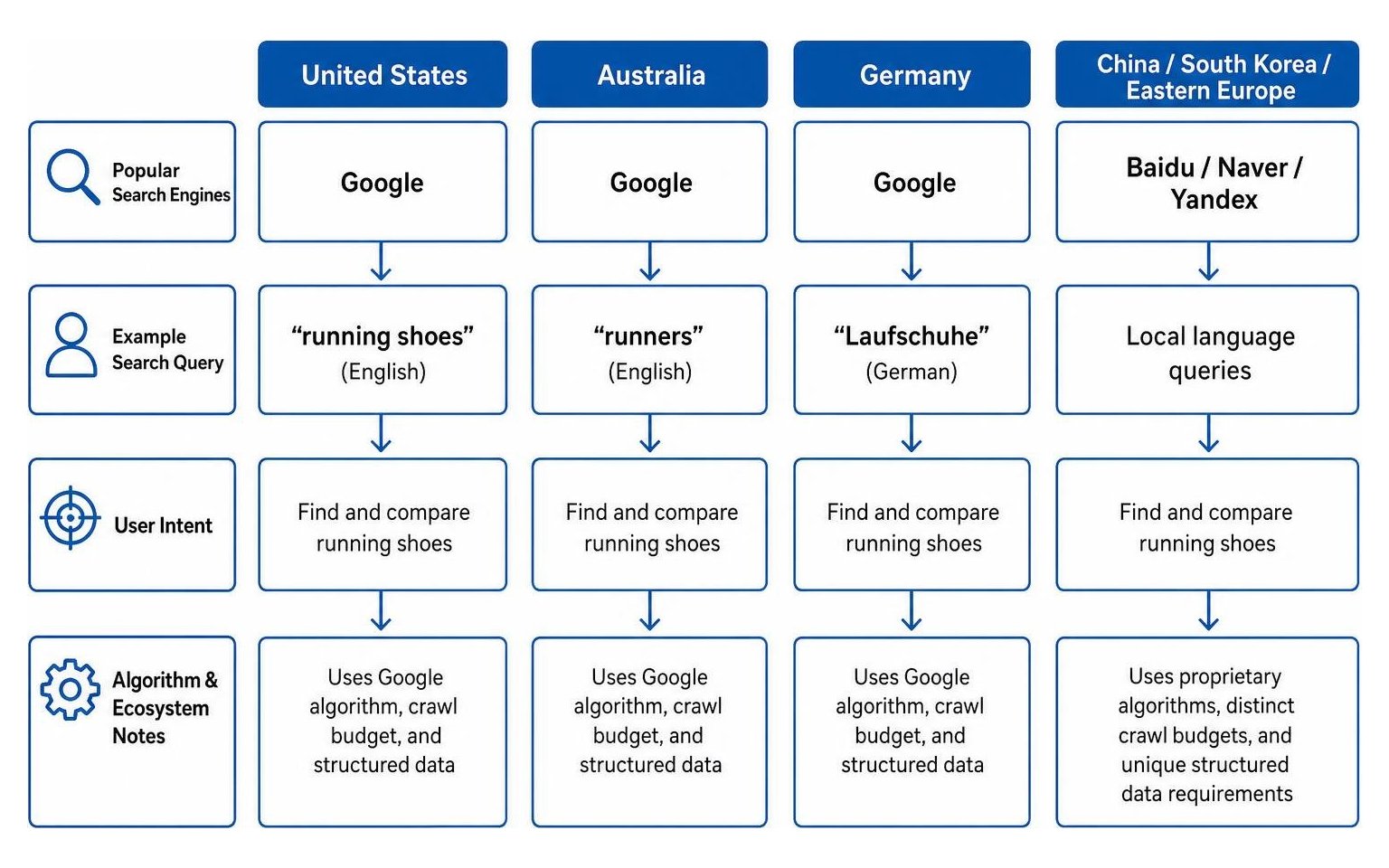
Expanding beyond your home market requires much more than simply duplicating web pages. Search behavior shifts dramatically once you cross borders. A user in the United States might search for "running shoes," while an Australian shopper looks for "runners," and a buyer in Germany queries "Laufschuhe." Furthermore, platforms like Baidu, Naver, and Yandex command significant market share in East Asia and Eastern Europe, each using proprietary ranking algorithms and distinct crawl budgets. An experienced international SEO company treats each regional engine as its own ecosystem with dedicated audits, content workflows, and performance benchmarks.
Core Capabilities of a Top International SEO Company
When evaluating a prospective multilingual SEO company, you should look for competencies that extend well beyond standard keyword optimization:
- Technical Architecture Governance: Designing scalable URL structures and managing server response times globally.
- Native Transcreation: Moving past machine translation to craft culturally resonant, native copy.
- Geolocalized Off-Page Authority: Securing top-tier backlinks from country-code top-level domains (ccTLDs) and regional publications.
- Multi-Currency and Structured Data Schema: Implementing clear product, organization, and currency tags to capture rich search snippets.
- Search Console Geolocation: Setting up individual profiles and sub-properties for flawless regional monitoring.
- Regional Crawl Management: Allocating crawl budget across language versions so search engines prioritize your most valuable pages in each market.
- Localized Conversion Optimization: Aligning calls to action, trust signals, and page layouts with regional buying behavior and payment preferences.
Keyword Research and Cultural Transcreation Across Markets
Literal, word-for-word translation is one of the quickest ways to derail a cross-border campaign. Effective international optimization relies on transcreation—adapting messaging to preserve original intent, context, and emotion while matching local dialect nuances. A phrase that feels persuasive in one language can sound awkward, overly formal, or even misleading in another, which is why native linguists should review every piece of content before it goes live.
For true impact, agencies must map out localized search intent rather than simply translating seed keywords. That means studying how users in each country phrase questions, compare products, and move through the buying journey. A robust approach to SEO for topical authority ensures your domain builds comprehensive topical depth across every language tier, establishing your brand as a trusted resource in every new country you enter. Over time, this depth helps search engines recognize your site as a reliable answer source for an entire topic cluster, not just a handful of isolated keywords.
Core Technical Criteria for Selecting an International SEO Company
Technical execution represents the backbone of cross-border search marketing. A single misconfiguration in your canonical tags or language headers can cause search engines to misattribute entire regional sections of your website. When that happens, the wrong page may rank in the wrong country, duplicate content may compete against itself, and your international visibility can stall before it gains momentum.
When scaling a multilingual ecommerce SEO company footprint, crawl budget management becomes critical. Large catalogs with multiple languages can quickly dilute crawl equity unless supported by high-performance Content Delivery Networks (CDNs) and optimized server locations. A well-configured CDN reduces latency for users in distant regions, while strategic server placement helps search engine bots access and index your pages more efficiently. Without these safeguards, search engines may waste crawl resources on low-value URLs and leave your most important regional pages undiscovered.
| Architecture Type | Structure Example | Pros | Cons | Ideal Use Case |
|---|---|---|---|---|
| ccTLD | brand.de, brand.fr |
Strongest local trust and search geo-signals | Expensive to maintain; link equity is split across domains | Large enterprises with localized teams in each country |
| Subdomain | de.brand.com |
Flexible server hosting; easier regional testing | Splits domain authority; more complex maintenance | Brands requiring separate regional server environments |
| Subfolder | brand.com/de/ |
Consolidates all backlinks and authority into root domain | Complex URL structures; requires strict directory governance | Most growing businesses and scalable online platforms |
International URL Structures and Domain Architecture Decisions
Selecting the right domain architecture represents a permanent foundational choice. Utilizing subfolders (example.com/es/) allows you to inherit the primary root domain's established authority, drastically reducing the time required to rank new pages. Conversely, deploying country-code top-level domains (example.es) signals immediate local relevance to users, though each domain starts with zero backlink equity. The right decision depends on your long-term expansion plans, available regional resources, and how much authority your root domain has already accumulated.
Analyzing common domain structure patterns helps clarify how top global brands balance crawl efficiency against local trust signals. Many brands begin with subfolders to consolidate authority, then migrate to ccTLDs only when a market justifies dedicated infrastructure. Others keep subfolders indefinitely because the maintenance burden is lower and the root domain continues to pass authority to every language version.
Hreflang Tag Implementation and Geo-Targeting Accuracy
Hreflang tags inform search engines which language and regional version of a webpage to present based on the user's location and browser settings. When implemented correctly, they prevent duplicate-content confusion and ensure that a German user sees the German page while a Spanish user sees the Spanish equivalent.
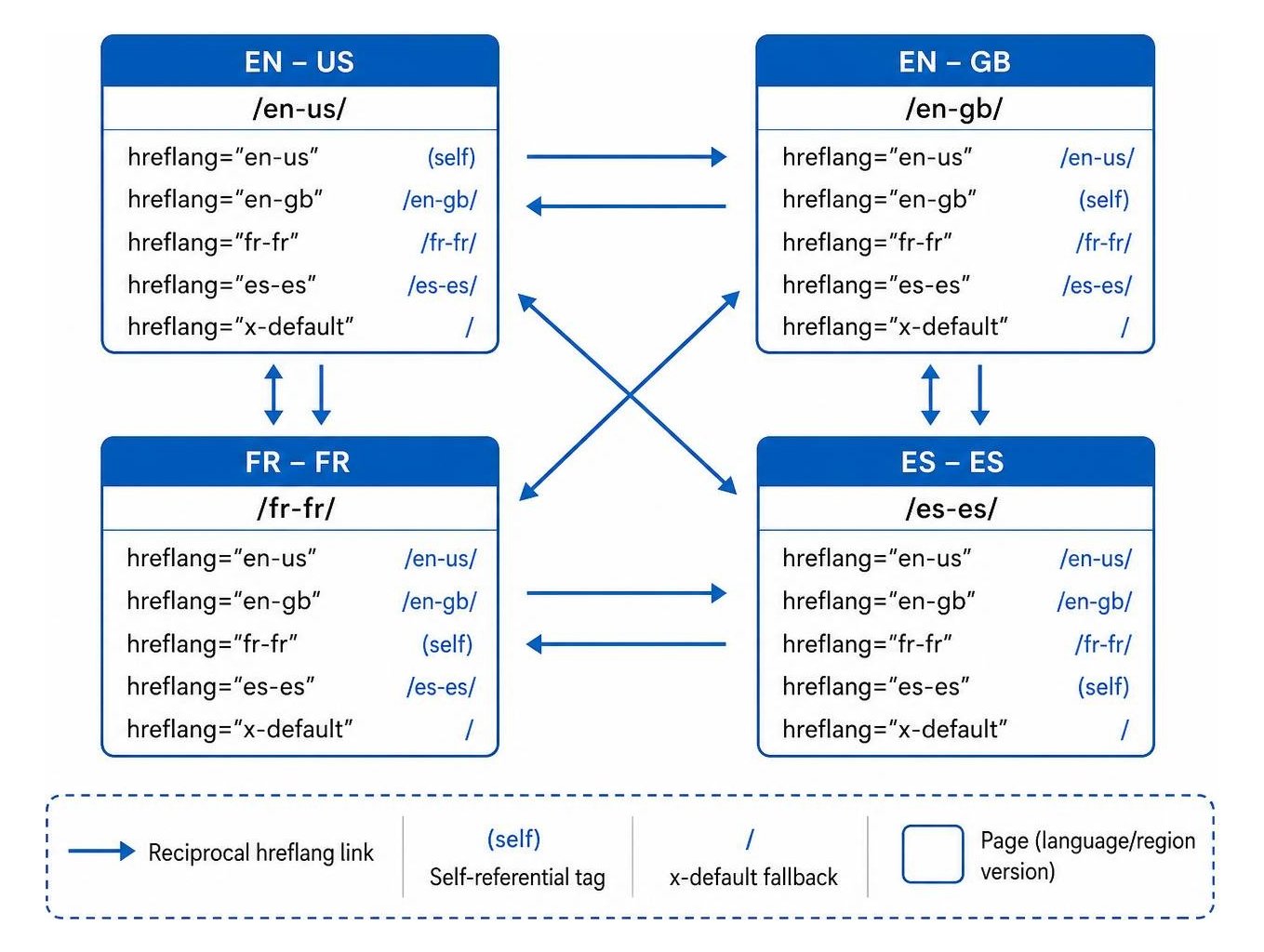
Hreflang errors remain the primary technical reason international sites fail to gain traction. The most vital rules include:
- Strict Reciprocity: If page A links to page B via an hreflang alternate tag, page B must link back to page A.
- Self-Referential Tags: Every page must include an hreflang tag pointing back to itself.
- The x-default Attribute: You should always designate an
x-defaultfallback URL for unmatched geographic locations or language preferences. - Consistent Language-Region Codes: Use valid ISO language and country codes, and keep them consistent across your sitemap, HTML head, and HTTP headers.
- Canonical Alignment: Each hreflang alternate should point to a canonical version of the page, not a parameterized or filtered URL.
A disciplined international SEO company will audit these signals regularly, because even a small change to a template or CMS can break reciprocity across dozens of regional pages at once.
Agency Models, Pricing, and Measuring Cross-Border ROI
Selecting an agency requires balancing budget, scalability, and performance tracking. When vetting prospective partners through an RFP, ask these critical questions:
- How do your native linguistic teams handle keyword research in non-English markets?
- What automated monitoring systems do you use to detect broken hreflang reciprocity?
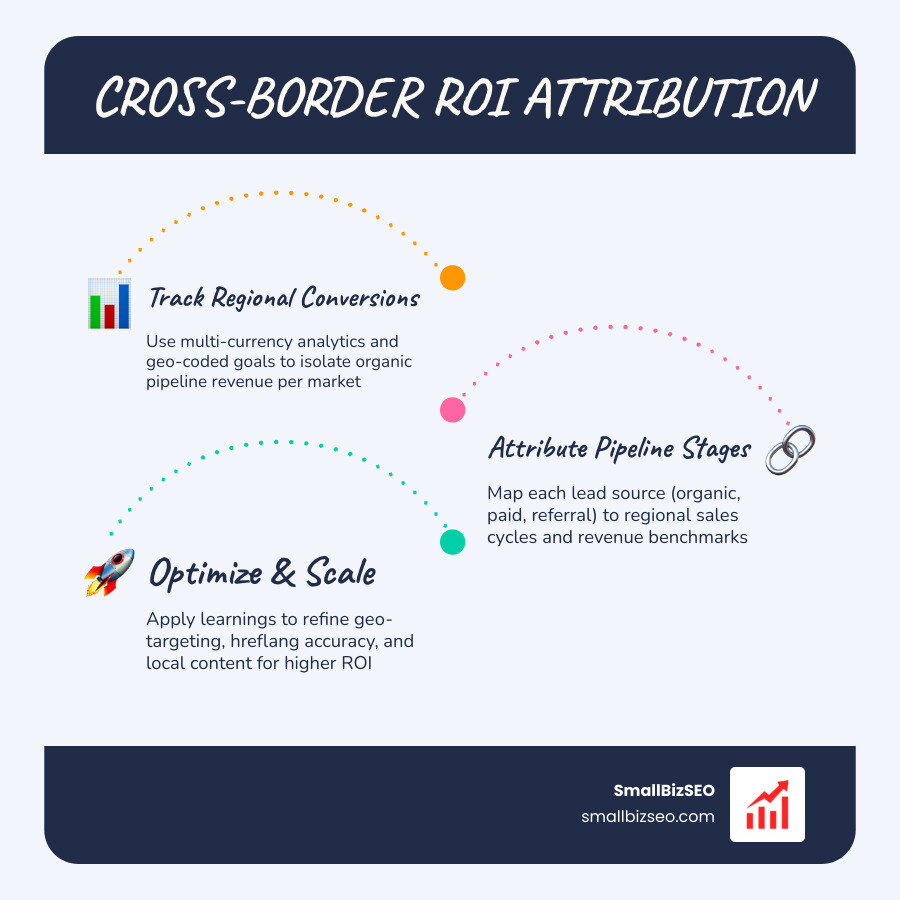
- How do you isolate regional organic pipeline revenue in multi-currency analytics dashboards?
- Which regional search engines do you optimize for beyond Google, and how do you measure visibility on those platforms?
- How do you report on technical health, content performance, and link acquisition for each country separately?
- What is your process for coordinating with in-house regional teams or local partners?
Vetting an International SEO Company: Network vs. Specialized Boutique
Large global holding networks offer broad infrastructure across dozens of countries, but they often present significant overhead and layered account management. Campaigns can move slowly when decisions must pass through multiple regional offices, and your account may not receive the senior-level attention you expect.
Conversely, partnering with an agile enterprise SEO company or specialized boutique ensures dedicated senior talent, rapid technical turnaround, and focused governance. Boutiques adapt swiftly to algorithmic changes without bureaucratic lag, delivering custom attention to your core markets. They also tend to offer more transparent reporting, because the people analyzing your data are often the same people making strategic recommendations.
Omnichannel Alignment and Generative AI Search Discovery
Cross-border organic search no longer operates in a silo. Modern international optimization blends technical SEO with localized digital PR, regional social media campaigns, and paid search. When these channels work together, they reinforce brand recognition, generate consistent regional signals, and create a larger surface area for discovery across every stage of the customer journey.
Furthermore, AI-driven discovery platforms and answer engines now surface brand recommendations before a user ever clicks a standard search link. These systems draw from structured data, authoritative content, and citations across the web, which means your international presence must be consistent and credible everywhere it appears. Implementing our actionable strategies for generative AI search optimization ensures your brand earns citations across both classic search results and localized AI answer layers worldwide.
Frequently Asked Questions About International SEO Services
How much does it cost to hire an international SEO agency?
Pricing structures typically depend on target market volume, technical complexity, and content scope. Project-based diagnostic audits commonly range between $5,000 and $15,000, while recurring monthly retainers for multi-country campaigns often start between $3,000 and $10,000+ per month. The final cost also depends on how many language versions you need, how much existing content must be localized, and whether you require ongoing link-building or technical maintenance. To better understand scope options, explore our breakdown of comprehensive SEO services designed for sustainable cross-border scaling.
What is the difference between direct translation and content localization?
Direct translation converts words mechanically from one language to another, frequently missing regional idioms, search habits, and cultural context. Content localization (transcreation) rewrites and adapts messaging to align with regional consumer expectations, buying triggers, and authentic search engine query behavior. For example, a direct translation may preserve the literal meaning of a headline while losing the emotional appeal that drives clicks, whereas localization recreates that appeal using language and references that feel native to the target market.
How long does it take to achieve rankings in new international markets?
Websites utilizing a consolidated subfolder architecture on a high-authority root domain often see initial keyword traction within 3 to 6 months. Independent ccTLDs or newly launched subdomains typically require 9 to 18 months to build sufficient localized domain trust and authority. The timeline also depends on keyword competitiveness, content depth, and how consistently you publish localized material. Markets with strong local competitors may take longer, while niche categories with limited regional competition can produce faster results.
Accelerate Your Global Search Visibility With SmallBizSEO
Expanding into international markets opens massive growth opportunities, but winning across borders requires deep technical precision, native cultural fluency, and transparent reporting. Without those elements, brands often waste months chasing rankings in markets where their content, architecture, or authority signals are not yet ready to compete.
At SmallBizSEO, we eliminate cross-border guesswork using our proprietary Velocity framework. We deliver data-driven technical audits, zero-error hreflang implementations, and E-E-A-T-compliant content strategies supported by automated, transparent reporting dashboards. Our approach gives you a clear view of what is working in each market, so you can scale confidently without relying on vague updates or delayed reports.
Ready to scale your organic revenue across new international territories? Learn more about partnering with our international SEO company and accelerate your global rankings today.