Keyword Shortlisting Playbook: Mining Real Objections for Organic Pipeline

The Step-by-Step Framework for Mining and Categorizing Sales Objections
Building a keyword shortlist from common sales objections starts with extracting verbatim friction points from call transcripts and CRM notes, clustering those phrases by how often distinct prospects raise them, weighting the clusters by deal impact, and then validating the resulting terms against live search results before creating content. This process turns real buyer hesitation into bottom-of-funnel pages that capture prospects who are already evaluating solutions.
Why are customer objections more valuable than generic keyword metrics?
Customer objections reveal the exact doubts prospects must resolve before signing a contract. When you optimize content around these hesitations, you capture prospects who are already actively evaluating solutions.
Standard keyword research often focuses on raw search volume. Marketers chase broad, informational queries that generate large traffic spikes but negligible revenue. This creates a massive conversion gap: top-of-funnel broad terms typically convert at under 0.5%, whereas comparison and alternative keywords average an 8.43% conversion rate, and category-level terms sit at 4.85%.
Relying solely on vanity metrics ignores the fact that 70% of purchase decisions are driven by emotion and risk mitigation. When a buyer asks, "What happens if this breaks during onboarding?" they are protecting their time and internal reputation. A phrase showing zero monthly search volume in traditional databases that five separate prospects asked on sales calls holds significantly more revenue value than a 10,000-volume generic phrase that generates no qualified pipeline.
By evaluating high-intent buyer intent keyword options, we capture problem-aware phrasing directly from the field. Addressing authentic friction points early in the organic search journey builds trust, shortens deal cycles, and accelerates sales velocity.
What types of sales objections map directly to bottom-of-funnel search intent?
Sales objections naturally align with the BANT framework (Budget, Authority, Need, Timing). Each category mirrors specific search intents that dictate the ideal content structure.
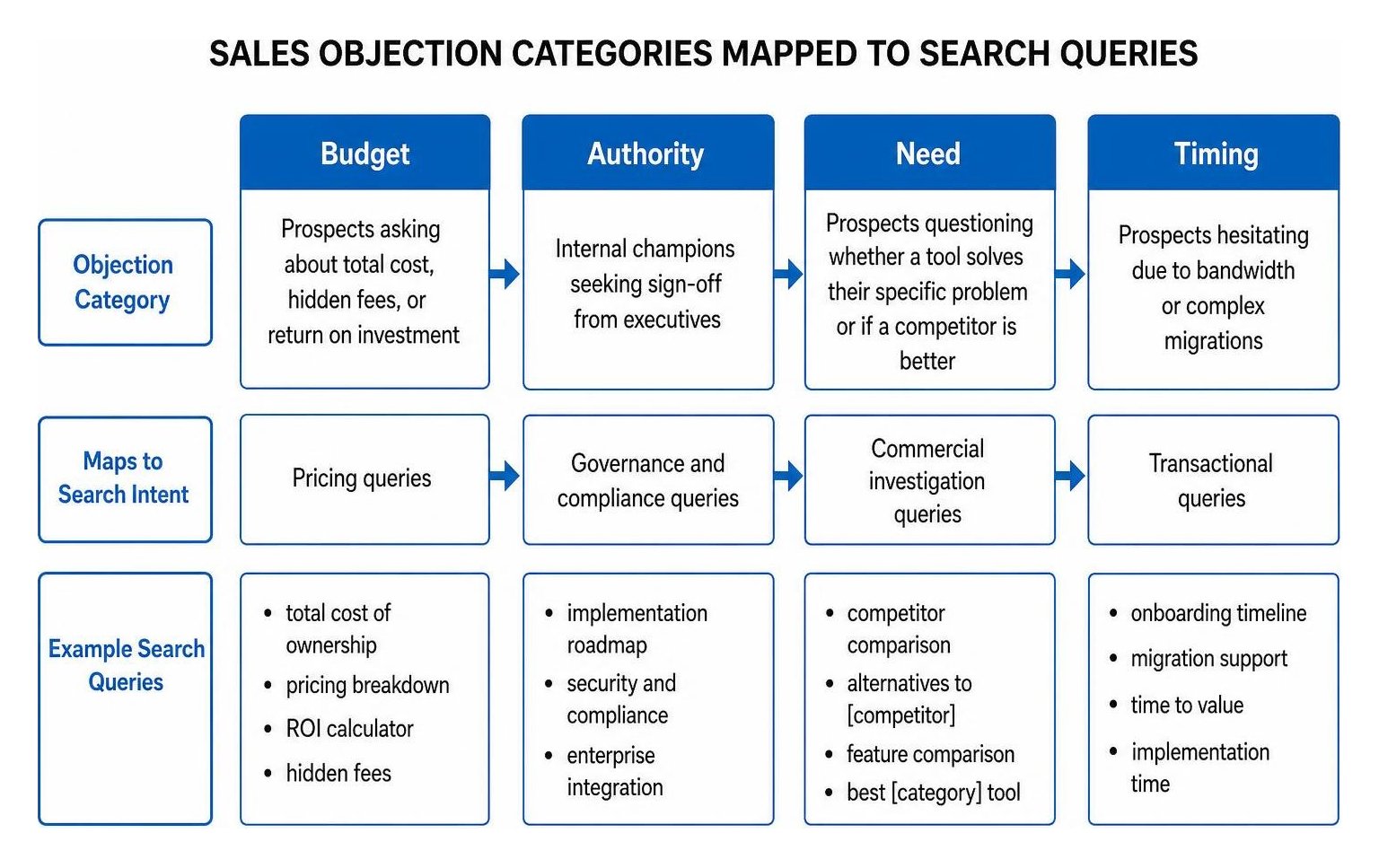
- Budget Objections: Prospects asking about total cost, hidden fees, or return on investment generate pricing queries. They search for transparent cost breakdowns, billing flexibility, and total cost of ownership calculators.
- Authority Objections: Internal champions seeking sign-off from executives search for governance, compliance, and departmental impact resources. They require implementation roadmaps, security briefs, and enterprise integration guides.
- Need Objections: Prospects questioning whether a tool solves their specific problem or wondering if a competitor offers better capabilities search for commercial investigation keyword opportunities. These map to head-to-head comparison matrices, feature alternative guides, and distinct use-case tear-downs.
- Timing Objections: Prospects hesitating due to bandwidth or complex migrations turn to transactional keyword terms centered on onboarding timelines, migration support, and time-to-value assurances.
| Objection Category | Common Prospect Phrase | Target Search Intent | Ideal Content Format |
|---|---|---|---|
| Budget | "Your setup fees are too high compared to alternatives." | Commercial / Transactional | Pricing calculator, ROI breakdown page |
| Authority | "I need approval from IT before moving forward." | Commercial Investigation | Security whitepaper, technical integration brief |
| Need | "We are already using another platform and it works fine." | Comparison / Commercial | Dedicated competitor comparison page |
| Timing | "We do not have the internal bandwidth to switch right now." | Informational / Transactional | Step-by-step migration guide, onboarding timeline |
Transforming verbal hesitations into organic assets requires an objective listening process. Sales reps spend only about a third of their working hours actively selling, with the rest consumed by administrative overhead. Consequently, verbal objections shared on calls rarely make it into marketing planning unless a structured extraction system is in place.
Reviewing call transcripts through platforms like Gong, Zoom, or Chorus yields raw language that keyword tools miss. For reliable patterns, review common sales objection frameworks across a 20-call sampling threshold. Identifying the sweet spot—phrases mentioned by 3 to 7 distinct prospects across separate deals—filters out individual quirks while pinpointing genuine market friction points.
What is the workflow for building a keyword shortlist from common sales objections in call transcripts?
A structured five-day extraction workflow organizes raw sales conversations into production-ready content briefs without overwhelming your team:
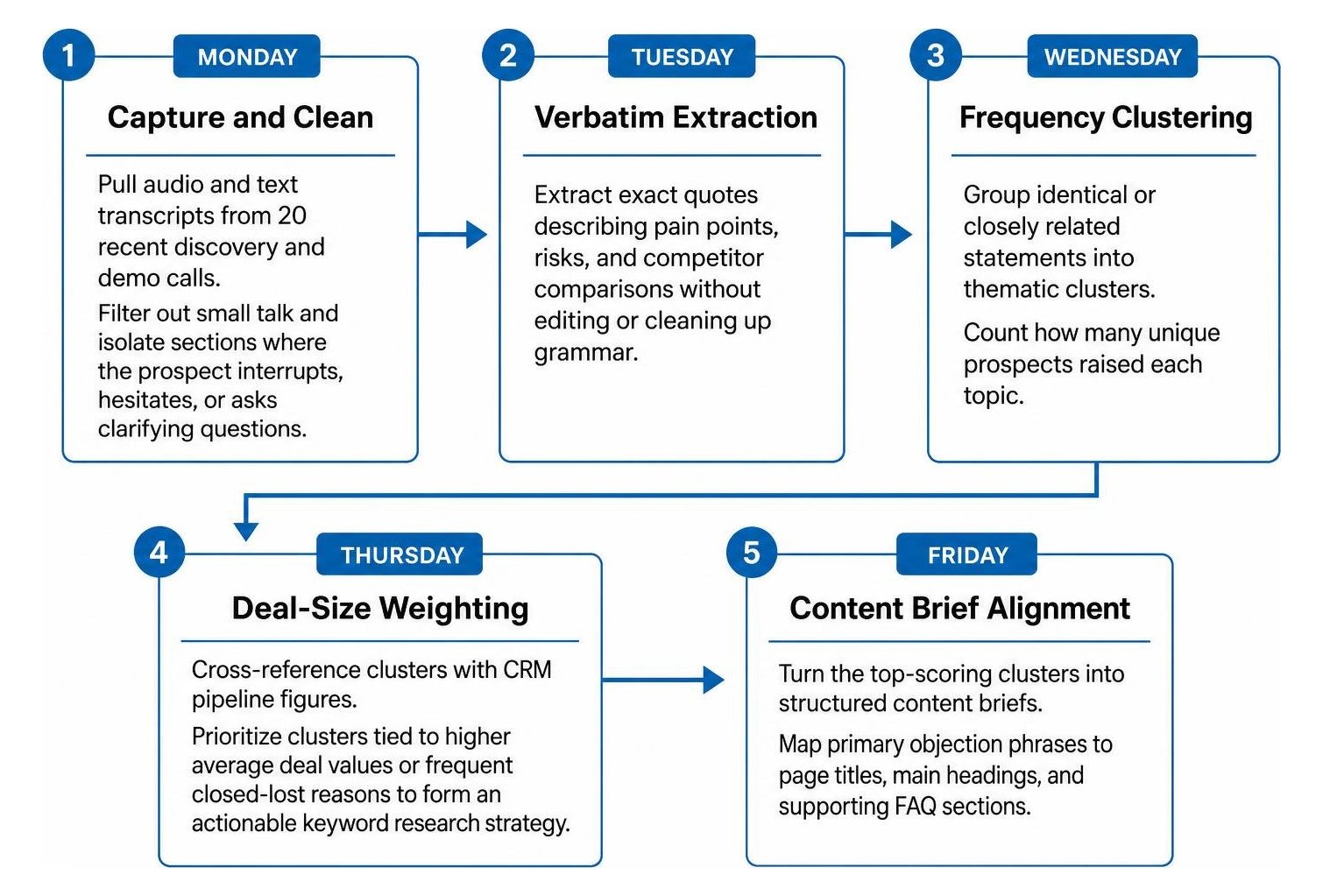
- Monday (Capture and Clean): Pull audio and text transcripts from 20 recent discovery and demo calls. Filter out small talk and isolate sections where the prospect interrupts, hesitates, or asks clarifying questions.
- Tuesday (Verbatim Extraction): Extract exact quotes describing pain points, risks, and competitor comparisons without editing or cleaning up grammar.
- Wednesday (Frequency Clustering): Group identical or closely related statements into thematic clusters. Count how many unique prospects raised each topic.
- Thursday (Deal-Size Weighting): Cross-reference clusters with CRM pipeline figures. Prioritize clusters tied to higher average deal values or frequent closed-lost reasons to form an actionable keyword research strategy.
- Friday (Content Brief Alignment): Turn the top-scoring clusters into structured content briefs, mapping primary objection phrases to page titles, main headings, and supporting FAQ sections.
How do you systematically extract objection phrases from CRM logs and sales scripts?
Your CRM contains high-intent objection data across closed-lost notes, field tags, and discovery scripts. Unlocking this data requires targeted querying across key pipeline fields.

To uncover high-converting queries from your CRM records:
- Filter closed-lost opportunities by specific fields like "Primary Competitor" and "Lost Reason Detail."
- Run text searches across sales rep activity logs for question marks (
?) and qualifying trigger phrases such as "concerned about," "cannot support," "too expensive," and *"asked if we do." - Review objection-handling enablement sheets to see the standard rebuttals reps rely on every week.
- Cross-reference internal findings with proven CRM search intent research to translate rep notes into scalable organic topics.
Following this systematic mining approach helps in finding the most profitable search terms and keywords for your business that competitors overlook.
Prioritizing, Validating, and Optimizing Objection-Based Keywords for Maximum ROI

Not every sales objection warrants its own standalone URL. Once you compile your raw list, validate each phrase to avoid wasting editorial resources.
Score every objection-derived term using a balanced 4-part rubric. Your priority score is the combined total of four factors: intent fit, commercial value, click potential, and rankability.
Each factor is evaluated on a clear 1 to 3 scale:
- Intent Fit (1–3): Does this search query directly reflect an active evaluation or buying decision?
- Commercial Value (1–3): Is the term tied to high-margin offerings or frequent closed-lost deal stages?
- Click Potential (1–3): Does the live search engine results page (SERP) offer room for organic clicks without being buried beneath heavy ad stacks?
- Rankability (1–3): Can your site realistically compete with the domains currently ranking for this term?
Sort the combined scores to pinpoint your seed keyword candidates. That traditional keyword difficulty tools often overstate the competitiveness of low-volume, highly specific sales queries, making live SERP evaluation critical.
How do you validate search intent and commercial value before creating content?
Before drafting a single paragraph, evaluate the live search landscape to make sure your proposed page format matches what search engines reward.
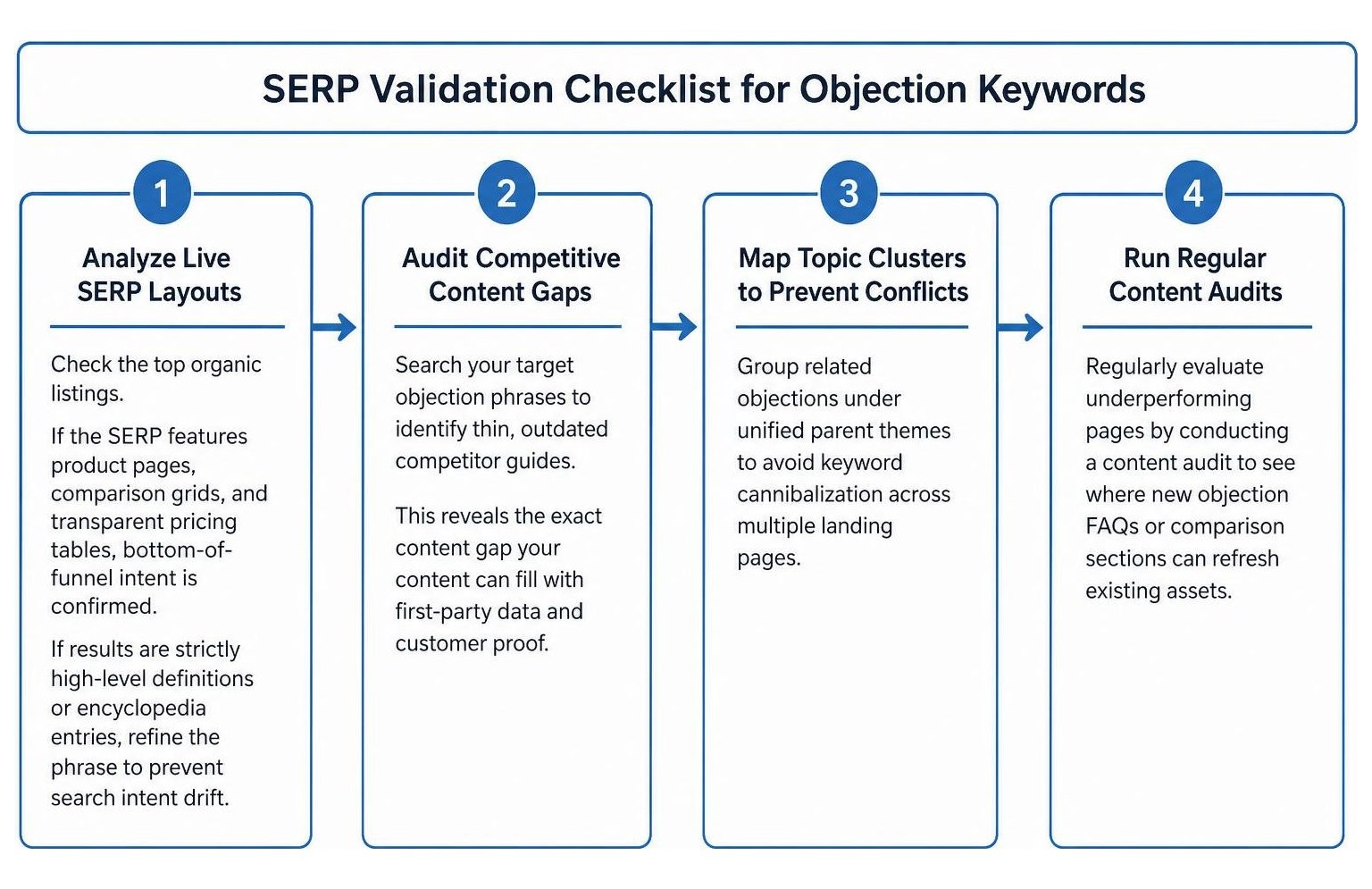
- Analyze Live SERP Layouts: Check the top organic listings. If the SERP features product pages, comparison grids, and transparent pricing tables, bottom-of-funnel intent is confirmed. If results are strictly high-level definitions or encyclopedia entries, refine the phrase to prevent search intent drift.
- Audit Competitive Content Gaps: Search your target objection phrases to identify thin, outdated competitor guides. This reveals the exact content gap your content can fill with first-party data and customer proof.
- Map Topic Clusters to Prevent Conflicts: Group related objections under unified parent themes to avoid keyword cannibalization across multiple landing pages.
- Run Regular Content Audits: Regularly evaluate underperforming pages by conducting a content audit to see where new objection FAQs or comparison sections can refresh existing assets.
What best practices ensure building a keyword shortlist from common sales objections drives AI and voice search visibility?
Modern search engines and AI discovery tools prioritize natural, conversational language over isolated keyword fragments. Research shows that AI overviews appear on 9.5% of single-word queries, but trigger on 46.4% of queries containing seven or more words. Similarly, studies tracking search patterns reveal that 8% of one-to-two-word searches yield AI summaries compared to 53% for ten-word conversational prompts.
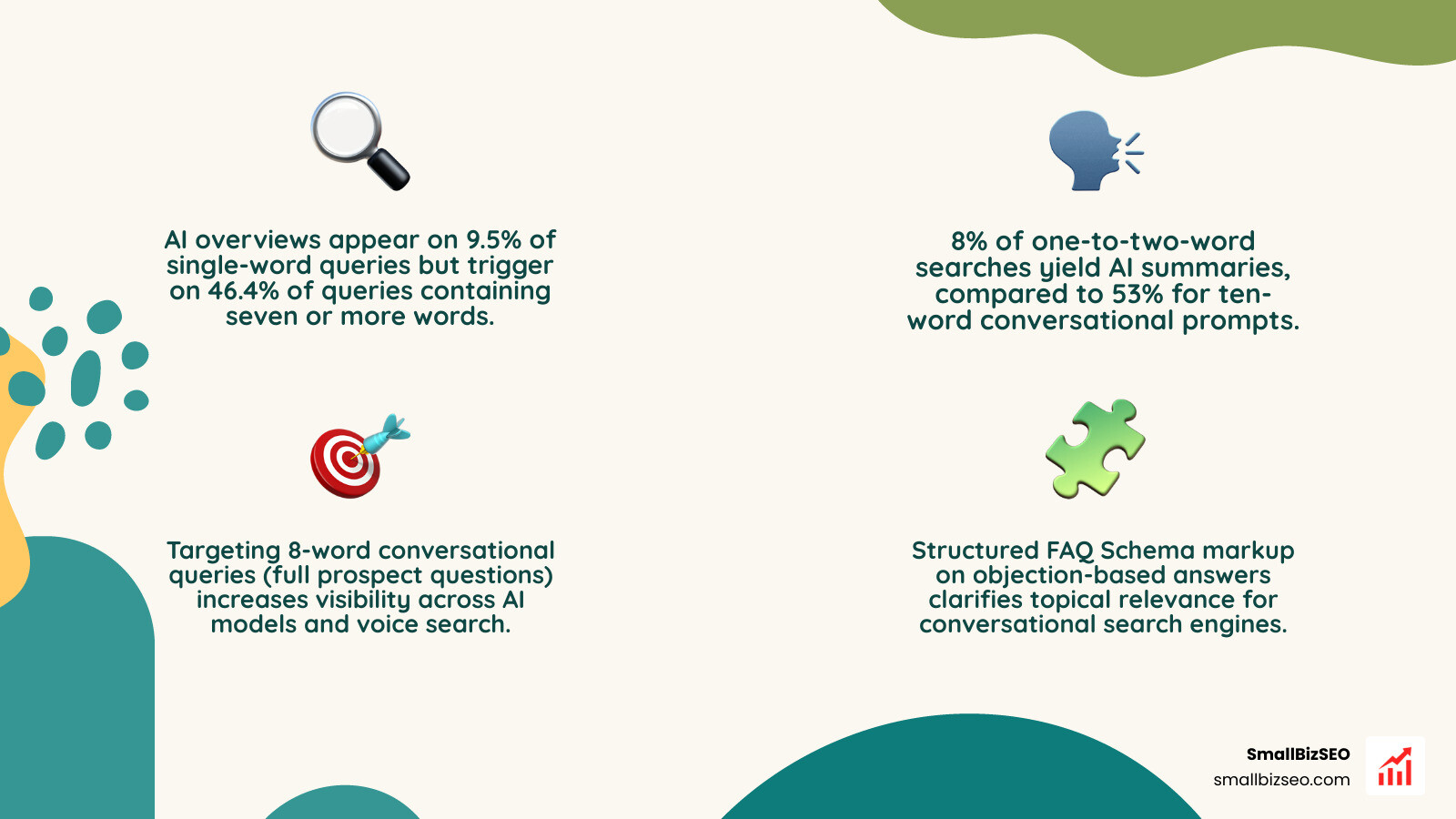
To maximize visibility across AI models, voice search engines, and traditional results:
- Target 8-Word Conversational Queries: Frame section headings using full-sentence prospect questions (for example, "How long does onboarding take for a small marketing team?").
- Provide Direct Answer Blocks: Place concise, 40-to-60-word answers directly beneath question headers to make extraction effortless for conversational search engines.
- Deploy Structured FAQ Schema: Mark up every objection-based answer with clean Schema markup to clarify topical relevance.
- Maintain a Quarterly CRM Sync: Review new sales call notes every 90 days. As market conditions shift and product features evolve, fresh objections will emerge to fuel your organic strategy.
Turn Objections Into Your Unfair Pipeline Advantage
Sales objections are direct insights into buyer hesitation. By systematically extracting authentic phrases from call transcripts, scoring them by commercial intent, and publishing targeted comparison and pricing assets, you turn everyday sales friction into long-term organic growth.
At SmallBizSEO, our data-driven Velocity framework helps small businesses turn complex search intent into consistent organic pipeline. Explore how buyer intent keyword targeting can capture high-value prospects and accelerate your revenue growth.