Finding the Most Profitable Search Terms and Keywords for Your Business

What Are Search Keywords and Why Does Your Small Business Need Them?
To find the right keywords for your business, start with what customers ask for, not what you call your services. List your main products or services, add the problems they solve, and check those phrases in Google Autocomplete or Keyword Planner. Then choose terms that match what you offer and what the searcher wants to do. Put each distinct topic on the page best suited to answer it.
Keyword research helps a small business focus its limited time on searches that could lead to inquiries or sales. A specific phrase such as “emergency plumber in Minneapolis” may bring fewer searches than “plumber,” but it makes the customer’s need much clearer.
I’m Clayton Johnson, founder of SmallBizSEO. I use SEO, content strategy, and customer questions to help small businesses choose keywords for your business that connect search visibility with qualified leads.
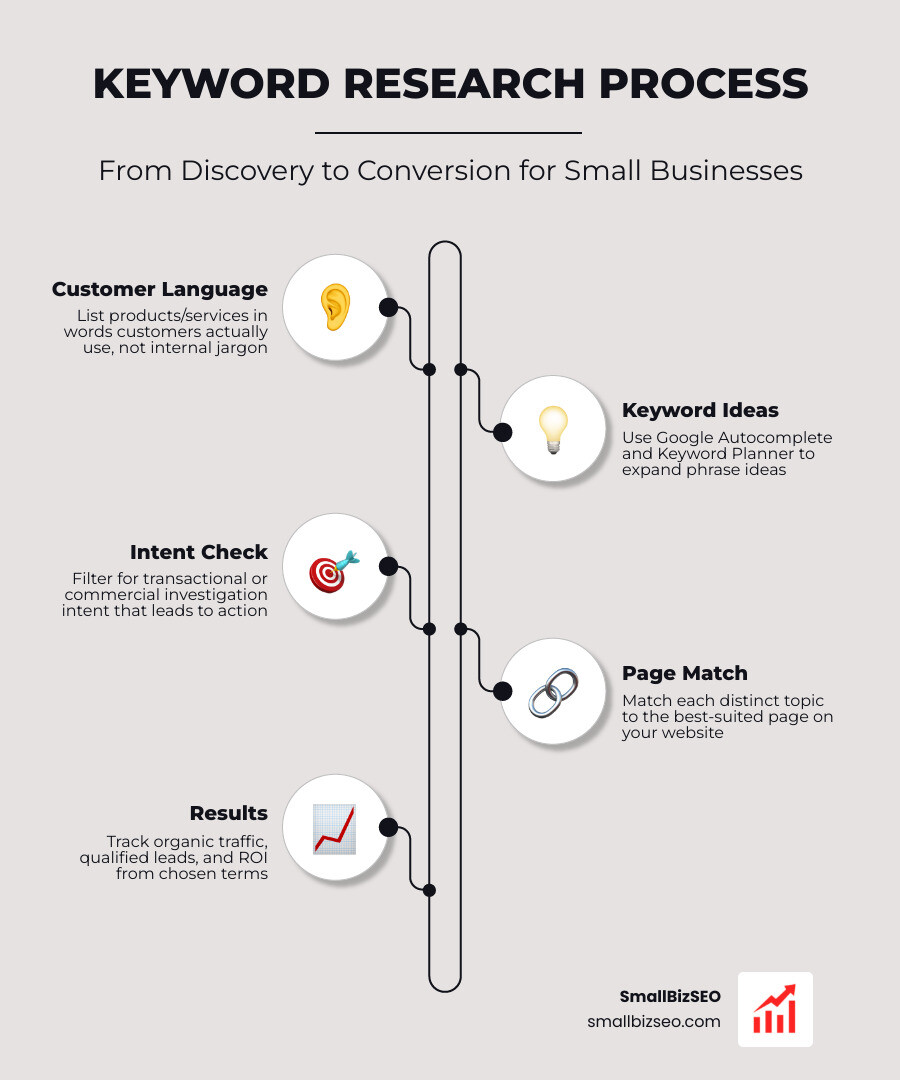
Quick keywords for your business terms:
Every successful digital marketing campaign relies on understanding search demand. When potential buyers experience a problem, they turn to search engines using specific words and phrases. Keyword research is the deliberate practice of uncovering those exact terms so we can position our website directly along the buyer journey.
Targeting the wrong terms wastes budget and attracts casual browsers who have no intention of buying. By aligning our content strategy with true search intent, we improve organic traffic and maximize return on investment (ROI). Google search algorithms have evolved beyond basic word matching to evaluate topical relevance and context. Even so, selecting precise keywords remains the single most direct way to signal to search engines that our business offers the exact solution a user needs.
How to Find and Select the Best Keywords for Your Business

Finding the best search terms requires discovering seed terms, analyzing search volume, evaluating user intent, and choosing phrases your site can realistically rank for. Start by listing your primary offerings, then use research platforms to expand that list into high-opportunity queries with demonstrable commercial intent.
Finding profitable keywords isn't about guessing what sounds clever. It is a systematic market research process. We begin by defining seed keywords—broad phrases representing our core offerings. From there, we evaluate the real search demand behind those terms, weeding out vanity metrics in favor of phrases that indicate high purchasing intent.
What Are the Key Types of Keywords for Your Business Strategy?
Keywords fall into three main categories based on length and specificity: short-tail, mid-tail, and long-tail. Each plays a distinct role across navigational, informational, commercial, and transactional search stages.
When building an organic growth plan, it helps to explore key types of SEO keywords and how they work to balance broad reach with bottom-line conversions. Libraries and academic institutions also emphasize this principle in their academic overview of keyword importance, demonstrating how specific terminology connects users with relevant resources.
- Short-tail keywords (1–2 words): These are broad, high-volume terms like "accounting software." They have massive search volume but fierce competition and vague search intent.
- Mid-tail keywords (2–3 words): More focused terms such as "small business accounting" that balance reasonable search volume with clearer user intent.
- Long-tail keywords (3+ words): Highly specific phrases like "cloud accounting software for digital agencies." While they boast lower individual search volume, they feature the highest conversion rates and lowest competition.
| Keyword Type | Word Count | Monthly Search Volume | Competition Level | Conversion Potential | Primary User Intent |
|---|---|---|---|---|---|
| Short-Tail (Head) | 1–2 words | High (10,000+) | Extremely High | Low (1% – 2%) | Informational / Broad Discovery |
| Mid-Tail | 2–3 words | Moderate (1,000–10,000) | Moderate to High | Medium (2% – 5%) | Commercial Investigation |
| Long-Tail | 3+ words | Low to Modest (50–1,000) | Low to Moderate | High (5% – 15%+) | Transactional / Problem Solving |
Which Free Tools and SERP Features Uncover High-Intent Keywords?
You can build an exhaustive keyword list without paid software by combining Google Keyword Planner, Google Autocomplete, People Also Ask boxes, and WordStream's Free Keyword Tool. These platforms reveal live search behavior directly from actual query databases.
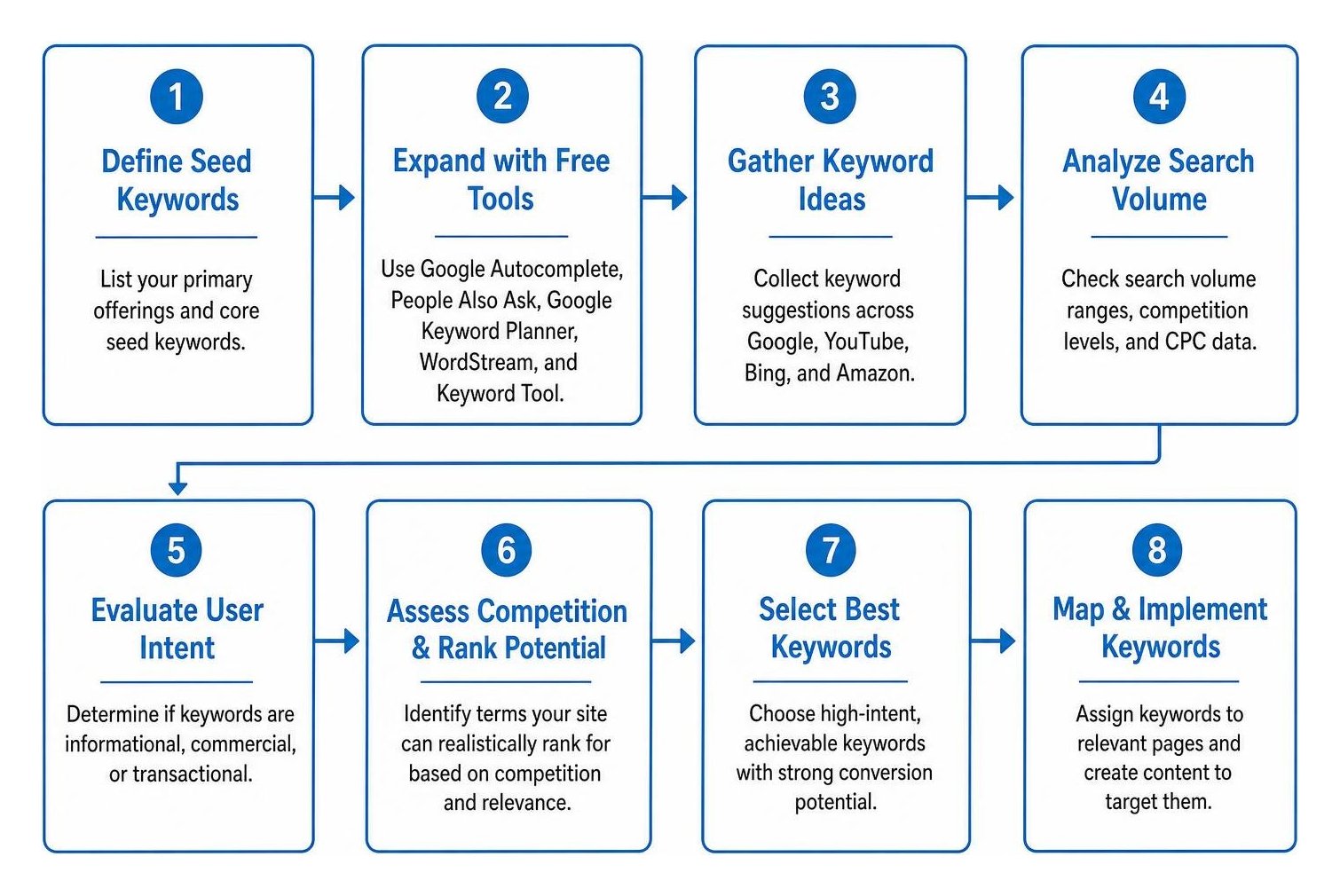
Free tools offer deep insights into search patterns when used properly:
- Google Keyword Planner: The foundational tool for search data. It provides historical search volume ranges, competition levels, and advertiser bid estimates directly from Google.
- WordStream's Free Keyword Tool: Sourced through the Google keyword research API, this tool gives you instant access to the first 25 keyword ideas along with exact volume and cost-per-click (CPC) data, with full CSV export capabilities.
- Keyword Tool: Generates up to 750+ long-tail keyword suggestions across platforms like Google, YouTube, Bing, and Amazon by querying autocomplete APIs.
- Google Autocomplete & People Also Ask (PAA): Typing your seed terms directly into Google shows real-time user questions and related queries, uncovering valuable conversational keywords.
- Google Search Console: Displays the exact queries already bringing impressions and clicks to your existing pages, highlighting quick-win optimization opportunities.
You can also uncover high-performing terms by learning how to check competitors' keywords free through manual SERP analysis and open-access tools, tapping into databases that index billions of real-world queries.
How Do You Evaluate and Target Long-Tail Keywords for Your Business?
To evaluate whether a keyword is worth targeting, assess its monthly search volume, keyword difficulty score, cost per click (CPC), and underlying search intent.

Knowing how to analyze keywords properly prevents small businesses from wasting resources on unwinnable search terms:
- Monthly Search Volume: For newer or smaller sites, targeting terms with 100 to 1,000 monthly searches represents the ideal sweet spot. Established small business sites can target terms up to 10,000 searches per month.
- Keyword Difficulty (KD): Measured on a scale of 0 to 100, KD estimates how difficult it is to outrank current competitors. New websites should focus on keywords with a difficulty score under 30. Scores above 80 are usually dominated by enterprise brands with thousands of authoritative backlinks.
- Cost Per Click (CPC): While CPC is a paid advertising metric, a high CPC (roughly $3.00 or more) signals strong commercial value. If advertisers are paying substantial money per click, ranking organically for that phrase yields high-value leads.
- Search Intent Match: Ensure the phrase aligns with what you offer. If the top 10 search results are informational DIY guides and you sell an enterprise service, ranking for that specific phrase will rarely generate sales.
How to Implement Your Keywords and What Results to Expect
Keyword research only delivers business value when systematically mapped to targeted website pages, embedded in core HTML elements, and supported by local optimization. Once published, consistent tracking ensures your strategy adapts as search rankings grow.
Finding your search terms is only half the battle. Transforming that data into measurable revenue requires strategic on-page optimization, clean site architecture, and realistic performance milestones.
How Do You Map Keywords to Pages and Avoid Cannibalization?
Keyword mapping is the process of assigning one primary keyword and two to four supporting secondary keywords to a dedicated page on your website. Assigning different pages the same target query causes keyword cannibalization, forcing your own URLs to compete against each other in search results.

A structured approach keeps your site organized:
- Homepage: Target your primary brand name and broadest core category term.
- Service & Product Pages: Target commercial-intent keywords that describe your specific offerings.
- Blog Posts & Guides: Target informational questions, long-tail phrases, and educational topics.
When deploying your mapping sheet, follow proven standards for keyword content optimization. Place your primary keyword in the URL slug, title tag, H1 heading, within the first 100 words of body copy, and naturally throughout subheadings.
To expand your topical reach without duplicating topics, conduct regular keyword gap analysis to spot missing subtopics. You can also review technical standards like the Schema.org keywords property to understand how search engines categorize structured entity metadata. Google does not use the deprecated meta keywords tag, so focus your attention on visible on-page copy and clear internal links.
How Can You Boost Local SEO?
To attract nearby customers, combine service terms with geo-modifiers across your website, Google Business Profile, and local landing pages.
Applying fundamental local search optimization techniques connects your business with high-converting "near me" and regional queries. Build a service-location matrix matching each offering with the areas you serve.
Optimize your Google Business Profile (GBP) categories and descriptions to align with these terms. Publishing natural updates on your GBP profile can trigger local search justifications (such as "Their website mentions...") in Google Maps, directly increasing click-through rates from local customers.
How Long Does It Take to Rank and Measure SEO Success?
Ranking for new keywords typically takes anywhere from 4 weeks to 12 months, depending on keyword difficulty, domain authority, and competition levels.
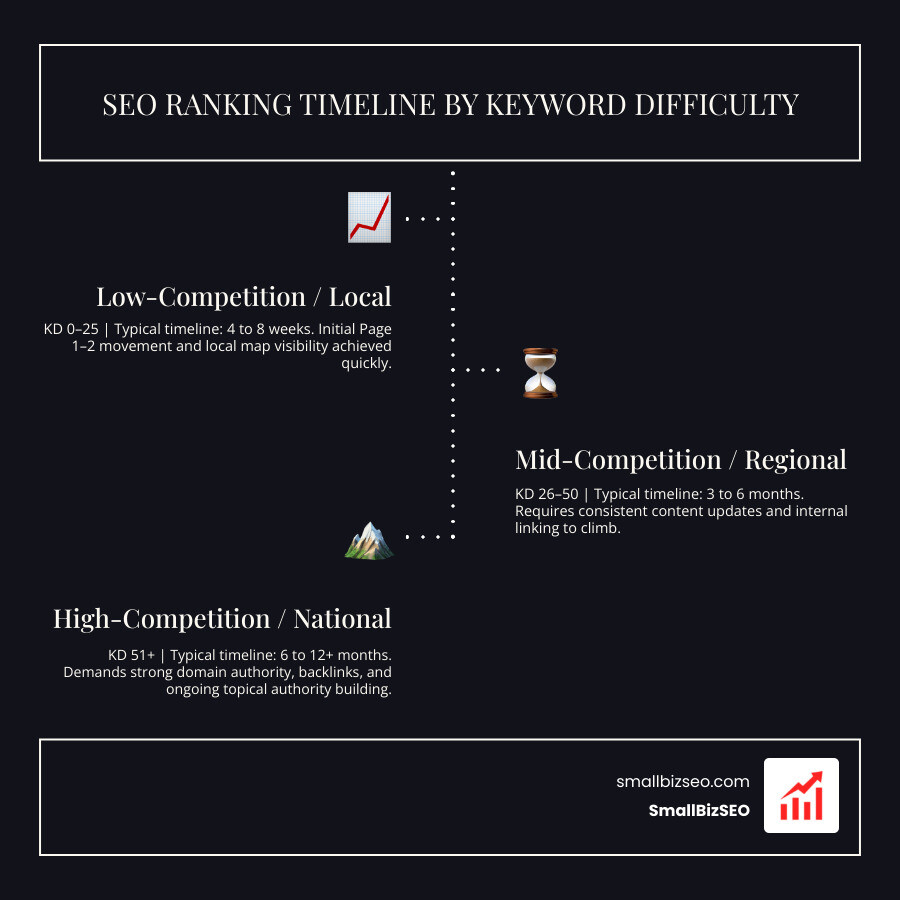
Because Google discovers and evaluates pages primarily through crawling links, building topical authority is an ongoing process.
| Keyword Competition Level | Target Difficulty Range | Typical Ranking Timeline | Expected Milestone |
|---|---|---|---|
| Low-Competition / Local | KD 0–25 | 4 to 8 Weeks | Initial page 1–2 movement and local map visibility |
| Mid-Competition | KD 26–50 | 3 to 6 Months | Steady organic traffic growth and lead generation |
| High-Competition / National | KD 51–80+ | 6 to 12+ Months | Authority compounding and top-tier competitive rankings |
A small business website with 6 to 8 core service pages and an active blog can target 20 to 30 well-chosen keywords to build reliable traffic. At SmallBizSEO, we use our proprietary "Velocity" framework to help small businesses bypass common growth delays, delivering rapid ranking improvements and E-E-A-T-compliant organic growth backed by transparent, automated reporting. If you want a complete roadmap tailored to your market, explore our professional SEO services to accelerate your business growth.
Turn Your Search Terms into Long-Term Business Growth
Successful keyword research is not a one-time setup task; it is an ongoing engine for business visibility and revenue. By listening to real customer conversations, targeting specific long-tail terms with high purchase intent, and organizing your website with clean keyword mapping, you can outrank competitors and attract qualified leads month after month.
Review your search performance quarterly in Google Search Console, refresh older content to cover new questions, and expand your keyword clusters as your site gains authority. When you align your digital strategy with the exact language your buyers use every day, sustainable organic growth is the natural result.